Python Operators and Expressions: Precedence, Types and Worked Output Traces
Trace Python expressions without guessing. This guide connects operator families, precedence, types, short-circuiting and exact output through worked examples.
KnowledgeGate Team
Exam prep & CS education
Updated 23 Sep 20266 min read
You may recognise +, and and == separately, yet still trace a composite expression incorrectly. Evaluation order, operand return values and object identity are common traps. Use the operator map to trace composite expressions, calculate scores and check outputs.
Python operators and expressions: build the map before tracing
An operator is syntax that acts on operands. An expression is code that evaluates to a value. In correct + bonus, the names are operands; in score = correct + bonus, Python evaluates the right-hand expression before binding score to its result.
Family | Example | Result or purpose |
|---|---|---|
Arithmetic |
|
|
Comparison |
|
|
Logical |
|
|
Assignment |
| Binds |
Bitwise |
|
|
Membership |
|
|
Identity |
| Asks whether both names refer to the same object |
Conditional |
|
|
For the wider syntax-to-execution foundation, Introduction to Python: Core Concepts, Worked Trace and Exam Patterns owns variables, blocks, functions and mutation. Here, the operator map isolates evaluation order, returned operands, identity, bitwise logic and augmented assignment. Coding & DSA Courses for Placements then applies these rules inside larger programs.
Python arithmetic operators: division, remainder and powers
True division and floor division differ: 17 / 5 = 3.4, while 17 // 5 = 3. Also, 17 % 5 = 2, and 17 = (17 // 5) * 5 + (17 % 5) = 3 * 5 + 2. The checkpoint 7 / 2 = 3.5 versus 7 // 2 = 3 shows why both value and type matter.
Floor division takes the mathematical floor, not truncation towards zero. Therefore, -17 // 5 = -4, not -3, and -17 % 5 = 3. The identity remains (-4) * 5 + 3 = -17.
Exponentiation has two common traps. -2 ** 2 is parsed as -(2 ** 2) and equals -4, but (-2) ** 2 = 4. Exponentiation is right-associative, so 3 ** 2 ** 2 becomes 3 ** (2 ** 2) = 3 ** 4 = 81.
Numbers and Arithmetic in Python: Operators, Precision, and Worked Examples owns the deeper treatment of numeric types, floating-point representation and rounding. Here, those arithmetic rules support mixed logical, identity and assignment traces.
Python comparison, membership and identity operators
For x = 6, 2 < x <= 8 is True and means 2 < x and x <= 8. Likewise, 3 < 5 == 5 is True. Python evaluates the chain, not (3 < 5) == 5.
Equality and identity answer different questions:
primary = [4, 7]
alias = primary
copy = [4, 7]
Here, primary == alias and primary is alias are True; primary == copy is True, but primary is copy is False. The == operator compares values, while is compares identity. Reserve is for checks such as value is None, not numeric or string equality.
Membership depends on the container. 3 in [1, 2, 3] and "py" in "python" are True. For record = {"score": 31}, "score" in record is True, but 31 in record is False because dictionaries test keys. This container-specific rule keeps value membership separate from identity and numeric comparison.
Python logical expressions: short-circuiting and returned operands
In a Boolean context, bool(0) and bool([]) are False, while bool(7) and bool([0]) are True. Yet and and or return an operand: 0 or 18 returns integer 18, "ready" and 7 returns integer 7, and [] or ["retry"] returns list ["retry"].
With attempted = 0, attempted != 0 and 31 / attempted >= 0.75 gets False on the left, skips division and returns False, so no ZeroDivisionError occurs. With attempted = 40, it continues through 31 / 40 = 0.775 and 0.775 >= 0.75, returning True.
The expression not 3 > 5 means not (3 > 5), so it is True. Also, name = entered_name or "Guest" gives "Guest" for entered_name = "", but this fallback replaces every falsy value.
Python operator precedence: a complete worked score expression
attempted = 40
correct = 31
penalty = 0.25
bonus = 2

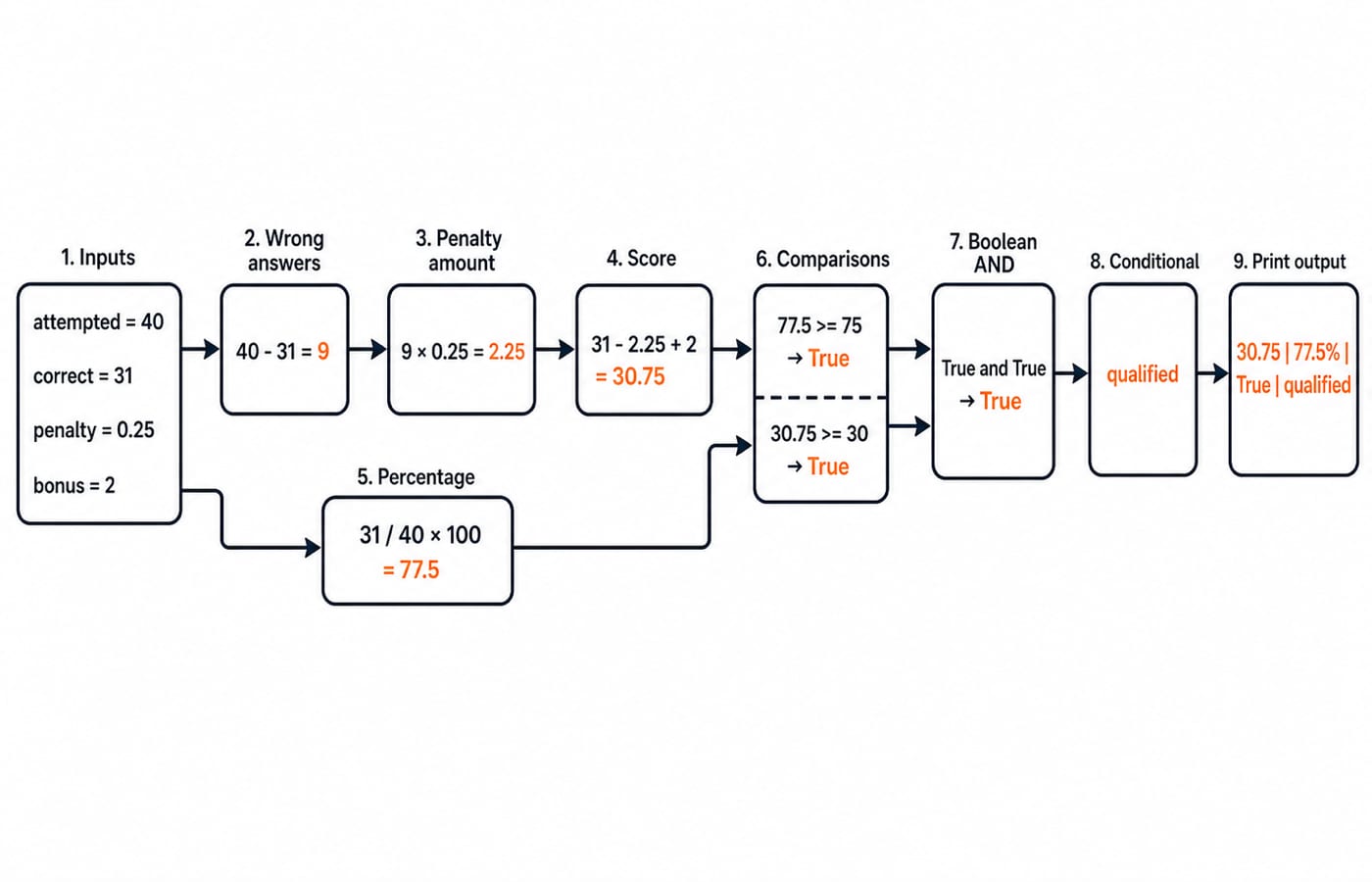
raw_score = correct - (attempted - correct) * penalty + bonus
accuracy = correct / attempted * 100 if attempted != 0 else 0.0
eligible = accuracy >= 75 and raw_score >= 30
status = "qualified" if eligible else "revise"

print(f"{raw_score:.2f} | {accuracy:.1f}% | {eligible} | {status}")
First, (attempted - correct) = 40 - 31 = 9, then 9 * 0.25 = 2.25. Addition and subtraction proceed left to right: 31 - 2.25 + 2 = 28.75 + 2 = 30.75.
Because attempted != 0 is True, accuracy is 31 / 40 = 0.775, then 0.775 * 100 = 77.5. Both comparisons are True, so eligible is True and the conditional selects "qualified". The exact output is:
30.75 | 77.5% | True | qualifiedHere, parentheses come first, multiplication and division precede addition and subtraction, comparisons follow arithmetic, and follows comparisons, and the conditional follows its condition.
Python bitwise and augmented assignment operators
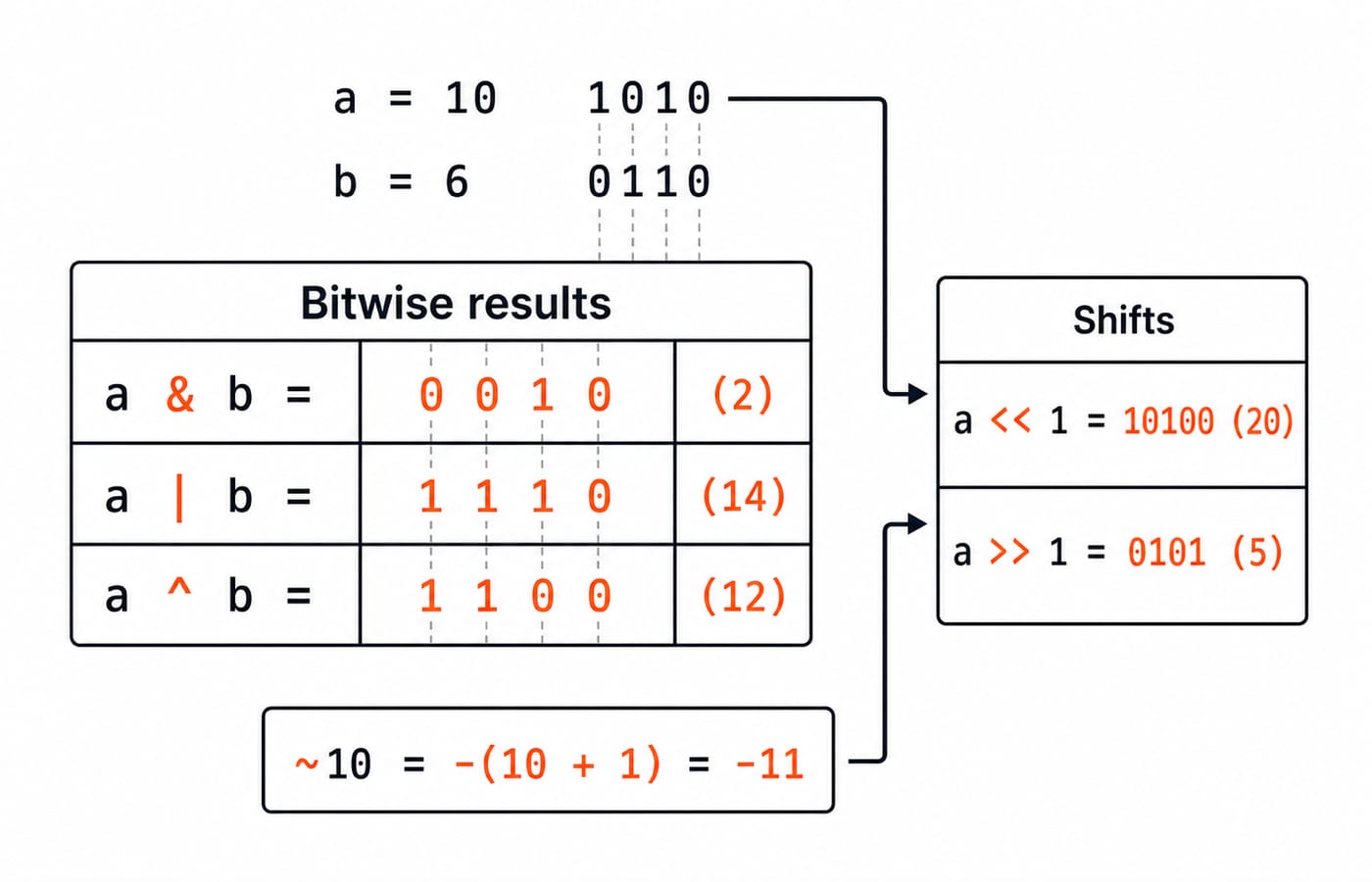
For a = 10 (1010) and b = 6 (0110), a & b = 2 (0010), a | b = 14 (1110) and a ^ b = 12 (1100). Also, a << 1 = 20 (10100), a >> 1 = 5 (0101), and ~a = -11 because ~n = -(n + 1). Bitwise & and | do not short-circuit like logical and and or.
Starting with score = 7, score += 3 * 2 performs multiplication first, then stores 7 + 6 = 13. The += form is assignment, not the == equality comparison.
Type changes += behaviour. After x = 10, y = x, then x += 5, x = 15 and y = 10 because integers are immutable. After a = [10], b = a, then a += [20], both names show the mutated list [10, 20]. With a fresh list, a = a + [20] instead rebinds a, leaving b as [10].
Python operator questions: predict values, types and errors
Question shapes include computing expressions, finding the next operator, tracing short-circuiting, distinguishing == from is, predicting types, and identifying errors. For each shape, write the first decisive reduction step, then predict both the value and its type or exception.
Use these fast checks:
print(3 ** 2 ** 2)prints81because powers group from the right.print(17 // 5, 17 % 5)prints3 2.print(0 or 18, "ready" and 7)prints18 7.print(10 & 6, 10 ^ 6)prints2 12.
The expression "8" + 2 raises TypeError, while int("8") + 2 gives integer 10.
Now rerun the full program with only correct = 29. Then attempted - correct = 11, 11 * 0.25 = 2.75, and raw_score = 29 - 2.75 + 2 = 28.25. Accuracy is 29 / 40 * 100 = 72.5. Since 72.5 >= 75 is False, and skips the raw-score comparison, eligible is False, and the output becomes 28.25 | 72.5% | False | revise.
The short version and the next Python step
Use a six-part recall chain: classify the family, inspect operand types, resolve parentheses, apply precedence and associativity, respect short-circuiting, then check value and type. The six-part recall chain produces raw_score = 30.75, accuracy = 77.5 and eligible = True.
The Python Course, Concepts, MCQs & Coding is the structured next step for syntax, concepts and practice. If you are ready to use comparisons, expressions and assignments inside algorithms, continue with DSA Using Python.
Finally, restore correct = 31 and set bonus = 0. Raw score changes from 30.75 to 28.75, accuracy stays 77.5, raw_score >= 30 becomes False, and status changes to "revise". Use this variation to test the full evaluation chain.
Keep learning
Pandas Basics in Python: Build, Clean and Analyse a DataFrame Step by Step
Follow one student dataset from its first DataFrame to a clean city summary, while learning how selection, missing values and vectorised calculations really work.
Updated 24 Sep 20265 min readPython
CSV Files Explained: Parsing Rules, Worked Records and Exam Traps
Learn why commas and newlines are not always boundaries, trace a quote-aware parser, validate text fields with a schema, and calculate processing costs.
Updated 22 Sep 20265 min readPython
Polymorphism and Dunder Methods in Python: Runnable Examples and Exercises
See how one Python operation supports different types, then build a Vector2D class with readable output, addition, magnitude and equality. Includes runnable code, protocol failures and exercises.
Updated 21 Sep 20265 min readPython
Inheritance in Python: A Practical Tutorial with Examples
Learn how Python classes inherit state and behaviour through runnable examples. Trace super(), overrides, MRO, common mistakes, and three focused exercises.
Updated 19 Sep 20265 min readPython