

Ethernet Evolution (IEEE 802.3): From 10BASE5 to Switched 400 Gb/s Links
See how Ethernet kept a familiar frame while moving from shared coaxial buses to switched full-duplex links. Work through serialisation and collision-window calculations step by step.
KnowledgeGate Team
Exam prep & CS education
Updated 21 Nov 20266 min read
Ethernet is often memorised as a list of 10BASE, Fast Ethernet and Gigabit labels. The useful story is what stayed compatible while cable, topology, duplex mode and speed changed. Ethernet evolved from shared coaxial buses to switched full-duplex links; frame-time and collision-window calculations explain the minimum frame size. Use CS Fundamentals for Exams & Placements as the broader home for this Computer Networks study.
Ethernet and IEEE 802.3: a stable MAC above changing physical links
Ethernet is an IEEE 802.3 family of wired technologies, not one cable or connector. Its data-link MAC provides addressing, a frame envelope and local delivery. Each PHY defines a rate, medium, encoding and reach.
That separation enabled compatibility. A host could keep handing a frame to its MAC while a suitable PHY carried the bits over coaxial cable, twisted pair, fibre or a backplane. Faster links did not require a new local-link service. Ethernet delivers frames on one local link; IP routing connects those links into a larger network.
Early Ethernet: decode 10BASE5, 10BASE2 and 10BASE-T
In 10BASE5, 10 means 10 Mb/s, BASE means baseband signalling, and 5 identifies the approximately 500 m segment class. 10BASE2 used thinner coax with an actual maximum segment length of 185 m, despite the rounded 2. In 10BASE-T, T means twisted pair, not topology.
Technology | Physical layout | Practical change | Collision behaviour |
|---|---|---|---|
10BASE5 | Thick shared coax with vampire taps | Long segments, but awkward installation and fault isolation | One shared collision domain |
10BASE2 | Thinner shared coax bus | Simpler cable and connectors | One shared collision domain |
10BASE-T | A twisted-pair run from each station to a hub | Easier structured cabling and fault isolation | A hub still forms one shared collision domain |
These half-duplex forms used CSMA/CD. Two distant stations could both sense an apparently idle medium because one station's signal had not yet reached the other.
Switched Ethernet and full duplex removed collisions
A hub repeats each incoming bit to every other port, so all stations contend together. A bridge or switch learns source MAC addresses and forwards only towards the required port. Each switch port gets a point-to-point collision domain.
On a 100 Mb/s full-duplex link, A can send 100 Mb/s to B while B simultaneously sends 100 Mb/s to A. It is not a 200 Mb/s one-way link. Separate transmit and receive paths prevent collisions, so CSMA/CD is not used.
Twisted pair alone did not achieve this because hub-based 10BASE-T remained shared. Switching plus full duplex removed contention while preserving frames and MAC addresses.
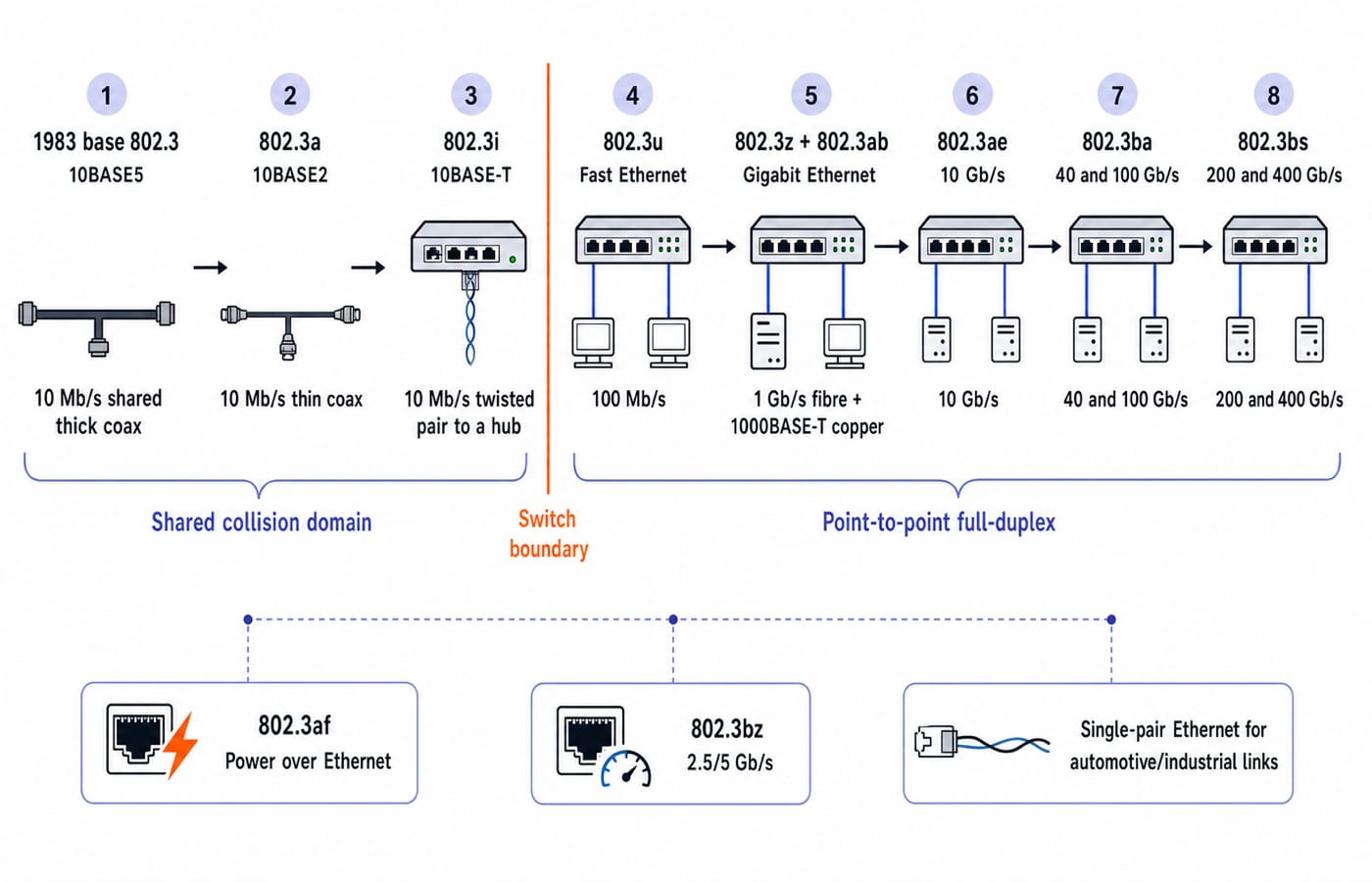
IEEE 802.3 evolution: speed, media and feature milestones
According to the IEEE Standards Association's Ethernet history, IEEE adopted the original standard in 1983. Later capabilities arrived as named amendments and were subsequently folded into the larger standard.
Milestone | Rate or capability | Medium or topology change | Problem solved |
|---|---|---|---|
Base 802.3, 10BASE5 | 10 Mb/s | Shared thick coax | Standardised the original bus LAN |
802.3a, 10BASE2 | 10 Mb/s | Shared thin coax | Reduced cable complexity |
802.3i, 10BASE-T | 10 Mb/s | Twisted pair to a hub | Enabled structured cabling |
802.3u, Fast Ethernet | 100 Mb/s | Faster LAN PHYs | Raised access speed |
802.3z and 802.3ab, Gigabit Ethernet | 1 Gb/s | Fibre and 1000BASE-T copper | Extended gigabit links across media |
802.3ae | 10 Gb/s | High-speed full-duplex links | Scaled backbone capacity |
802.3ba | 40 and 100 Gb/s | Parallel high-speed links | Scaled aggregation and data-centre links |
802.3bs | 200 and 400 Gb/s | Higher-capacity full-duplex links | Increased core and data-centre capacity |
Evolution also branched beyond peak speed.
802.3afadded Power over Ethernet.802.3bzintroduced2.5and5 Gb/scopper rates between1and10 Gb/s. Single-pair Ethernet amendments targeted automotive, industrial and building links.
Half-duplex scaling exposed a timing limit. Fast Ethernet reduced allowable collision-domain timing to retain the 64-byte minimum. Half-duplex Gigabit Ethernet defined carrier extension around a 4096-bit slot. Modern high-speed Ethernet instead assumes switched full-duplex links, making collision handling historical context rather than a current data-centre mode.
Ethernet frame continuity: serialisation across four rates
An untagged frame contains a 6-byte destination MAC, 6-byte source MAC, 2-byte Length/Type field, 46 to 1500 bytes of payload plus pad, and a 4-byte FCS. From destination address through FCS, the frame is 64 to 1518 bytes. A 7-byte preamble and 1-byte start-frame delimiter precede it. A 96-bit, or 12-byte-time, interpacket gap follows it as idle time, not as a frame field.
Use Ethernet Frame Format Explained: Preamble, SFD, Field Sizes and Worked Calculations for padding, preamble, SFD and payload-specific wire timing. Here, a fixed 1,500-byte payload compares the same 1,538-byte-time cycle across rates and connects it to collision timing.
For back-to-back maximum frames with a 1500-byte payload, one cycle is:
Count the byte-times:
8 + 1518 + 12 = 1538.Convert to bit-times:
1538 x 8 = 12,304.Divide by rate: at
10 Mb/s,12,304 / 10,000,000 = 1.2304 ms.The same cycle takes
123.04 microsecondsat100 Mb/s,12.304 microsecondsat1 Gb/s, and1.2304 microsecondsat10 Gb/s.
This model excludes propagation, switching delay and PHY coding overhead. Its payload efficiency is 1500 / 1538 = 0.9753, about 97.53%. A minimum frame carrying 46 bytes instead uses 8 + 64 + 12 = 84 byte-times, giving 46 / 84 = 54.76%. The envelope stayed stable while faster PHYs shortened serialisation time.
Ethernet collision detection: why the 64-byte minimum mattered
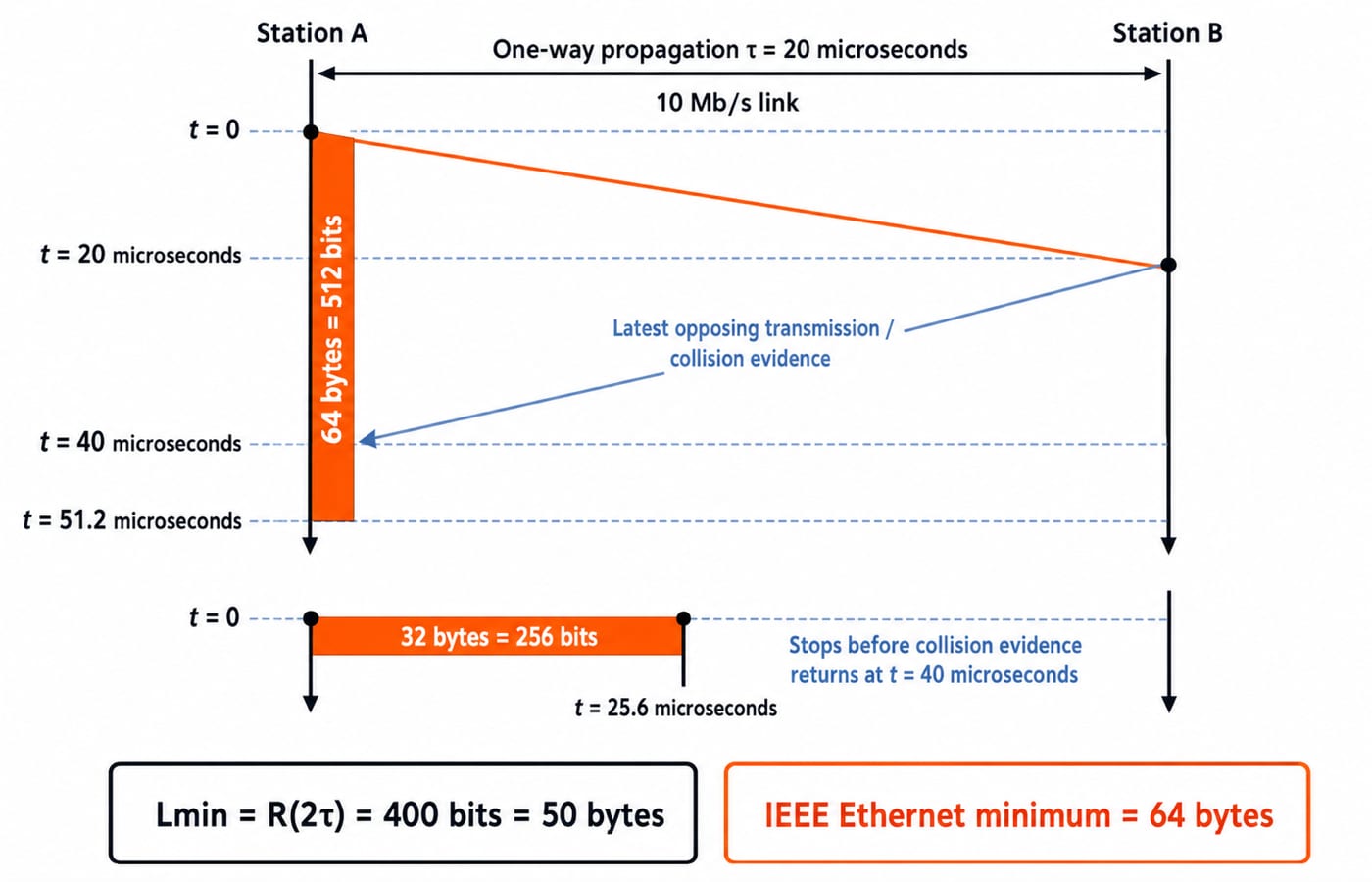
Consider shared Ethernet at R = 10 Mb/s, maximum one-way delay tau = 20 microseconds, and no repeater delay. The round trip is 2tau = 40 microseconds. Since collision detection requires L/R >= 2tau:
Data Link Layer and MAC Sublayer Explained places the minimum-frame inequality beside ALOHA and access control. CSMA/CD Explained: Collision Detection, Binary Backoff and Solved Numericals handles carrier sensing, state transitions and backoff. Here, the boundary explains why faster shared Ethernet needed smaller collision domains before full duplex removed collisions.
L >= 10 x 10^6 x 40 x 10^-6 = 400 bits = 50 bytes.
That 50-byte result belongs only to this supplied topology. The Ethernet minimum remains 64 bytes. A 64-byte = 512-bit frame takes 512 / 10^7 = 51.2 microseconds, longer than the 40-microsecond round trip. A hypothetical 32-byte = 256-bit frame lasts only 25.6 microseconds, so its sender could finish before returning collision evidence arrived.
At 100 Mb/s, keeping the same round trip would require 100 x 10^6 x 40 x 10^-6 = 4000 bits = 500 bytes. To preserve 64 bytes in half duplex, the round trip must be at most 512 / (100 x 10^6) = 5.12 microseconds. Under the no-repeater-delay assumption, one-way propagation must be at most 2.56 microseconds. Faster shared Ethernet therefore needed smaller collision domains, until switching and full duplex removed the constraint.
Ethernet exam patterns and traps
First identify the generation and mode. Questions may ask you to decode a 10BASE-X name, match an amendment to a speed or medium, distinguish a physical star from a hub's single collision domain, compare hub, bridge and switch behaviour, separate collision domains from broadcast domains, decide whether CSMA/CD applies, or calculate serialisation, efficiency and 2tau R.
For a numerical, identify shared half duplex or switched full duplex. Convert rates to bit/s and delays to seconds. Decide whether preamble and interpacket gap count, then check whether the answer requires bits, bytes, time, efficiency or a domain count. Useful checks here are 51.2 microseconds, 12,304 bit-times, 97.53% and 5.12 microseconds.
Correct these six traps before practising Computer Networks MCQs:
10BASE2reaches185 m, not exactly200 m.Tmeans twisted pair.A 10BASE-T hub is still one shared collision domain.
Full-duplex switched Ethernet does not use CSMA/CD.
The
12-byte-timeinterpacket gap is not part of the MAC frame.100 MB/sequals800 Mb/s, not100 Mb/s.
Ethernet evolution in the short version
Keep a five-part retrieval chain: shared coax made collisions normal; twisted pair simplified cabling; switches isolated links; full duplex removed collisions; faster PHYs retained the frame while changing rate, medium and encoding.
For a 15-minute revision, redraw the ladder and recompute the 1538-byte-time cycle at 2.5 Gb/s: 12,304 / (2.5 x 10^9) = 4.9216 microseconds. Efficiency remains 97.53% because only the rate changed.
For the next study step, use GATE Guidance by Sanchit Sir for a sequenced Computer Networks path with mixed standard-matching and timing practice.
Keep learning
Ethernet IEEE 802.3 MCQs: 12 Solved Questions with Explanations
Solve 12 Ethernet questions on IEEE 802.3, speed generations, hubs, MAC addresses, multicast, CSMA/CD and the first binary backoff race.
Updated 30 Oct 20267 min read77 viewsComputer Networks MCQs
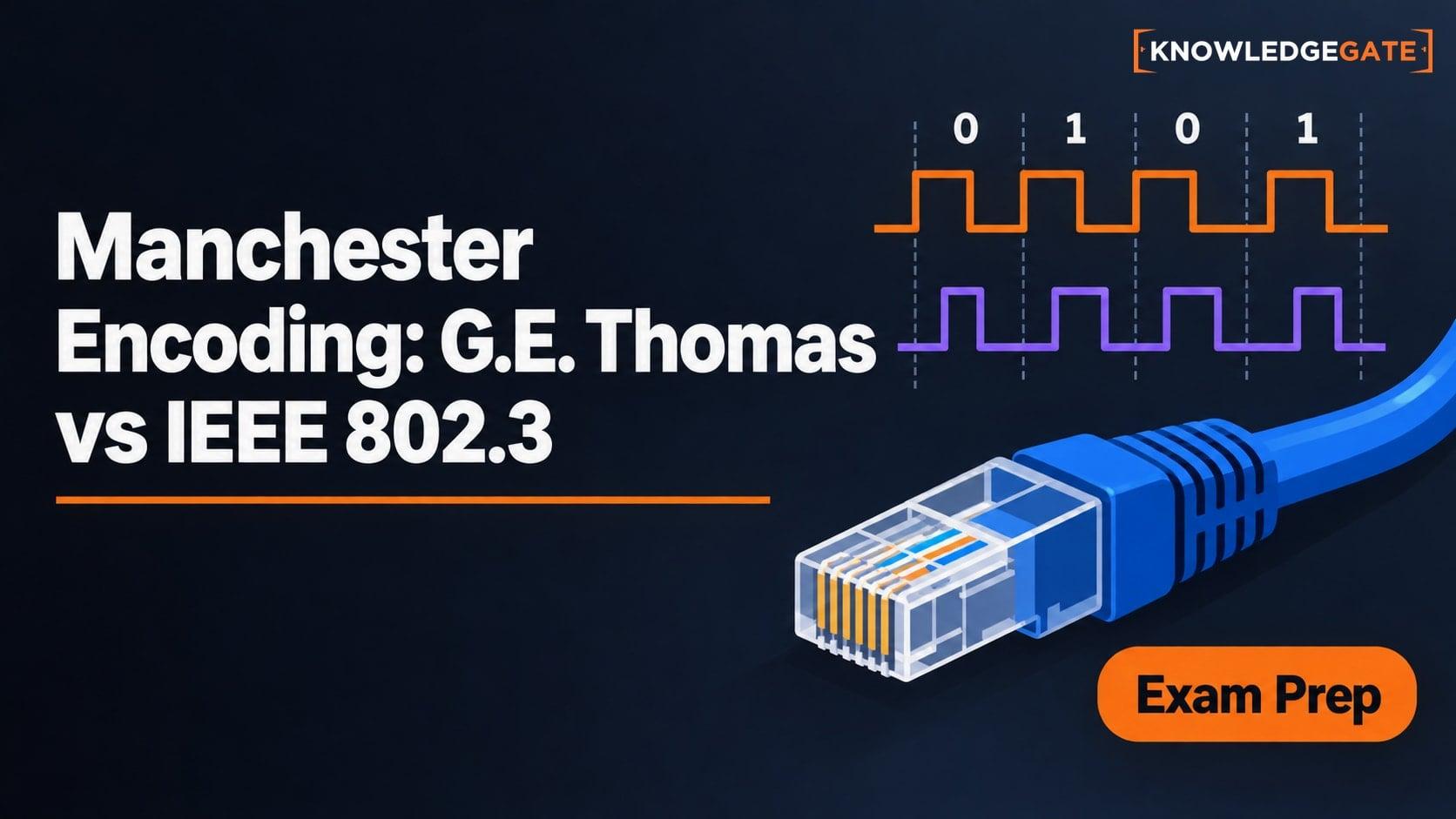
Manchester Encoding: G.E. Thomas vs IEEE 802.3, With Differential Manchester Worked Waveforms
Learn why two Manchester conventions reverse the bit mapping, then encode and decode Differential Manchester with a complete eight-bit trace and timing check.
Updated 20 Nov 20265 min readComputer Networks

Directory Structure in Operating Systems: Paths, Links and a Worked Example
Build a clean mental model of directories, resolve absolute and relative paths step by step, and see what hard links, symbolic links and unlink operations really change.
Updated 10 Nov 20266 min readOperating Systems

Run-Time Environment in Compiler Design: Activation Records, Access Links, and Worked Examples
Learn how code, static data, heap, and stack work together at run time. Follow worked examples for recursion depth, stack bytes, and nonlocal access.
Updated 8 Aug 20266 min read72 viewsCompiler Design