

Data Link Layer and MAC Sublayer Explained: ALOHA and CSMA/CD Worked Examples
Build a precise layer map, follow an Ethernet frame across a router, and solve Pure ALOHA, Slotted ALOHA, and CSMA/CD numericals step by step.
KnowledgeGate Team
Exam prep & CS education
Updated 13 Nov 20266 min read

In Computer Networks, “MAC” can mean a hardware address or the Medium Access Control sublayer. “DLL” means the Data Link Layer here, not a software library. Mixing these meanings makes even simple questions look harder than they are.
Use the hop-by-hop frame trace to separate packet scope from frame scope. Then apply the same layer map to one Pure-versus-Slotted ALOHA calculation and one CSMA/CD collision-window calculation.
Use CSMA/CD and ALOHA for GATE: Efficiency and Minimum Frame Size Numericals Solved for formula drills and the CSMA/CD efficiency approximation. Continue with the layer map below when the missing piece is how frames, router hops, MAC addresses, and the three access families fit around those numericals.
1. Data Link Layer: what it does on one hop
The Data Link Layer encloses a Network Layer packet in a frame for one physical hop. The Network Layer routes source to destination, while the Transport Layer delivers between processes.
Its responsibilities include framing, link-layer addressing, medium access, and error detection. Some protocols also provide flow control or retransmission. An Ethernet FCS can detect corruption, but does not repair bits or guarantee retransmission.
Layer | Data unit | Address or identifier | Scope |
|---|---|---|---|
Network Layer | Packet | IP address | End to end |
Data Link Layer | Frame | Link-layer address | One link |
Physical Layer | Bits | None | Signal on the medium |
Practise the Network Layer with Subnetting MCQs: 12 Solved IP Addressing Questions, then compare the Transport Layer through TCP and UDP MCQs: 12 Solved Transport Layer Questions.
2. MAC sublayer and MAC addresses: related, but not identical
IEEE 802 LANs divide DLL into Logical Link Control (LLC) above and Medium Access Control (MAC) below. LLC presents a common service upward. MAC defines framing, addressing, and shared-medium access. Not every non-IEEE data-link protocol uses this split.
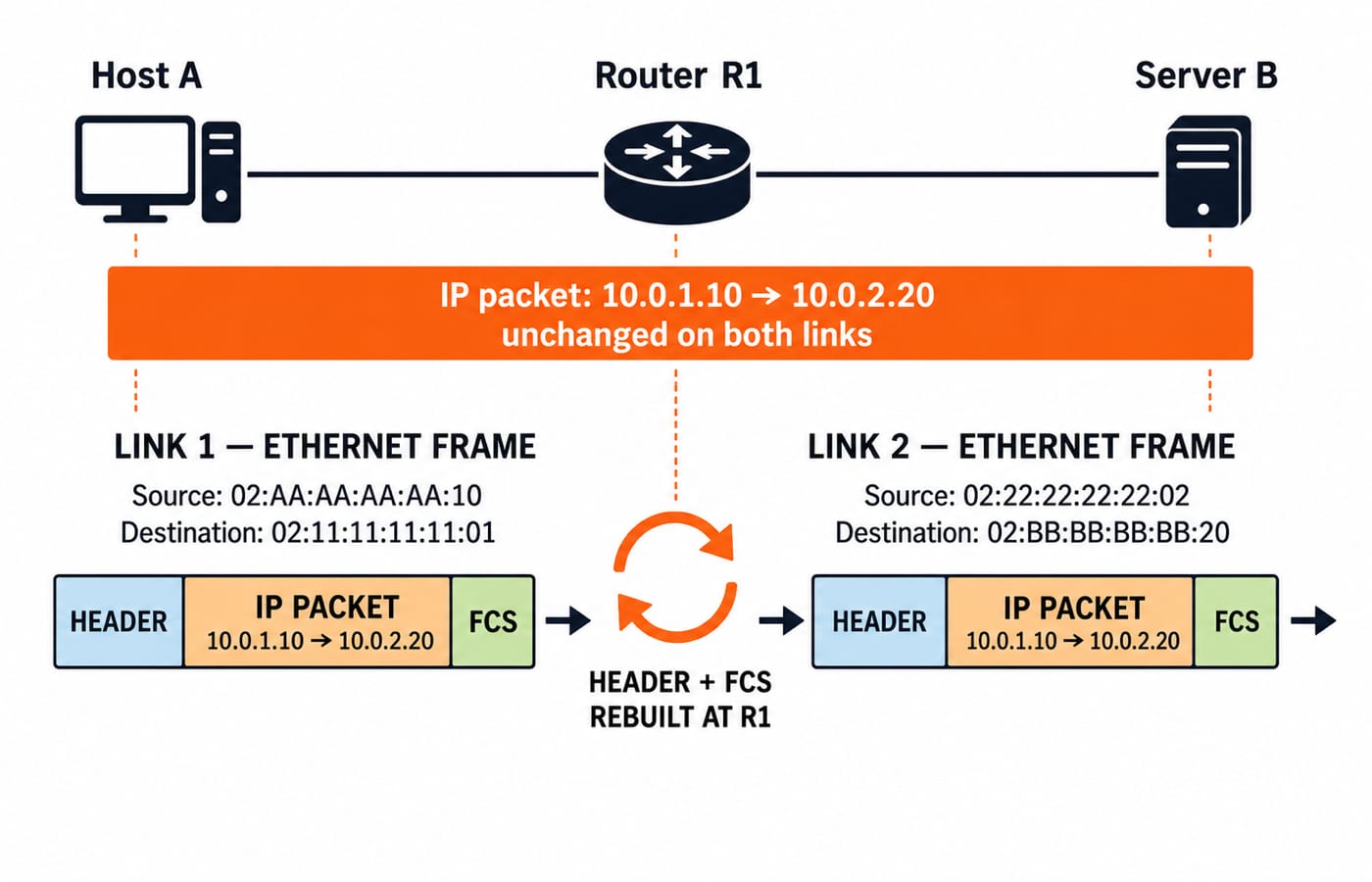
Host A has IP 10.0.1.10 and MAC 02:AA:AA:AA:AA:10. Server B has IP 10.0.2.20 and MAC 02:BB:BB:BB:BB:20. On link 1, the Ethernet source is A's MAC. Its destination is 02:11:11:11:11:01, R1's incoming-interface MAC.
On link 2, R1 builds a new frame. Its source is 02:22:22:22:22:02, R1's outgoing-interface MAC, and its destination is B's MAC. Without NAT, IPs 10.0.1.10 and 10.0.2.20 remain unchanged. R1 replaces the frame header and FCS.
3. MAC protocols: three ways to share a medium
Family | Examples | Core rule | Coordination required | Are collisions possible? |
|---|---|---|---|---|
Channel partitioning | TDMA, FDMA | Divide time or frequency among users | A schedule or fixed allocation | No, when allocations do not overlap |
Random access | Pure ALOHA, Slotted ALOHA, CSMA, CSMA/CD, CSMA/CA | Stations contend when they have data | None for Pure ALOHA; slot timing for Slotted ALOHA; sensing and protocol rules for CSMA variants | Yes; detection or avoidance manages the risk |
Controlled access | Polling, token passing | Only the selected station transmits | A controller or token protocol | Normally avoided when coordination works |
Carrier sensing reduces but cannot eliminate collisions. Distant stations can both sense idle before either new signal reaches the other, then transmit.
CSMA/CD detects collisions in classic shared, half-duplex Ethernet. CSMA/CA tries to avoid them in wireless, where listening while transmitting is impractical. Switched full-duplex Ethernet has no shared collision domain, but the timing model remains important in exams.
4. ALOHA throughput worked example: Pure versus Slotted
Let T be one frame-transmission time and G the average attempts per frame time, including retransmissions. In Pure ALOHA, starts within one T before or after the target start can overlap it. The vulnerable period is 2T, giving S = G e^(-2G).
Slotted ALOHA restricts starts to slot boundaries. Its vulnerable period is T, giving S = G e^(-G).
For T = 10 ms = 0.01 s and G = 0.5:
Calculation step | Pure ALOHA | Slotted ALOHA |
|---|---|---|
Formula |
|
|
Substitute |
|
|
Result |
|
|
Unrounded values give 30.3265 - 18.3940 = 11.9325, about 11.93 more frames per second. Slotting requires time synchronisation.
These are same-load results. Pure ALOHA peaks at G = 0.5, with Smax = 1/(2e) = 0.1839. Slotted ALOHA peaks at G = 1, with Smax = 1/e = 0.3679.
5. CSMA/CD minimum frame size worked example
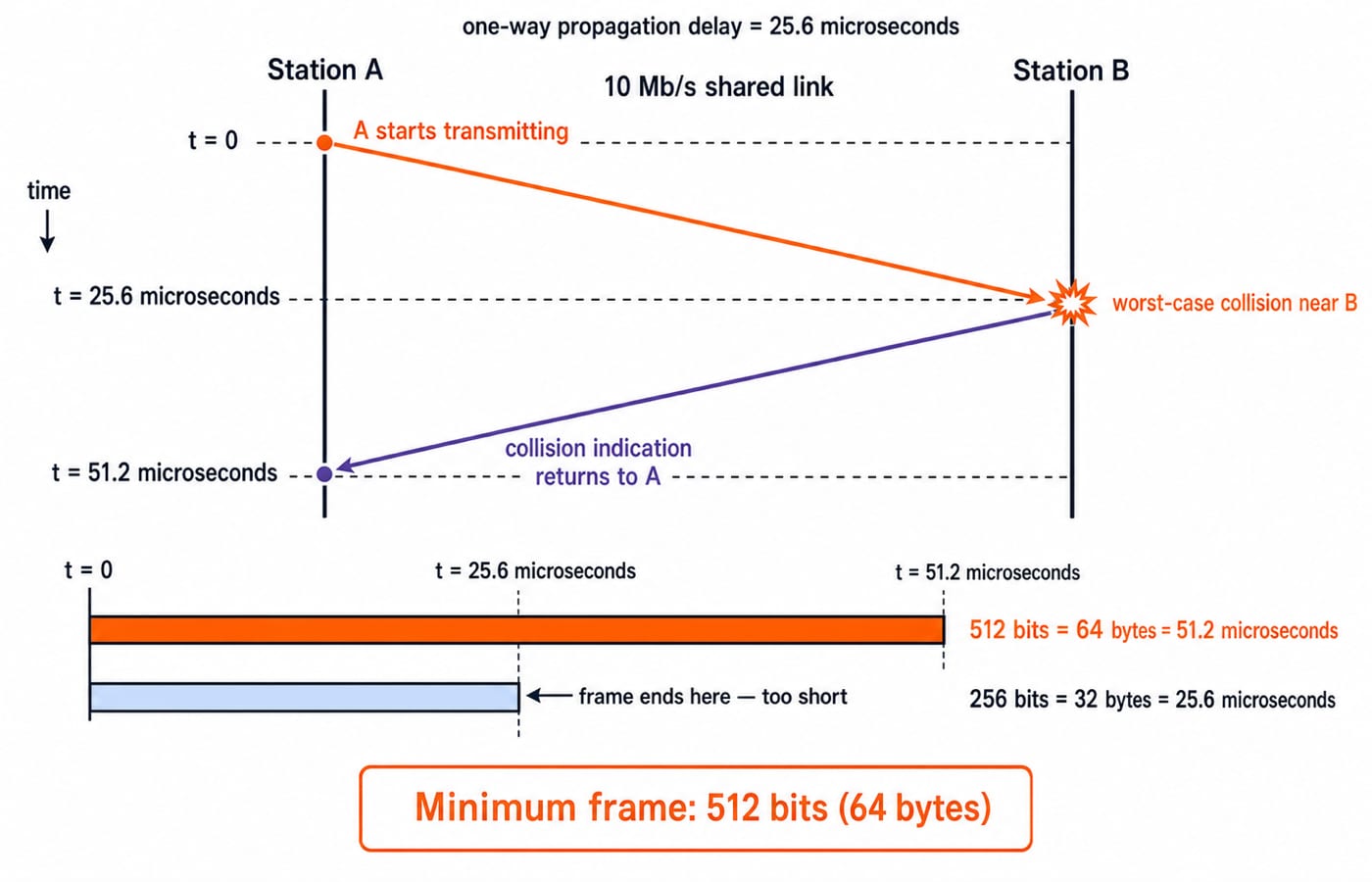
A sender must still be transmitting when the worst-case collision indication returns. For one-way delay tau, bit rate R, and frame length L, CSMA/CD requires L/R >= 2tau, so Lmin = 2tauR bits.
For a 10 Mb/s shared Ethernet with tau = 25.6 microseconds:
Round-trip propagation delay =
2 x 25.6 = 51.2 microseconds.Lmin = 10,000,000 x 51.2 x 10^(-6) = 512 bits.512 / 8 = 64 bytes.Check:
512 / 10,000,000 = 51.2 x 10^(-6) s = 51.2 microseconds, exactly the round-trip delay.
A 32-byte frame has 256 bits. Its transmission time is 256 / 10,000,000 = 25.6 microseconds, too short to guarantee detection of the farthest collision.
6. Data Link Layer and MAC exam question patterns
Question clue | Method |
|---|---|
Vulnerable period or throughput | Identify Pure or Slotted ALOHA, then use the matching |
Listen before transmitting | Apply CSMA and account for propagation delay |
Minimum frame size or round-trip delay | Start with |
Interframe spacing, backoff, and wireless acknowledgements | Think CSMA/CA |
Which address changes at a router? | Link-layer addresses change for the next hop; IP endpoints stay unchanged without NAT |
First identify one-way or round-trip delay, then convert units before multiplying. Keep ALOHA throughput normalised until the final frames-per-second conversion, and finish with a dimensional check. Treat these as recurring problem shapes and practise the method rather than memorising one set of numbers.
7. MAC and DLL traps that cost correct answers
Misconception | Consequence | Correction |
|---|---|---|
A MAC address is the whole MAC sublayer | Addressing gets confused with medium access and framing | Treat the address as one field used by the sublayer |
Carrier sensing prevents every collision | Propagation delay is ignored | Two stations can sense idle before either signal arrives |
Pure ALOHA uses | The throughput exponent is reversed | Pure uses |
A given one-way delay can be used directly | Minimum frame size is halved | Use the round trip, |
A bit result is reported as bytes | The answer becomes eight times too large | Divide bits by eight |
CSMA/CD logic is applied to wireless | Detection and avoidance are mixed | Wireless questions usually require CSMA/CA reasoning |
Quick self-check 1: At 20 Mb/s and tau = 10 microseconds, Lmin = 2 x 10 x 10^(-6) x 20 x 10^6 = 400 bits = 50 bytes. Its 20-microsecond transmission time matches the round trip.
Quick self-check 2: Without NAT, a router changes the next link's Ethernet addresses, but not the packet's IP endpoints.
8. Data Link Layer and MAC: the short version and next step
A frame carries a packet hop to hop.
MAC names both a sublayer and an address type.
Shared-access methods differ in coordination and collision handling.
ALOHA numericals begin with the vulnerable period.
CSMA/CD frame-size numericals begin with the round-trip delay.
For structured Computer Networks study, including medium access control, use GATE Guidance by Sanchit Sir. The GATE CS Exam category covers the wider syllabus. Keep layer scopes separate, write the formula first, and check the units.
Keep learning
Ethernet in the Data Link Layer: Frame Format, CSMA/CD, and Worked GATE Examples
Build Ethernet from its frame fields upward, then solve collision-window, back-off, efficiency, and domain-counting problems with the reasoning shown.
Updated 15 Aug 20266 min read79 viewsComputer Networks

Data Link Layer Access Control: Choose the Right MAC Method and Solve Mixed Numericals
Learn to classify MAC methods, build one timing model, and solve collision windows, contention probabilities and controlled-access efficiency without mixing assumptions.
Updated 10 Nov 20266 min readComputer Networks

DLL Overview and MAC MCQs: 12 Solved Data Link Layer Questions
Test your Data Link Layer basics with 12 solved MCQs. Attempt each one first, then use the compact explanations to fix the rule behind the answer.
Updated 30 Oct 20267 min readComputer Networks MCQs

CSMA/CD and ALOHA for GATE: Efficiency and Minimum Frame Size Numericals Solved
Separate one-way delay from round-trip delay, then solve the standard CSMA/CD frame-size and ALOHA throughput numericals step by step.
Updated 24 Aug 20265 min read63 viewsComputer Networks