Ethernet IEEE 802.3 MCQs: 12 Solved Questions with Explanations
Solve 12 Ethernet questions on IEEE 802.3, speed generations, hubs, MAC addresses, multicast, CSMA/CD and the first binary backoff race.
KnowledgeGate Team
Exam prep & CS education
Updated 16 Oct 20267 min read
Ethernet looks easy until similar terms appear in the same option set. Students remember that Ethernet means IEEE 802.3, then mix it with IEEE 802.11, confuse a hub with a switch, miss the progression from 10 Mb/s to 1 Gb/s, or treat a jam signal as frame padding. Ethernet IEEE 802.3 questions combine standards, speeds, devices, addressing and shared-medium collision handling. Questions 2, 4-9 and 11 link directly to their solved bank pages. For Questions 1, 3, 10 and 12, use the Ethernet IEEE 802.3 PYQ practice hub.
Ethernet IEEE 802.3 MCQs: build the concept and speed map
Use five buckets while solving. Standard and scope covers Ethernet, IEEE 802.3 and wired LANs. Evolution and rate covers Standard, Fast, Gigabit and 10 Gigabit Ethernet. Device and negotiation covers hubs, repeaters and auto-negotiation. Addressing covers the 48-bit MAC address and multicast range. Shared-medium behaviour covers collision detection, the jam signal and binary exponential backoff.
Ethernet generation | Data rate |
|---|---|
Standard Ethernet | 10 Mb/s |
Fast Ethernet | 100 Mb/s |
Gigabit Ethernet | 1 Gb/s = 1000 Mb/s |
10 Gigabit Ethernet | 10 Gb/s = 10,000 Mb/s |
The earlier Ethernet Cross-Concept MCQs set owns bridges, VLANs, spanning tree, switching domains and frame-payload NATs. This set stays with IEEE 802.3 standards, rate families, link negotiation, IPv4 multicast mapping and classic collision handling.
Keep this map beside the wider GATE CS exam preparation route when revising Computer Networks.
Ethernet and IEEE 802.3 basics MCQs
Question 1
Tagged: UP Police, Computer Science, Paper 2 - Subject Oriented, 2018
Ethernet is also known as:
803.2
802.11b
802.3
802.5
Answer: 802.3, the third option. IEEE 802.3 is the standards family associated with Ethernet. IEEE 802.11 covers wireless LANs, IEEE 802.5 is associated with Token Ring, and 803.2 is not the requested IEEE LAN designation.
Question 2
Tagged: UGC NET, Paper I, June 2025
Which of the following is an example of IEEE 802.3?
LAN
MAN
WAN
PAN
Answer: LAN, the first option. IEEE 802.3 specifies Ethernet LAN technologies, so LAN is the intended category among these choices. This does not mean that every possible LAN technology is Ethernet; the stem asks for the narrower IEEE 802.3 mapping.
Question 3
What is Ethernet?
A collision-detection protocol
A protocol used by many wired LANs
A protocol used for address translation
A security protocol
Answer: A protocol used by many wired LANs, the second option. Ethernet is a wired LAN technology family, so it covers more than collision detection alone. CSMA/CD is one historical shared-medium access mechanism, while address translation and security perform different functions.
Ethernet evolution and speed MCQs
Question 4
Tagged: TPSC, Computer Science, Assistant Programmer, 2025
What is the maximum data transfer rate of Gigabit Ethernet?
100 Mbps
1 Gbps
10 Gbps
1 Tbps
Answer: 1 Gbps, the second option. The unit conversion is 1 Gbps = 1000 Mbps. That separates Gigabit Ethernet from Fast Ethernet at 100 Mbps and 10 Gigabit Ethernet at 10 Gbps.
Question 5
Tagged: UGC NET, Computer Science, Paper 2 (August), 2016
Consider the following statements : A. High speed Ethernet works on optic fiber. B. A point to point protocol over Ethernet is a network protocol for encapsulating PPP frames inside Ethernet frames. C. High speed Ethernet does not work on optic fiber. D. A point to point protocol over Ethernet is a network protocol for encapsulating Ethernet frames inside PPP frames. Which of the following is correct ?
A and B are true; C and D are false.
A and B are false; C and D are true.
A, B, C and D are true.
A, B, C and D are false.
Answer: A and B are true; C and D are false, the first option. Check the statements independently. High-speed Ethernet can use optical fibre, and PPPoE encapsulates PPP frames inside Ethernet frames. C contradicts A, while D reverses the encapsulation direction stated in B.
Ethernet hubs and auto-negotiation MCQs
Question 6
Tagged: Indian Space Research Organization, 2007, and BEL, 2007
An Ethernet hub
functions as a repeater
connects to a digital PBX
connects to a token-ring network
functions as a gateway
Answer: functions as a repeater, the first option. A hub repeats an incoming signal to its other ports. It does not learn MAC addresses or route between networks, and the gateway, PBX and Token Ring choices assign roles that a hub does not perform.
Question 7
Tagged: Indian Space Research Organization, Computer Science, 2014
A mechanism or technology used in Ethernet by which two connected devices choose common transmission parameters such as speed, duplex mode and flow control is called
Autosense
Synchronization
Pinging
Auto negotiation
Answer: Auto negotiation, the fourth option. Auto-negotiation lets two link partners agree on supported settings such as speed and duplex. Pinging tests IP reachability, while Autosense and Synchronization do not name the Ethernet link-parameter mechanism described here.
Ethernet MAC addressing and multicast MCQs
Question 8
Tagged: Indian Space Research Organization, Computer Science, 2009
Which of the following is a MAC address?
192.166.200.50
00056A:01A01A5CCA7FF60
568, Airport Road
01:A5:BB:A7:FF:60
Answer: 01:A5:BB:A7:FF:60, the fourth option. It contains six hexadecimal octets, so its length is 6 x 8 = 48 bits. The first option uses dotted-decimal IP-style notation, the second does not match the six-octet form, and the third is a postal address.
Question 9
Tagged: Indian Space Research Organization, Computer Science, 2014
Which of the following is not a valid multicast MAC address?
01:00:5E:00:00:00
01:00:5E:00:00:FF
01:00:5E:00:FF:FF
01:00:5E:FF:FF:FF
Answer: 01:00:5E:FF:FF:FF, the fourth option. For the IPv4 multicast mapping tested here, the Ethernet prefix is 01:00:5E, and the next octet must remain from 00 to 7F because only the lower 23 bits vary. FF in that position exceeds the valid range, while the first three options remain inside it. The earlier DLL Overview and MAC MCQs set owns layer placement, six-octet formatting and I/G-bit classification. This Ethernet set applies the narrower IPv4 multicast prefix range.
Ethernet CSMA/CD, jam signal and backoff MCQs
Question 10
Which of the following is true about jamming signals in Ethernet?
Jamming signals are sent to resolve collisions by padding frames to the required size.
Jamming signals are only used in full-duplex communication.
Jamming signals help notify all stations about a collision.
Jamming signals increase the bandwidth of Ethernet links.
Answer: Jamming signals help notify all stations about a collision, the third option. In shared half-duplex Ethernet, a station detecting a collision sends a jam signal so every participant recognises the event before backoff. It does not pad a short frame or increase bandwidth, and full-duplex switched links do not use CSMA/CD collision handling.
Question 11
Tagged: GATE, Computer Science, Set 2, 2016
In an Ethernet local area network, which one of the following statements is TRUE?
A station stops to sense the channel once it starts transmitting a frame.
The purpose of the jamming signal is to pad the frames that are smaller than the minimum frame size.
A station continues to transmit the packet even after the collision is detected.
The exponential backoff mechanism reduces the probability of collision on retransmissions.
Answer: The exponential backoff mechanism reduces the probability of collision on retransmissions, the fourth option. A station keeps monitoring the shared medium while transmitting. After detecting a collision, it aborts normal frame transmission, sends the jam sequence and chooses a random backoff. The expanding choice range after repeated collisions reduces the chance that the same stations transmit together again.
Question 12
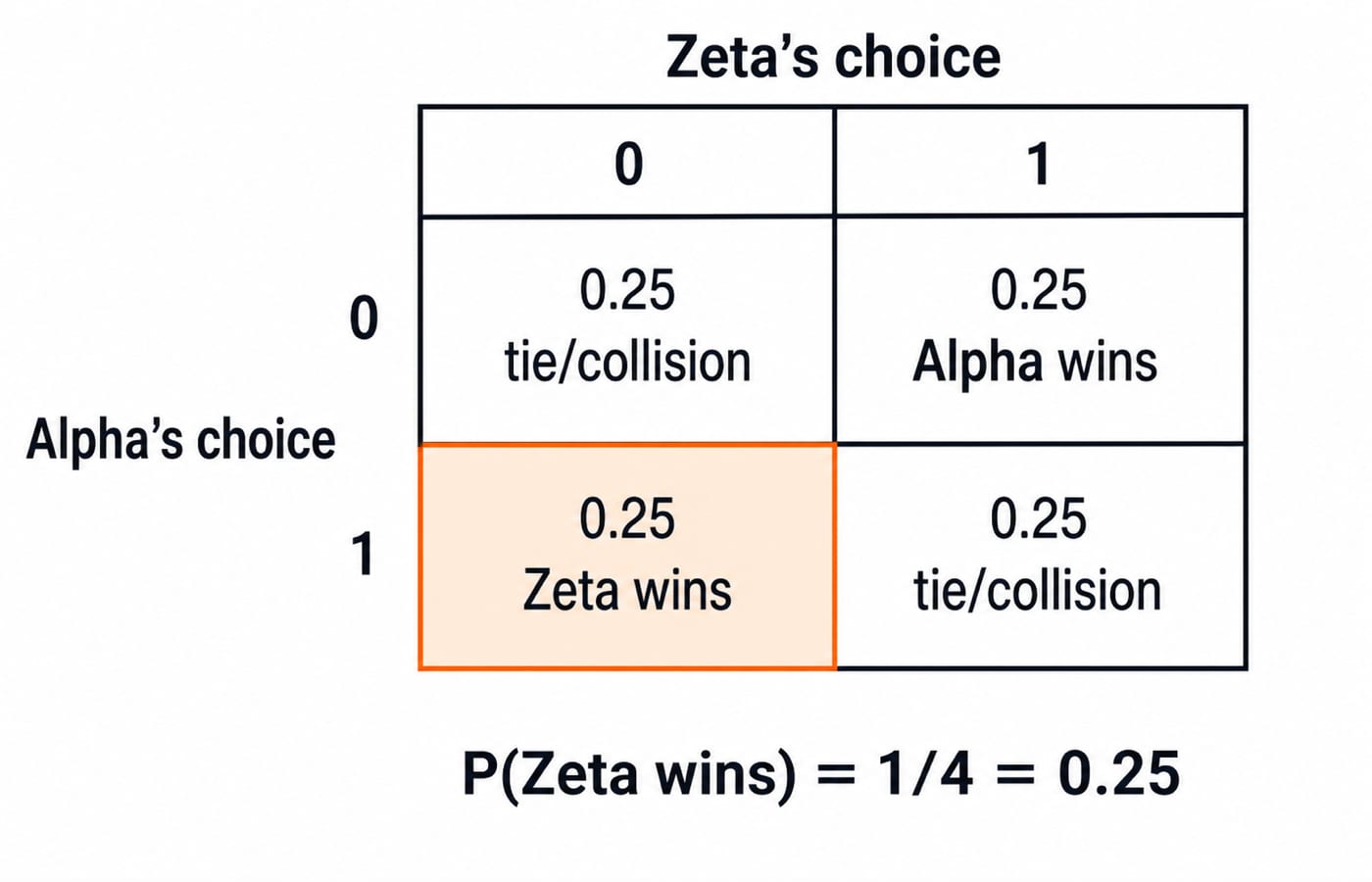
Stations Alpha and Zeta attempt to transmit a frame over Ethernet, but they collide. With what probability does Zeta win the first backoff race?
0.25
0.625
0.125
0.375
Answer: 0.25, the first option. After the first collision, each station independently chooses a backoff value from {0, 1}, with probability 1/2 for each value. The four equally likely ordered outcomes (Zeta, Alpha) are (0,0), (0,1), (1,0) and (1,1). Zeta wins only in (0,1); equal values are ties, not wins.
Therefore,
P(Zeta wins) = P(Zeta=0) x P(Alpha=1) = 1/2 x 1/2 = 1/4 = 0.25.
A common slip is to discard the tied outcomes and compute the probability only among decisive races. The answer expected here is the unconditional probability for this first race, so all four outcomes stay in the denominator. The earlier CSMA/CD MCQs set owns collision-window calculations and unequal multi-stage backoff races. This Ethernet set isolates the first two-slot race.
Ethernet IEEE 802.3 MCQs: traps, coverage and the next step
Correct these six traps before you leave the topic:
802.3is Ethernet;802.11is wireless LAN.1 Gbps = 1000 Mbps.A hub repeats signals; it does not learn addresses or route packets.
Auto-negotiation chooses common link parameters.
A MAC address has six hexadecimal octets.
A jam signal announces a collision; binary exponential backoff randomises retransmission.
Ethernet questions test standard definitions, evolution and speed, device negotiation, MAC addressing and collision handling. Reattempt the questions by concept bucket, then explain why each distractor belongs to a different layer, standard or collision rule.
The short retrieval sequence is standard -> rate -> device -> address -> collision response. Keep its two numerical anchors visible: 1 Gbps = 1000 Mbps and 1/2 x 1/2 = 0.25. For broader Computer Networks study in a structured course sequence, use GATE Guidance by Sanchit Sir as the next step.
Keep learning
Repeater, Hub, Bridge & Switch MCQs: 12 Solved Questions with Explanations
Solve 12 exam questions on device layers, MAC forwarding, VLANs, collision and broadcast domains, port mirroring, bridges and crosspoint counting.
Updated 20 Oct 20267 min readComputer Networks MCQs
OSI Model & Layers MCQs: 12 Solved Questions on PDUs and Encapsulation
Test OSI layers, PDUs, encapsulation and router traversal through solved MCQs, with explanations, a byte-by-byte frame trace and a layer-visit method.
12 Oct 20267 min readComputer Networks MCQs

Mobile Computing MCQs: Solved Questions on Concepts, Features and Applications
Work through 10 solved questions covering portability, cellular standards, Bluetooth, CDMA, Android, mobile cloud, and device constraints. Each answer has a concise explanation.
7 Oct 20267 min readComputer Networks MCQs
Computer Networks Basics & Criteria MCQs: 12 Solved Questions with Explanations
Solve 12 Computer Networks questions, then use clear explanations and worked criteria checks to separate similar terms confidently.
3 Oct 20268 min readComputer Networks MCQs