

Manchester Encoding: G.E. Thomas vs IEEE 802.3, With Differential Manchester Worked Waveforms
Learn why two Manchester conventions reverse the bit mapping, then encode and decode Differential Manchester with a complete eight-bit trace and timing check.
KnowledgeGate Team
Exam prep & CS education
Updated 20 Nov 20265 min read
Every Manchester waveform has a middle transition, yet two correct books may assign opposite bits to the same transition direction. G.E. Thomas and IEEE 802.3 reverse the mapping, while Differential Manchester reads data from a boundary transition rather than midpoint direction. Encoding and Modulation in Computer Networks: Worked Examples and GATE Traps compares line coding with carrier modulation. One complete bit string exposes both Manchester convention mappings and every Differential Manchester boundary decision.
Manchester encoding: fix the invariant before memorising a convention
Let one bit cell have duration T_b, split into two equal halves. Here, H and L mean only physical high and low levels, not binary 1 and 0.
Ordinary Manchester has one compulsory transition at every bit centre. It supplies timing; its direction carries data only after the convention is named.
Decoding checkpoint: midpoint transition always; direction depends on convention.
Apply this checkpoint before assigning a value to a rising or falling edge.
G.E. Thomas vs IEEE 802.3: the two Manchester mappings
Convention | Binary 0 | Binary 1 |
|---|---|---|
G.E. Thomas |
|
|
IEEE 802.3 |
|
|
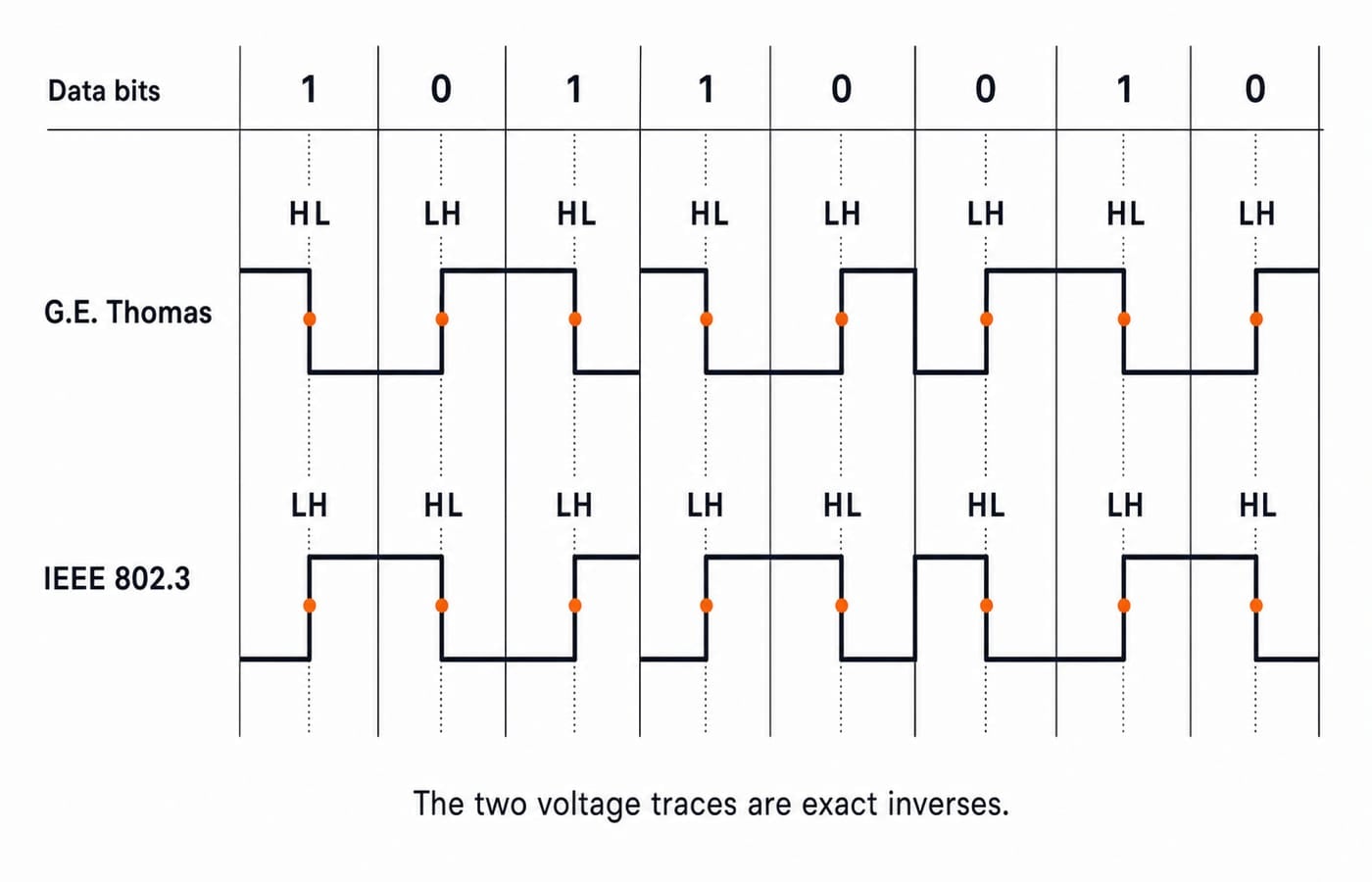
For 1 0 1 1 0 0 1 0, G.E. Thomas gives:
HL | LH | HL | HL | LH | LH | HL | LH
IEEE 802.3 gives:
LH | HL | LH | LH | HL | HL | LH | HL
The IEEE trace is the level-by-level inverse of the G.E. Thomas trace, with unchanged timing. A midpoint direction has no unique bit value unless the convention is defined.
Differential Manchester: the boundary carries data, the midpoint carries timing
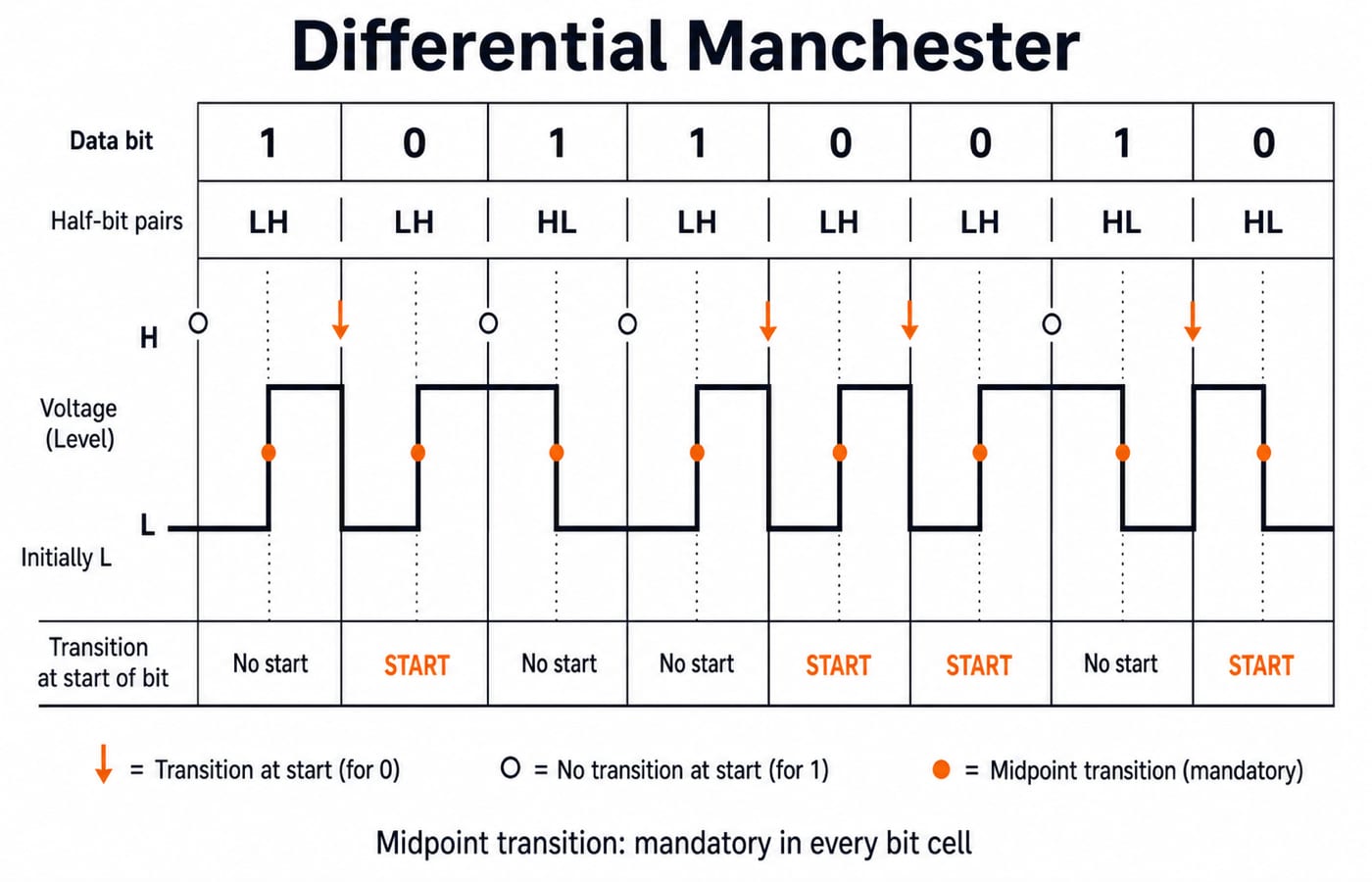
For Differential Manchester here, every bit has a midpoint transition. A transition at the start means 0; no start transition means 1.
It cannot be encoded from an isolated two-half pattern because each first level depends on the preceding line level. The line level before bit 1 determines the first half-bit; without it, the absolute waveform is ambiguous.
Ordinary Manchester asks which way the middle transition moves. Differential Manchester ignores that direction and checks for a change at the bit boundary.
Differential Manchester worked example: encode 10110010 from an initial low level
For 1 0 1 1 0 0 1 0, let the line be L before bit 1. Keep the start level for 1, change it for 0, then change at the midpoint.
Bit position | Data bit | Transition at start? | First half, second half | Ending level |
|---|---|---|---|---|
1 | 1 | No |
|
|
2 | 0 | Yes, |
|
|
3 | 1 | No |
|
|
4 | 1 | No |
|
|
5 | 0 | Yes, |
|
|
6 | 0 | Yes, |
|
|
7 | 1 | No |
|
|
8 | 0 | Yes, |
|
|
The half-level sequence is LH | LH | HL | LH | LH | LH | HL | HL.
Reverse-decoding the starts, no, yes, no, no, yes, yes, no, yes becomes 1 0 1 1 0 0 1 0.
An initial H would invert every absolute level, but the transition pattern and recovered bits would remain unchanged.
Manchester properties: clock recovery, DC balance and polarity reversal
The guaranteed midpoint transition makes Manchester self-clocking. In the ideal symmetric two-level model, each ordinary Manchester bit spends half its time high and half low, so its average level over that bit is zero. Long constant-level runs cannot occur.
Every bit occupies two half-bit signal intervals, and Manchester changes level more often than NRZ. It needs wider transmission bandwidth than comparable NRZ, though transition count alone does not give one exact bandwidth. CS Fundamentals for Placements by Sanchit Sir places line coding within the wider interview-ready networking foundation.
Swapping the two wires reverses all absolute levels. A fixed-direction ordinary Manchester decoder then swaps its bit mapping. Differential Manchester still sees the same boundary transition pattern, so its decoded bits survive.
Manchester timing numerical: place every transition at 10 Mb/s
At R_b = 10 Mb/s,
T_b = 1 / R_b = 1 / 10,000,000 s = 100 ns.
Each half-bit is 100 / 2 = 50 ns. The word lasts 8 x 100 ns = 800 ns and contains 8 x 2 = 16 half-bit intervals. The half-bit interval rate is 20 million per second. Occupied bandwidth also depends on the signal spectrum and channel, so this rate alone is insufficient.
For either ordinary Manchester convention, the compulsory midpoint transitions occur at:
t = 50, 150, 250, 350, 450, 550, 650, 750 ns.
For 10110010, extra boundary transitions appear from bit 3 to 4 and bit 5 to 6, at t = 300 ns and t = 500 ns. Thus the 800 ns word has 8 + 2 = 10 transitions.
For Differential Manchester with initial L, zeros create boundary transitions at t = 100, 400, 500, 700 ns. With the eight midpoints, the total is 8 + 4 = 12.
Manchester encoding in exams: decode in the right order and avoid four traps
Use three steps:
Draw boundaries and midpoints.
Identify G.E. Thomas, IEEE 802.3 or Differential Manchester.
Decode midpoint direction for ordinary Manchester, or start-transition presence for Differential Manchester.
Avoid four common traps:
Assuming every rising midpoint means
1. Check the convention first.Using midpoint direction to decode Differential Manchester. Inspect the boundary instead.
Drawing Differential Manchester without an initial level. State the preceding level before bit 1.
Counting only midpoints. Test every boundary too.
Quick checks: under IEEE 802.3, what does HL decode to? Under our Differential Manchester rule, what does a boundary transition followed by the midpoint transition decode to?
The answers are 0 and 0. Use Computer Networks MCQs to practise on unfamiliar traces.
Manchester encoding: the short version and the next study step
Keep this three-line memory aid:
G.E. Thomas:
0 = LH,1 = HL.IEEE 802.3:
0 = HL,1 = LH.Differential Manchester: start transition means
0, no start transition means1, and every bit has a midpoint transition.
For a sequenced GATE route, use GATE Guidance by Sanchit Sir. To place line coding among core subjects, browse CS Fundamentals for Exams & Placements. Redraw the eight-bit trace once, then reverse-decode it before moving on.
Keep learning
Manchester Encoding MCQs: 11 Published Questions, Solved and Scope-Checked
Solve 11 published records filed under Manchester encoding, learn the three line-code conventions, and see five outliers identified by their actual topics.
Updated 29 Aug 20267 min read88 viewsComputer Networks MCQs

Ethernet IEEE 802.3 MCQs: 12 Solved Questions with Explanations
Solve 12 Ethernet questions on IEEE 802.3, speed generations, hubs, MAC addresses, multicast, CSMA/CD and the first binary backoff race.
Updated 30 Oct 20267 min read76 viewsComputer Networks MCQs
IEEE 754 MCQs: 12 Solved Questions with Step-by-Step Explanations
Solve 12 IEEE 754 questions covering binary32 and binary64 fields, exact conversion, special values, rounding traps and arithmetic on encoded operands.
Updated 30 Oct 20267 min read138 viewsComputer Organization MCQs

IEEE 754 Floating-Point Standard: Binary32, Rounding and Worked Examples
Learn how IEEE 754 stores floating-point values, then encode -13.25, decode 0x3F400000, classify special values and reason about rounding errors.
Updated 23 Aug 20266 min read77 viewsComputer Organization & Architecture