

Multiplexing in Computer Networks: FDM, TDM, WDM and Statistical Multiplexing with Solved Numericals
Build one clear shared-link model, then solve bandwidth, frame-rate, average-load and optical-capacity questions without mixing their rules.
KnowledgeGate Team
Exam prep & CS education
Updated 20 Nov 20266 min read
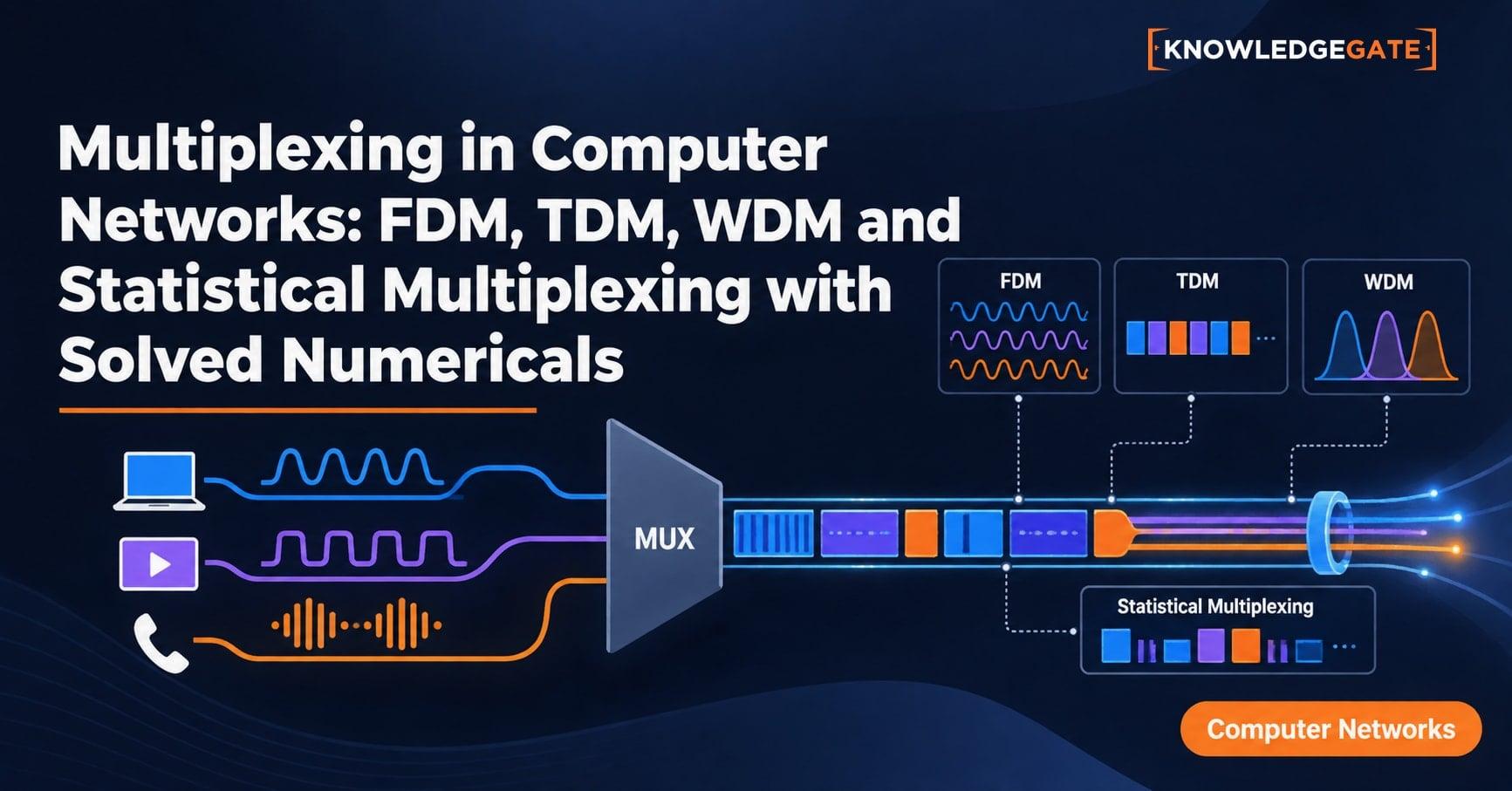
FDM, TDM, WDM and statistical multiplexing all combine traffic onto one link, but they divide different resources. That difference changes every numerical. Bandwidth, frame rate, average load and aggregate optical capacity follow from the same shared-link model. Use CS Fundamentals for the wider Computer Networks context.
Multiplexing combines streams, not link capacity
Independent sources feed a multiplexer. One composite signal crosses a higher-capacity shared link, and a demultiplexer recovers the destination streams using frequency, time, wavelength or an identifier. Multiplexing improves link use, but sustained payload still cannot exceed the capacity left after overhead.
FDM gives streams simultaneous, non-overlapping frequency bands.
Synchronous TDM gives every source a fixed, recurring time slot.
Statistical TDM sends slots for active sources, so it needs identifiers and buffering.
WDM combines separate optical carriers on one fibre.
Do not confuse link-sharing multiplexing with transport-layer multiplexing. At the transport layer, port numbers deliver data to applications; TCP vs UDP: Comparison Table, Headers, Exam Angle explains that endpoint-level role.
FDM numerical: four channels and three guards in 1 MHz
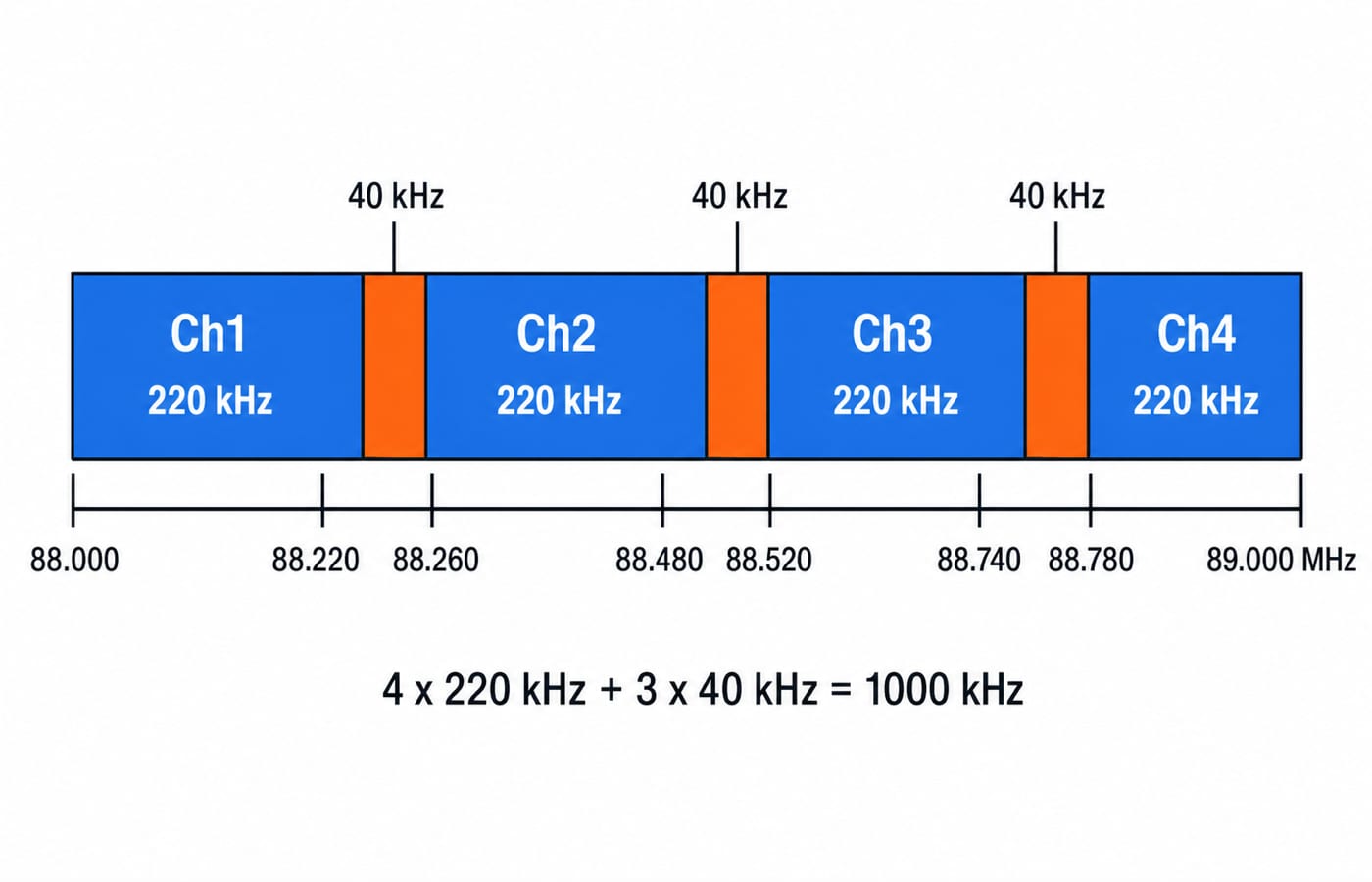
Suppose the available band is 88.000 MHz to 89.000 MHz. Thus, B_total = 1 MHz = 1000 kHz. Four equal traffic channels must fit, every adjacent pair needs a 40 kHz guard band, and there are no edge guards.
Four channels create 4 - 1 = 3 internal guards.
Guard bandwidth =
3 x 40 = 120 kHz.Traffic bandwidth =
1000 - 120 = 880 kHz.Each channel width =
880 / 4 = 220 kHz.
The allocation is Ch1 88.000-88.220 MHz, guard 88.220-88.260, Ch2 88.260-88.480, guard 88.480-88.520, Ch3 88.520-88.740, guard 88.740-88.780, and Ch4 88.780-89.000.
The conservation check is 4 x 220 + 3 x 40 = 1000 kHz. Dividing 1000 by 4 first is wrong because it leaves no space for guards. If edge guards were stated, they would also have to be subtracted.
Synchronous TDM numerical: frame rate, line rate and efficiency
Take four sources S1 to S4, each producing 2 kb/s. One frame takes one bit from each source and adds one framing bit. Since each frame carries one bit from a given source, carrying that source's 2000 bit/s requires 2000 frames/s.
Each frame has four payload bits and one framing bit. Therefore:
Output rate =
2000 x 5 = 10,000 bit/s = 10 kb/s.Frame duration =
1 / 2000 s = 0.5 ms.Output-bit duration =
0.5 / 5 = 0.1 ms = 100 microseconds.Payload efficiency =
4 / 5 = 80%.
If S4 becomes idle but keeps its fixed slot, useful source traffic is 3 x 2 = 6 kb/s, only 6 / 10 = 60% of the line rate.
For S1=10, S2=01, S3=11 and S4=00, two transmitted frames are F|1|0|1|0 and F|0|1|1|0. The demultiplexer recovers a source by taking the same slot from successive frames. The 10 kb/s figure is the line rate, not useful payload throughput.
Statistical multiplexing numerical: average gain and queueing risk
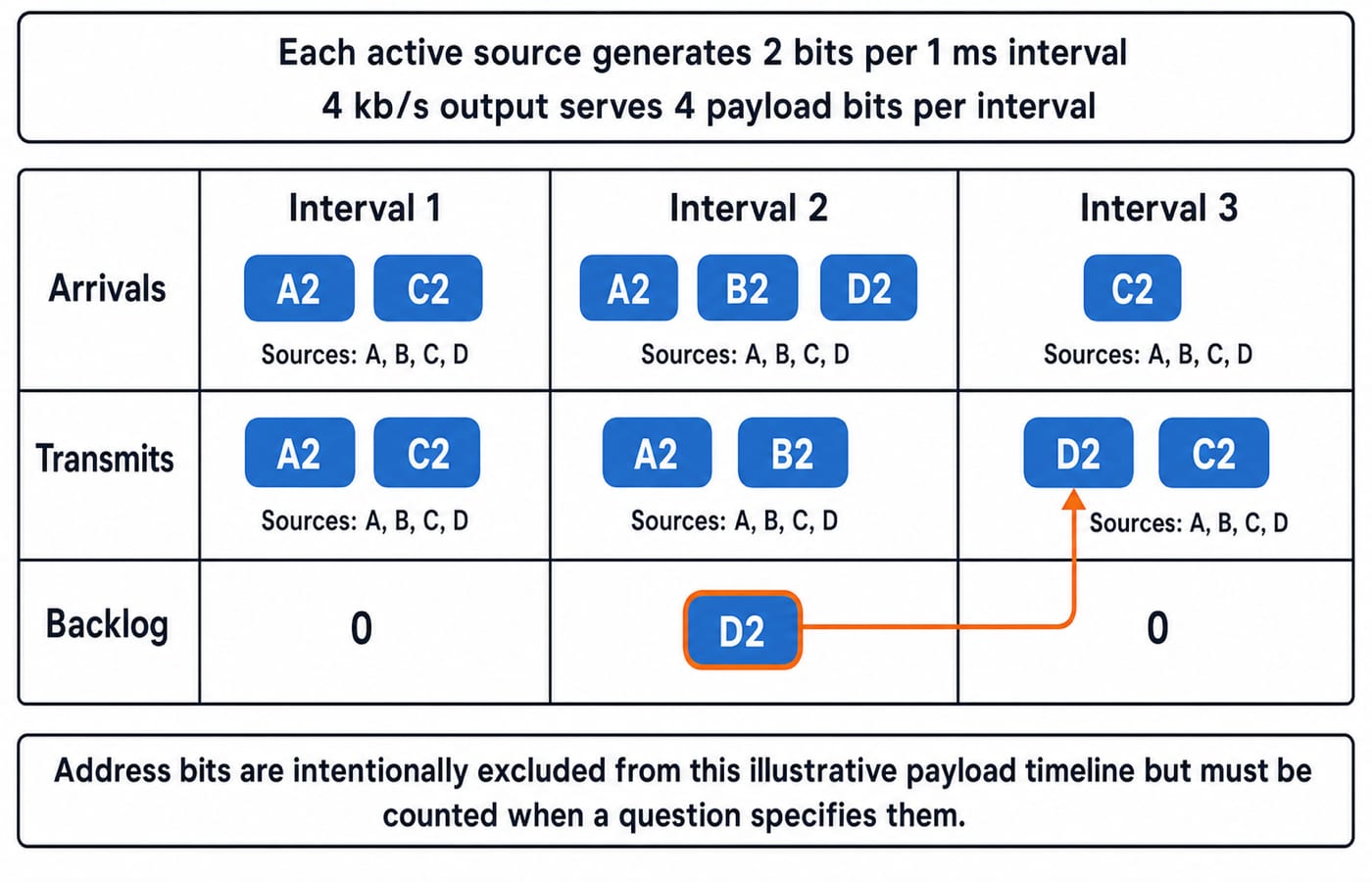
Four independent sources A to D each send at 2 kb/s when active and are active with probability p = 0.25. A statistical multiplexer feeds a 4 kb/s link. Ignoring address overhead, mean offered load is:
4 x 0.25 x 2 = 2 kb/s
Mean utilisation is 2 / 4 = 50%. The output can serve at most two full-rate sources at once. If K is the number active, instantaneous overload is:
P(K > 2) = C(4,3)(0.25)^3(0.75) + C(4,4)(0.25)^4
= 12/256 + 1/256 = 13/256, or about 5.08%.
Average load below capacity does not guarantee zero delay. With three or four active sources, excess bits queue, or get dropped if the buffer fills. Synchronous TDM for the same four peak-rate sources would need 4 x 2 = 8 kb/s before framing. The 4 kb/s statistical link trades guaranteed allocation for sharing. Add identifier bits whenever a question states them.
WDM numerical: count carriers before adding rates
WDM is the optical counterpart of frequency separation. An optical multiplexer combines distinct light carriers onto one fibre, and a demultiplexer separates them at the other end. These are not time slots and not one carrier merely running faster.
Consider an inclusive grid from 193.1 THz through 193.8 THz in steps of 0.1 THz. Its carriers are 193.1, 193.2, 193.3, 193.4, 193.5, 193.6, 193.7 and 193.8 THz.
Carrier count = ((193.8 - 193.1) / 0.1) + 1 = 8. The +1 includes both endpoints. At 25 Gb/s per wavelength, raw capacity is 8 x 25 = 200 Gb/s. If this question reserves two carriers for protection, usable traffic capacity is (8 - 2) x 25 = 150 Gb/s. Reserving two carriers reduces this grid's usable capacity; WDM itself does not require two protection carriers.
FDM vs TDM vs WDM vs statistical multiplexing
Method | What separates streams | Allocation | Overlap in time? | Main overhead or loss | Typical calculation |
|---|---|---|---|---|---|
FDM | Frequency | Fixed | Yes | Guard bands | Bandwidth |
Synchronous TDM | Time slots | Fixed | No | Framing, idle slots | Frame and line rate |
Statistical TDM | Labelled time slots | Demand-based | No | Addressing, queueing | Mean load, overload |
WDM | Optical carrier | Fixed | Yes | Spacing, reserved wavelengths | Aggregate bit rate |
Continuous radio signals with guards suggest FDM. Equal-rate digital sources in repeating slots suggest synchronous TDM. Bursty terminals and a buffered output suggest statistical TDM. Several light carriers on one fibre suggest WDM.
Ask what resource distinguishes streams before choosing a formula. IP addresses identify network-layer endpoints and routing chooses paths; multiplexing shares capacity on one link.
Exam traps: audit units, slot rules and assumptions
Use this checklist before accepting an answer:
Convert MHz to kHz before subtraction.
Use
n - 1only for internal guards. Add edge guards if stated.Distinguish frame duration from slot duration.
Include any framing or address bits the question states in the output rate.
Retain fixed slots for inactive synchronous sources.
Do not infer zero queueing from a low statistical average.
Two fast checks expose common errors. Six 80 kHz FDM channels with five internal 10 kHz guards need 6 x 80 + 5 x 10 = 530 kHz, not 540 kHz. Five TDM sources at 1.2 kb/s, one bit each per frame and no overhead, produce 1200 frames/s, an output rate of 5 x 1.2 = 6 kb/s, and a frame duration of 1 / 1200 s, about 0.833 ms.
Questions may use a resource diagram, guard-band arithmetic, frame and slot timing, WDM capacity, or a fixed-versus-demand-based statement. The earlier Channelization in Computer Networks: FDMA, TDMA and CDMA with Solved Numericals owns planned multiple-access allocation and CDMA decoding; the worked examples here teach link multiplexing through FDM, synchronous and statistical TDM, and WDM, including overload probability and optical carrier capacity. The GATE Test Series adds practice across those mixed forms.
The short version and a practical next step
FDM separates frequency bands. Synchronous TDM repeats fixed time positions. Statistical TDM sends labelled slots for active sources and can queue bursts. WDM separates optical carriers. Subtract overhead before division, derive frames per second from each source rate, count inclusive carrier endpoints carefully, and keep mean load separate from peak demand.
For a 20-minute revision, redraw the FDM strip, recover the 10 kb/s TDM rate and 80% efficiency, derive 13/256, then recompute 200 Gb/s raw and 150 Gb/s usable WDM capacity. You should reproduce all four without looking. Use GATE Guidance by Sanchit Sir to place Multiplexing inside the wider Computer Networks syllabus.
Keep learning

Channelization MCQs: 11 Solved Questions on FDM, TDM, CDMA and WDM
Solve 11 channelization MCQs with clear reasoning for resource splits, guard bands, TDM rates, propagation delay, duty cycle and packet backlog.
Updated 4 Nov 20268 min readComputer Networks MCQs
Channelization in Computer Networks: FDMA, TDMA and CDMA with Solved Numericals
Learn how frequency, time and code divide a shared medium. Three worked examples calculate FDMA bandwidth, TDMA useful throughput and CDMA correlation decoding.
Updated 6 Nov 20266 min readComputer Networks
Computer Interfaces in COA: Registers, Handshaking and I/O Mode Numericals
Learn how an I/O interface decodes addresses, uses data, status and control registers, coordinates handshakes, and changes CPU occupancy across polling, interrupts and DMA.
Updated 30 Oct 20267 min read84 viewsComputer Organization & Architecture
Encoding and Modulation in Computer Networks: Worked Examples and GATE Traps
Separate encoding from modulation with a four-path map, then work through line coding, 8-PSK baud, PCM sampling, quantisation, AM and FM bandwidth.
Updated 18 Nov 20266 min readComputer Networks