Algebra for Aptitude Tests: Fast Methods for Equations, Identities and Substitution
Learn how to recognise the algebraic structure in an aptitude question, choose the shortest valid method, and verify the result through worked examples.
KnowledgeGate Team
Exam prep & CS education
Updated 21 Aug 20266 min read
Algebra questions often look unrelated because one is dressed as an age problem, another as a rectangle, and a third as data sufficiency. The real task is recognising the object beneath the wording. Name the object first and the method follows: 997 squared collapses to a single identity line, a rectangle problem to a factorised quadratic, and every answer stays cheap to verify.
Algebra for aptitude tests: recognise the object before choosing a method
An expression such as 3x + 5 has no equality sign, so you simplify it. An equation such as 3x + 5 = 20 is true only for values that satisfy it, so you solve it. An identity such as (a + b)^2 = a^2 + 2ab + b^2 is true for every allowed value, so either form can replace the other.
Match the clue to the method before you calculate:
Clue | First method | Quick check |
|---|---|---|
| Isolate the one unknown | Substitute the answer |
| Factorise the quadratic | Check the root sum and product |
| Use a nearby-base identity | Estimate just below |
| Substitute into a matching identity | Check whether separate values are even needed |
Two linear unknowns usually suggest substitution or elimination. A visible square or difference of squares suggests an identity. An x^2 term suggests factorisation or the quadratic formula. Symmetric data such as a + b and ab should go directly into a matching identity.
Linear equations: isolate one unknown and eliminate two unknowns
Solve 5(x - 3) - 2(x + 4) = 25 by expanding carefully:
5x - 15 - 2x - 8 = 25
3x - 23 = 25
3x = 48, so x = 16.
Check in the original equation: 5(13) - 2(20) = 65 - 40 = 25. This check catches the common mistake of dropping the negative sign before the second bracket.
Now suppose three pens and two notebooks cost 190, while two pens and three notebooks cost 210. Let a pen cost p and a notebook cost n:
3p + 2n = 190
2p + 3n = 210
Multiply the first equation by 3 and the second by 2:
9p + 6n = 570
4p + 6n = 420
Subtracting gives 5p = 150, so p = 30. Then 3(30) + 2n = 190, which gives n = 50. Both totals check: 90 + 100 = 190 and 60 + 150 = 210.
Eliminate when coefficients can be matched cheaply. Substitute when a variable is already isolated or has coefficient 1.
Algebraic identities: calculate from structure instead of long multiplication
The three high-use forms are (a + b)^2 = a^2 + 2ab + b^2, (a - b)^2 = a^2 - 2ab + b^2, and a^2 - b^2 = (a - b)(a + b). Their clues are a squared sum, a squared difference, or two squares being subtracted.
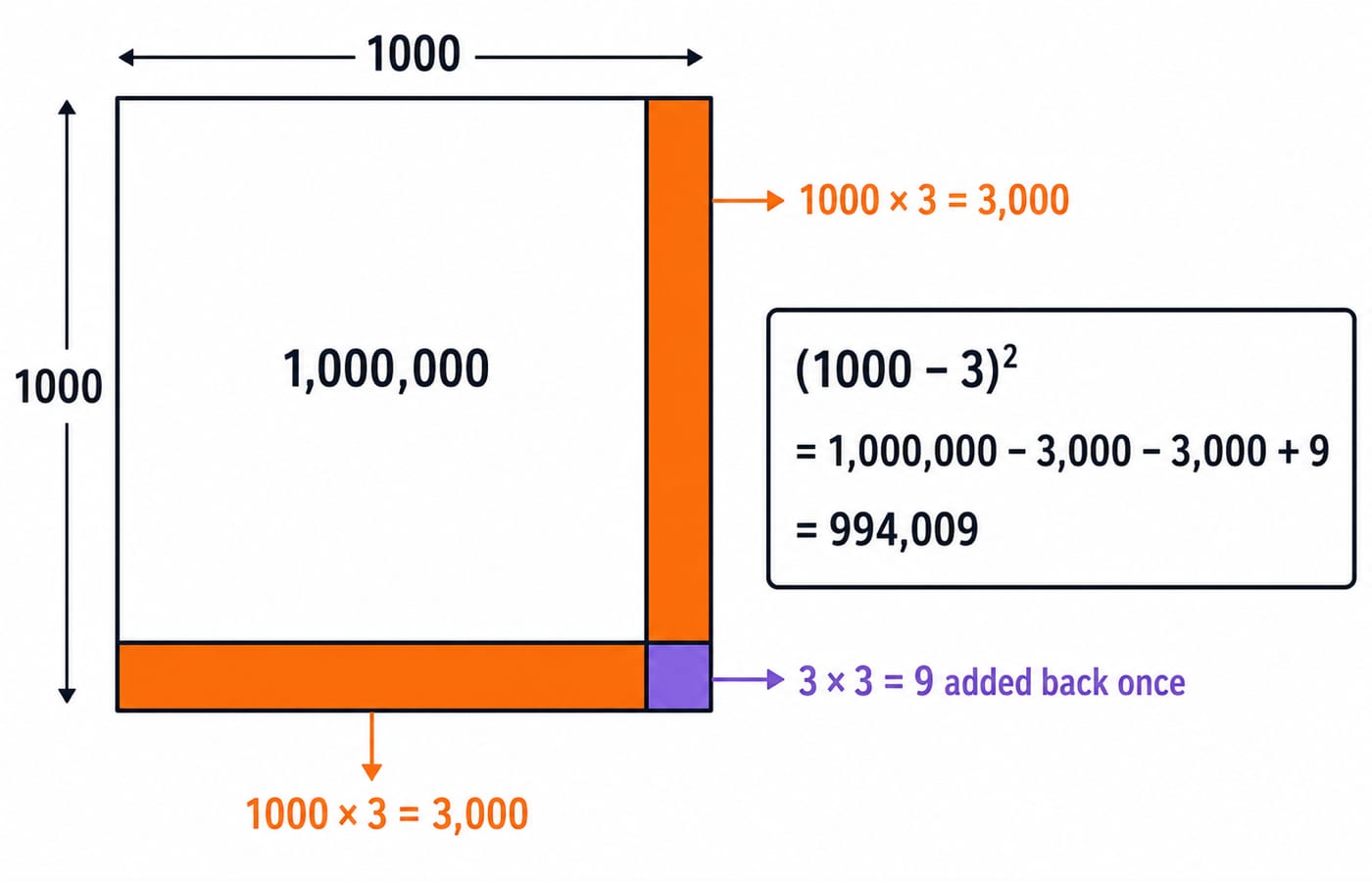
For 997^2, use the nearby base 1000:
(1000 - 3)^2 = 1000^2 - 2(1000)(3) + 3^2
= 1,000,000 - 6,000 + 9 = 994,009.
For 48^2 - 32^2, do not calculate two squares separately. Use the difference of squares: (48 - 32)(48 + 32) = 16 x 80 = 1,280.
Quadratic equations: factor first, then reject impossible roots
A quadratic has standard form ax^2 + bx + c = 0. Factor when integer factor pairs are visible; otherwise use the quadratic formula. Test every root against the story's domain.
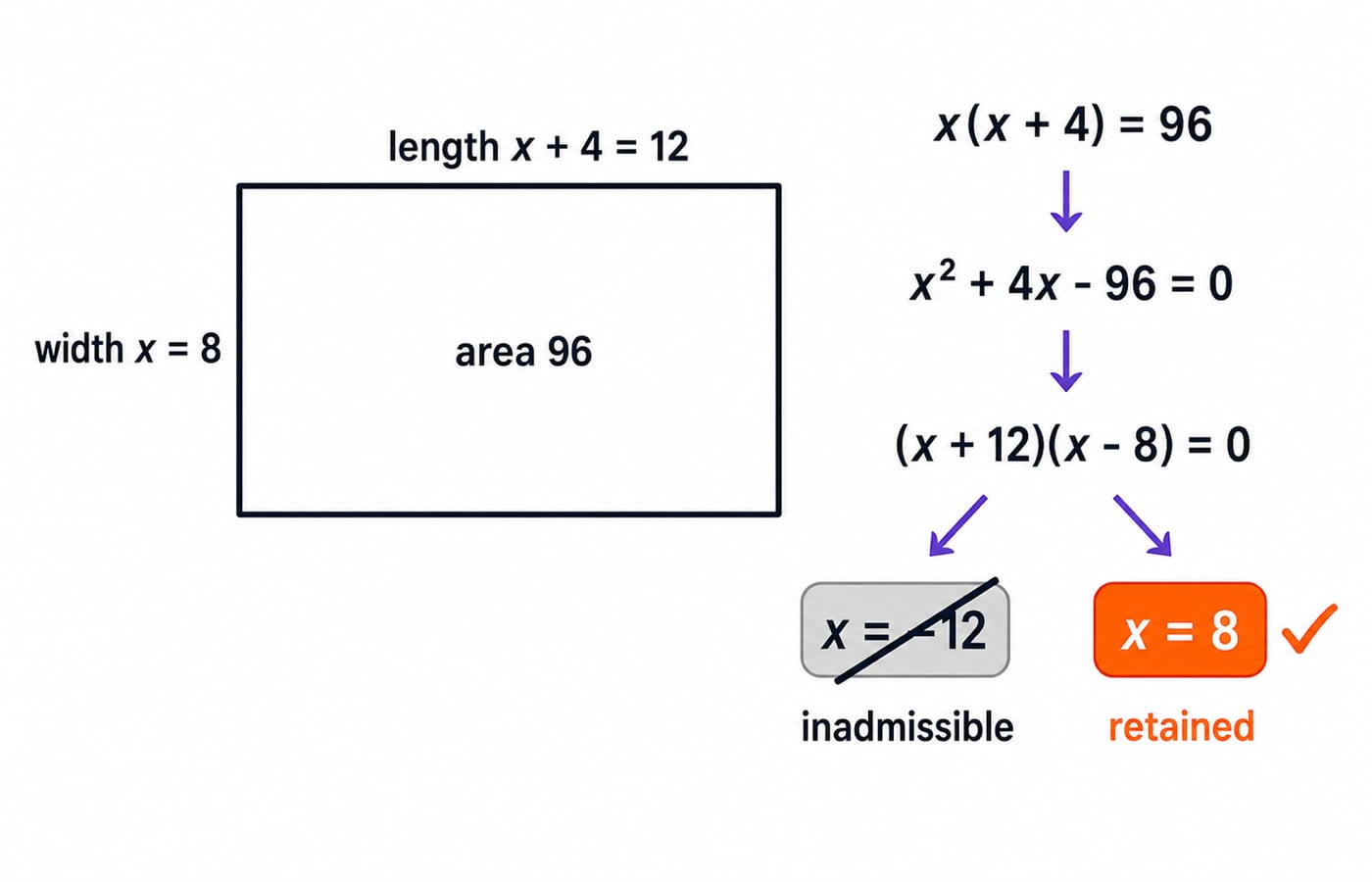
Suppose a rectangle has width x, length x + 4, and area 96:
x(x + 4) = 96
x^2 + 4x - 96 = 0
(x + 12)(x - 8) = 0
The algebraic roots are x = -12 and x = 8. A negative length is impossible, so the rectangle has width 8 and length 12. The check is 8 x 12 = 96.
For x^2 - 11x + 24 = 0, the roots are 3 and 8. They sum to 11 and multiply to 24, matching the coefficients.
Substitution shortcuts: use the values given, not the values you wish you had
If a + b = 11 and ab = 24, then:
a^2 + b^2 = (a + b)^2 - 2ab = 121 - 48 = 73.
Because ab is nonzero, 1/a + 1/b = (a + b)/ab = 11/24. Neither answer requires solving for a and b separately.
For an age problem, let the younger person's age be x and the older person's age be x + 8. If their current ages total 50, then x + (x + 8) = 50, so 2x = 42 and x = 21. Their ages are 21 and 29; after five years, they are 26 and 34. The difference remains 8, and the original total is 50.
Substitute directly when the requested expression matches a known sum, product, or difference. Solve individual variables only when you cannot form the requested quantity directly.
Algebra mistakes that lose easy marks
Missing the middle term:
(7 - 2x)^2 = 49 - 28x + 4x^2, not49 + 4x^2. Write the full identity before inserting values.Dividing away a root:
x(x - 5) = 0has roots0and5. Dividing both sides byxassumesxis nonzero and loses the root0. Apply the zero-product rule instead.Ignoring a restriction:
(x + 1)/(x - 3) = 2requiresx ≠ 3. Cross-multiplication givesx + 1 = 2x - 6, sox = 7, which is allowed and checks as8/4 = 2.Keeping a root the story forbids: both rectangle roots satisfy the factorised equation, but
-12cannot represent a physical length. State the domain before accepting an answer.
Build a three-part verification habit: substitute into the original equation, check units or domain, and estimate the scale of the result.
Algebra in aptitude tests: mixed-method and data-sufficiency questions
Aptitude tests commonly translate prose into equations, hide identities inside large-number arithmetic, or ask whether supplied statements determine a value. The topic context differs across exams, as the broader maps for SSC CGL Quantitative Aptitude: High-Yield Topics and Bank PO Quant: High-Yield Topics First show, but the algebraic recognition skill stays the same.
Consider a data-sufficiency target, x^2 + y^2. Statement 1 gives x + y = 10; statement 2 gives xy = 21. Statement 1 alone leaves the product unknown and statement 2 alone leaves the sum unknown, so neither fixes the target by itself. Together:
x^2 + y^2 = (x + y)^2 - 2xy = 100 - 42 = 58.
If the target were the ordered value of x, the pair {3, 7} would still leave x and y interchangeable unless an ordering condition were supplied.
For a six-question mixed drill, include two one-variable linear equations, one simultaneous-equation purchase problem, one nearby-base identity calculation, one quadratic rectangle problem, and one data-sufficiency item. Before every calculation, write the method label, such as isolate, eliminate, identity, factor, or substitute. This trains recognition before speed.
Algebra for aptitude tests: the short version and next step
Keep the process to five lines:
Classify the algebraic object.
Choose the cheapest valid method.
Preserve restrictions such as nonzero denominators.
Reject roots that violate the story.
Verify in the original statement.
KnowledgeGate's question bank carries over 450 algebra questions in its Mathematics and Aptitude section. Try a 40-minute block: 10 minutes for method recognition, 20 minutes for solving, and 10 minutes to retry errors from your log. For a longer sequence, follow Aptitude for Placements: A 30-Day Practice Routine.
Use the Aptitude for Placement course if a structured path across aptitude, reasoning, and verbal ability is useful. If algebra is the only weak area, stay with targeted algebra drills. Compare wider options in the Placement Preparation category.
Keep learning
Mensuration and Geometry for Competitive Exams: Formulas, Shortcuts and Solved Examples
Learn how to choose the right mensuration formula, avoid common geometry traps, and solve 2D path and 3D recasting problems step by step.
Updated 6 Oct 20266 min readAptitude & Reasoning

Age Comparison and Multiple-Condition Problems: 12 Solved MCQs
Practise 12 age-problem MCQs with equations, timelines, back-checks, relation chains, changing ratios, birth years, and family conditions.
1 Oct 20268 min readAptitude & Reasoning

True, False and Cannot Say Questions: 10 Solved Passage MCQs
Learn how to separate contradictions from missing evidence, then apply the method to 10 previous-year passage MCQs with concise, evidence-led solutions.
26 Sep 20268 min readAptitude & Reasoning
TCS Aptitude Questions: High-Yield Quant and Reasoning Topics, Solved Step by Step
Learn the first move for common quant and reasoning question families through solved examples on ratios, work, trains, data, remainders, and seating.
Updated 25 Sep 20266 min read104 viewsAptitude & Reasoning