You may understand fractions and decimals yet still lose time in a timed aptitude test. The usual causes are converting every option, finding an unnecessary LCM, or putting a decimal point in the wrong place. The solution is a compact decision system for conversion, comparison and arithmetic, followed by a check. These methods preserve exact values. Estimation confirms an answer, but never replaces correct calculation.
1. Treat fractions and decimals as two forms of the same value
To convert a terminating decimal into a fraction, place its digits over the matching power of ten and reduce:
0.375 = 375/1000 = 3/8
For a fraction whose denominator can be scaled to 10, 100 or 1000, scale it directly. For example, 8 x 125 = 1000, so:
7/8 = 875/1000 = 0.875
Build a small exact-value bank that you can recognise without fresh calculation:
Fraction | Decimal |
|---|---|
|
|
|
|
|
|
|
|
|
|
|
|
|
|
|
|
There is also a useful termination test. After a fraction is reduced, its decimal terminates only if the denominator's prime factors are 2, 5, or both. Thus 3/40 = 75/1000 = 0.075, because 40 contains only factors 2 and 5. By contrast, 2/3 = 0.666... repeats. Do not chase a long decimal when the exact fraction is cleaner.
2. Compare fractions without converting every option
Choose the quickest exact method in this order: use a familiar benchmark such as 1/2 or 1; cross-multiply when comparing two fractions; use a shared denominator only when it appears immediately.
Consider 7/9, 13/14, 15/21 and 3/4. First reduce 15/21 to 5/7. All four fractions are below 1, so compare their gaps from 1:
7/9has gap2/9.13/14has gap1/14.5/7has gap2/7.3/4has gap1/4.
The smallest gap is 1/14, so 13/14 is the largest. The exact descending order is:
13/14 > 7/9 > 3/4 > 5/7
The less obvious middle comparison follows from 7 x 4 = 28 > 27 = 3 x 9. The last comparison follows from 3 x 7 = 21 > 20 = 5 x 4.
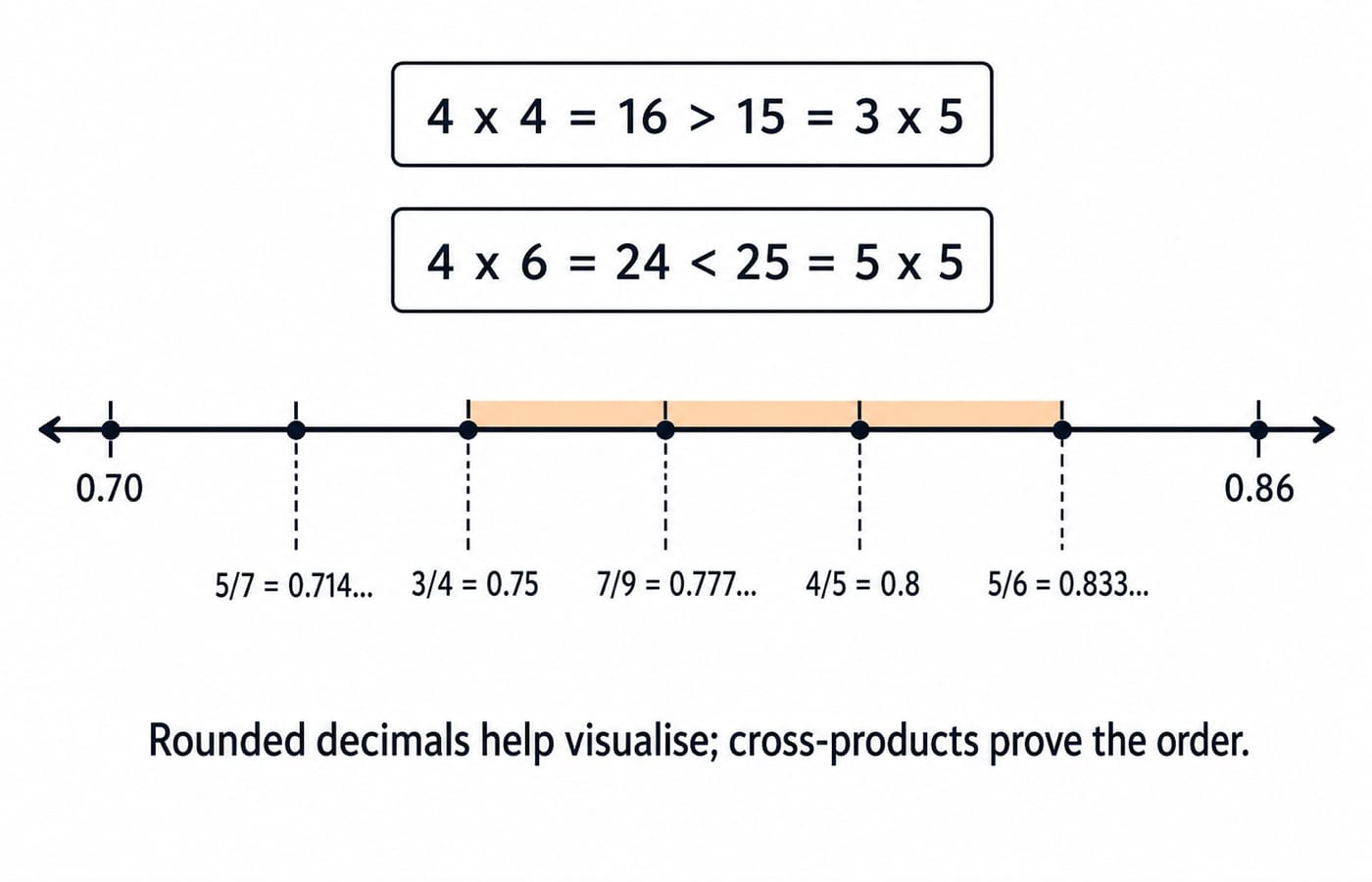
Now test whether 4/5 lies between 3/4 and 5/6. It is greater than 3/4 because 4 x 4 = 16 > 15 = 3 x 5. It is less than 5/6 because 4 x 6 = 24 < 25 = 5 x 5. Therefore:
3/4 < 4/5 < 5/6
No rounded decimals are needed for the proof.
3. Multiply and divide decimals by temporarily removing the point
For decimal multiplication, multiply the integer digits first, then restore the total number of decimal places. Take 0.006 x 0.5:
Calculate
6 x 5 = 30.The factors contain
3 + 1 = 4decimal places in total.Restore four places:
0.0030 = 0.003.
Check the magnitude. Half of 0.006 must be 0.003, so 0.03 and 0.30 cannot be right.
For division, move both decimal points by the same number of places until the divisor is an integer:
5.5 / 1.1 = 55/11 = 5
Multiplying both dividend and divisor by 10 preserves the quotient. Addition and subtraction use a different rule: align decimal points by place value. Do not count decimal places for those operations.
4. Use LCM for addition, cancellation for multiplication
The operation tells you the method. For fraction addition or subtraction, use a common denominator. For example:
7/12 + 5/18
LCM(12, 18) = 36
7/12 = 21/36 and 5/18 = 10/36
21/36 + 10/36 = 31/36
Denominators are not added.
For multiplication, cancel common factors before multiplying:
14/25 x 15/28 = 1/2 x 3/5 = 3/10
Here, 14/28 reduces to 1/2, and 15/25 reduces to 3/5. For division, multiply by the reciprocal:
3/5 / 9/10 = 3/5 x 10/9 = 2/3
Simplifying early keeps the numbers small. Never cancel terms across addition or subtraction, because cancellation applies to common factors, not separate terms.
5. Choose one representation for a mixed expression
Evaluate the mixed expression (1.75 - 3/8) / 0.55. Fractions are the cleaner representation because 1.75 = 7/4 and 0.55 = 55/100 = 11/20. Keep the parentheses visible:
(1.75 - 3/8) / 0.55
= (7/4 - 3/8) / (11/20)
= (14/8 - 3/8) / (11/20)
= (11/8) / (11/20)
= 11/8 x 20/11
Cancel 11 from numerator and denominator:
= 20/8 = 5/2 = 2.5
Now apply two checks. For magnitude, 1.75 - 0.375 = 1.375, and dividing by about 0.55 should produce about 2.5, not 0.25 or 25. For a reverse check:
2.5 x 0.55 = 1.375 = 1.75 - 0.375
The quick method is a representation choice, not a magic trick. Convert everything into the form that makes cancellation or place value easiest.
6. Catch the four traps that cost easy marks
Trap | Wrong move | Repair |
|---|---|---|
Magnitude | Treating | Write |
Decimal placement | Reporting | Half of |
Fraction addition | Writing | Use denominator 12: |
Division | Forgetting the reciprocal in | Use |
Parentheses are another trap. 8.5 - (3/1.1) is not the same as (8.5 - 3)/1.1. The second expression is:
(8.5 - 3)/1.1 = 5.5/1.1 = 5
The first expression is:
8.5 - (3/1.1) = 17/2 - 30/11 = 187/22 - 60/22 = 127/22, approximately 5.77.
Copy the expression exactly before choosing a shortcut. The broader Aptitude for Placements guide can help you build these checks into regular quantitative practice.
7. How timed aptitude sets combine these methods
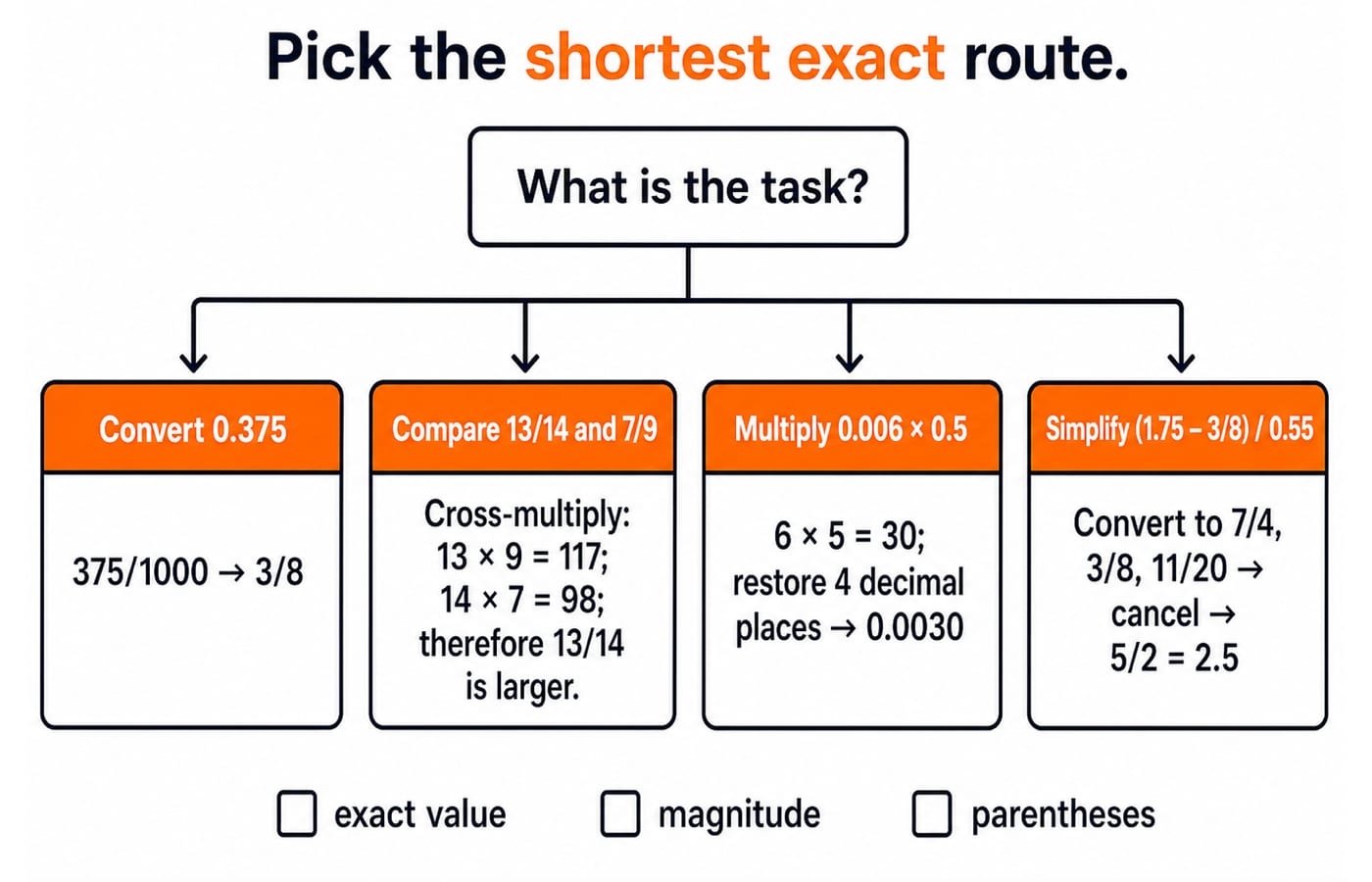
Timed practice sets often combine ranking fractions, locating a value between two bounds, multiplying small decimals and simplifying a mixed expression. The fastest route changes with the operation, so identify the task before calculating.
Try this four-question drill in one uninterrupted attempt. Start a stopwatch before question 1 and stop after question 4.
Convert
0.375to a fraction. Answer:3/8.Choose the largest of
7/9,13/14,15/21,3/4. Answer:13/14.Calculate
0.006 x 0.5. Answer:0.003.Evaluate
(1.75 - 3/8) / 0.55. Answer:2.5.
Afterwards, classify every delay as conversion, comparison, arithmetic or checking. The live Placement Preparation category shows how this skill fits into the wider placement path.
8. Short version and the next practice step
Recognise common fraction and decimal equivalents.
Compare exact values before using rounded decimals.
Count decimal places only for multiplication.
Use LCM for fraction addition and cancellation for multiplication.
Check magnitude and brackets before committing an answer.
Use the Aptitude for Placement course for structured aptitude practice, then visit the Aptitude and Reasoning hub for related lessons. Redo the four-question drill once without notes and record which decision step still takes the longest.