Individual Differences for Teaching Exams: Complete Notes, Classroom Examples and MCQ Traps
Understand how learners differ, why heredity and environment interact, and how evidence-led teaching adapts support without fixing labels or lowering the learning goal.
KnowledgeGate Team
Exam prep & CS education
Updated 14 Sep 20265 min read

Individual differences are normal variations within and between learners, not evidence that some children deserve lower expectations. In teaching-exam questions, the crucial step is deciding what those differences require in a real classroom. Sound teaching changes routes, support and pace while preserving a meaningful learning goal. Evidence must be collected, interpreted cautiously and checked again after support.
Meaning of individual differences: variation, not deficiency
Individual differences are observable variations among learners in characteristics that affect learning, participation or performance. Between-learner variation means that two pupils may begin with different prior knowledge. Within-learner variation means that the same pupil may read fluently but need more support in spatial reasoning. A difference is not automatically a disorder, weakness or permanent trait.
Keep three principles safe for the exam. Learners do not begin from identical starting points. Equal dignity does not require identical support. One score or one classroom observation cannot justify a fixed label. The sound position is same goal, responsive support. It rejects both the same method for everyone and lower expectations for selected learners.
CTET CDP: the high-yield concepts and theorists you must know connects individual differences with development, learning and pedagogy.
Dimensions that can differ from one learner to another
dimension | evidence a teacher may notice | responsive move |
|---|---|---|
prior knowledge | can name a triangle but not compare its side properties | activate prerequisite and connect representations |
learning pace | needs 12 minutes rather than 6 for the same task | allow time plus staged prompts |
language experience | understands a diagram but misreads the written direction | simplify wording without simplifying the concept |
interest and motivation | persists with a real-life context but disengages from repetitive drill | vary context and task format |
social or cultural experience | uses a valid example unfamiliar to the textbook | invite multiple relevant examples |
physical or sensory access | cannot access small print or rapid oral directions | provide an accessible format and adequate processing time |
Other dimensions include cognitive ability, aptitude, attention, personality/temperament and emotional state. They are not boxes; strength can coexist with need.
Reject fixed visual-versus-auditory labels. Use multiple representations when content and evidence require them.
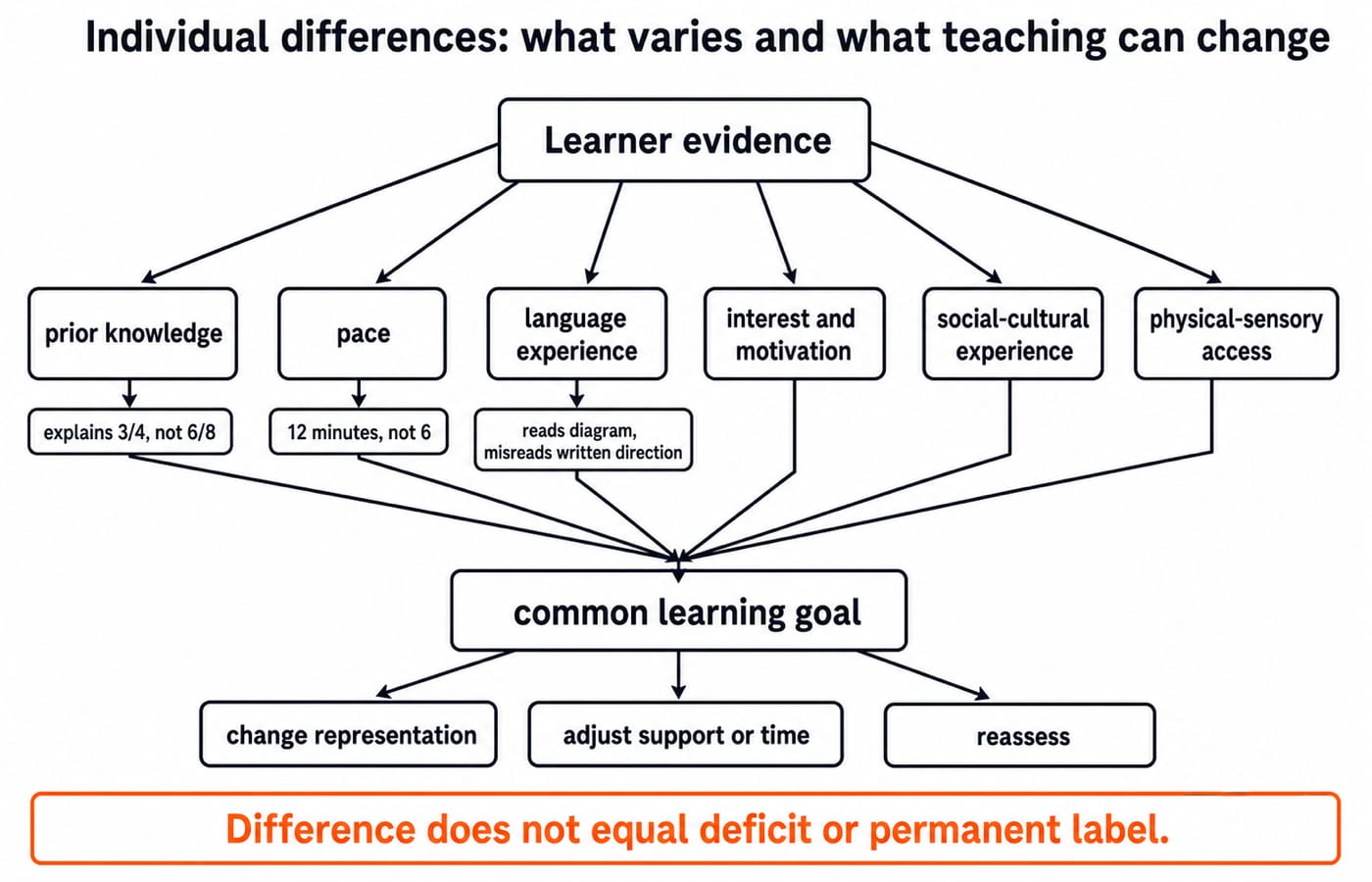
Where differences come from: heredity and environment interact
Biological inheritance and environmental experience interact throughout development. Two pupils may both have the capacity to learn a new map-reading skill, but one has used maps at home while the other is meeting map symbols for the first time. Their starting gap does not prove a fixed capacity gap.
Environmental influences include home and language experience, nutrition and health, schooling opportunities, peer interaction, expectations, practice and access to resources. Learner characteristics include maturation, temperament and broad biological variation. Do not assign a percentage contribution to either side or frame the issue as heredity versus environment, as if only one can operate.
For an exam stem, reject deterministic words such as only, entirely, unchangeable or all learners of a group. Prefer an interactional explanation when both learner characteristics and classroom or social conditions are present.
Classroom example: one learner, two evidence sources
A Class VI teacher checks whether Kavya can classify triangles by their side properties. Two pieces of evidence point in different directions:
Written item: Kavya labels an isosceles triangle incorrectly.
Sorting task with explanation: she groups four of five triangle cards correctly and says that the isosceles examples have two equal sides.
The common objective is to classify triangles as equilateral, isosceles or scalene and justify the choice from side properties. The teacher does not turn one wrong label into a judgement about Kavya's geometry ability. She checks whether the barrier is the concept, the vocabulary or the written format.
Kavya first points to matching sides on three diagrams, then pairs each diagram with its term. On a second written item, she names all three triangle types and explains the isosceles choice correctly. The combined evidence suggests a language-to-symbol transfer need, not a fixed lack of ability. The objective stayed constant while representation and prompting changed, and reassessment tested whether the support worked.
What individual differences require from a teacher
Turn the principle into a five-step loop:
Collect evidence through observation, questions and short tasks.
Identify the immediate barrier without diagnosing from one result.
Keep the intended concept explicit.
Vary representation, scaffolding, grouping, pace or practice.
Reassess and regroup.
Flexible grouping changes with the topic and the evidence, and can change again after each reassessment. Differentiation is not unrelated easy work for a struggling learner. It is not asking the fastest learner to teach the class every day. It is not permanent ability grouping. It can keep a common objective while providing different entry points, prompts or ways to demonstrate understanding.
For a second application, Computer Science pedagogy for teacher recruitment exams: what it tests and how to score it shows how learner evidence can guide a teaching move in another subject. The content changes, but the evidence-response logic remains the same.
MCQ: the inclusive response and its traps
Question: Kavya mislabels an isosceles triangle in writing but sorts four of five triangle cards correctly and explains that two sides are equal. Which response best recognises individual differences?
(A) Place Kavya permanently in a low-ability geometry group.
(B) Repeat the same written worksheet until she memorises the spellings.
(C) Keep the triangle-classification objective, check the vocabulary barrier with diagram-word matching, then reassess in writing.
(D) Replace the classification objective with an unrelated colouring task.
Answer: (C). The response uses both pieces of evidence, preserves the learning goal and checks whether targeted support changes performance. Option (A) fixes identity from one answer. Option (B) ignores the stronger sorting evidence. Option (D) lowers the goal instead of addressing the barrier.
When several options sound positive, apply this transfer rule: Does the response preserve participation, use evidence, provide an appropriate route and reassess? An answer that removes challenge or fixes identity from one score fails at least one test.
How teaching exams frame the concept, and five common traps
Teaching-exam questions can use a definition or principle, a heredity-environment statement pair, a classroom-situation judgement, or an inclusive-teaching and differentiation choice. For any named exam, use its current official material for the syllabus, marks, question count and pattern.
trap | why it fails | repair |
|---|---|---|
different means deficient | turns variation into judgement | describe evidence, not worth |
equal means identical | ignores access and starting points | keep the goal, vary support |
one low score proves low intelligence | overgeneralises from one measure | use multiple observations and reassessment |
learning style is fixed | boxes the learner | use content-appropriate multiple representations |
individualisation means isolated work | removes peer learning | combine responsive support with purposeful collaboration |
Broad absolutes such as always, only, all and permanent should trigger scrutiny. Evidence-led, flexible and inclusive responses usually fit the concept more closely.
The short version and the next study move
Meaning: normal learner variation.
Sources: heredity and environment interact.
Evidence: observe more than one task.
Teacher response: common goal plus responsive routes.
Grouping: flexible, not permanent.
Decision rule: support, reassess, then adjust.
Next, redraw the six-branch concept map and solve the Kavya classroom MCQ without viewing the options. Choose a structured path through CTET Paper 1 2026 or CTET Paper 2 2026. Use the broader Govt Teaching Eligibility Tests category to review live CTET and UPTET options.
Keep learning

सामान्य अशुद्धियाँ (Samanya Ashuddhiyaan): Complete Hindi Grammar Notes for CTET and TET Exams
Learn to identify and correct Hindi word-form, agreement, pronoun and redundancy errors through exact examples, a worked MCQ and a scored diagnostic.
Updated 6 Oct 20266 min readCTET & UPTET

Universities and Learning Programmes for Teaching Exams: Types, Modes and Solved Examples
Separate university status, delivery mode and programme purpose with a repeatable method, then test it on five UGC NET-style classification cases.
Updated 2 Oct 20265 min readCTET & UPTET

National Education Policy (NEP) 2020 Notes for Teaching Exams: 5+3+3+4, Reforms and MCQ Traps
Build an exam-ready map of NEP 2020, from the age-stage structure to pedagogy, language, PARAKH, B.Ed. routes and reliable distractor elimination.
Updated 26 Sep 20265 min readCTET & UPTET

Miscellaneous Pedagogy Topics for Teaching Exams: Complete Notes and Worked Examples
Turn a loose syllabus label into a five-part concept map, then use classroom evidence to distinguish sound pedagogy from attractive but incomplete options.
Updated 25 Sep 20266 min readCTET & UPTET