Inclusive Education Notes for Teaching Exams: Concepts, Classroom Cases and Worked Examples
Learn to distinguish inclusion from integration, identify classroom barriers, preserve learning goals and reason through original teaching-exam cases.
KnowledgeGate Team
Exam prep & CS education
Updated 12 Sep 20266 min read

Inclusive education can sound simple in theory until a classroom case offers two helpful-looking actions. Aspirants may know "all children together" but confuse inclusion with integration, equal treatment with equitable access, or accommodation with a lower goal. Use four checks: identify the barrier, preserve participation and belonging, choose support, and examine evidence. Inclusive education connects with wider CTET child development and pedagogy concepts; confirm your examination's official syllabus.
1. Inclusive education means presence, participation and progress
Inclusive education organises the environment so diverse learners can be present, participate, belong and progress. Learners need not become "normal" first. Schools remove barriers and add support.
Presence means sharing the setting. Participation means communicating, attempting, collaborating and choosing. Progress requires evidence. Seating a child proves only presence. Giving everyone the same 12-point worksheet is identical treatment. The same content in 18-point high-contrast print, audio or a tactile diagram changes access, not the concept. Equity is responsive support, not lower expectations.
2. Exclusion, segregation, integration and inclusion are four different arrangements
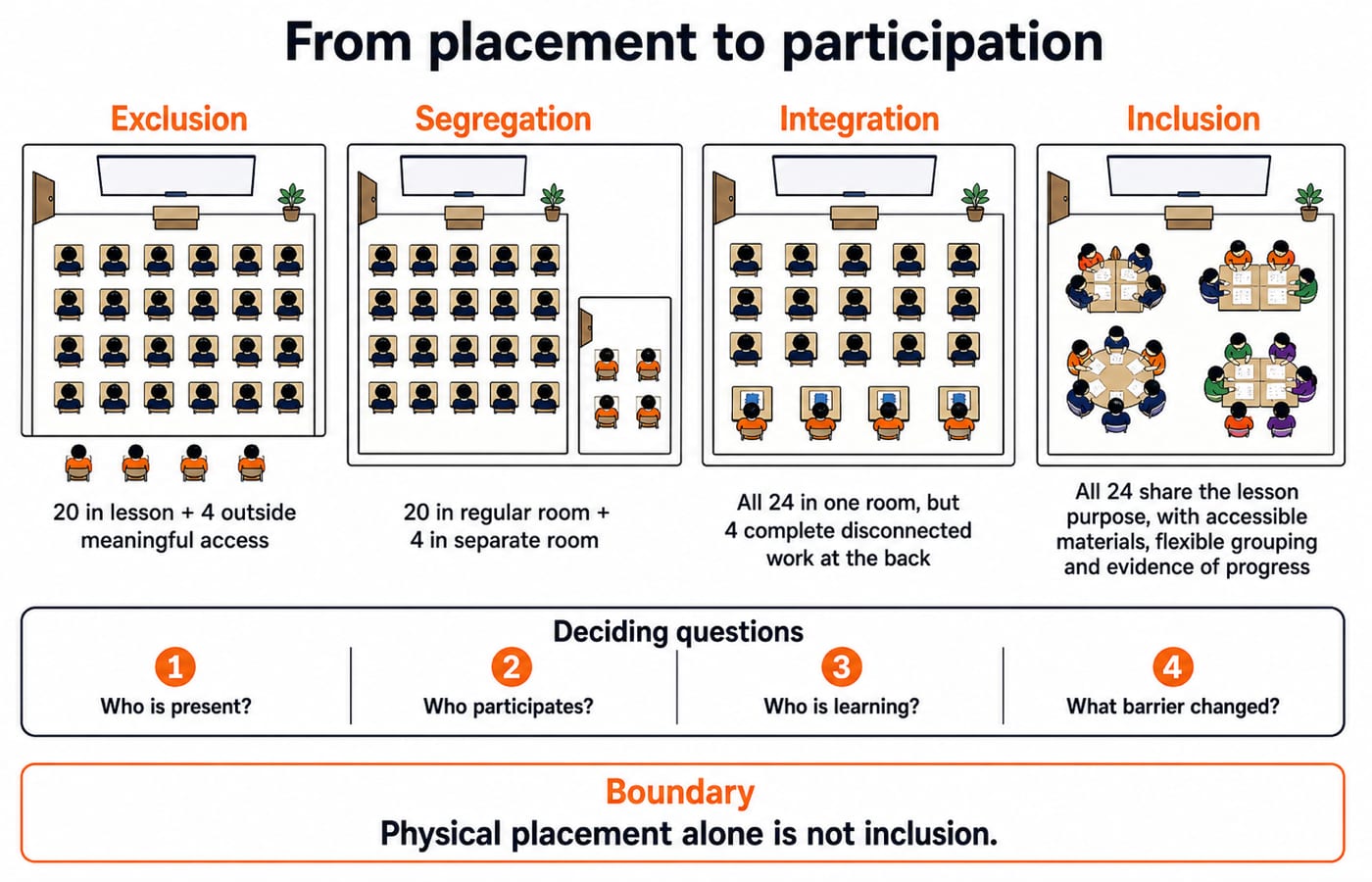
Illustrative class of 24:
Exclusion:
20enter the lesson and4are denied meaningful access.Segregation:
20use the regular room while4are routinely taught separately.Integration: all
24share one room, but the same4do disconnected work at the back.Inclusion: all
24work towards a shared lesson purpose, with access supports and flexible grouping built in.
Integration asks the learner to fit; inclusion asks barriers to change. Co-location is insufficient. Unrelated colouring in mathematics lacks curricular participation. Tactile fraction strips and an oral answer enable the common comparison.
3. Find the barrier before choosing the support
Group barriers as physical (stairs), sensory and communication (speech-only directions), curricular (dense text without models), linguistic and social (unfamiliar language or exclusion), and attitudinal (assuming low ability).
Use: The learner must do X; barrier Y blocks access; support Z reduces Y; evidence E shows learning. Goal: identify the main idea and cite two clues. Barrier: a 320-word small-print passage. Support: 18-point high-contrast text plus audio. Evidence: the main idea and two textual clues. The goal remains.
Observation is not diagnosis. Dyslexia is associated with persistent reading and spelling difficulty, dysgraphia with written expression or handwriting, and dyscalculia with number and calculation difficulty. Attention or communication needs may affect access. Record the task, response and useful support, seek referral, and never diagnose from one error.
4. Build support into teaching, then distinguish accommodation from modification
Plan in four steps: set the goal; predict barriers in materials, language, movement and response; offer usable access and expression; collect evidence, then adjust support. Options include written plus spoken directions, manipulatives, captions, high contrast, flexible responses and structured peer discussion.
An accommodation changes access, timing, setting, format or response while preserving the outcome. A modification changes expected learning. For compare 3/4 and 2/3 and justify, tactile strips or an oral explanation are accommodations. Replacing it with identify 1/2 and 1/4 modifies.
Do not modify automatically. Match support to evidence and planning. Peer support works only when the learner thinks and responds, not when the peer completes the task.
5. Fully worked classroom case: one fraction goal, several access routes
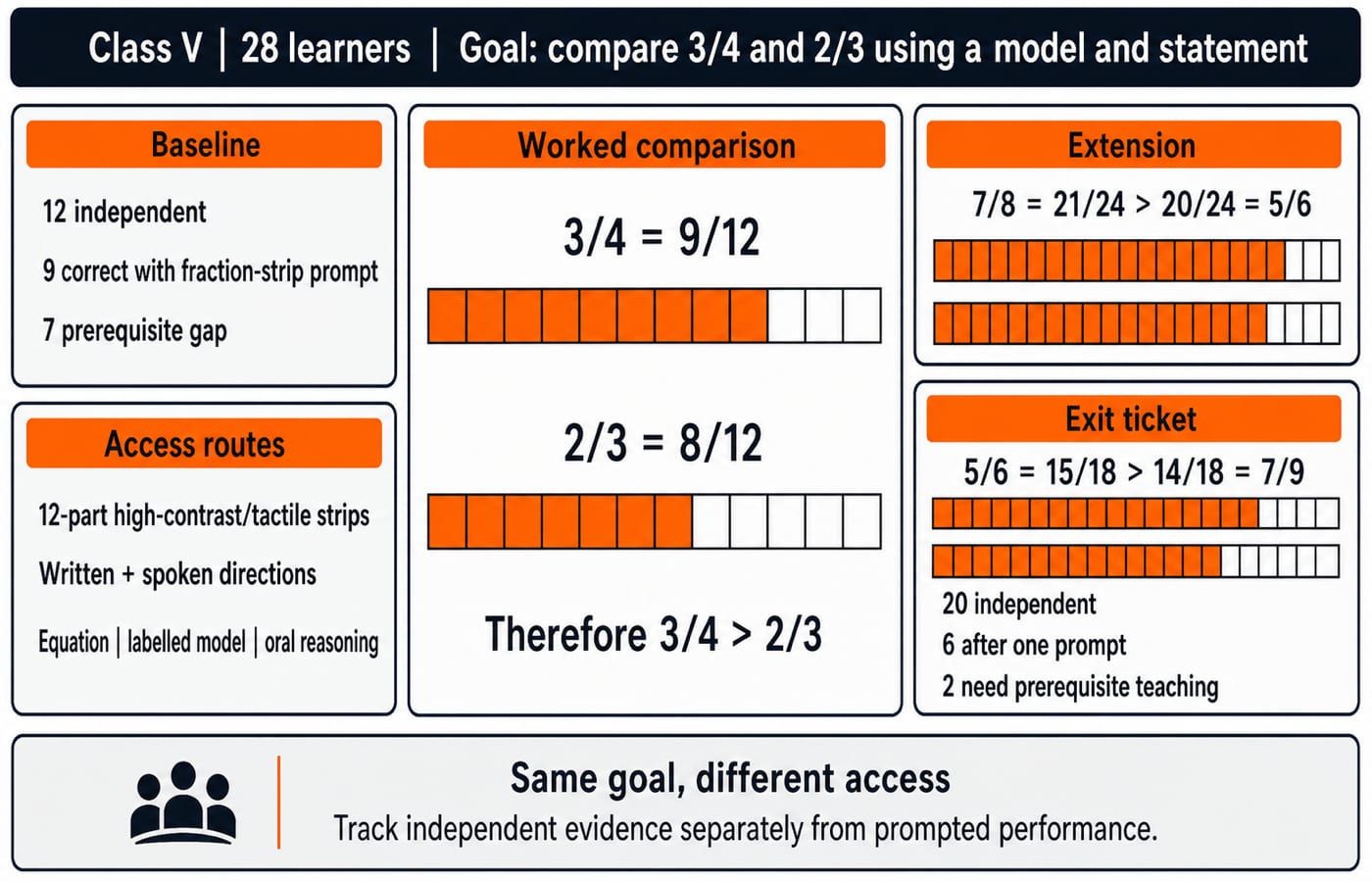
A Class V teacher has 28 learners and one goal: compare 3/4 and 2/3 using a model and statement. At baseline, 12/28 solve independently, 9/28 need a fraction-strip prompt, and 7/28 cannot connect model to equivalent fractions. 12 + 9 + 7 = 28. These are responses, not permanent labels.
Use denominator 12: 3/4 = (3 × 3)/(4 × 3) = 9/12, while 2/3 = (2 × 4)/(3 × 4) = 8/12. Therefore 3/4 > 2/3.
Provide 12-part high-contrast or tactile strips and written plus spoken directions. Allow equation, labelled model or oral responses. The 9 align strips, then retry unprompted. The 7 revisit 1/2 = 2/4 = 6/12. Extension: 7/8 = 21/24 > 20/24 = 5/6.
Exit ticket: compare 5/6 and 7/9. 5/6 = 15/18 > 14/18 = 7/9. Suppose 20/28 answer independently, 6/28 after one prompt and 2/28 need prerequisite teaching. 20 + 6 + 2 = 28, but 26/28 successes are not independent mastery. Fade prompts for the 6 and teach the gap for the 2. This is CTET mathematics pedagogy in action.
6. How teaching exams can turn inclusion into a reasoning question
Questions may distinguish arrangements, identify a barrier, preserve a goal or judge participation, without a fixed pattern. Check CBSE's applicable CTET information bulletin for CTET and the responsible body's source for other exams.
Original practice MCQ: All Class V learners must compare 3/4 and 2/3. One learner uses tactile fraction strips and gives an oral explanation while classmates use printed strips and written explanations. What is the best interpretation?
(A) Segregation because the material differs
(B) An accommodation that preserves the learning outcome
(C) A modification because the learner does not write
(D) Exclusion because an adult prepared the tactile strip
Answer: (B). Access differs; the comparison and justification remain.
Statement pair: Statement I: Inclusive education means every learner must receive identical material and use an identical response mode. Statement II: Inclusive education removes barriers so learners can participate and show progress, while supports are matched to need.
(A) Both correct
(B) Only I correct
(C) Only II correct
(D) Both incorrect
Answer: (C). Identical makes I wrong; responsive access makes II right.
7. Common traps and the exact classroom repair
Mistake | What goes wrong | What to do instead |
|---|---|---|
Seat the learner in the room and declare inclusion | Presence is mistaken for participation | Check task access, interaction and learning evidence |
Give everybody the identical worksheet | Sameness ignores a known barrier | Preserve the goal but vary access format |
Lower the goal as the first response | Difficulty becomes a permanent low expectation | Try an accommodation and diagnostic support first |
Assign a helpful peer to do the work | Dependency replaces participation | Structure turn-taking so the learner makes decisions and responds |
Label a child from one error | Observation is mistaken for diagnosis | Record repeated task evidence and use the proper referral process |
For the 24 learners, one room plus disconnected work fails. Check shared purpose + usable access + participation + progress and repair the missing part. Inclusion is not pity, unlimited help or unsupported praise. Use person-centred language, preserve agency and give needed support. No technique suits everyone.
8. Short version, a 12-case revision loop and the next study move
Use this seven-line revision card:
inclusion = presence + participation + belonging + progressintegration asks the learner to fitinclusion changes barriers in the environmentequality gives the sameequity gives usable accessaccommodation changes access while preserving the goalmodification changes the expected outcome
Explain each line through a case. Build a 12-case revision loop from mixed inclusive-education questions. In a 12-case loop, 9/12 leaves 3 errors. Tag them B for barrier, A for accommodation versus modification, or I for integration versus inclusion. Rewrite them as goal | barrier | support | evidence, then retry each missed concept with a new classroom case.
Use the CTET Paper 1 course for primary, the CTET Paper 2 course for upper-primary, or the Govt Teaching Eligibility Tests category to compare live CTET and UPTET options. Now write one lesson's goal | barrier | support | evidence plan.
Keep learning
सामान्य अशुद्धियाँ (Samanya Ashuddhiyaan): Complete Hindi Grammar Notes for CTET and TET Exams
Learn to identify and correct Hindi word-form, agreement, pronoun and redundancy errors through exact examples, a worked MCQ and a scored diagnostic.
Updated 6 Oct 20266 min readCTET & UPTET

Universities and Learning Programmes for Teaching Exams: Types, Modes and Solved Examples
Separate university status, delivery mode and programme purpose with a repeatable method, then test it on five UGC NET-style classification cases.
Updated 2 Oct 20265 min readCTET & UPTET

National Education Policy (NEP) 2020 Notes for Teaching Exams: 5+3+3+4, Reforms and MCQ Traps
Build an exam-ready map of NEP 2020, from the age-stage structure to pedagogy, language, PARAKH, B.Ed. routes and reliable distractor elimination.
Updated 26 Sep 20265 min readCTET & UPTET
Miscellaneous Pedagogy Topics for Teaching Exams: Complete Notes and Worked Examples
Turn a loose syllabus label into a five-part concept map, then use classroom evidence to distinguish sound pedagogy from attractive but incomplete options.
Updated 25 Sep 20266 min readCTET & UPTET