

Inclusive Education and Special Needs for Teaching Exams: Concepts, Classroom Cases and MCQ Traps
Learn to separate inclusion from integration and accommodation from modification. Then apply a barrier-to-support method to classroom scenarios and MCQs.
KnowledgeGate Team
Exam prep & CS education
Updated 8 Nov 20266 min read

A teaching-exam scenario may offer four kind-sounding choices and only one inclusive choice. The decisive question is not which option gives the most help, but which removes the observed barrier while preserving the assessed construct, participation and learner agency. Equality and equity, integration and inclusion, accommodation and modification separate at that point.
For the full inclusion continuum and a worked fraction lesson, use Inclusive Education Notes for Teaching Exams: Concepts, Classroom Cases and Worked Examples. For special-needs profiles, referral limits and a 32-learner source-analysis lesson, use Inclusive Education and Special Needs for Teaching Exams: Concepts, Cases, and Common Traps. For close MCQ options, apply the construct-barrier-support-evidence test used here.
Inclusive education concepts: six distinctions that decide the answer
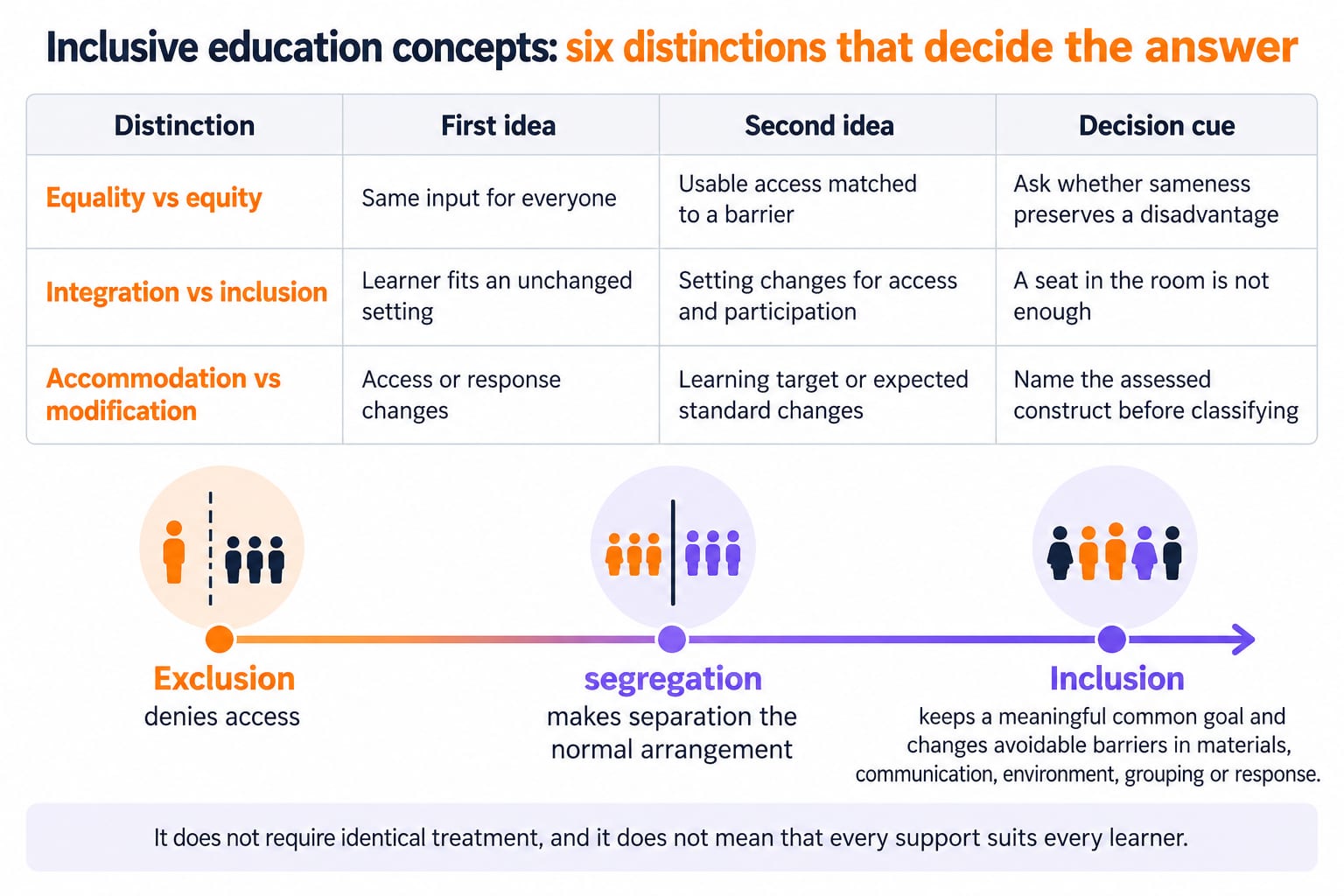
Distinction | First idea | Second idea | Decision cue |
|---|---|---|---|
Equality vs equity | Same input for everyone | Usable access matched to a barrier | Ask whether sameness preserves a disadvantage |
Integration vs inclusion | Learner fits an unchanged setting | Setting changes for access and participation | A seat in the room is not enough |
Accommodation vs modification | Access or response changes | Learning target or expected standard changes | Name the assessed construct before classifying |
Exclusion denies access, while segregation makes separation the normal arrangement. Inclusion keeps a meaningful common goal and changes avoidable barriers in materials, communication, environment, grouping or response. It does not require identical treatment, and it does not mean that every support suits every learner.
Special-needs cases start with the assessed construct, not the label
A label never selects an answer by itself. Dyslexia may create a decoding barrier in a science passage, but audio could be appropriate when water-cycle understanding is assessed and inappropriate when independent reading is the assessed skill. Low vision may call for readable print or a tactile diagram. Attention needs may call for visible steps or shorter chunks. The support follows evidence from the task.
A teacher can observe repeated patterns, document the task and response, try a suitable support, consult the learner and family, and follow the referral process. One spelling error, one low score or one restless lesson does not establish a diagnosis. The wider developmental setting appears in CTET CDP: High-Yield Concepts and Theorists.
A five-check method for inclusive-education MCQs
Name the construct. What knowledge or skill must every learner demonstrate?
Locate the barrier. Use the evidence in the stem, not a stereotype attached to a label.
Classify the change. Does the option alter access, or does it lower or replace the target?
Check participation and agency. A peer doing the work, routine isolation or a token seat removes meaningful participation.
Demand evidence. The teacher should review whether the support improves access and learning rather than assume it worked.
The least intrusive useful support is usually stronger than a sweeping response. Eliminate any option that diagnoses from one sign, separates for convenience, promises one strategy for every learner with a label, or changes the assessed construct without evidence that a modification is required.
Classroom case 1: access changes while the goal stays
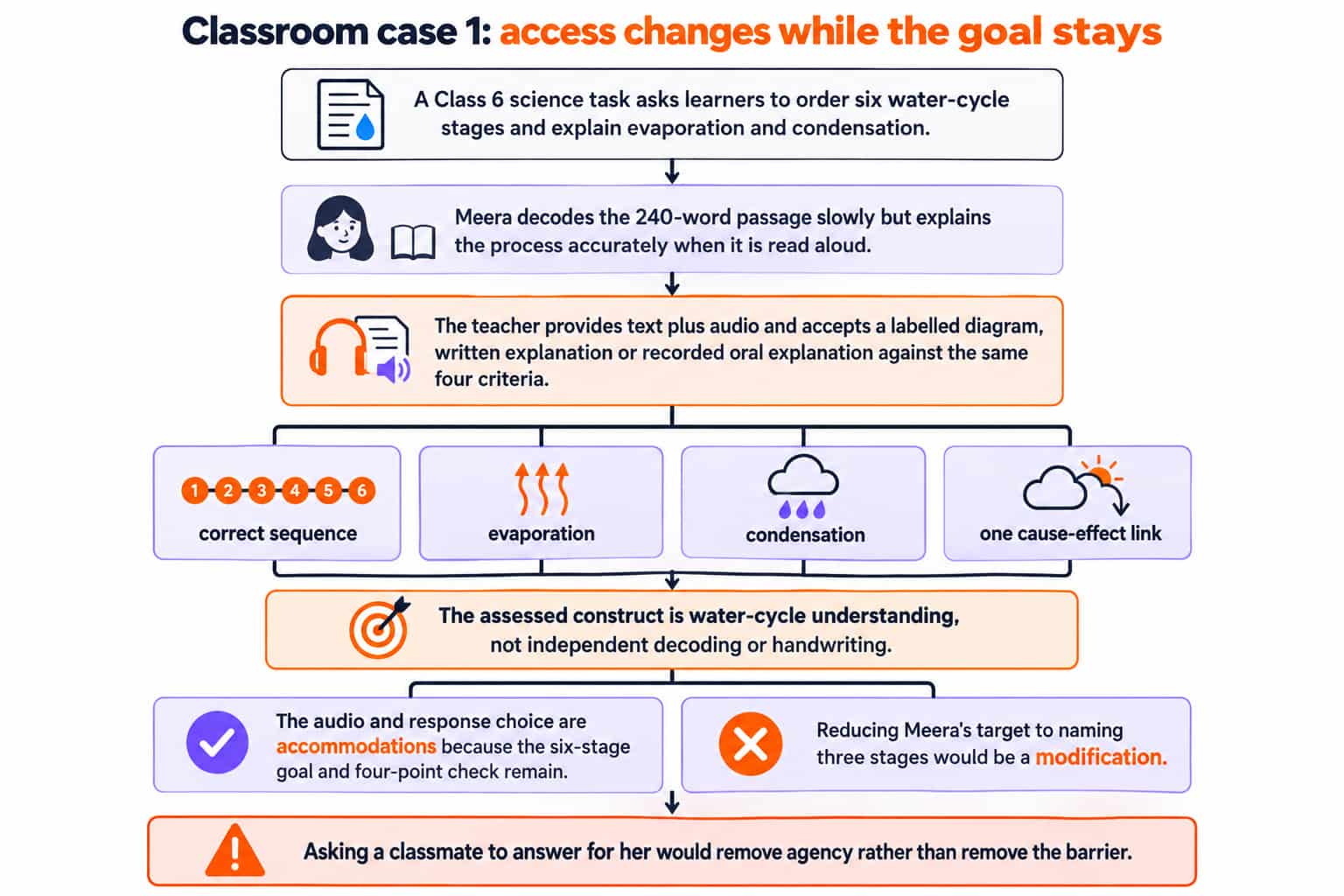
A Class 6 science task asks learners to order six water-cycle stages and explain evaporation and condensation. Meera decodes the 240-word passage slowly but explains the process accurately when it is read aloud. The teacher provides text plus audio and accepts a labelled diagram, written explanation or recorded oral explanation against the same four criteria: correct sequence, evaporation, condensation and one cause-effect link.
The assessed construct is water-cycle understanding, not independent decoding or handwriting. The audio and response choice are accommodations because the six-stage goal and four-point check remain. Reducing Meera's target to naming three stages would be a modification. Asking a classmate to answer for her would remove agency rather than remove the barrier.
Classroom cases 2 and 3: when helpful-looking support is wrong
Case 2, group participation. Arjun cannot read a small board diagram. Moving him to the front may help only if the diagram becomes usable. A high-contrast copy in his agreed format removes the visual barrier. Giving him the role of timekeeper while others interpret the diagram creates presence without curricular participation.
Case 3, attention and task design. Zoya completes two six-minute evidence-sorting rounds with a visible sequence but loses track during one unstructured 12-minute block. Splitting the same task into two chunks changes organisation, not the goal. Sending her to a separate room by default or excusing the evidence task changes participation without first testing the targeted support.
MCQ traps: eliminate the option by naming the broken principle
Tempting option | Broken principle | Better decision |
|---|---|---|
Give every learner the identical sheet | Equality is mistaken for equity | Preserve the goal and make the material usable |
Seat the learner in the room and stop there | Presence is mistaken for inclusion | Check access, role, response and evidence |
Lower the target immediately | A barrier is mistaken for inability | Try a relevant accommodation first |
Let a helpful peer complete the response | Help replaces learner agency | Structure shared work while the learner decides and responds |
Diagnose from one error | Observation is treated as clinical proof | Document patterns, support access and refer properly |
Use one support for everyone with the label | Need is treated as fixed by category | Match support to learner, task and evidence |
How CTET, TET, NET and recruitment papers vary the question frame
The same concept can appear as a direct distinction, a best-first-action vignette, an assertion-reason item, an accommodation-versus-modification judgement, or a question about observation and referral. The solving order stays stable: construct, barrier, change, participation, evidence.
Exact terminology and syllabus placement can vary by examination. Check the applicable CBSE CTET information bulletin for CTET and the responsible official body for another exam. Do not infer current marks, question counts, policy wording or weightage from a practice case.
Inclusive education MCQ practice: four original caselets
1. All learners analyse the same poem. One receives a large-print copy. This is best classified as (A) segregation, (B) accommodation, (C) modification, or (D) exclusion. Answer: B. The poem and analytical goal stay the same; only access changes.
2. A learner struggles to hear oral-only directions. The best first action is (A) reduce the chapter, (B) provide written or visual directions, (C) diagnose a hearing disability, or (D) ask a peer to do the task. Answer: B. It targets the observed communication barrier without inventing a diagnosis or changing the goal.
3. A learner with strong mathematics reasoning cannot decode a wordy problem independently. Reading it aloud is an accommodation only when (A) speed matters, (B) decoding is not the assessed construct, (C) the learner has any label, or (D) all options are correct. Answer: B. The construct determines whether audio preserves or changes the task.
4. A teacher uses one spelling error to declare dyslexia. The strongest correction is (A) separate the learner, (B) lower every language goal, (C) observe patterns, support access, document evidence and refer appropriately, or (D) ignore the error. Answer: C. Teacher observation guides support and referral, not diagnosis from one response.
The short version and the next study step
Name what the question actually assesses.
Find the observed barrier, not a presumed deficit.
Keep access changes separate from target changes.
Protect participation and learner agency.
Look for evidence and review the support.
Practise one set by writing five words beside every stem: construct | barrier | access | participation | evidence. Continue with the CTET Paper 1 Course 2026 when primary teaching is your route, or use CTET Exam Preparation: Paper 1 and 2 to choose the relevant paper and study path.
Go deeper with the full courseCTET Paper 1 2026 — प्राथमिक शिक्षक (कक्षा 1–5)
Keep learning

Inclusive Education and Special Needs for Teaching Exams: Concepts, Cases, and Common Traps
Learn to separate inclusion from integration, match barriers to supports, and solve teaching-exam caselets through one fully worked classroom redesign.
Updated 29 Oct 20266 min readCTET & UPTET
Inclusive Education Notes for Teaching Exams: Concepts, Classroom Cases and Worked Examples
Learn to distinguish inclusion from integration, identify classroom barriers, preserve learning goals and reason through original teaching-exam cases.
Updated 12 Sep 20266 min readCTET & UPTET

Guidance, Counselling and Mental Health for Teaching Exams: Concepts, Cases and Exam Traps
Learn to separate guidance, counselling and mental-health support, then apply the distinctions to learner cases without crossing a teacher's professional boundaries.
Updated 23 Oct 20266 min readCTET & UPTET
Principles of English Language Teaching: CTET Notes with Classroom Examples
Turn language-teaching principles into classroom decisions. Follow a library timetable lesson, understand purposeful error correction, and practise matching an activity to its learning objective.
Updated 18 Nov 20265 min readCTET & UPTET