Learning and Motivation Notes for Teaching Exams: Concepts, Theories and Classroom Examples
Separate learning, performance and motivation through classroom evidence, then apply learning lenses, motivation theory and consequence rules to original scenarios.
KnowledgeGate Team
Exam prep & CS education
Updated 15 Sep 20266 min read

Aspirants often memorise intrinsic versus extrinsic motivation, reinforcement versus punishment and lists of theories, yet miss scenarios because they confuse evidence of learning with evidence of motivation. One classroom case separates durable learning from current performance, then traces expectancy, value and consequences to defensible teacher actions.
Learning, performance and motivation are not interchangeable
Learning is a relatively durable change in knowledge, skill, strategy, understanding or capacity through experience or practice. One correct answer after a hint may show performance, not learning. Fatigue, anxiety, illness or an easy item can alter performance temporarily; maturation is not learning through experience. Independent retention and transfer offer stronger evidence.
Motivation initiates, directs and sustains goal-oriented activity. Its clues include task choice, start time, effort, strategy change and persistence, but no clue proves an inner state. Motivation may support engagement; it is not ability, prior knowledge or learning.
Observation | Best reading | Why |
|---|---|---|
8/10 immediately after hints | Current performance | Support is still present |
7/8 independently next day and 5/6 on a new transfer set after one week | Stronger learning evidence | It combines delay, independence and transfer |
Begins within 45 seconds and continues after one error | Motivation evidence | It shows initiation and persistence |
Collect several kinds of evidence before labelling a learner.
Four learning lenses and useful classroom moves
Lens | What changes | Useful classroom move | Misuse to avoid |
|---|---|---|---|
Behavioural | Observable responses shaped by practice and consequences | Retrieval practice with feedback | Treating every inner process as irrelevant |
Cognitive | Attention, memory, organisation and strategy | A clear worked example | Overloading working memory |
Constructivist | Connections between new ideas and prior understanding | Explore with fraction strips | Leaving discovery completely unguided |
Social | Learning through observation, language and participation | Peer modelling of an explanation | Assuming group work guarantees learning |
For equivalent fractions, retrieval can strengthen responses, a worked example can reduce cognitive load, fraction strips can rebuild prior ideas, and a peer can model comparison language. These moves can work together.
Useful conditions include readiness and prior knowledge, focused attention, meaningful organisation, spaced practice, retrieval, timely information-rich feedback, emotional safety and transfer. Do not match teaching to a fixed visual, auditory or kinaesthetic type. For the broader learner-readiness and learning-cycle framework, use Learners and Learning Process for Teaching Exams: Concepts, Examples and Traps. The narrower task here is to separate learning evidence from motivation indicators and classify consequences accurately.
Motivation by source, expectation, value and need
Intrinsic motivation means acting because an activity is interesting or satisfying. Extrinsic motivation involves a separable outcome, such as a mark, certificate or avoided consequence. They are not permanent learner types, and rewards do not automatically destroy interest. A learner may enjoy a problem and value its score.
In scenarios, ask four questions:
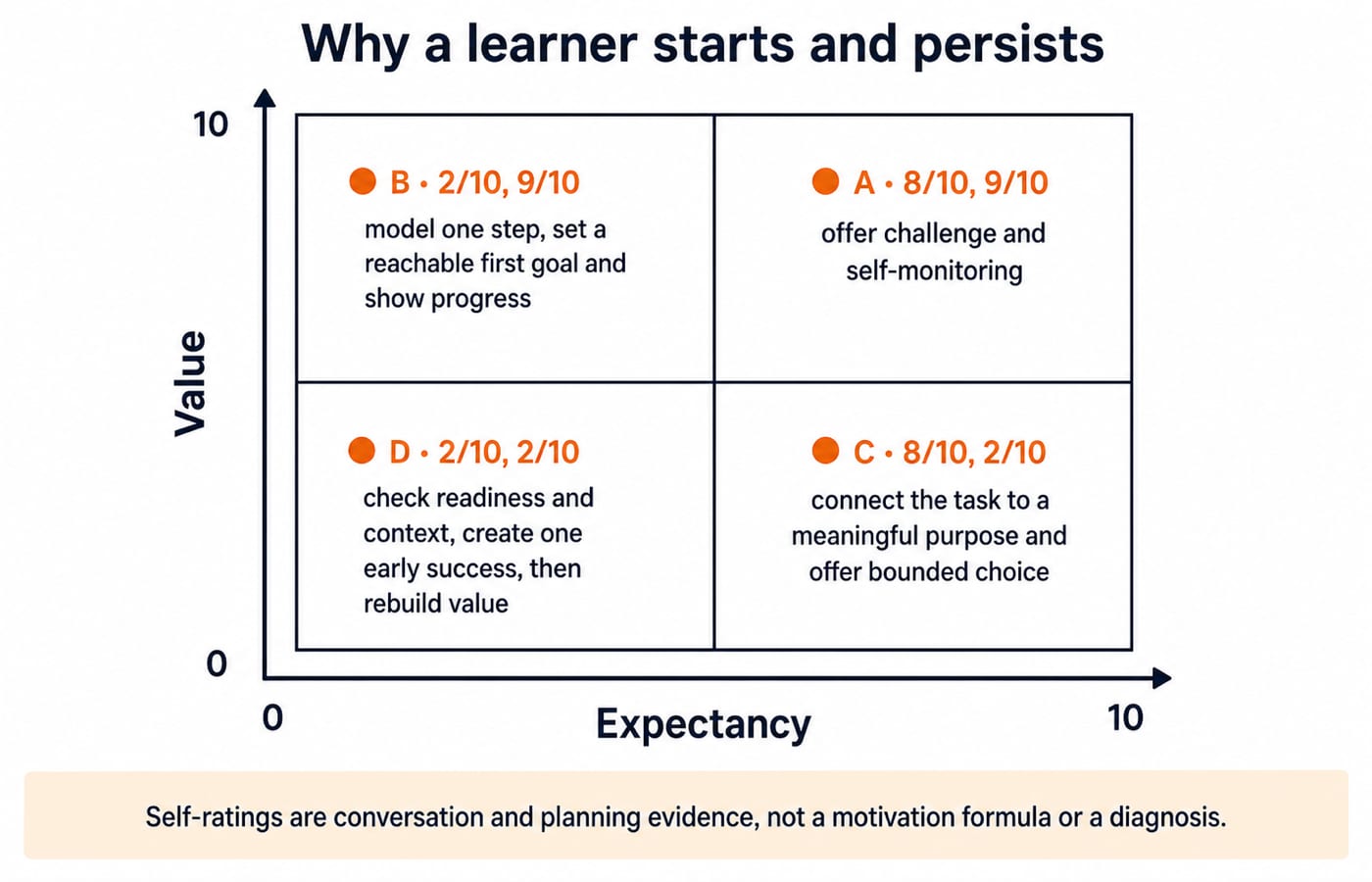
Expectancy: Can I succeed with an effective strategy?
Value: Why is this worth doing?
Goals: Mastery emphasises improvement; performance emphasises demonstrating ability against a standard or others.
Attribution: Prefer changeable explanations involving strategy, practice and support to fixed labels.
Autonomy, competence and relatedness can support engagement through bounded choice, progress on an achievable challenge and respectful belonging. Maslow's needs remind us that safety and basic needs matter; they are not a rigid staircase that blocks learning until each lower need is satisfied.
Reinforcement, punishment, rewards and feedback
Use a direction test. Reinforcement increases behaviour; punishment aims to decrease it. Positive adds a consequence; negative removes one.
Specific praise is added and strategy explanation increases: positive reinforcement.
An unwanted reminder stops and punctual submission increases: negative reinforcement.
A corrective task is added and unsafe conduct decreases: positive punishment.
A privilege is removed and off-task conduct decreases: negative punishment.
Ask: was the consequence added or removed, and did the behaviour increase or decrease? Intention is insufficient. Without an increase, do not automatically call a consequence reinforcement.
Informational feedback differs from controlling reward language. "Your common-denominator step is correct; now label the common whole" gives evidence and a next move. "You are a genius" gives no strategy information. Feedback, reinforcement and intrinsic motivation can interact, but are not synonyms.
Worked classroom case: Riya and equivalent fractions
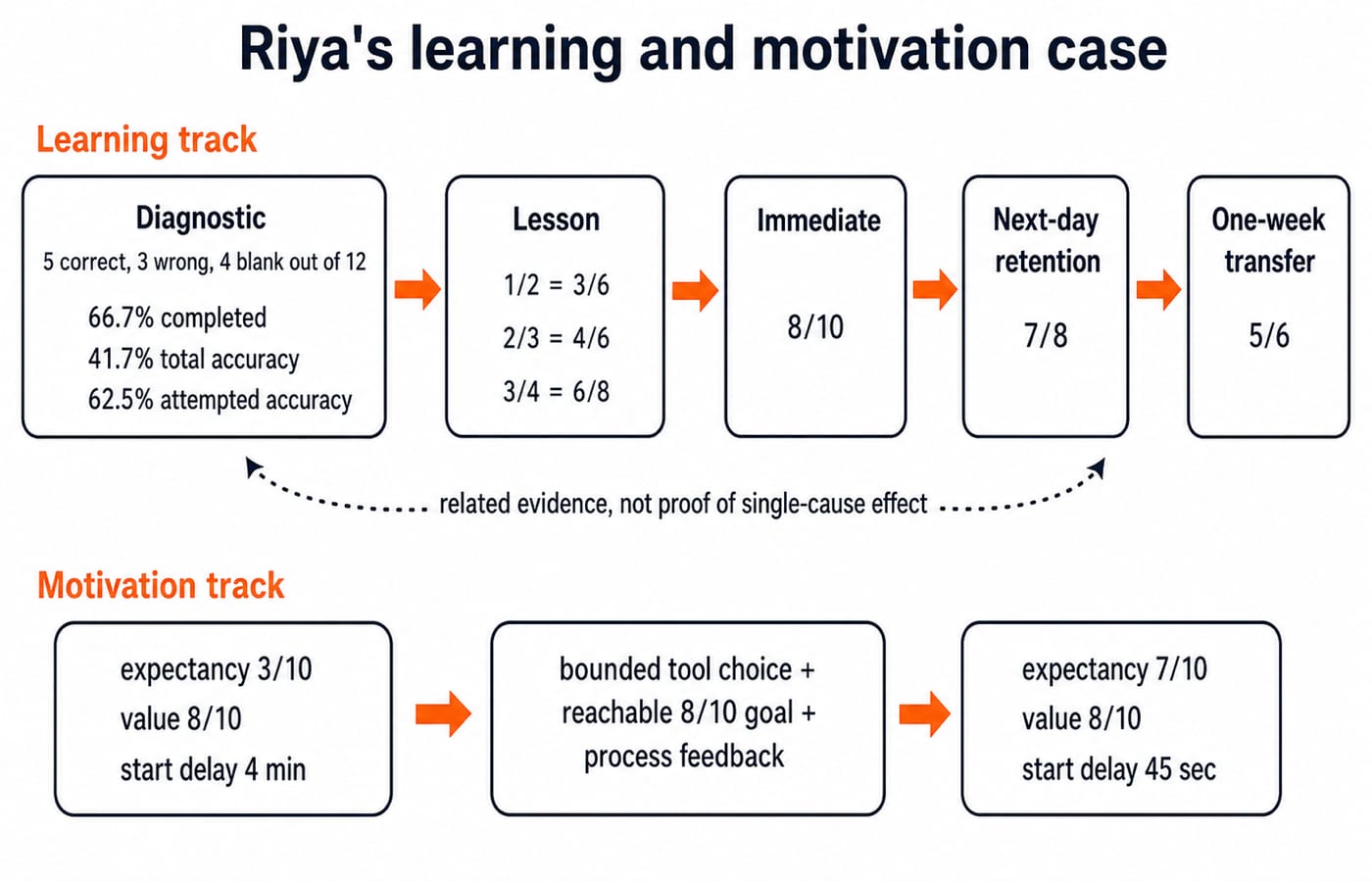
Riya's 12-item diagnostic has 5 correct, 3 incorrect and 4 blank. Completion is (5 + 3) / 12 = 8/12 = 66.7%; whole-set accuracy is 5/12 = 41.7%; attempted accuracy is 5/(5 + 3) = 5/8 = 62.5%. She says, "I always get fractions wrong", with expectancy 3/10 and value 8/10. This is high value with low expectancy, not laziness or low ability.
In 20 minutes, set a reachable goal of at least 8/10 independently on equivalent-fraction items. Offer fraction strips or a number line. Model 1/2 = 3/6, guide 2/3 = 4/6, then ask 3/4 = ?/8. Multiply numerator and denominator by 2: 3 x 2 = 6, 4 x 2 = 8, so 3/4 = 6/8. Give process feedback about using the same non-zero multiplier, then ten mixed items without hints. Avoid speed prizes and public comparisons.
She scores 8/10 immediately, 7/8 independently next day and 5/6 on a one-week transfer set. Start delay falls from 4 minutes to 45 seconds; expectancy rises from 3/10 to 7/10 while value stays 8/10. Delay and transfer support learning; quicker initiation and self-report support a motivation hypothesis. One case cannot prove bounded choice caused every change.
How teaching exams turn concepts into questions
Teaching exams use definition discrimination, scenario classification and best-teacher-action items. Solve each as observable evidence -> concept -> reason a competing option fails. Use CTET Mock Test Strategy That Raises Scores to practise the same classification under time pressure.
Original item A: A learner chooses an ungraded logic puzzle because solving it is enjoyable. What is the clearest description? (A) intrinsic motivation; (B) negative reinforcement; (C) punishment; (D) maturation. Answer: A, because satisfaction lies in the activity.
Original item B: A teacher stops sending a daily reminder after a learner begins submitting work on time; punctual submission then becomes more frequent. What is illustrated? (A) positive punishment; (B) negative reinforcement; (C) intrinsic motivation; (D) extinction. Answer: B, because a stimulus is removed and the target behaviour increases.
Original item C: Which evidence most strongly supports retained learning rather than one-time performance? (A) 10/10 while copying a model; (B) 8/10 with hints immediately; (C) 7/8 independently the next day and 5/6 on a new transfer set one week later; (D) beginning within 45 seconds. Answer: C, because it combines delay, independence and transfer. Option D is motivation evidence.
For current CTET coverage and past questions, use the CBSE CTET portal and its completed-paper archive; use the relevant conducting body for another examination. Treat the three items above as concept checks, not as evidence of a paper's wording or frequency.
The short version and next step
Shortcut | Why it sounds plausible | What goes wrong | Repair rule |
|---|---|---|---|
High score means learning | Scores look conclusive | It may be supported performance | Check independence, retention and transfer |
Negative reinforcement means punishment | Negative sounds bad | Removal is confused with decrease | Test for removal plus increase |
Intrinsic good, extrinsic bad | The contrast sounds absolute | It ignores context and control | Examine task and context |
Maslow is a fixed ladder | Stages look sequential | Context becomes lockstep | Treat needs as conditions |
The learner is unmotivated | One label feels efficient | It hides the barrier | Check expectancy, value, readiness, belonging and design |
Learning is durable change through experience.
Performance is what is observable now.
Motivation concerns direction, initiation and persistence.
Retention and transfer strengthen a learning inference.
Expectancy, value, autonomy, competence and relatedness guide action.
Reinforcement increases behaviour; punishment decreases it.
Reconstruct Riya's 5/12 -> 8/10 -> 7/8 -> 5/6 trail without looking. Classify ten mixed scenarios and explain why each rejected option fails. Continue from CTET & UPTET Teaching Eligibility Test Prep; choose CTET Paper 1 Course 2026 or CTET Paper 2 Course 2026 according to the paper you are preparing for.
Keep learning

सामान्य अशुद्धियाँ (Samanya Ashuddhiyaan): Complete Hindi Grammar Notes for CTET and TET Exams
Learn to identify and correct Hindi word-form, agreement, pronoun and redundancy errors through exact examples, a worked MCQ and a scored diagnostic.
Updated 6 Oct 20266 min readCTET & UPTET

Universities and Learning Programmes for Teaching Exams: Types, Modes and Solved Examples
Separate university status, delivery mode and programme purpose with a repeatable method, then test it on five UGC NET-style classification cases.
Updated 2 Oct 20265 min readCTET & UPTET

National Education Policy (NEP) 2020 Notes for Teaching Exams: 5+3+3+4, Reforms and MCQ Traps
Build an exam-ready map of NEP 2020, from the age-stage structure to pedagogy, language, PARAKH, B.Ed. routes and reliable distractor elimination.
Updated 26 Sep 20265 min readCTET & UPTET

Miscellaneous Pedagogy Topics for Teaching Exams: Complete Notes and Worked Examples
Turn a loose syllabus label into a five-part concept map, then use classroom evidence to distinguish sound pedagogy from attractive but incomplete options.
Updated 25 Sep 20266 min readCTET & UPTET