

Teaching-Learning Process for Teaching Exams: Phases, Principles and a Worked Classroom Example
Connect teaching decisions to learner evidence. Revise the three phases, four learning lenses and common distractors through one complete fractions lesson.
KnowledgeGate Team
Exam prep & CS education
Updated 2 Nov 20266 min read

Definitions of teaching, learning, assessment and feedback look simple in notes. Put them inside a classroom vignette, however, and two options can seem equally reasonable. The process, its three phases and the evidence loop become clearer through a fully worked lesson for 36 learners. For broader CTET and UPTET preparation, begin with the Govt Teaching Eligibility Tests category.
Teaching-Learning Process: Meaning, Components and the Central Loop
Teaching is the deliberate organisation of conditions, experiences and support for learning. Learning is a relatively durable change in knowledge, skill, understanding or disposition through experience and practice. Teacher activity alone does not prove learner understanding.
Component | Question for the teacher | Evidence |
|---|---|---|
Objective | What should learners know or do? | Learner performance |
Readiness and prior knowledge | What do they already believe? | Diagnostic answers |
Content, method and materials | What activity can reveal or change understanding? | Learner work |
Learner participation | Who is thinking and doing? | Explanations and attempts |
Assessment | What has changed? | Response patterns |
Feedback and replanning | What should happen next? | Changed action |
The central chain is objective -> diagnosis -> planned activity -> learner response -> evidence -> feedback -> revised action. Teacher, learner and content interact throughout. Learning is the intended outcome, not a passive product delivered by the teacher.
Pre-active, Interactive and Post-active Phases of Teaching
The pre-active phase sets the learning outcome, diagnoses entry behaviour, sequences content, chooses methods and materials, anticipates learner differences, and decides what evidence will count as success. It is broader than writing a lesson plan.
The interactive phase is the live teacher-learner-content relationship. It includes explanation, modelling, questioning, discussion, practice, observation, reinforcement, scaffolding and adjustment. When responses expose a misconception, the teacher may change the planned activity.
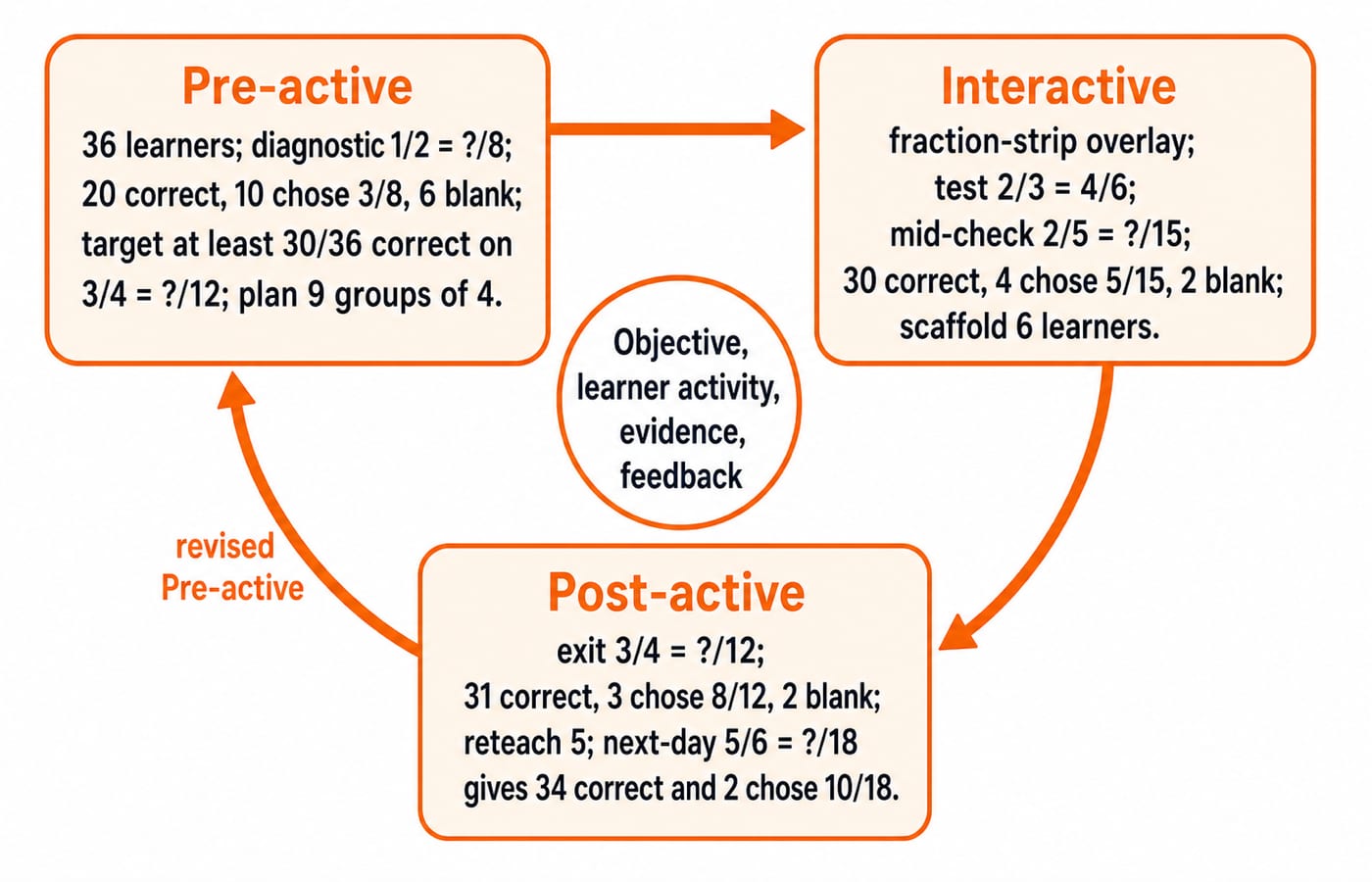
The post-active phase compares evidence with the outcome, gives feedback, provides remediation or enrichment, records what worked and replans. Selecting fraction strips before class is pre-active. Using them with learners is interactive. Deciding from exit responses who needs reteaching is post-active. That post-active decision feeds the next pre-active phase, so the process is a cycle rather than three disconnected boxes.
Principles and Learning Lenses Behind Sound Teaching Decisions
Sound decisions follow six connected principles: activate prior knowledge; set clear, observable outcomes; require meaningful learner participation; account for readiness and individual differences; provide practice with specific feedback; and align the objective, activity and assessment. Learner-centred teaching means responding to learning evidence, not withdrawing teacher guidance.
Lens | Main cue | Sensible action | Common distractor |
|---|---|---|---|
Behaviourist | Observable response, practice, consequence | Shape responses with feedback | Infer learning from activity alone |
Cognitive | Attention, organisation, memory, strategy | Organise content and model strategy | Repeat without checking processing |
Constructivist | Prior ideas, active meaning-making, conceptual change | Elicit ideas and create conceptual conflict | State the rule before exposing ideas |
Social learning | Modelling, observation, interaction | Model, observe and discuss | Treat observation as passive |
No lens is universally best. The objective and evidence determine the response. Three earlier notes divide the surrounding territory. Learners and Learning Process for Teaching Exams: Concepts, Examples and Traps owns readiness, learner profiles, scaffolding and transfer. Nature, Objectives and Characteristics of Teaching: Concept Notes for Teaching Exams owns definitions, objectives and characteristics of teaching, including a 40-learner decimal-conversion lesson. Child Development for Teaching Exams: CTET and TET Pedagogy Notes with Examples owns development theory and a fraction-addition misconception. The fixed 36-learner task below instead isolates the decisions that belong to the pre-active, interactive and post-active phases.
Worked Teaching-Learning Process Example: Equivalent Fractions With 36 Learners
Consider a Class V teacher working with 36 learners in 25 minutes. The outcome: at least 30 of 36 learners will complete 3/4 = ?/12 correctly and explain that numerator and denominator were multiplied by the same factor.
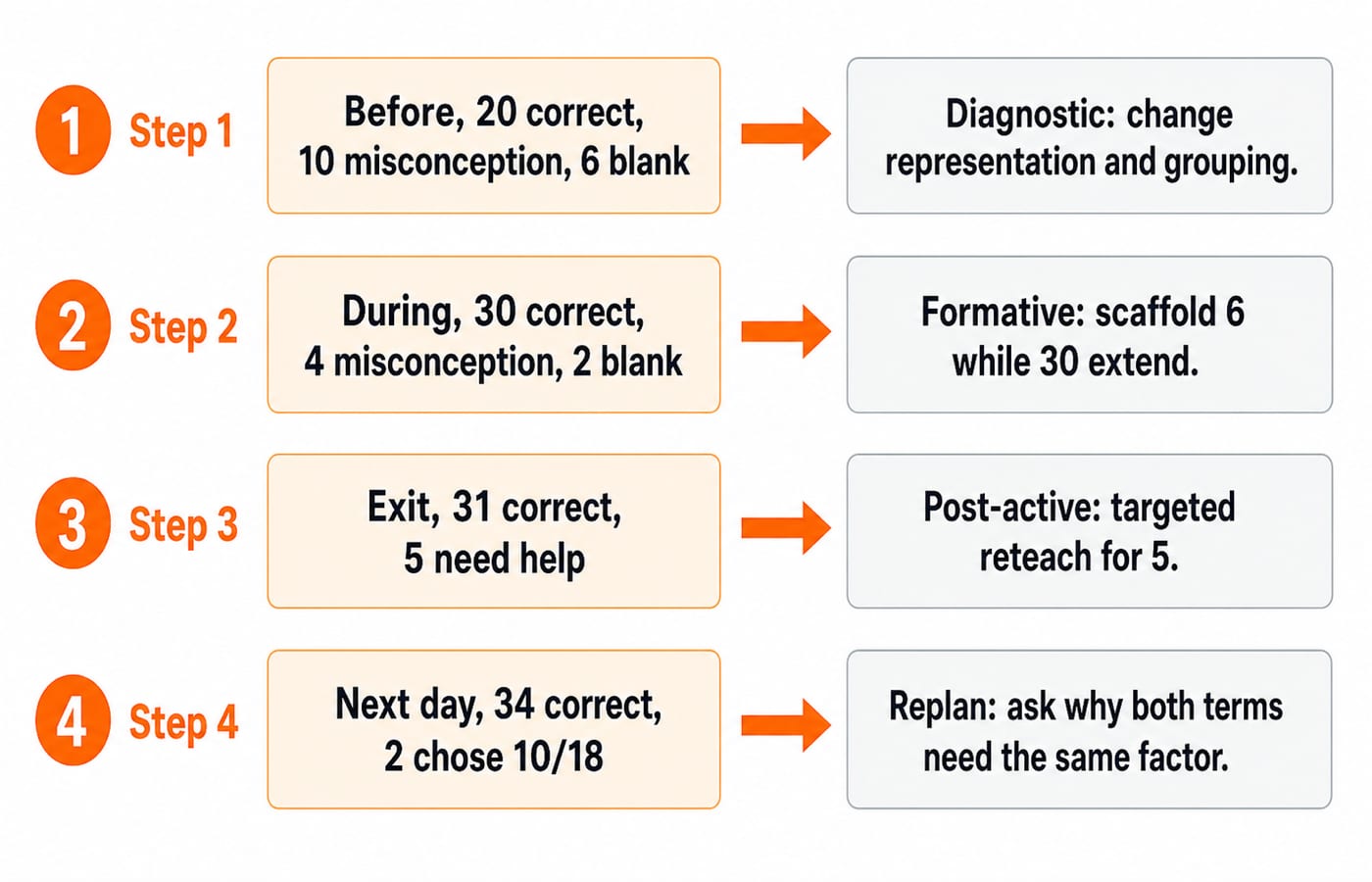
In the pre-active phase, a diagnostic 1/2 = ?/8 produces 20 answers of 4/8, 10 of 3/8, and 6 blanks. Since 20 + 10 + 6 = 36, all responses are counted. The teacher prepares 9 groups of 4 because 9 × 4 = 36, plus 9 fraction-strip sets showing halves and eighths. Diagnosis changes grouping and representation.
During interaction, groups overlay 1/2 and 4/8, then test 2/3 = 4/6. The teacher asks, “What changed, and what stayed equal?” On 2/5 = ?/15, 30 answer 6/15, 4 answer 5/15, and 2 leave it blank. The total is 30 + 4 + 2 = 36. The six needing support rebuild with strips, while the other 30 create and explain a new equivalent pair. Formative evidence triggers differentiated feedback.
In the post-active phase, the exit item 3/4 = ?/12 gets 31 answers of 9/12, 3 of 8/12, and 2 blanks. Again, 31 + 3 + 2 = 36. The target of at least 30 correct is met, but the remaining 3 + 2 = 5 learners receive a brief reteach. Next day, 5/6 = ?/18 gets 34 answers of 15/18 and 2 of 10/18, so 34 + 2 = 36. Those two responses shape the next prompt and begin a revised plan. The sequence shows decisions responding to evidence. It does not prove that one method caused the improvement.
Assessment and Feedback: How Evidence Turns Teaching Into a Loop
Diagnostic assessment happens before instruction to locate readiness. Formative assessment operates during learning to guide the next move. Summative assessment judges learning after a defined unit or period. Here, the first item is diagnostic, while the mid-lesson and exit items guide teaching. An exit slip is not automatically summative because it ends a class.
Actionable feedback identifies a reasoning step and supplies the next move: “You multiplied the denominator 6 by 3 to reach 18; multiply the numerator 5 by the same factor.” The result is 15/18. “Wrong” and praise alone do not locate the error.
Evidence also supports differentiation. The 31 successful learners can explain or generate a harder equivalent pair. The five still needing support use concrete strips and a factor prompt. This is stronger than repeating the whole lesson for everyone or ignoring the minority error.
How Teaching Exams Test the Teaching-Learning Process
Teaching-exam stems commonly use four forms: definition, phase identification, best action in a vignette, and objective-activity-evidence alignment. Use timing first. Before interaction suggests pre-active planning or diagnosis. While learners respond suggests interactive adjustment. After evidence is collected suggests post-active evaluation and replanning. Use theory cues only when the stem supports them: reinforcement for behaviourism, organisation and strategy for cognition, prior ideas for constructivism, and modelling for social learning.
The method becomes clear through three eliminations:
Before instruction, 10 of 36 choose
3/8. Probe the misconception and adapt the representation. Repeating the rule is weaker because it misses their reasoning.After 31 succeed and five do not, choose targeted reteaching plus enrichment. Repeating everything ignores the groups' different needs.
If the objective says “explain” but the check asks learners only to recognise a printed pair, reject it as misaligned. Recognition is not evidence of explanation.
Teaching-Learning Process Traps and Their Corrections
Trap | Why it fails | Better decision test |
|---|---|---|
Teaching equals learning | Activity is not learning | What changed? |
Teacher-centred is always wrong | Guidance may fit objectives | Does it meet the need? |
Learner-centred means no guidance | Learners need scaffolding | Who thinks, and what support? |
Post-active means assigning marks | It includes feedback and replanning | What follows the evidence? |
Feedback means praise | Praise misses reasoning | Does it show the next move? |
Every exit slip is summative | Purpose defines its role | Will it guide teaching? |
One method always works | Method must fit evidence | Why this method now? |
Preparing 9 strip sets is pre-active, overlaying 1/2 and 4/8 is interactive, and using 31 correct plus five needing support is post-active. Timing and purpose determine the phase; the mathematics stays fixed so that only the teaching decision changes.
Teaching-Learning Process: The Short Version and Next Study Step
Revise the complete process chain: set outcome -> diagnose prior knowledge -> plan method and evidence -> create learner activity -> observe responses -> give feedback -> replan. In 30 seconds, ask: When does the action occur? What is the objective? What learner evidence exists? Who is cognitively active? What should happen next?
For primary-level preparation, use the CTET Paper 1 Course 2026 to place this phase model beside child development, assessment and subject pedagogy.
Go deeper with the full courseCTET Paper 1 2026 — प्राथमिक शिक्षक (कक्षा 1–5)
Keep learning

Principles of English Language Teaching: CTET Notes with Classroom Examples
Turn language-teaching principles into classroom decisions. Follow a library timetable lesson, understand purposeful error correction, and practise matching an activity to its learning objective.
Updated 18 Nov 20265 min readCTET & UPTET

Learning Theories for Teaching Exams: Complete Notes with Classroom Examples
Build a usable map of major learning theories, then apply it to classroom cases involving fractions, reinforcement, observation, morality, identity and language.
Updated 7 Nov 20265 min readCTET & UPTET

Teaching-Learning Aids and ICT Integration for Teaching Exams: Notes with Worked Classroom Examples
Learn how to select and sequence teaching-learning aids, recognise genuine ICT integration, and solve classroom scenarios with worked calculations.
Updated 30 Oct 20265 min readCTET & UPTET

Learning and Motivation Notes for Teaching Exams: Concepts, Theories and Classroom Examples
Separate learning, performance and motivation through classroom evidence, then apply learning lenses, motivation theory and consequence rules to original scenarios.
Updated 15 Sep 20266 min readCTET & UPTET