

Principles of English Language Teaching: CTET Notes with Classroom Examples
Turn language-teaching principles into classroom decisions. Follow a library timetable lesson, understand purposeful error correction, and practise matching an activity to its learning objective.
KnowledgeGate Team
Exam prep & CS education
Updated 18 Nov 20265 min read

You may remember “learning by doing” yet struggle to choose a teacher's response to an English error. For teaching eligibility test preparation, a principle becomes useful when you connect it to what learners actually do: meaningful language use, purposeful practice and evidence of learning.
What a principle of language teaching actually tells you
A principle guides a teaching decision: language is learnt through meaningful use. An approach organises teaching around that idea; a communicative approach makes exchanging meaning central. An activity is the particular task, such as asking a partner for a missing timetable entry. A method provides a more specific teaching procedure. One activity can put several principles into practice.
Communicative competence means forming an understandable message, choosing language suited to the listener, and repairing misunderstanding. A learner who asks “Could you say that again?” is doing useful language work.
Other recurring principles include learner-centredness, integrated skills, meaningful context and assessment for learning. Learner-centredness gives pupils an active role; integrated skills connect listening, speaking, reading and writing; assessment evidence guides the next teaching move. This distinction keeps each classroom choice tied to observable learning.
“Give me your pencil” is grammatically correct. “Could I borrow your pencil, please?” is usually more appropriate as a polite classroom request. Correct form and social appropriateness are different checks.
Use this revision frame: objective → learner action → evidence of learning. Ask what the lesson aims to develop, what learners do, and what would show progress.
From habit formation to meaningful practice
Habit formation explains the emphasis on modelling, repetition and reinforcement in behaviourist and audio-lingual traditions. A short drill can help learners practise a sentence form. Successful repetition alone does not show that they can communicate independently.
Suppose the teacher models “This is a book.” Learners substitute familiar nouns to produce “This is a pen” and “This is a bag.” That is controlled practice: the frame and expected responses are supplied.
Now hide an object from a partner and ask “What is in your bag?” The listener has information the questioner needs. This creates an information gap, giving the exchange a purpose.
Three planning principles become visible here:
Selection: choose manageable content, such as book, pen and bag.
Gradation: move from a supported sentence frame to a question-and-answer exchange.
Contextualisation: use actual objects so words have an immediate meaning.
Progression should respond to learners. Oral-before-written and simple-to-complex are useful planning ideas, not inflexible rules for every learner or task.
Worked lesson: asking for a missing library time
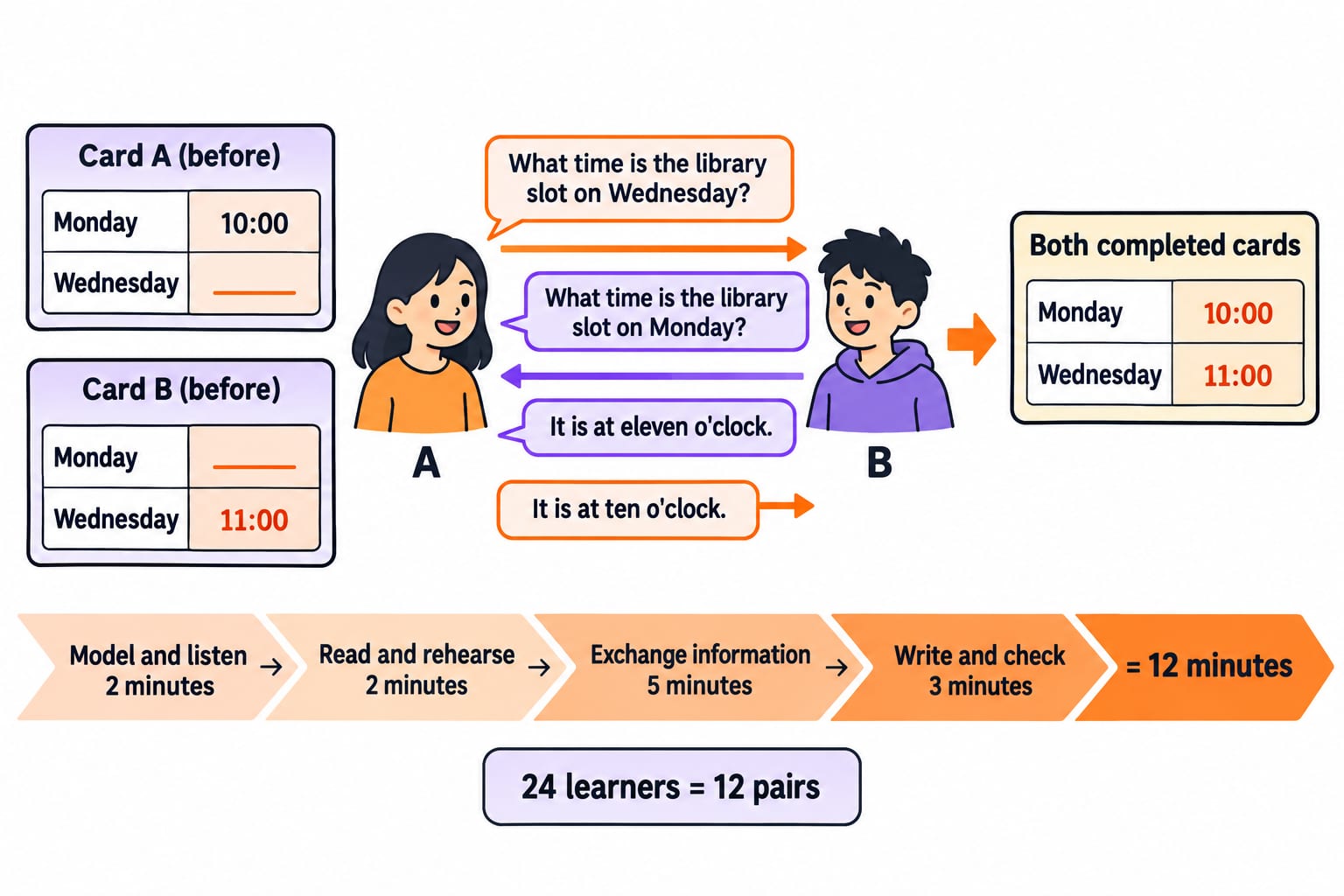
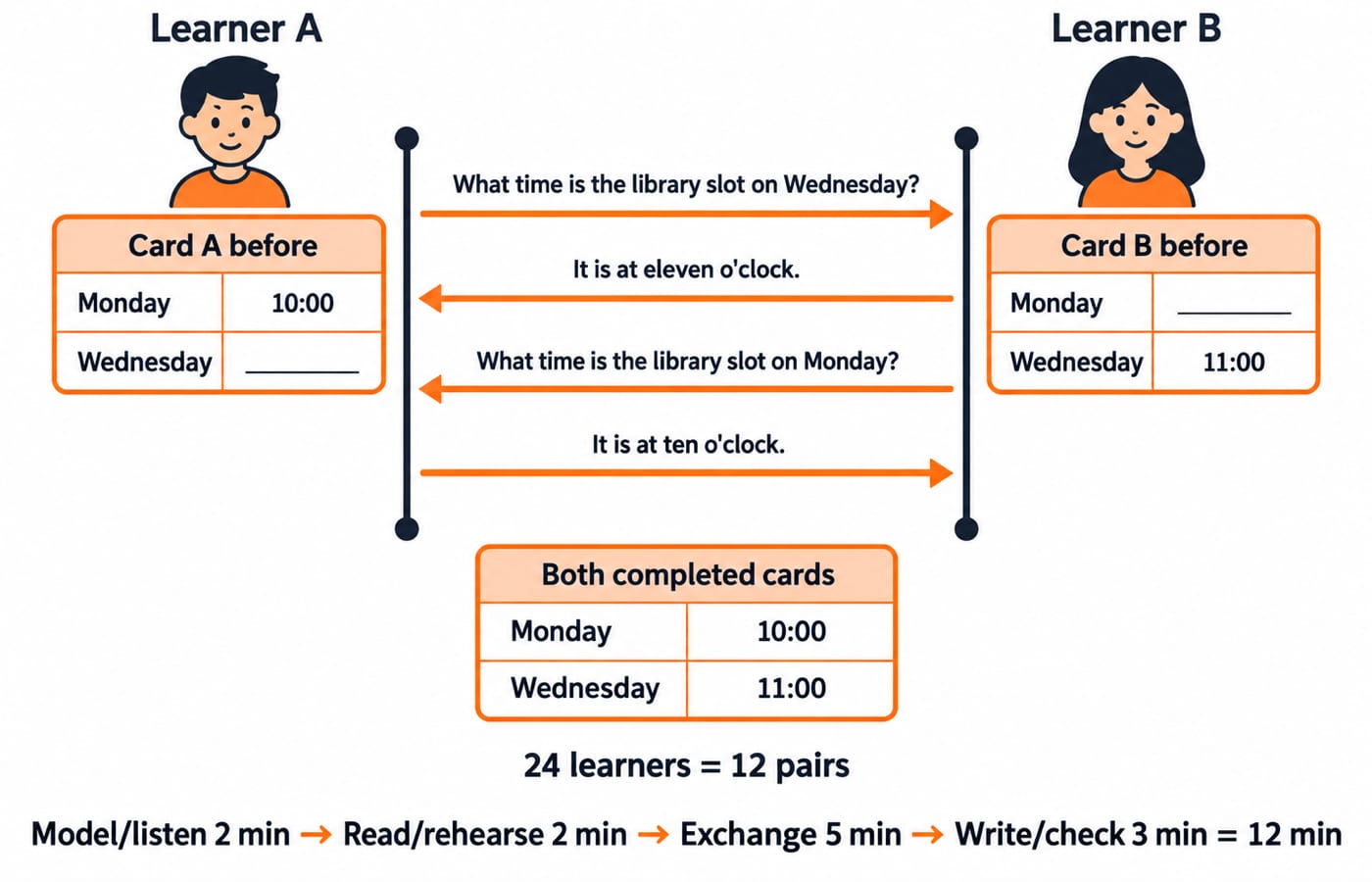
Consider an invented Class V lesson with 24 learners in 12 pairs, lasting 12 minutes. The goal is to ask for and record a missing library-slot time. Each pair gets these cards, kept hidden from the partner:
Day | Card A | Card B |
|---|---|---|
Monday | 10:00 | Blank |
Wednesday | Blank | 11:00 |
Stage | Time | Learner action |
|---|---|---|
Model and listen | 2 minutes | Listen to the teacher demonstrate the exchange. |
Read and rehearse | 2 minutes | Read the cards and rehearse “What time is the library slot on ___?” |
Exchange information | 5 minutes | Ask and answer without showing the cards. |
Write and check | 3 minutes | Write the completed sentences and check them. |
Pairing gives 24 ÷ 2 = 12 pairs. The stages total 2 + 2 + 5 + 3 = 12 minutes.
A asks, “What time is the library slot on Wednesday?” B answers, “It is at eleven o'clock.” B then asks about Monday, and A answers, “It is at ten o'clock.” Both completed cards show Monday 10:00 and Wednesday 11:00.
Each learner writes:
“The library slot on Monday is at ten o'clock.”
“The library slot on Wednesday is at eleven o'clock.”
Reading supports speaking; listening supplies information for writing. Check whether learners ask, understand and record, rather than merely remain quiet or repeat.
Support different learners and respond to errors
Connect new language to familiar meaning. A brief home-language clarification of “library slot” can help learners enter the task; then return to the English exchange. Using multilingual resources does not indicate failure, nor does it require translating every sentence.
Offer a learner who needs support the frame “What time is ___?” and a visible clock. For a confident learner, remove the frame and invite a follow-up question. The support changes while the communication goal remains shared.
Consider “Yesterday I goed to the library.” The learner has overgeneralised a regular past-tense pattern. During fluency work, acknowledge the meaning and recast: “You went to the library yesterday. What did you read?”
Later, compare go/went with play/played. This keeps the conversation moving while creating space for attention to form. A single error does not establish a disorder; persistent difficulty calls for further observation and support.
Traps: when a sensible principle becomes an absolute
“All repetition is bad.” This sounds attractive because drills can become mechanical. But rejecting all repetition discards useful focused practice. Briefly rehearse the question frame, then let learners use it in the information-gap task.
“Correct every error immediately.” Accuracy matters, but constant interruption can derail a fluency objective. Choose feedback timing according to the activity. During focused accuracy work, an immediate prompt can help a learner notice and correct the target form.
“Communication means ignoring grammar.” Meaning is central, but learners still need support with form. Return to a noticed difficulty after the exchange and practise it in a meaningful sentence.
Each trap turns a useful idea into a universal command. Ask what learners need at that moment and what the activity is intended to develop.
How to reason through a CTET-style classroom question
CBSE's December 2024 CTET Information Bulletin, Appendix I, includes principles of language teaching within language-development pedagogy.
Try this practice question:
A teacher wants learners to ask for information they do not already have. Which activity best matches this objective?
(a) Copy a completed timetable.
(b) Repeat the teacher's question in chorus.
(c) Exchange missing timetable entries with a partner.
(d) Memorise the definition of an interrogative sentence.
Answer: (c). The partner has information the questioner needs. Option (a) practises copying, (b) rehearses a form, and (d) recalls terminology. These activities can have learning value, but they do not meet this objective as directly.
Identify the objective, inspect learner action, then judge the evidence. If the objective changed to accurate pronunciation of a new sound, reconsider the options. “Always choose group work” is not a reliable rule.
For wider preparation, continue with the CTET Language I and II preparation strategy.
Short revision check and a next step
Revise five connected ideas: meaningful language, manageable progression, active use, appropriate support and purposeful feedback. Explain each through a classroom action rather than memorising its label alone.
Change the library lesson into a school sports timetable. Keep different entries missing on the partners' cards so they genuinely need to ask each other.
Readers preparing for Paper 1 can inspect the CTET Paper 1 course. For your next revision session, take one activity and explain its objective, the learner's action and the evidence that would show learning.
Go deeper with the full courseCTET Paper 1 2026 — प्राथमिक शिक्षक (कक्षा 1–5)
Keep learning

Teaching-Learning Process for Teaching Exams: Phases, Principles and a Worked Classroom Example
Connect teaching decisions to learner evidence. Revise the three phases, four learning lenses and common distractors through one complete fractions lesson.
Updated 2 Nov 20266 min readCTET & UPTET

NCF 2005 for CTET: Key Recommendations and Classroom Question Traps
Turn NCF 2005 recommendations into classroom decisions. Use an equal-strip fractions lesson to understand constructivism, diagnose mistakes and choose useful assessment responses.
Updated 19 Nov 20266 min readCTET & UPTET

CTET Language I and Language II: a strategy that actually scores
A CTET Language I and Language II strategy: what each paper really tests, why pedagogy of language is the scoring half, and a prep plan for both papers.
Updated 29 Oct 20265 min readCTET & UPTET

Inclusive Education and Special Needs for Teaching Exams: Concepts, Classroom Cases and MCQ Traps
Learn to separate inclusion from integration and accommodation from modification. Then apply a barrier-to-support method to classroom scenarios and MCQs.
Updated 8 Nov 20266 min readCTET & UPTET