

Learning Theories for Teaching Exams: Complete Notes with Classroom Examples
Build a usable map of major learning theories, then apply it to classroom cases involving fractions, reinforcement, observation, morality, identity and language.
KnowledgeGate Team
Exam prep & CS education
Updated 7 Nov 20265 min read
Candidates often memorise one keyword beside each theorist, then lose the mark when the same idea appears as a classroom situation. The decisive clue is what changes: reasoning, assisted performance, consequence-linked behaviour, observation, moral reasoning, identity or language. The CTET & UPTET Teaching Eligibility Test Prep page places these theories in the wider preparation route.
Use Learners and Learning Process for Teaching Exams for learner evidence, readiness, feedback and transfer; Child Development for Teaching Exams for growth, inclusion and the Piaget-Vygotsky-Kohlberg classroom lens; and Learning and Motivation for Teaching Exams for expectancy, value and consequence classification. For theory-recognition questions, distinguish eleven theory families and twelve named theorists from the evidence in one scenario.
Learning theories for teaching exams: organise the theorists before memorising them
Identify what changes: thinking, assisted performance, consequence-linked behaviour, observation, moral reasoning, identity or language. Choose the theorist.
Theory family | Theorist | Signature idea | Question clue |
|---|---|---|---|
Cognitive development | Piaget | Schemas and stages | Reasoning form |
Social constructivism | Vygotsky | Social learning and ZPD | Performance with help |
Cognitive learning | Bruner | Discovery, spiral curriculum, three modes | Representation |
Connectionism | Thorndike | Readiness, exercise and effect | Strengthened connection |
Behaviourism | Pavlov, Watson | Conditioning, observable responses | Stimulus association |
Operant learning | Skinner | Consequences shape action | Consequence after response |
Social learning | Bandura | Observation and modelling | Learning by watching |
Moral development | Kohlberg | Moral reasoning stages | Reason for a choice |
Psychosocial | Erikson | Life-stage conflicts | Identity or social task |
Psychosexual | Freud | Five drive-focused stages | Stage clue |
Language development | Chomsky | Innate language capacity | Rule generation |
Piaget, Vygotsky and Bruner: one learner, three different explanations
For Piaget, assimilation fits experience into an existing schema, while accommodation changes it when experience conflicts. The stages are sensorimotor at about 0 to 2, preoperational at about 2 to 7, concrete operational at about 7 to 11, and formal operational from about 11 onward. Stages describe reasoning, not fixed ability.
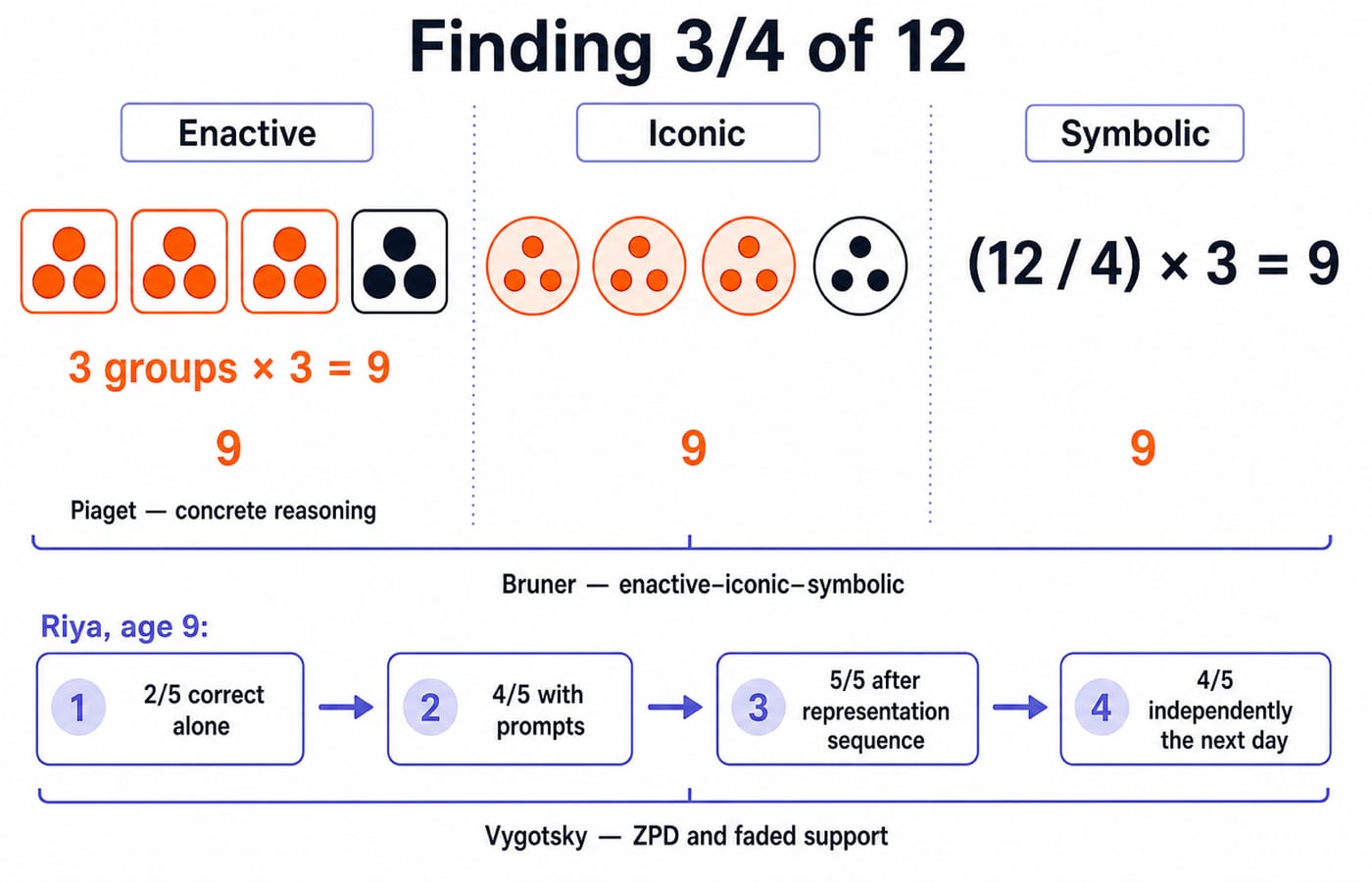
Riya, age 9, answers 2 of 5 fraction items alone. For 3/4 of 12, the teacher provides 12 counters. Riya makes 4 equal groups of 3, then selects 3 groups:
(12 / 4) x 3 = 3 x 3 = 9
With prompts, she answers 4 of 5 items. The teacher shifts from counters to a 12-dot drawing, then symbols. Riya answers 5 of 5. The next day, without prompts, she answers 4 of 5 independently.
Piaget explains the value of concrete objects at age 9. Vygotsky places the move from 2/5 alone to 4/5 with help inside the zone of proximal development, or ZPD, then fades support. Bruner explains the enactive counters, iconic drawing and symbolic expression. Scaffolding is commonly taught with Vygotsky's ZPD, although Wood, Bruner and Ross developed the term later.
Behaviourist learning theories: Thorndike, Pavlov, Watson and Skinner
Theorist | What changes learning | Timing and clue |
|---|---|---|
Thorndike | Stimulus-response connections | Readiness, repetition and satisfying results |
Pavlov | Association between stimuli | Pairing occurs before an involuntary response |
Watson | Observable learned responses | Explain behaviour through observable conditions |
Skinner | Consequences shape voluntary action | Reinforcement or punishment follows a response |
In a Thorndike example, a learner completes the same puzzle in 80 seconds, then 55 seconds, then 35 seconds. Repetition strengthens connections through exercise; satisfaction illustrates effect.
In a Skinner example, a learner scores 6/10. For two practice sets, one point follows immediately after each correct response. The learner reaches 9/10. The point is positive reinforcement only if it increases the target behaviour.
Positive and negative mean added and removed, not good and bad. Reinforcement increases behaviour, while punishment decreases it. Stimulus association suggests classical conditioning. A consequence after a chosen response suggests operant conditioning.
Bandura's social learning theory: observation needs four processes
Bandura's sequence is attention, retention, reproduction and motivation. Modelling, vicarious reinforcement and self-efficacy also matter. Observation can produce learning before direct reward, separating Bandura from Skinner.
A teacher models 36 x 14 = 36 x (10 + 4) = 360 + 144 = 504, explaining each decision. The learner watches, writes it from memory, then reproduces it on 42 x 13 = 42 x (10 + 3) = 420 + 126 = 546. She persists after seeing a peer praised for explaining the method. Those moments map to attention, retention, reproduction and motivation. The same model, practise and explain cycle applies to a programming demonstration.
Kohlberg, Erikson, Freud and Chomsky: identify the domain first
Kohlberg studies reasoning about right and wrong across three levels and six stages. Erikson studies psychosocial conflicts, including industry versus inferiority in school-age children and identity versus role confusion in adolescence. Freud's five psychosexual stages concern drive-focused development, not generic classroom management. Chomsky's shorthand is innate language capacity, the language acquisition device and universal grammar, not language learned only through imitation and reinforcement.
Use the evidence, not a loose keyword:
A child returns 50 rupees because classmates will approve. The stated reason suggests Kohlberg's conventional reasoning.
A 14-year-old compares possible careers and values. This suggests Erikson's identity versus role confusion.
A child says "goed" after learning "walked". The generated rule supports a Chomskyan reading, rather than simple imitation.
A morally correct action alone cannot reveal a Kohlberg stage. The learner's reason is the evidence.
Learning-theory exam traps: solve one complete classroom question
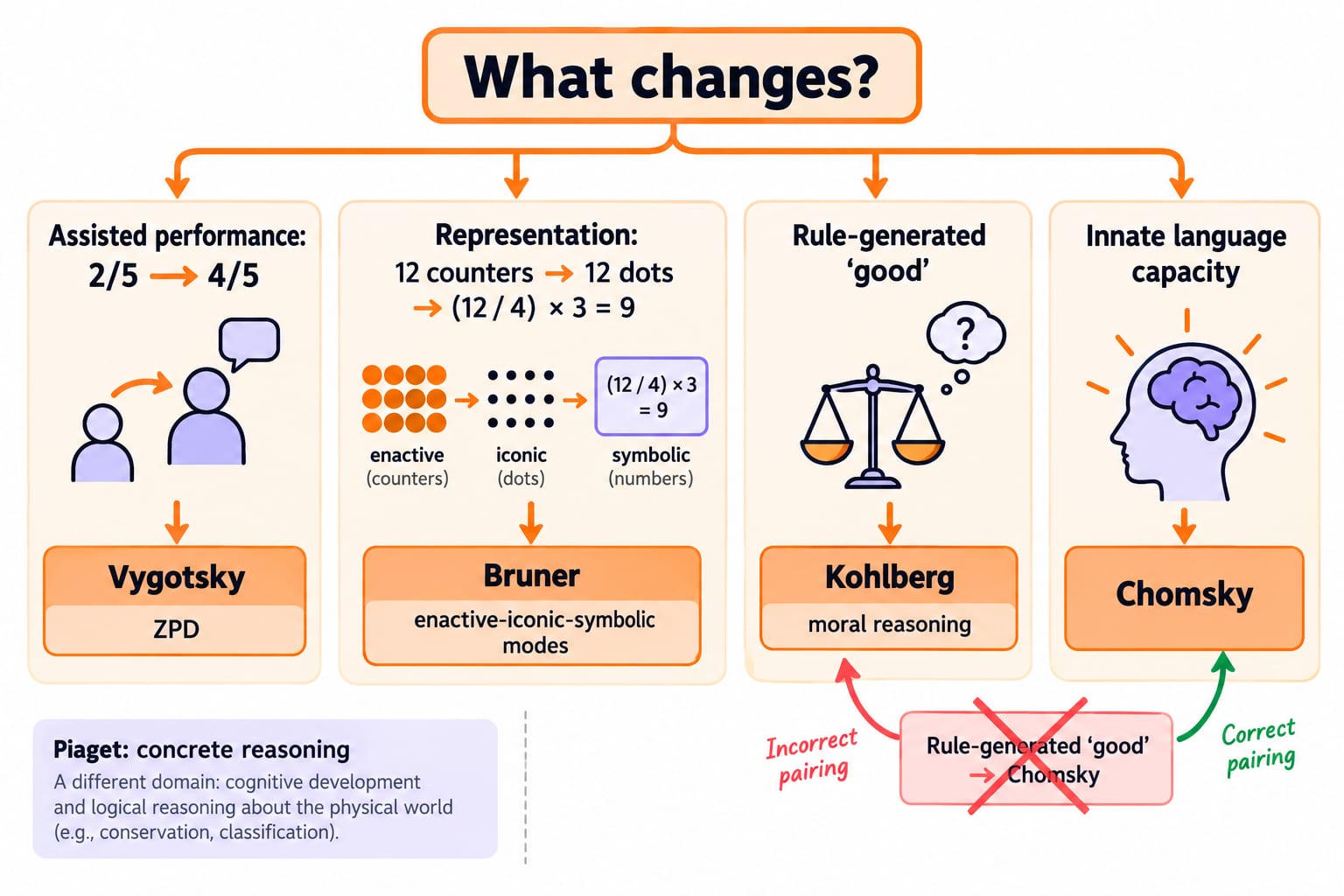
A 9-year-old answers 2 of 5 fraction items independently. With teacher prompts and 12 counters, she correctly finds 3/4 of 12 as 9. The teacher then moves from counters to a dot picture and finally to
(12 / 4) x 3. Which pairing best explains the support and representation sequence? A. Piaget's assimilation plus Skinner's punishment. B. Vygotsky's ZPD plus Bruner's enactive-iconic-symbolic modes. C. Kohlberg's conventional morality plus Pavlov's conditioning. D. Erikson's identity crisis plus Chomsky's LAD.
B is best. The 2/5-alone to 4/5-assisted gap identifies ZPD. Counters, dots and an expression are Bruner's enactive, iconic and symbolic modes. Piaget explains concrete reasoning, but A adds punishment without a consequence. C and D use the wrong domains.
Trap | Better test |
|---|---|
Any help is scaffolding | Check whether temporary support enables a reachable next step and is faded |
Any reward is Thorndike | Ask whether it tests connections or consequences after voluntary behaviour |
Observation needs direct reward | Bandura allows learning by watching before direct reinforcement |
Correct conduct gives a Kohlberg stage | Use the reason for the conduct |
Age settles every Piaget item | Prefer the described reasoning when it conflicts with an age cue |
How teaching exams test learning theories
Recurring shapes include theorist-to-term matching, stage or domain identification, the most learner-centred response, close-theory distinctions, and assertion-reason items. Underline the changed variable and stated reason before reading the options.
Apply the method to mixed scenarios, then continue with the CTET Paper 1 Course 2026 for a structured Paper 1 route.
Learning theories for teaching exams: the short version and next step
Piaget is thinking structure, Vygotsky guided reach, Bruner representation, Thorndike and Skinner consequences, Pavlov and Watson conditioning, Bandura observation, Kohlberg moral reasoning, Erikson psychosocial conflict, Freud psychosexual development, and Chomsky innate language capacity.
Redraw the decision tree. Solve 10 mixed scenarios, then explain why each rejected option uses the wrong domain. Practise until the changed variable points to the theory before the options do.
Go deeper with the full courseCTET Paper 1 2026 — प्राथमिक शिक्षक (कक्षा 1–5)
Keep learning
Learning and Motivation Notes for Teaching Exams: Concepts, Theories and Classroom Examples
Separate learning, performance and motivation through classroom evidence, then apply learning lenses, motivation theory and consequence rules to original scenarios.
Updated 15 Sep 20266 min readCTET & UPTET

Teaching-Learning Process for Teaching Exams: Phases, Principles and a Worked Classroom Example
Connect teaching decisions to learner evidence. Revise the three phases, four learning lenses and common distractors through one complete fractions lesson.
Updated 2 Nov 20266 min readCTET & UPTET

Teaching-Learning Aids and ICT Integration for Teaching Exams: Notes with Worked Classroom Examples
Learn how to select and sequence teaching-learning aids, recognise genuine ICT integration, and solve classroom scenarios with worked calculations.
Updated 30 Oct 20265 min readCTET & UPTET

Principles of English Language Teaching: CTET Notes with Classroom Examples
Turn language-teaching principles into classroom decisions. Follow a library timetable lesson, understand purposeful error correction, and practise matching an activity to its learning objective.
Updated 18 Nov 20265 min readCTET & UPTET