IBPS SO IT Officer Computer Science Topics: The Prerequisite-First Study Order
Build professional knowledge in the order that concepts depend on one another. Use five worked questions to find the first weak block and repair it before moving ahead.
KnowledgeGate Team
Exam prep & CS education
Updated 3 Aug 20267 min read74 views
Many candidates remember isolated SQL commands, protocol names, scheduling formulas, and security terms, yet cannot decide what to study first. Later topics then feel fragile because the earlier mental model is missing.
Professional Knowledge, the subject-specific paper at the IBPS SO IT Officer Mains stage, draws on six computer science subjects at once, and four of them stack in a fixed order. Data structures and the programming fundamentals beneath them carry the state-and-memory ideas Operating Systems needs; OS carries what DBMS needs for transactions; OS and DBMS together carry what Computer Networks needs for sockets, ports and database clients. Security sits inside the networks syllabus rather than standing as its own subject, but it reads better once those four are in place, so it takes the last block here.
The other two subjects sit outside the chain. Computer Organization and Architecture is self-contained and fits wherever you have room, though a pass over the memory hierarchy pays off before OS paging. Software Engineering with programming and web concepts tests recognition rather than derivation, so leave it last. The IBPS SO IT Professional Knowledge: Subject Topic Map lists the sub-areas inside all six.
1. Run five diagnostics before you open the first subject
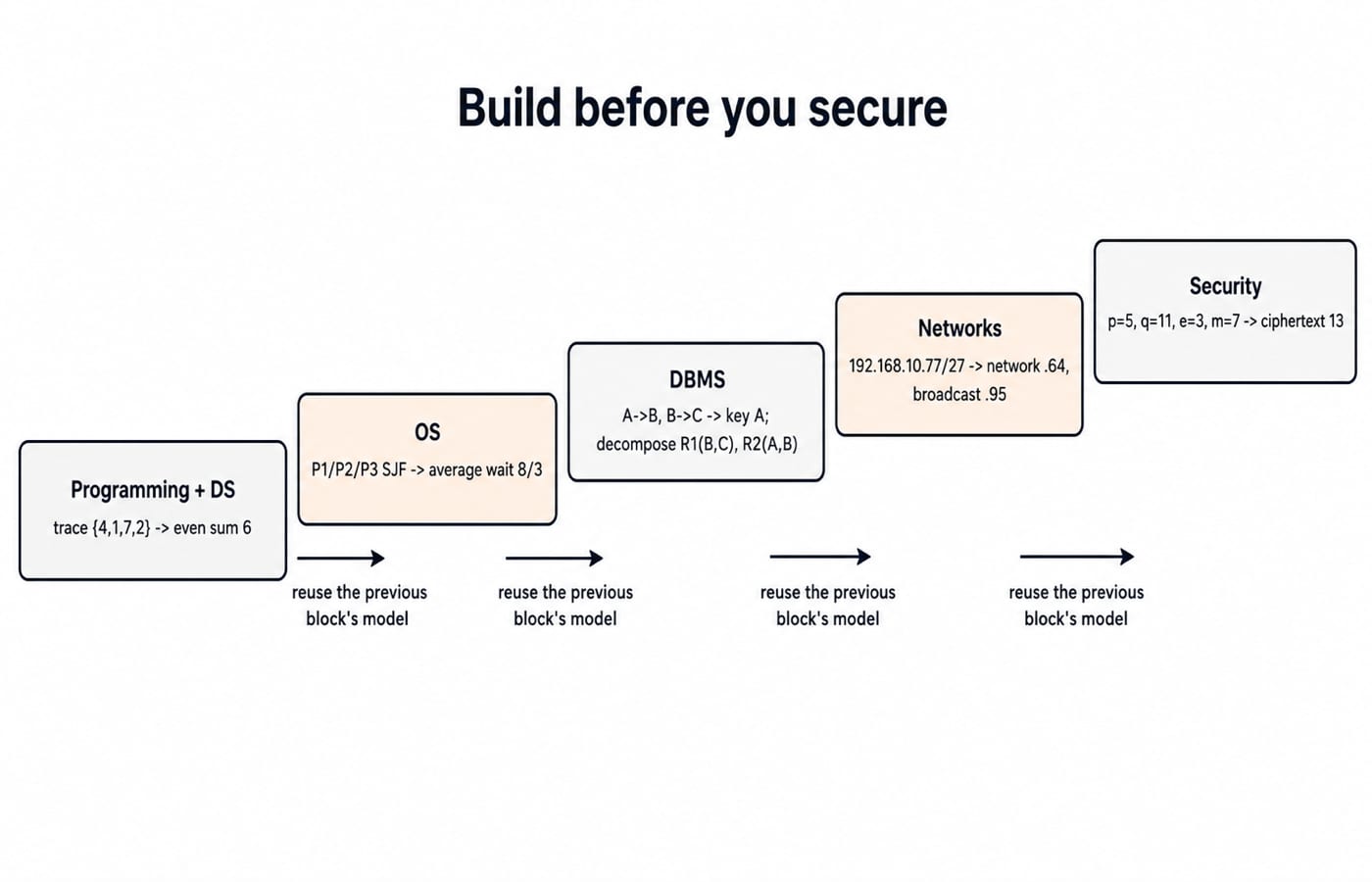
You may compress a block you already know, but only after a diagnostic proves it. Attempt these five checkpoints on paper, one per block, and justify every answer:
Trace the even-number sum in
{4, 1, 7, 2}.Schedule
P1(AT=0,BT=5),P2(AT=1,BT=3), andP3(AT=2,BT=1)with non-preemptive SJF.Find the key of
R(A,B,C)underA -> BandB -> C.Subnet
192.168.10.77/27.Encrypt
m=7using RSA valuesp=5,q=11, ande=3.
A correct value without reasoning is only partial recall.
2. Block 1, Programming and Data Structures: learn to trace changing state
Study variables and types, control flow, arrays and strings, functions and parameter passing, and pointers, then stacks, queues, linked lists, trees, searching, sorting and basic time complexity.
Consider this C-style trace:
int a[] = {4,1,7,2}; int s = 0; for (int i=0; i<4; i++) if (a[i] % 2 == 0) s += a[i];
i | a[i] | Even? | s after iteration |
|---|---|---|---|
0 | 4 | yes | 4 |
1 | 1 | no | 4 |
2 | 7 | no | 4 |
3 | 2 | yes | 6 |
The output is 6. Never write an output or a Big-O label you have not derived; count pushes, pops, comparisons or swaps rather than quoting a complexity from memory.
3. Block 2, Operating Systems: move from program state to process state
Study process versus thread, states and context switching, scheduling, synchronisation and deadlock, paging and virtual memory, then files and disk scheduling. Concurrency makes the order of state changes matter.
For non-preemptive SJF, at time 0 only P1 has arrived, so run P1: 0-5. At time 5, P2 and P3 are available. P3 has the shorter burst, so run P3: 5-6, then P2: 6-9.
Waiting times are:
P1 = 0 - 0 = 0P3 = 5 - 2 = 3P2 = 6 - 1 = 5Average waiting time
= (0 + 3 + 5) / 3 = 8/3 = 2.67time units
Do not choose P3 early or label turnaround time as waiting time. Here, WT = start - arrival. The burst values carry no unit, so the answer is 2.67 time units, not seconds.
4. Block 3, DBMS: organise data before studying transactions
Learn the relational model and constraints, relational algebra and SQL, dependencies, keys and normal forms, indexing, then transactions, locking and recovery. To reason about anomalies, first know what a row means and which attributes determine others.
For R(A,B,C) with A -> B and B -> C, start with closures. A+ = {A,B,C}, so A is a candidate key. In B -> C, B is not a superkey and C is non-prime, so the dependency violates 3NF.
Decompose into R1(B,C) and R2(A,B). Their common attribute B determines all of R1 through B -> C, so the decomposition is lossless. Ten questions that push the same closure reasoning one normal form further are in Boyce-Codd Normal Form (BCNF): 10 Solved MCQs.
A transitive dependency is not automatically a 3NF violation. Identify the key and prime attributes first.
5. Block 4, Computer Networks: reason from layers down to bits
Study layering, what each OSI and TCP/IP layer does, frames, packets and segments, IPv4 and subnetting, routing, TCP versus UDP, then DNS, HTTP and email. Sockets, ports and database clients connect this block to OS and DBMS.
For 192.168.10.77/27, the mask is 255.255.255.224. The last-octet block size is 256 - 224 = 32, so blocks begin at 0, 32, 64, 96, .... The value 77 lies in 64-95. Therefore:
Network address:
192.168.10.64Broadcast address:
192.168.10.95Usable host range:
192.168.10.65-192.168.10.94
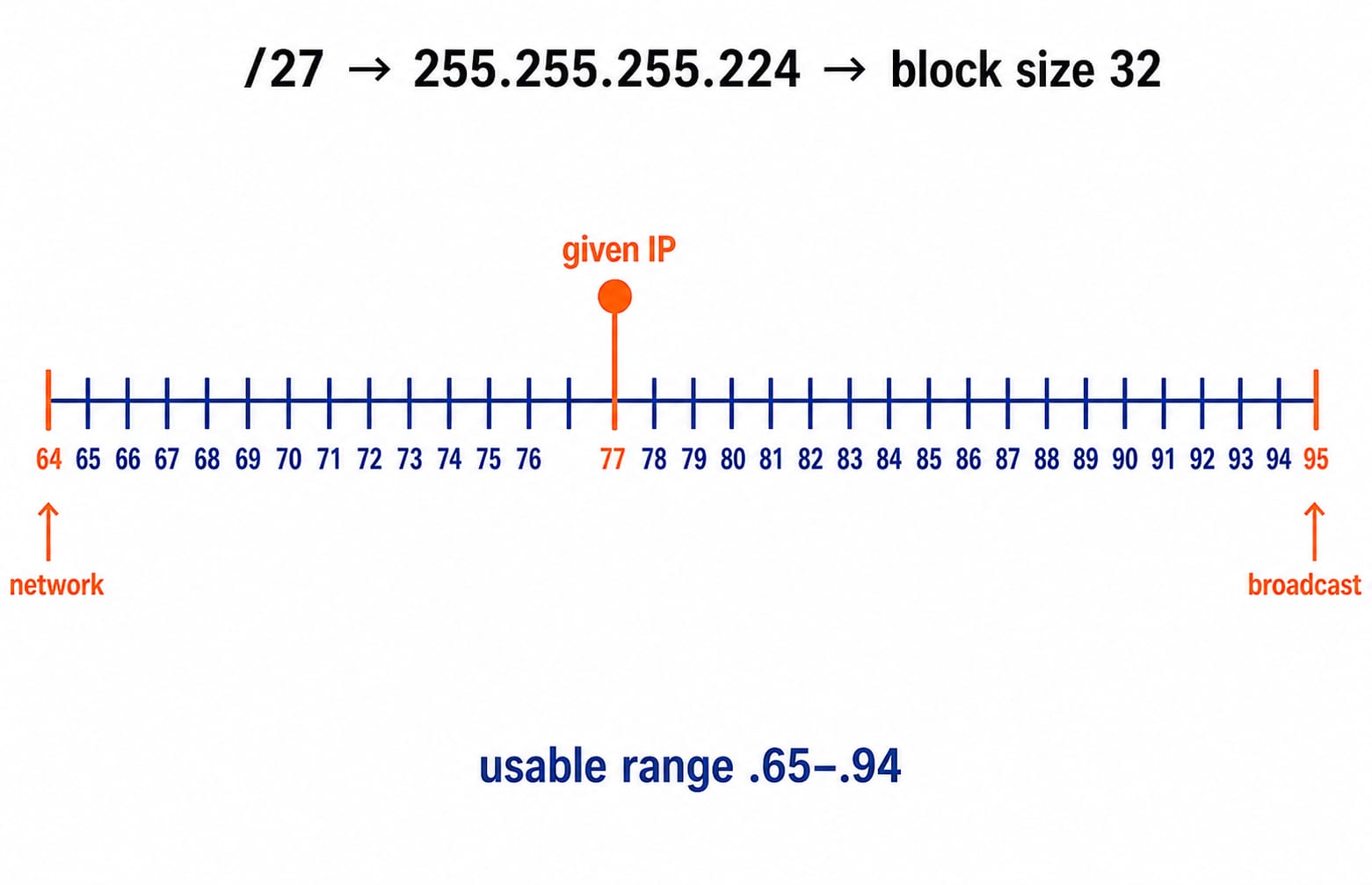
Do not subtract 27 from 32 and call 5 the host count. Five is the number of host bits. This subnet contains 2^5 = 32 addresses and 32 - 2 = 30 conventionally usable host addresses.
6. Block 5, Security: protect the code, host, data and traffic
Build vocabulary in order: confidentiality, integrity and availability; authentication versus authorisation; hashes, symmetric and asymmetric encryption; network and application attacks; access control; then incident response.
Then attach each defence to what it protects. Code is protected by input validation and output encoding, which is why SQL injection and cross-site scripting are coding faults, not firewall faults. The host is protected by authentication, access control and patching. Data is protected by encryption at rest and by hashing. Traffic is protected by TLS, an asymmetric key exchange followed by symmetric encryption, so the RSA arithmetic below is the exchange half.
For the small RSA example, p=5, q=11, e=3, and m=7:
n = pq = 5 x 11 = 55.phi(n) = (5 - 1)(11 - 1) = 4 x 10 = 40.Choose
d=27, since3 x 27 = 81, and81 mod 40 = 1.Encrypt:
c = 7^3 mod 55 = 343 mod 55 = 13.Decrypt by squaring:
13^2=4,13^4=16,13^8=36, and13^16=31(all modulo 55). Since27=16+8+2+1,31 x 36 x 4 x 13 mod 55 = 7.
Real RSA uses primes hundreds of digits long; p=5 and q=11 exist here only to keep the arithmetic hand-checkable. The method does not change with size: identify the stage, write the formula, reduce modulo at each step, and check that the result lies between 0 and n-1.
The traps here are pairs that sound interchangeable. Encryption hides content and is reversible with the right key; hashing is one-way and only proves the content did not change. Authentication settles who you are; authorisation settles what you may touch.
7. Use mixed questions to expose gaps in the chain
Create a 20-question, 25-minute drill with four questions per block, so no block can hide behind another. That is roughly 75 seconds a question, tight enough to expose a block you can only do slowly. Record correct, wrong, skipped, time, and one error tag per miss: prerequisite gap, formula, trace, terminology, or careless arithmetic.
Suppose you attempt 15, answer 12 correctly and 3 wrongly, and skip 5. Attempted accuracy is 12/15 x 100 = 80%. If two wrong and two skipped answers belong to Networks, all four questions in that block need review. Return to subnetting and protocol layers inside Block 4 instead of restarting all five blocks.
Sequence mistakes have predictable fixes:
Security acronyms without context confuse attack and defence matching. Rebuild network and OS concepts.
SQL before keys and dependencies turns normalisation into guessing. Work closures first.
Rereading creates false familiarity. End with one closed-book worked item.
The Institute of Banking Personnel Selection controls the recruitment notification. Confirm current syllabus, stage, marking, timing, date, or eligibility details in the latest CRP Specialist Officers notification on the official IBPS website. The IBPS SO IT Mains Preparation Course is built around this Professional Knowledge syllabus, if you would rather work the blocks with practice attached to each.
8. The short version and the next study action
Trace code and data structures. Model processes and memory. Organise data and transactions. Move data through networks. Secure every layer.
Start at the earliest diagnostic you cannot explain on paper. Solve the five entry questions today, mark the first weak block, and schedule three sessions there before retesting.
The IBPS PO and SO IT Exam Preparation page lists the other banking routes if you are still choosing. If IT Officer Scale 1 is settled, the IBPS IT Officer (Scale I) 2026 bundle covers Prelims, Mains and Interview as one path. Diagnose, repair the first missing prerequisite, then continue through the chain.
Keep learning
IBPS SO IT Officer Preparation Mistakes: 7 Fixes Before They Cost Selection
Avoid seven preparation errors that hide weak recall, neglected sections and repeated mock mistakes. Use worked planning examples to build a repairable study system.
Updated 27 Oct 20265 min readIBPS Exams
IBPS SO IT Officer Last 60 Days Plan: Daily Revision and Mock Schedule
Turn the final 60 days into a repeatable cycle of diagnosis, focused revision, timed practice, mock analysis, repair, retesting, and a calm taper.
Updated 25 Oct 20265 min readIBPS Exams
IBPS Clerk Cutoff Trends: Set a Defensible Target Score
Turn comparable official cutoff values into a practical working target, then use mock accuracy and consistency to decide what to repair next.
Updated 24 Oct 20264 min readIBPS Exams
IBPS SO IT Officer Syllabus: What to Study for Each Section
Separate the official IBPS exam structure from the detailed study map. See what to cover for English, Reasoning, Quantitative Aptitude, Professional Knowledge and Descriptive English.
Updated 21 Oct 20264 min readIBPS Exams