IBPS Clerk Quant Speed Training: A 6-Week Accuracy-First Plan
Build Quantitative Aptitude speed through a six-week ladder that protects accuracy, repairs weak calculation lanes, and replaces blind guesses with clear decisions.
KnowledgeGate Team
Exam prep & CS education
Updated 22 Aug 20265 min read
You can solve Quantitative Aptitude questions at home, yet a timer changes everything. Rushing creates avoidable calculation errors; waiting for a shortcut wastes the set. Speed comes from reliable recognition and clean calculation, not blind attempts. Train three lanes over six weeks: simplification, number series, and arithmetic. Start with a baseline, repair the weakest lane, compress time only after meeting the accuracy gate, and give every error a dated reattempt. The target is controlled speed that survives mixed practice, not one unusually fast set.
1. Establish a speed baseline before trying shortcuts
Start with a diagnostic of six simplification questions, six number-series questions, and six arithmetic word problems. Attempt all 18 in 18 minutes. Treat the result only as a personal training baseline; use the current official notification for the IBPS Clerk pattern.
Suppose your record is 15 attempted, 12 correct, 3 wrong, and 3 skipped. Calculate:
Attempt accuracy =
12 / 15 x 100 = 80%.Clean answers per minute =
12 / 18 = 0.67.
Do not convert this into an exam score. Any current negative-marking rule must come from the applicable official notification.
Separate the result by lane: simplification has 5 of 6 correct, number series has 4 of 6 correct, and arithmetic has 3 of 6 correct. Arithmetic is least accurate, so it receives the first repair block in Week 1.
2. Build three calculation lanes with exact methods
For simplification, solve 48% of 625 + 7^2 - 144 / 12. Convert 48% of 625 to (48 / 100) x 625 = 300. Then 7^2 = 49 and 144 / 12 = 12, giving 300 + 49 - 12 = 337. Write only the risky intermediate values: 300, 49, and 12.
For number series, take 3, 8, 18, 38, 78, ?. Test one rule repeatedly: 3 x 2 + 2 = 8, 8 x 2 + 2 = 18, 18 x 2 + 2 = 38, and 38 x 2 + 2 = 78. Therefore, the next term is 78 x 2 + 2 = 158. One matching jump is insufficient evidence.
For arithmetic, a 25-litre solution containing 40% concentrate has 25 x 0.40 = 10 litres of concentrate. Add 5 litres of water. The total becomes 30 litres, while concentrate remains 10 litres, so 10 / 30 x 100 = 33 1/3%.
Use Bank PO Quant: High-Yield Topics First to organise practice. Use the current IBPS Clerk notification for official topic weightage.
3. Follow a six-week time model that survives missed days
Weeks 1 and 2 are the control phase: five 60-minute sessions and one 60-minute review set. That is 6 x 60 = 360 minutes, or 6 hours weekly. Each regular session has 20 minutes for one calculation lane, 25 minutes for untimed accuracy, and 15 minutes for error-log repair.
Weeks 3 and 4 are the compression phase: five 75-minute sessions and one 75-minute mixed set. The total is 6 x 75 = 450 minutes, or 7 hours 30 minutes weekly. Use 20 minutes for technique recall, 35 for timed sets, and 20 for correction.
Weeks 5 and 6 are the transfer phase: four 75-minute sessions plus two 90-minute mixed-set days. That is 4 x 75 + 2 x 90 = 480 minutes, or 8 hours weekly, with one day free.
If you miss a day, use a 30-minute repair block on the free day: 10 minutes on old errors and 20 on the weakest lane. Do not double the next full session. For a shorter template, adapt the Aptitude for Placements: A 30-Day Practice Routine while retaining the accuracy gates.
4. Use a timer ladder with an accuracy gate
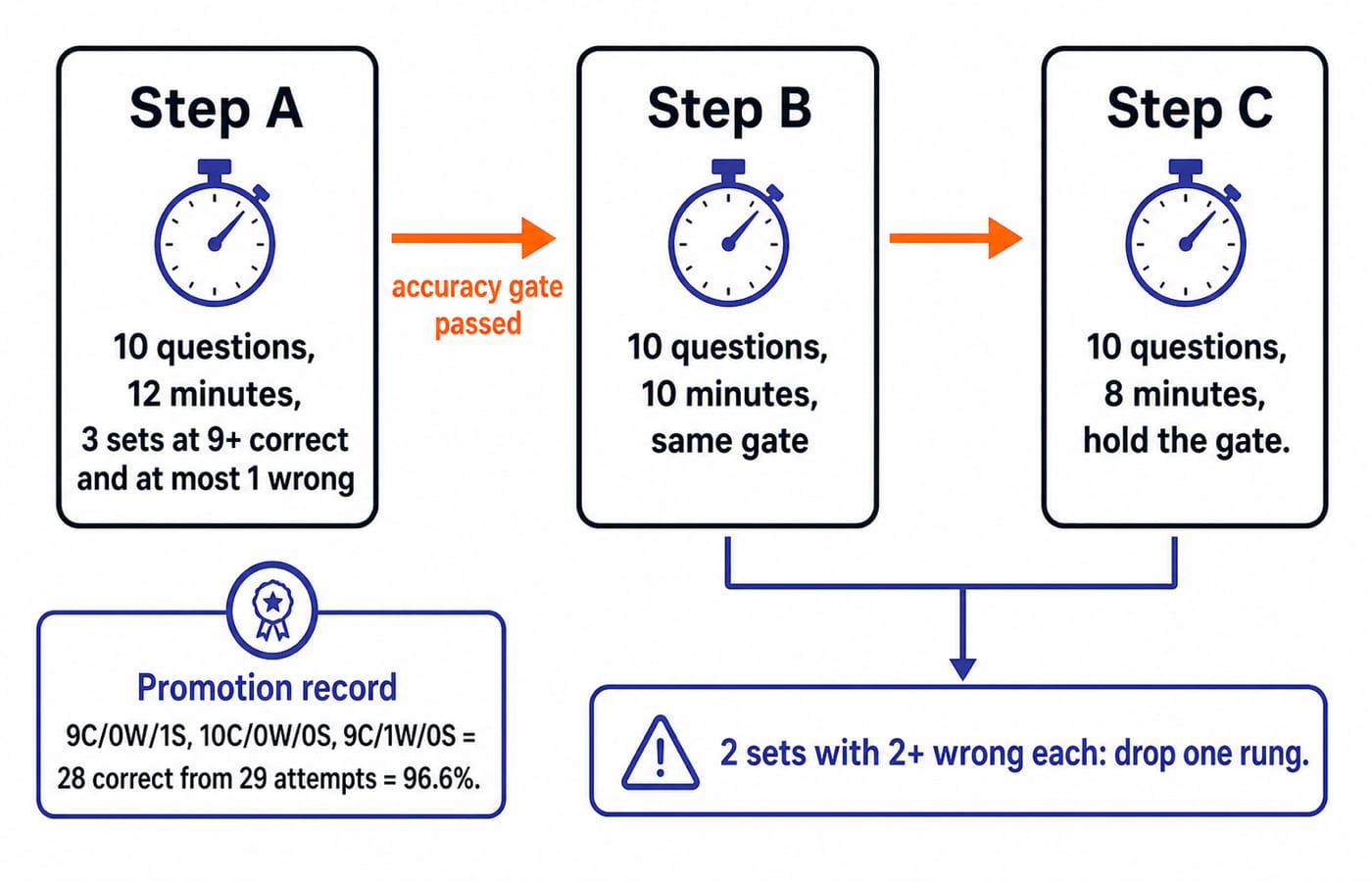
For personal training, Rung A gives you 12 minutes for 10 questions. Rung B gives 10 minutes, and Rung C gives 8 minutes. Check the current official notification for section timings. Move up only after three consecutive sets in which each set has at least 9 correct and no more than 1 wrong.
For example, Set 1 has 9 correct, 1 skipped, and 0 wrong. Set 2 has 10 correct, 0 skipped, and 0 wrong. Set 3 has 9 correct, 0 skipped, and 1 wrong. Across 30 questions, that is 28 correct from 29 attempts. Attempt accuracy is 28 / 29 x 100 = 96.6% after rounding, so you may move from 12 minutes to 10 minutes.
The gate also works in reverse. If two sets at the new rung each contain 2 or more wrong answers, return to the previous rung. Complete two clean sets there before trying the faster rung again.
5. Replace blind guessing with a two-pass decision rule
Use a recognition checkpoint. After roughly 20 seconds, you should be able to name the method. If no stable series rule or arithmetic setup is visible by 35 seconds, flag and move. If a valid setup exists, continue, but cap first-pass work at 90 seconds. Apply these cutoffs to your own practice; verify the current exam interface in official IBPS instructions.
Consider three questions. For Q1, recognise percentage conversion immediately and finish at 0:32. For Q2, inspect 4, 11, 25, 52, 106, ?. If no consistent rule is confirmed by 0:35, flag it. On review, the increments are 7, 14, 27, and 54. They do not form a clean repeated rule, so leave it unless you find a valid construction.
For Q3, the solution problem, write 25 x 0.40 = 10 by 0:45 and finish by 1:20. The setup justifies continuing. A skip preserves time. An unsupported option choice only hides a recognition gap.
6. Turn every error into a scheduled reattempt
Tag each error as concept, calculation, reading, or timer decision. Record the question type, wrong line, correct method, time taken, and next reattempt dates.
Suppose you answer 37.5% of 640 as 210 after treating 37.5% as 35%. Tag it as calculation and conversion. Since 37.5% = 3/8, the correction is 640 / 8 x 3 = 80 x 3 = 240.
Reattempt the method with changed values after 1 day, 3 days, and 7 days. For example, 37.5% of 480 = 480 / 8 x 3 = 60 x 3 = 180.
KnowledgeGate currently has more than 9,000 Mathematics and Aptitude questions in its practice bank across exams. Filter by your current topic and schedule the next reattempt.
7. The short version and your next action
In a 25-minute mixed set, suppose 30 questions give 24 attempted, 22 correct, 2 wrong, and 6 skipped. Attempt accuracy is 22 / 24 x 100 = 91.7%. Clean answers per minute are 22 / 25 = 0.88, up from 0.67. Below 90% accuracy, shorten the next set or drop one rung.
Short version: recognise the method, calculate cleanly, compress time after passing the gate, and review errors on schedule. Explore Banking & Insurance Exam Preparation. IBPS PO Prelims Preparation Course and IBPS SO IT Prelims Preparation Course are the closest catalogued prelims courses with Quantitative Aptitude, but neither is IBPS Clerk-specific. Confirm fit against the applicable Clerk notification on the official IBPS website before enrolling.
Keep learning
IBPS SO IT Officer Syllabus: What to Study for Each Section
Separate the official IBPS exam structure from the detailed study map. See what to cover for English, Reasoning, Quantitative Aptitude, Professional Knowledge and Descriptive English.
Updated 21 Oct 20264 min readIBPS Exams
IBPS SO IT Officer Preparation Strategy: A 16-Week Phase-by-Phase Plan
Turn 18 weekly hours into a realistic IBPS SO IT Officer plan, from the first diagnostic to mock repair, tapering and a conditional next-stage bridge.
Updated 17 Oct 20266 min readIBPS Exams
IBPS SO IT Officer Exam Pattern and Marking Scheme: Prelims, Mains and Interview
Understand the CRP SPL-XVI stage sequence, section timings and marks, then use worked score calculations and a 12-hour study plan to prepare for each stage.
Updated 13 Oct 20264 min read124 viewsIBPS Exams
IBPS Clerk Eligibility and Selection Process: From Application to Allotment
Separate the eligibility gate from the selection gate using a dated checklist, three candidate profiles and a 124-to-62 Main-score example.
Updated 8 Oct 20264 min readIBPS Exams