IBPS Clerk Reasoning Preparation: Puzzles, Syllogisms and a Safer Attempt Order
Turn uneven reasoning performance into a repeatable routine. Audit your choices, triage questions, solve from anchors and leave when a clear stop rule triggers.
KnowledgeGate Team
Exam prep & CS education
Updated 19 Aug 20265 min read155 views
Your reasoning performance swings even when the concepts are familiar. Opening a long puzzle too early steals time from short questions, while postponing every puzzle wastes a solvable set. What steadies the score is a fixed opening sequence with written stop rules, so the decision to enter or leave a set is made before the clock starts, not while it runs.
Audit selection before adding more study hours
Mock | Attempts | Correct | Wrong | Selection evidence | Raw accuracy |
|---|---|---|---|---|---|
A | 23 | 20 | 3 | Opening puzzle: 10 minutes | 20 ÷ 23 × 100 = 87.0% |
B | 28 | 24 | 4 | Quick questions first; abandoned set: 6 minutes | 24 ÷ 28 × 100 = 85.7% |
C | 25 | 23 | 2 | Longest puzzle in final pass | 23 ÷ 25 × 100 = 92.0% |
These are raw accuracies, not marks. Use three comparable mocks, not one unusual result.
Log five columns: question or set type, first decision (attempt or leave), time, result, and cause (concept, selection or execution). Ask "What was wrong?" and "Which opening decision wasted the block?" Bank PO Reasoning: the high-yield topics and how to master them maps which reasoning topics carry the weight. The ledger tells you which of those topics is costing you time, which is the part no topic list can supply.
Build a green, amber and red question queue
Green: a short item whose rule you recognise immediately, such as a basic syllogism, inequality, direction, ranking or coding-decoding question.
Amber: a familiar small set with at least two definite placements from its opening clues.
Red: an unfamiliar multi-variable set, or one whose diagram stays blank after the setup gate.
Run an 18-question triage drill: Q1 to Q8 are singles, Q9 to Q13 a five-floor set, and Q14 to Q18 a circular arrangement. Spend two minutes labelling, not solving. Recognised singles are green. Q9 to Q13 are amber only if three clues fix two floors. Q14 to Q18 are red without a fixed seat or direction anchor.
Labels can change. A five-floor set taking eight minutes in week 1 may become amber at four minutes in week 3. Timed evidence decides.
Make syllogisms the controlled quick-question lane
All tellers are clerks.
Some clerks are graduates.
No graduate is a cashier.
Test the conclusions separately:
I. Some tellers are graduates. No. The clerk-graduate overlap need not contain a teller.
II. Some clerks are not cashiers. This follows. The clerks who are graduates cannot be cashiers.
III. No teller is a cashier. No. A non-graduate teller may be a cashier.
Therefore, only conclusion II follows.
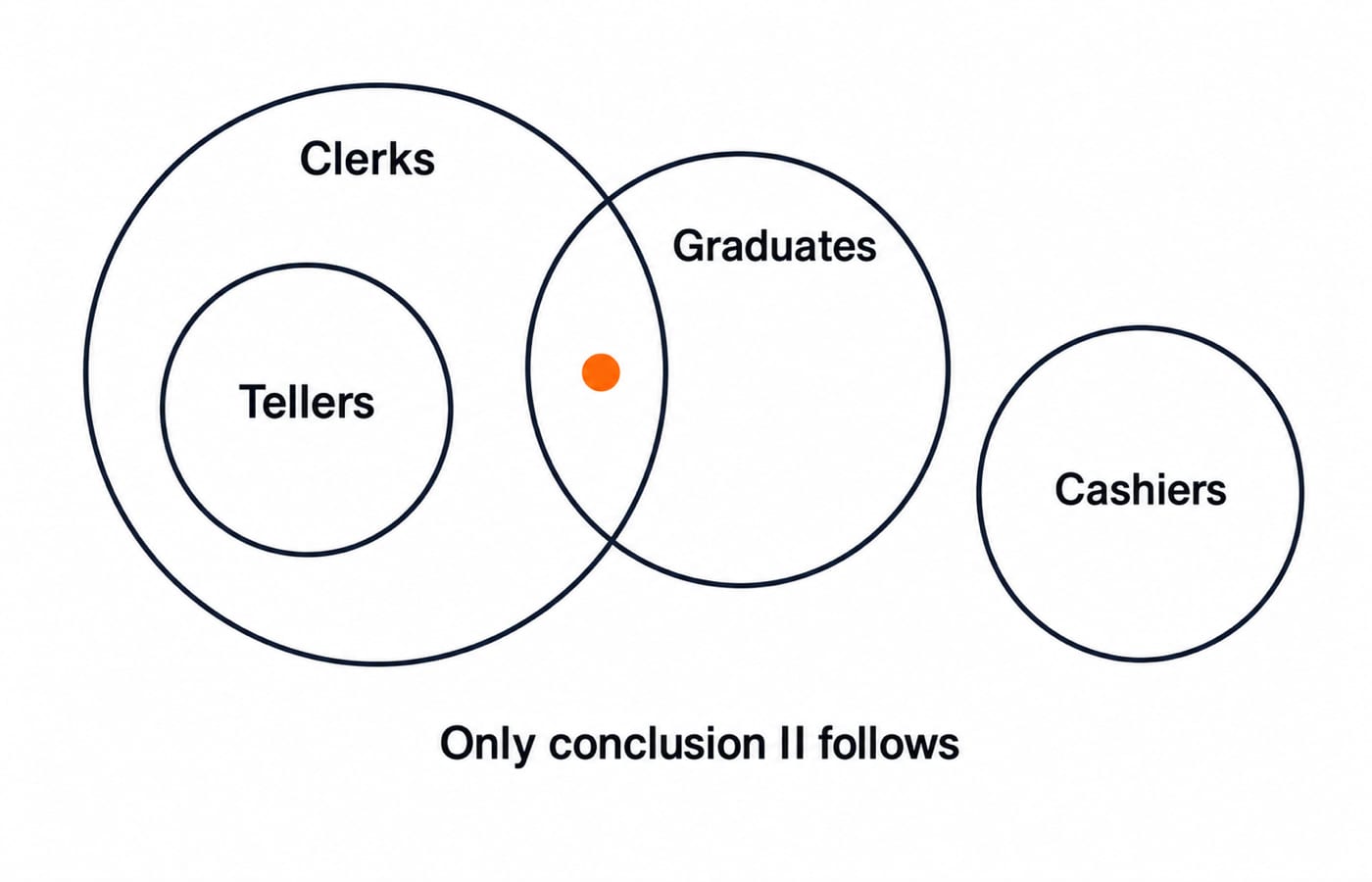
Translate "all" as containment, "some" as guaranteed overlap, and "no" as disjoint sets. Test conclusions separately. Never reverse "all" or upgrade "some" to "all". Leave if it remains unclear after 45 seconds.
Practise puzzles through anchors, not blind trial
Five people A to E live on floors 1 to 5, with floor 1 at the bottom. Start from the only clue that fixes a seat outright: B is on the top floor, so B=5. D is immediately below B, so D=4. A is two floors below D, so A=2. E is below A, and floor 1 is the only spot left under A, so E=1. C takes the remainder, C=3.
Floor | Person |
|---|---|
5 | B |
4 | D |
3 | C |
2 | A |
1 | E |
Checks: C is immediately above A and between A and D. E is on the lowest floor. The anchor sequence is B=5, D=4, A=2, E=1, C=3.
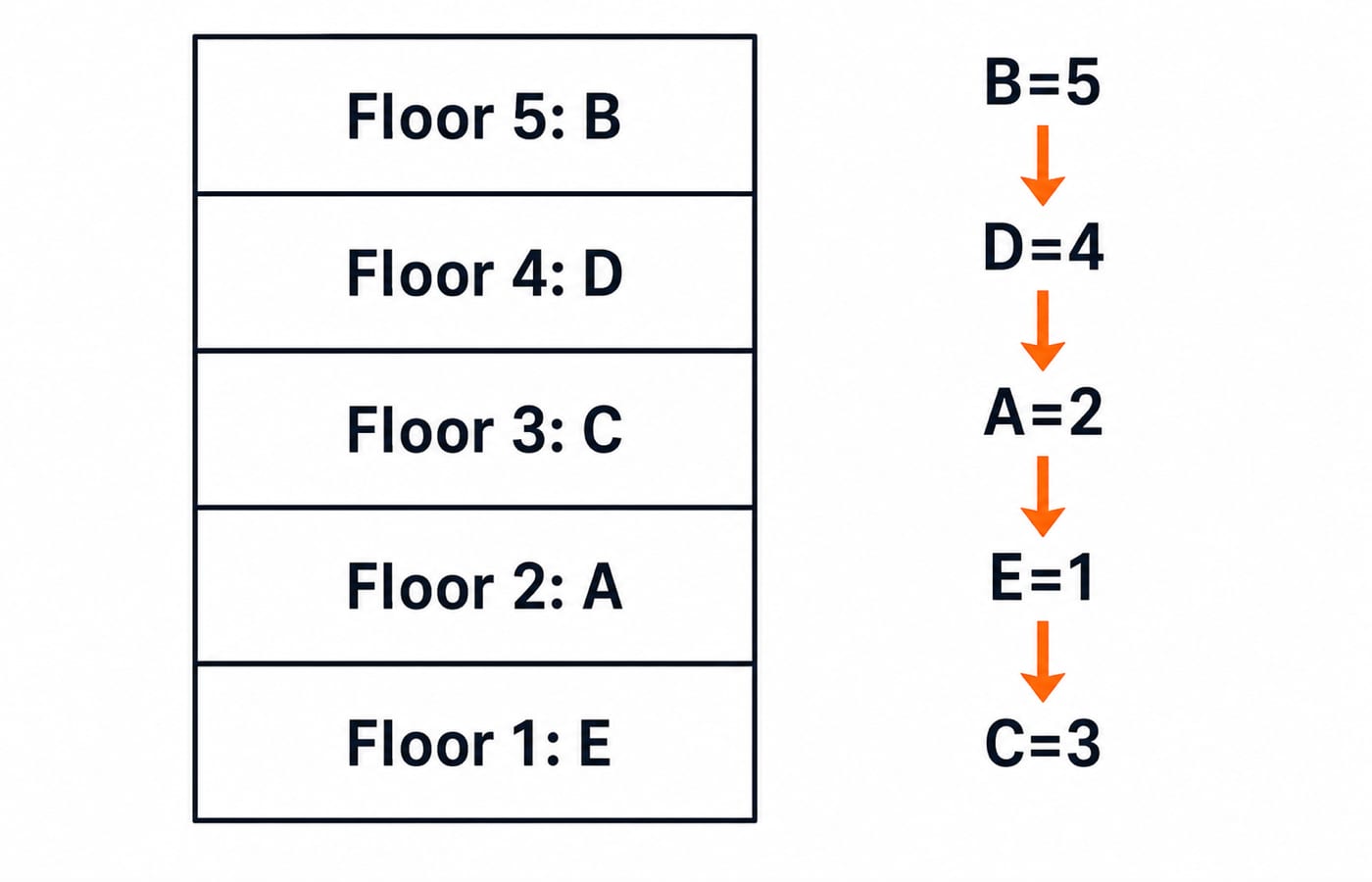
Apply a setup gate in later drills. Continue when 60 to 90 seconds produce two fixed placements or one strong chain. Leave a mostly blank grid for the return pass, then tune the rule from your ledger.
Rehearse an attempt order with stop rules
Train on a 20-minute block: long enough to force a real selection decision, short enough to repeat daily. Check the current reasoning section timing for your cycle at ibps.in before you rehearse the exam-day version.
Time | Task |
|---|---|
0:00 to 5:00 | Recognised green singles |
5:00 to 13:00 | One anchored amber set |
13:00 to 18:00 | A second set or marked singles |
18:00 to 20:00 | Checks and deliberate returns |
For another format, preserve the sequence and scale the blocks. Leave a single after 45 seconds without a method, a setup after 90 seconds without two placements or a chain, and any set after three minutes without one confident answer. Log exits to refine the thresholds.
Bank PO Prelims vs Mains: how to split your preparation explains why preparation changes by stage. IBPS Clerk preparation sits at the speed-weighted end of that split, which is why the block above spends its opening five minutes clearing recognised singles rather than setting up a puzzle.
Follow a four-week, eight-hour reasoning cycle
Week | Eight-hour allocation |
|---|---|
1: foundation and measurement | 2 hours basic syllogisms, 2 hours small linear and floor sets, 2 hours on three 20-minute diagnostic blocks plus setup, 2 hours ledger review |
2: controlled speed | 1.5 hours syllogisms, 3 hours linear and floor sets, 2.5 hours timed mixed blocks, 1 hour review |
3: selection under pressure | 1 hour quick-topic repair, 3 hours mixed puzzles, 3 hours timed blocks, 1 hour review |
4: mock transfer | 1 hour quick-topic repair, 2 hours on the weakest puzzle type, 4 hours split between mocks and analysis, 1 hour on the final attempt-order card |
Each row totals eight hours. After a missed day, do not double the next workload. Use a 30-minute rescue: 10 syllogisms, one five-person or five-floor puzzle, and 10 minutes of error review. Then resume. The banking exam preparation plan that works whatever the calendar supplies the longer schedule.
Review decisions, then lock the next opening sequence
Classify each miss. Opening an eight-variable puzzle with no placement in 90 seconds is a selection error, so change the order. Treating "some" as "all" is a concept error, so relearn the rule. Building the floor grid correctly but marking D instead of C is an execution error, so add a check.
For three drills, use personal targets, not IBPS cutoffs: at most one red set before the green queue is complete, and at least 16 correct per 20-question quick-topic batch. Then revise the attempt card.
The short version
Secure recognised singles, enter a puzzle after an anchor check, leave on the stop rule, and return later. KnowledgeGate carries over 600 Puzzle Solving and Syllogism questions, so test the order against real sets rather than on paper.
Review the broader catalogue at the Banking & Insurance course hub. IBPS PO Prelims drills the same puzzle and syllogism ground one difficulty step above Clerk, which makes it useful practice if you want guided sets while you build your attempt card.
Keep learning
IBPS SO IT Officer Preparation Mistakes: 7 Fixes Before They Cost Selection
Avoid seven preparation errors that hide weak recall, neglected sections and repeated mock mistakes. Use worked planning examples to build a repairable study system.
Updated 27 Oct 20265 min readIBPS Exams
IBPS SO IT Officer Last 60 Days Plan: Daily Revision and Mock Schedule
Turn the final 60 days into a repeatable cycle of diagnosis, focused revision, timed practice, mock analysis, repair, retesting, and a calm taper.
Updated 25 Oct 20265 min readIBPS Exams
IBPS Clerk Cutoff Trends: Set a Defensible Target Score
Turn comparable official cutoff values into a practical working target, then use mock accuracy and consistency to decide what to repair next.
Updated 24 Oct 20264 min readIBPS Exams
IBPS SO IT Officer Syllabus: What to Study for Each Section
Separate the official IBPS exam structure from the detailed study map. See what to cover for English, Reasoning, Quantitative Aptitude, Professional Knowledge and Descriptive English.
Updated 21 Oct 20264 min readIBPS Exams