Boyce-Codd Normal Form (BCNF) MCQs: 10 Solved Questions with Explanations
Solve 10 BCNF MCQs from GATE, UGC NET and DSSSB papers with clear reasoning on superkeys, candidate-key closures, 3NF exceptions and decomposition trade-offs.
KnowledgeGate Team
Exam prep & CS education
Updated 26 Jul 20268 min read90 views
BCNF questions look like definition checks, but the harder ones combine candidate keys, closures, prime attributes and decomposition properties in one chain of reasoning. The ten questions below run that whole range: the determinant rule, BCNF versus 3NF, highest-normal-form checks, and the lossless versus dependency-preserving trade-off. One repeatable test carries all of them: ignore trivial FDs, check whether the left side of each remaining FD is a superkey, and stop at the first determinant that fails. KnowledgeGate has about 80 BCNF questions in CS fundamentals for exams and placements.
Related reading: third normal form MCQs and second normal form MCQs.
BCNF in one decision rule, with a relation you can test
For every non-trivial FD X -> Y, BCNF requires determinant X to be a superkey. A superkey determines every attribute; a candidate key is a minimal superkey.
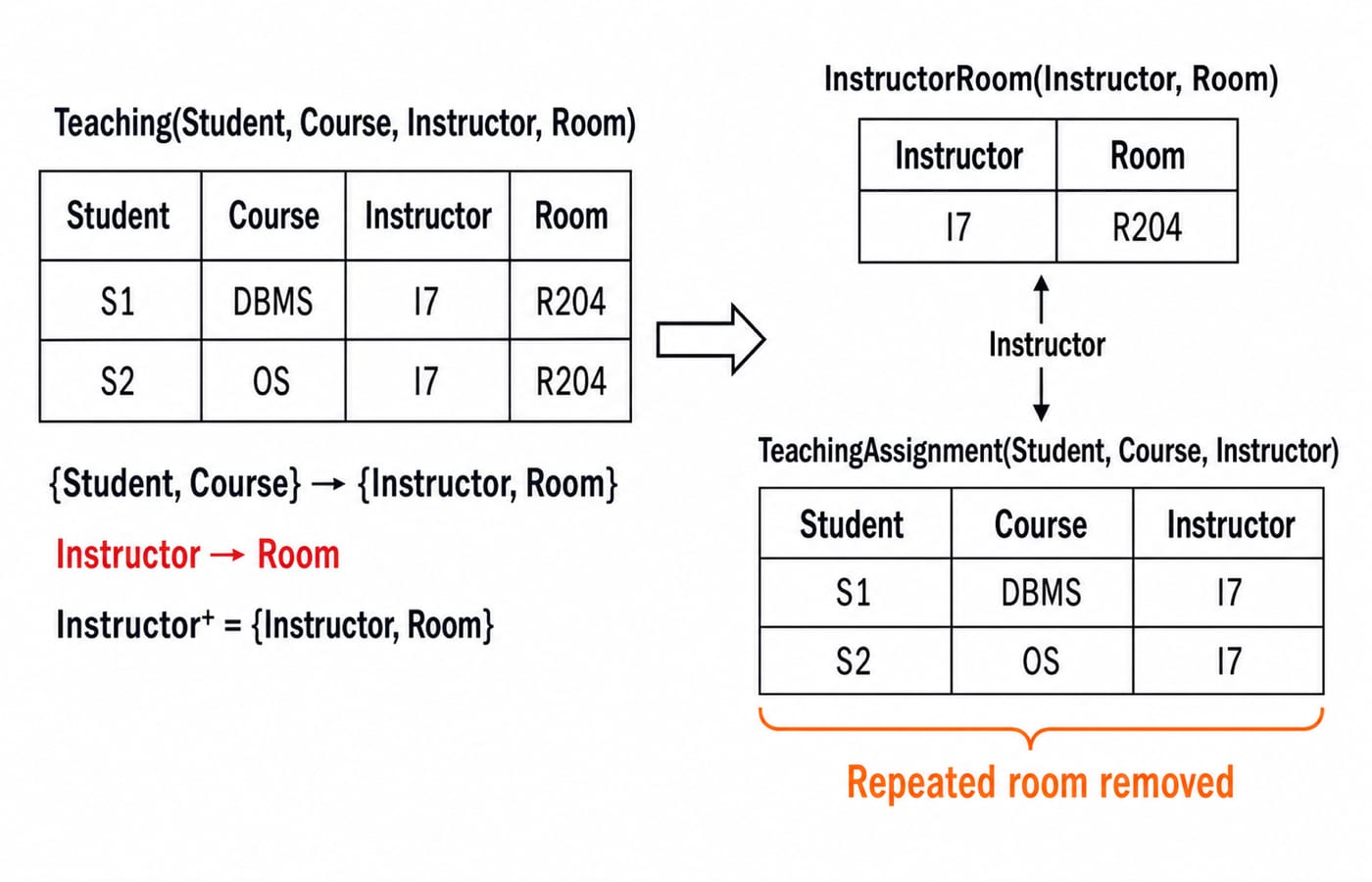
Consider Teaching(Student, Course, Instructor, Room) with {Student, Course} -> {Instructor, Room} and Instructor -> Room. Its rows are (S1, DBMS, I7, R204) and (S2, OS, I7, R204). Since {Student, Course}+ = {Student, Course, Instructor, Room}, {Student, Course} is a candidate key. But Instructor+ = {Instructor, Room} does not reach Student or Course. Therefore Instructor -> Room violates BCNF, and repeating (I7, R204) creates an update anomaly.
Decompose into InstructorRoom(Instructor, Room) with (I7, R204), and TeachingAssignment(Student, Course, Instructor) with (S1, DBMS, I7) and (S2, OS, I7). Common attribute Instructor keys InstructorRoom, so the join is lossless. Read Normalization in DBMS: 1NF to BCNF for the normal-form ladder.
BCNF definition and guaranteed-form MCQs
Question 1: identify the intended determinant condition
BEL 2023, Probationary Engineer.
In context of data normalization in database management system, relation is in Boyce-Codd Normal Form if and only if every determinant is a _____ .
A. Foreign key
B. Non-primary key
C. Alternate key
D. Candidate key
Answer: D. Candidate key.
Every other option names a key type that need not determine the rest of the tuple. Formally, each non-trivial determinant must be a superkey. Candidate keys are minimal superkeys, so D is the intended answer, though a determinant need not be minimal.
Question 2: recognise the always-BCNF schema size
Which of the following relation schema is always in BCNF?
A. R(A, B, C, D)
B. R(A, B, C)
C. R(A, B, C, D, E)
D. R(A, B)
Answer: D. R(A, B).
In a two-attribute relation, a non-trivial FD is A -> B or B -> A. Its determinant reaches both attributes, making it a superkey. Larger schemas lack this guarantee.
Question 3: highest form of a two-attribute employee relation
Consider a database relation Employee (SSN, Name). What is the highest normal form satisfied by the Employee relation?
A. 1 NF
B. 2 NF
C. 3 NF
D. BCNF
Answer: D. BCNF.
Under the intended semantics, SSN -> Name and SSN uniquely identifies an employee. Thus SSN is a candidate key and a superkey determinant, consistent with Question 2.
BCNF versus 3NF MCQs
Question 4: place BCNF inside the normal-form hierarchy
UGC NET December 2012, Computer Science.
Which of the following is true?
A. A relation in BCNF is always in 3NF
B. A relation in 3NF is always in BCNF
C. BCNF and 3NF are same
D. A relation in BCNF is not in 3NF
Answer: A. A relation in BCNF is always in 3NF.
BCNF requires superkey determinants. 3NF additionally permits a non-superkey determinant with a prime right side. Thus BCNF implies 3NF, but not conversely.
Question 5: identify the exact 3NF-but-not-BCNF exception
Consider a relational table R that is in 3NF, but not in BCNF. Which one of the following statements is TRUE ?
A. R has a nontrivial functional dependency X→A, where X is not a superkey and A is a prime attribute.
B. R has a nontrivial functional dependency X→A, where X is not a superkey and A is a non-prime attribute and X is not a proper subset of any key.
C. R has a nontrivial functional dependency X→A, where X is not a superkey and A is a non-prime attribute and X is a proper subset of some key.
D. A cell in R holds a set instead of an atomic value.
Answer: A. R has a nontrivial functional dependency X→A, where X is not a superkey and A is a prime attribute.
Option A is the 3NF exception removed by BCNF. A prime attribute belongs to a candidate key. B and C violate 3NF; D violates 1NF first.
Candidate keys and closures: find the first BCNF violation
Question 6: test a chain of determinants
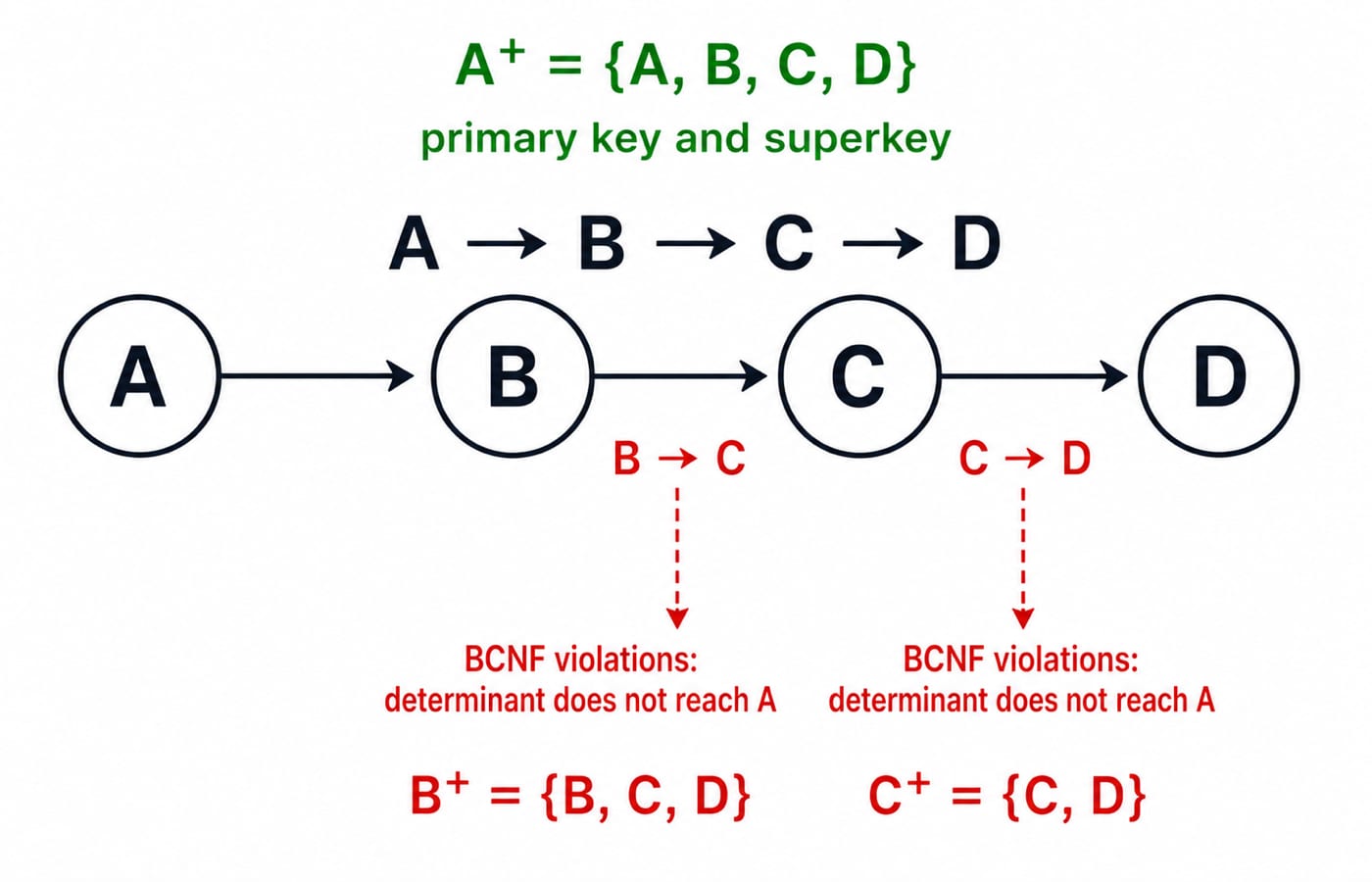
Consider a relation with attributes [A, B, C, D] and the following functional dependencies: A → B, B → C and C → D. If A is the primary key, which of the following is true regarding BCNF?
A. The relation is in BCNF because all determinants are super keys.
B. The relation is in 3NF but not in BCNF.
C. The relation is not in BCNF.
D. The relation is in BCNF because it is in 3NF.
Answer: C. The relation is not in BCNF.
A+ = {A, B, C, D}, so A is a key. But B+ = {B, C, D} and C+ = {C, D}; neither reaches A. Thus B -> C and C -> D violate BCNF, while their non-prime right sides also make 3NF fail.
Question 7: detect a partial dependency before checking BCNF
GATE 2008, Information Technology.
Let R (A, B, C, D, E, P, G) be a relational schema in which the following functional dependencies are known to hold: AB → CD, DE → P, C → E, P → C and B → G. The relational schema R is
A. in BCNF
B. in 3NF, but not in BCNF
C. in 2NF, but not in 3NF
D. not in 2NF
Answer: D. not in 2NF.
A and B never occur on an FD right side, so every key needs both. Applying AB -> CD, C -> E, DE -> P and B -> G gives AB+ = {A, B, C, D, E, P, G}. Neither alone reaches all attributes, so AB is a candidate key. Since B -> G makes non-prime G depend on proper subset B, 2NF fails, ruling out 3NF and BCNF.
Decomposition removes the partial dependency
Question 8: identify the weakest improvement after redesign
A database of research articles in a journal uses the following schema.
(VOLUME, NUMBER, STARTPAGE, ENDPAGE, TITLE, YEAR, PRICE)
The primary key is (VOLUME, NUMBER, STARTPAGE, ENDPAGE) and the following functional dependencies exist in the schema:
(VOLUME, NUMBER, STARTPAGE, ENDPAGE) → TITLE
(VOLUME, NUMBER) → YEAR
(VOLUME, NUMBER, STARTPAGE, ENDPAGE) → PRICE
The database is redesigned to use the following schemas:
(VOLUME, NUMBER, STARTPAGE, ENDPAGE, TITLE, PRICE)
(VOLUME, NUMBER, YEAR)
Which is the weakest normal form that the new database satisfies, but the old one does not?
A. 1NF
B. 2NF
C. 3NF
D. BCNF
Answer: B. 2NF.
In the old relation, (VOLUME, NUMBER) -> YEAR makes non-prime YEAR depend on a proper subset of the four-attribute key, violating 2NF. In the first new relation, the full key determines TITLE and PRICE; in the second, (VOLUME, NUMBER) is the key and determines YEAR. The redesign gains 2NF, even if its components reach stronger forms.
BCNF decomposition guarantees and trade-off MCQs
Question 9: find the dependency that BCNF decomposition cannot preserve
R(A, B, C, D) is a relation. Which of the following does not have a lossless join, dependency preserving BCNF decomposition?
A. A → B, B → CD
B. A → B, B → C, C → D
C. AB → C, C → AD
D. A → BCD
Answer: C. AB → C, C → AD.
For C, C+ = {A, C, D} excludes B, so C -> AD violates BCNF. Decompose into R1(C, A, D) and R2(B, C). Intersection C keys R1, making the join lossless, but AB -> C is not preserved because no component contains A, B and C. Lossless BCNF decomposition is always possible; full dependency preservation is not.
Question 10: select the correct normal-form statements
Consider the following statements regarding database normal forms:
1. Any relation with two attributes is BCNF.
2. Lossless, dependency-preserving decomposition into BCNF is always possible.
3. Lossless, dependency-preserving decomposition into 3NF is always possible.
4. BCNF is stricter than 3NF.
Which of the above statements are correct?
A. 1, 2 and 3
B. 1, 3 and 4
C. 1, 2 and 4
D. 2, 3 and 4
Answer: B. 1, 3 and 4.
Statement 1 follows from Question 2. Statement 2 is false because BCNF decomposition may lose dependency preservation, as Question 9 shows. Statement 3 holds for 3NF synthesis; statement 4 holds because BCNF removes 3NF's prime-right-side exception. Continue with DBMS Normalization MCQs: 12 Solved (1NF to BCNF) for mixed practice.
BCNF MCQs: diagnose the miss and take the next step
Questions 1 to 3 diagnose determinant and key vocabulary. Questions 4 and 5 test the 3NF prime-attribute exception. Questions 6 to 8 expose weak closure or partial-dependency work; Questions 9 and 10 clearly separate lossless join from dependency preservation.
Use this four-step revision algorithm:
List every non-trivial FD.
Find candidate keys by computing closures.
Test every determinant for superkey status.
If one fails, decompose, then test losslessness and dependency preservation separately.
Read DBMS Normalization Explained Simply for GATE for concept-first revision. Then redo Questions 5, 6, 8 and 9 without looking at the options. They test the 3NF exception, a closure-based violation, removal of a partial dependency and BCNF's preservation trade-off. Use GATE Guidance by Sanchit Sir as a structured next step.
Keep learning

SQL Library Functions MCQs: 12 Solved Math, Aggregate, String and Date Questions
Practise 12 solved SQL library function MCQs with inside-out calculations, exact intermediate values and clear explanations of the common traps.
Updated 3 Oct 20268 min readDBMS MCQs

SQL Introduction, Components & Structure MCQs: 12 Solved Questions
Test your SQL foundations with 12 explained MCQs covering terminology, query behaviour, metadata, dynamic SQL, database models and QBE.
28 Sep 20267 min readDBMS MCQs
GROUP BY Clause MCQs: 10 Solved SQL Questions with Explanations
Solve ten published GROUP BY questions, then check each answer with row-level and group-level reasoning. Two full traces make the common SQL traps visible.
Updated 25 Sep 20268 min readDBMS MCQs
Third Normal Form (3NF) MCQs: 12 Solved Questions with Explanations
Solve 12 real 3NF exam MCQs with clear explanations, candidate-key closures, a raw-row decomposition, and the prime-attribute exception that separates 3NF from BCNF.
Updated 24 Sep 20267 min readDBMS MCQs