IBPS SO Professional Knowledge Study Plan: An 8-Week Role-Specific Method
Build a role-specific eight-week plan that turns a wide specialist syllabus into testable blocks, then lets retrieval and sectional evidence direct your time.
KnowledgeGate Team
Exam prep & CS education
Updated 17 Aug 20266 min read66 views
Many aspirants give Professional Knowledge whatever time remains after common-section practice. Then revision begins, and the specialist syllabus proves too wide for random reading. Eight weeks is enough to change that, but only on three conditions: the syllabus for your exact post becomes a short list of concept blocks, every block carries an outcome you can test, and each week's hours follow last week's scores instead of a fixed timetable.
Fix the specialist role before building the study plan
Choose the role before choosing books. Open the current CRP Specialist Officers material on ibps.in, confirm your post, and copy only that post's Professional Knowledge syllabus into a working sheet. That material is the source of truth for cycle-specific roles, stages, paper structure, dates, eligibility, vacancies, and cut-offs.
One Professional Knowledge plan cannot use identical content for every specialist stream. An Agriculture Field Officer's paper sits on crop science and rural banking, while an IT Officer's sits on databases, networks and code, so the method carries across roles but the blocks never do. Treat the IT Officer plan that follows as a template: keep its six-block structure, its diagnostic and its retrieval schedule, and swap in the subjects from your own syllabus sheet. Check the IBPS course category for currently available preparation routes.
Turn the official syllabus into testable concept blocks
For this IT Officer example, organise study into six teaching blocks: DBMS and SQL; Operating Systems; Computer Networks and security; Data Structures and Algorithms; Software Engineering and testing; and programming and web fundamentals. Six blocks is a unit of scheduling, not a ranking. Which block earns extra hours is decided by the current notice and by your own count of how often each subject appeared in previous papers.
Now write outcomes that can be recalled and tested. Under DBMS, the four outcomes are keys and constraints, normalisation, SQL joins and aggregation, and transactions and concurrency. Keep one working-sheet row for each outcome and its latest test result. Replace “revise DBMS” with “derive a candidate key from functional dependencies, then solve 10 mixed key questions”. A task is useful only when you can tell whether it was completed correctly.
Use one diagnostic to decide where the hours go
Sit a 60-question baseline without notes, 10 questions per block, and mark it honestly. Suppose it comes back DBMS 8/10, Operating Systems 6/10, Networks and security 4/10, Data Structures and Algorithms 5/10, Software Engineering and testing 7/10, and programming and web fundamentals 3/10.
The total is 8 + 6 + 4 + 5 + 7 + 3 = 33, or 33/60 = 55%. Gaps from 10 are 2, 4, 6, 5, 3, 7, totalling 27. Give two of the next 10 study blocks to each of the four largest gaps: programming and web fundamentals, Networks and security, Data Structures and Algorithms, and Operating Systems. Give one each to DBMS and Software Engineering: 2 + 2 + 2 + 2 + 1 + 1 = 10.
This follows demonstrated gaps, not exam weightage. Tag every miss as one of concept gap, retrieval failure, misread condition, or rushed elimination. Recalculate after two weeks.
Follow an eight-week, 12-hour model with a real buffer
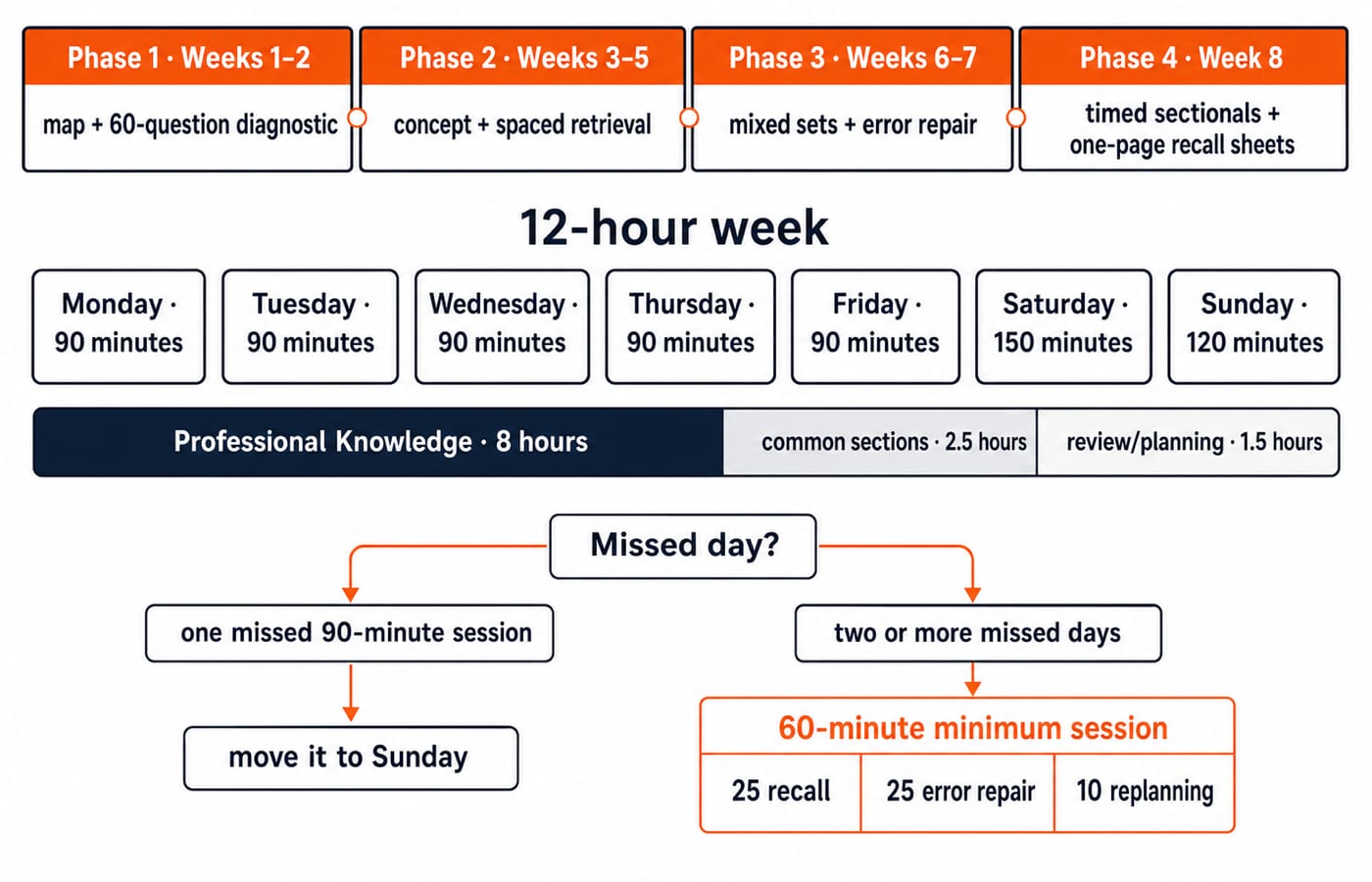
Use this week: Monday to Friday, 90 minutes each; Saturday, 150; Sunday, 120. 5 x 90 + 150 + 120 = 720 minutes, or 12 hours. Reserve 8 hours for Professional Knowledge, 2.5 for common sections, and 1.5 for review, planning, and error logging. 8 + 2.5 + 1.5 = 12 hours. The 1.5 hours of review is not spare capacity: it is when the error log gets read and next week's split gets decided.
Weeks 1 and 2: map the syllabus, take the diagnostic, and repair the four weakest blocks.
Weeks 3 to 5: learn concepts, retrieve them at spaced intervals, and solve topic sets.
Weeks 6 and 7: take mixed Professional Knowledge sets and revise from the error log.
Week 8: take timed sectionals and compress repeated errors into one-page recall sheets. Add a new source only for a repeated error.
Move one missed 90-minute weekday into Sunday's buffer. After two or more missed days, do not double the next sitting. Run 25 minutes recall + 25 minutes error repair + 10 minutes replanning, then resume. IT Officer learners can use the IBPS SO IT Mains course for sequenced Professional Knowledge.
Worked example: convert one DBMS concept into recall and tests
Suppose Unit(unit_id, unit_name) contains (10, Risk), (20, Digital), (30, Audit), while Ticket(ticket_id, unit_id) contains (501, 10), (502, 10), (503, 20). We need every unit and its ticket count, including units with no tickets.
SELECT u.unit_name, COUNT(t.ticket_id) AS ticket_count
FROM Unit u
LEFT JOIN Ticket t ON t.unit_id = u.unit_id
GROUP BY u.unit_id, u.unit_name;
Risk matches tickets 501 and 502, so its count is 2. Digital matches 503, so its count is 1. Audit has no match, but LEFT JOIN preserves it. Because COUNT(t.ticket_id) ignores the null joined value, the output is Risk 2, Digital 1, Audit 0. The trap matters: COUNT(*) would count Audit's preserved row and report Audit 1, while an INNER JOIN would remove Audit entirely.
Turn those values into five retrieval prompts:
Predict all three output rows.
Explain why Audit remains.
Predict Audit's result with
COUNT(*):1.Predict the
INNER JOINoutput: only Risk and Digital.Add
(504, 30)and predict Audit's new count:1.
Use the IBPS SO IT Officer DBMS guide for the deeper concept lesson after practising this conversion.
Repeat a learn, retrieve, test and repair loop
Apply one cycle to every block. Day 0 is 35 minutes learning + 10 minutes closed-book recall + 15 minutes for 10 questions. Day 2 is 10 minutes recall + 20 minutes for 12 mixed questions + 10 minutes review. Day 7 is 25 minutes for a 20-question mixed set + 20 minutes review. Day 9 repeats the Day 7 format on fresh questions. Write the corrected rule before a new topic.
Suppose the results are Day 0 6/10 = 60%, Day 2 9/12 = 75%, Day 7 16/20 = 80%, and Day 9 17/20 = 85%. Return the block to normal rotation only after two consecutive mixed sittings reach 80%. One sitting at 80% can be a friendly question mix; two in a row on different mixes is evidence. Next, use the IBPS SO IT Officer networking guide with the same retrieval timings.
Let sectional-test evidence rewrite the plan
Sit a 40-question mixed set under exam timing. Suppose Set 1 returns 36 attempts, 28 correct, 8 wrong, and 4 unattempted. Attempt accuracy is 28 / 36 x 100 = 77.8%. Tag the errors as four concept gaps, three retrieval failures, and one misread condition. Repair those questions before another set.
Suppose Set 2 returns 34 attempts, 29 correct, 5 wrong, and 6 unattempted. Accuracy is 29 / 34 x 100 = 85.3%. Fewer attempts can show a better decision process. Compare accuracy, repeated errors, and time per correct response. Every Saturday, move one block towards the largest error category. Keep one-page sheets only for rules missed twice.
The short version and the next action
Confirm the role, map its syllabus, diagnose each block, protect Professional Knowledge hours, retrieve on Days 0, 2, and 7, and let evidence move next week's time. IT Officer readers can pair the Mains route above with the IBPS SO IT Prelims course for first-stage preparation. Now build the six-row diagnostic sheet and book your 60-question baseline for this weekend.
Keep learning
IBPS SO IT Officer Syllabus: What to Study for Each Section
Separate the official IBPS exam structure from the detailed study map. See what to cover for English, Reasoning, Quantitative Aptitude, Professional Knowledge and Descriptive English.
Updated 21 Oct 20264 min readIBPS Exams
IBPS SO IT Officer Preparation Strategy: A 16-Week Phase-by-Phase Plan
Turn 18 weekly hours into a realistic IBPS SO IT Officer plan, from the first diagnostic to mock repair, tapering and a conditional next-stage bridge.
Updated 17 Oct 20266 min readIBPS Exams
IBPS SO IT Officer Exam Pattern and Marking Scheme: Prelims, Mains and Interview
Understand the CRP SPL-XVI stage sequence, section timings and marks, then use worked score calculations and a 12-hour study plan to prepare for each stage.
Updated 13 Oct 20264 min read115 viewsIBPS Exams
IBPS Clerk Eligibility and Selection Process: From Application to Allotment
Separate the eligibility gate from the selection gate using a dated checklist, three candidate profiles and a 124-to-62 Main-score example.
Updated 8 Oct 20264 min readIBPS Exams