IBPS SO IT Officer Professional Knowledge: a subject topic map
An IBPS SO IT Officer Professional Knowledge topic map: the CS subjects the Mains paper draws on, the sub-areas to focus on, and how to study each of them.
KnowledgeGate Team
Exam prep & CS education
8 Jul 20265 min read1.1k views
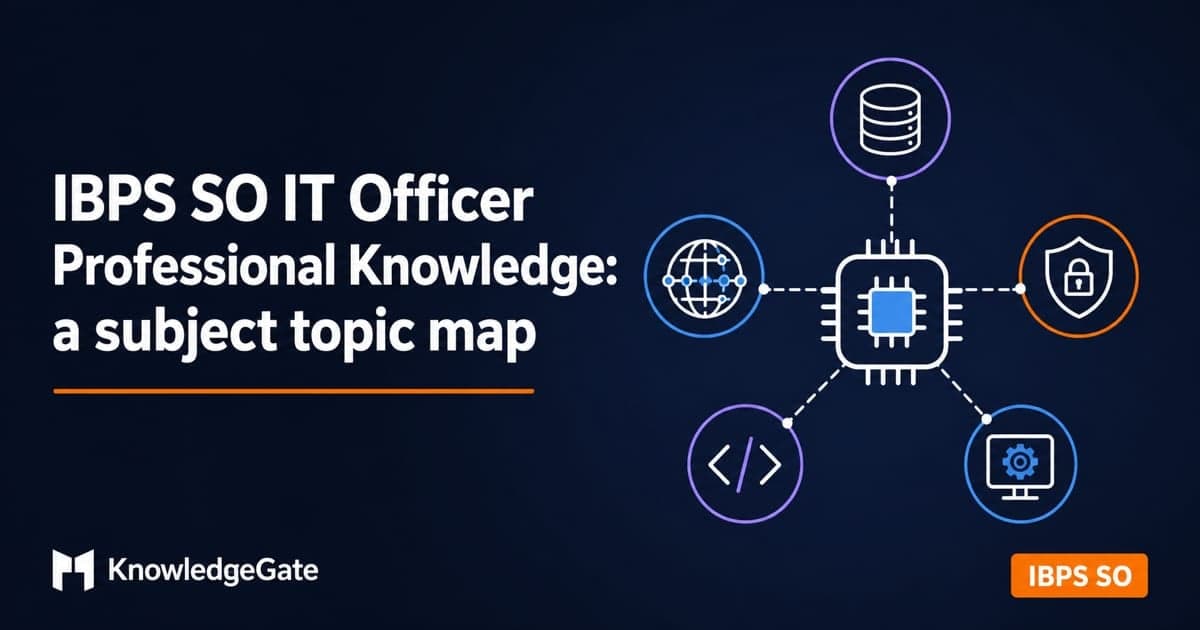
For the IBPS SO IT Officer (Scale-1), the Professional Knowledge paper in Mains is where the selection actually happens. It draws on the core computer science syllabus, and because one paper spans all of it, no single subject gets the runway a semester course gives it. Six subjects share that paper, so the question that matters is not what the syllabus contains but which parts of it repay study first, and how deeply.
The exact question count, sectional timing, marks and negative marking are fixed by the current notification at ibps.in, and subject emphasis shifts between cycles, so read the recent Professional Knowledge papers alongside it before you divide up your hours.
Database Management Systems
DBMS is a dependable, high-return subject for an IT Officer aspirant because its core is finite and heavily tested.
The relational model and keys, including primary, candidate, and foreign keys.
Normalisation, first through third normal form and BCNF, with the functional-dependency reasoning behind them.
SQL, queries, joins, and aggregate functions.
Transactions and concurrency, ACID properties and the basics of isolation.
Normalisation and SQL are the parts most worth mastering, because they are both testable and directly relevant to a banking IT role. IBPS SO IT Officer DBMS takes the same sub-areas further, including normalization worked step by step.
Computer Networks and Data Communication
Networks is a broad subject, so anchoring it to the layered models keeps it manageable.
The OSI and TCP/IP models, and what each layer does.
Protocols and addressing, IP addressing and subnetting, and the common application-layer protocols.
Switching, routing, and error control at a conceptual level.
Network security basics, the common attack types and the terms used to describe them.
Learn the layered model first as a scaffold, then hang the protocols and addressing details on it. Subnetting is worth targeted practice because it is both testable and easy to get wrong under time pressure. IBPS SO IT Officer Networking goes through the same list area by area.
Operating Systems
Operating Systems is core to the paper and rewards conceptual clarity over memorisation.
Processes and scheduling, the process lifecycle and the common CPU scheduling algorithms.
Memory management, paging, and virtual memory.
Process synchronization and deadlocks, the classic problems and their handling.
Scheduling, memory management and deadlock handling carry most of the conceptual load in this subject, and IBPS SO IT Officer Operating Systems works through each of them at the depth this paper expects.
Data Structures and Algorithms
This subject tests whether you understand structures and their costs, not whether you can write production code.
Core data structures, arrays, linked lists, stacks, queues, trees, and graphs.
Sorting and searching, and their time complexities.
Complexity analysis, reading the efficiency of an approach in Big-O terms.
Focus on knowing each structure's operations and their complexities cold, because that is the level the paper tests. IBPS SO IT Officer Data Structures adds hashing, sorting comparisons and the C basics that sit alongside them.
Computer Organization and Architecture
Computer Organization is finite and mostly formula-free, which makes it one of the cheaper subjects to secure once the memory hierarchy is clear in your head.
Number systems and Boolean logic, binary and two's complement arithmetic, and the gate-level identities.
CPU organization, the instruction cycle, registers, and addressing modes.
Memory organization, the hierarchy from registers down to disk, and cache mapping.
Input and output, interrupts, DMA, and bus basics.
Addressing modes and cache mapping deserve a slow first pass, because both are easy to answer confidently and wrongly. IBPS SO IT Officer Computer Organization covers the full list in sub-area order.
Software Engineering and Programming Concepts
Software Engineering and programming concepts test recognition rather than problem-solving: you need to know what each named term means and where it sits in the process, because guessing from the term alone is what costs marks.
Software Engineering, the software development life cycle, common process models, and the basics of testing.
Programming concepts and web technologies, language fundamentals and the basics of how the web works.
These reward familiarity rather than depth, so a careful pass plus previous-year questions usually suffices. Do not, however, skip them entirely on the assumption that the "hard" subjects carry the paper, because in a tightly ranked exam the easier marks you leave on the table are exactly the ones your competition collects. IBPS SO IT Officer Software Engineering runs through the SDLC, process models, requirements and testing in that order.
Sequencing the subjects in three study tiers
Three tiers are enough to sequence these six subjects. The first tier, the finite high-return subjects of DBMS, Operating Systems and the core of Data Structures, deserves your deepest and earliest study. The second tier, Computer Networks, Computer Organization and the algorithmic side of Data Structures, rewards a solid conceptual pass anchored to models and complexity. The third tier, Software Engineering with programming and web basics, rewards familiarity and previous-year practice. Sequencing it that way means the subjects you can rely on are the ones you built first, and nothing scoreable is left completely unprepared.
How to study the Professional Knowledge paper
Four habits decide how much of this syllabus actually converts into marks.
Go for genuine understanding. Mains ranks you, and the paper rewards the kind of knowledge that survives a follow-up twist, not last-week memorisation.
Prioritise the finite, high-return subjects. DBMS, Operating Systems, and the core of Data Structures give reliable marks for the study time, so build them solid first.
Use previous-year papers to read the emphasis. They tell you where recent cycles have actually concentrated, so let them set the depth you give each subject.
Remember the transfer. This same CS core is tested by GATE, UGC NET, and campus placements, so the preparation you do here is not single-use.
Your next step
Treat the Professional Knowledge paper as the decider it is: map the subjects, master the finite high-return ones first, study for understanding, and let previous-year papers set your emphasis.
If you want this paper structured end to end, the IBPS SO IT Officer (Scale-1) bundle covers Prelims, Mains and Interview together, and the IBPS SO IT Mains course is built specifically around this Professional Knowledge syllabus. The full banking line-up sits on the IBPS category page. Confirm the current pattern and subject emphasis in the official IBPS notification before you fix your study hours.
Keep learning
NABARD Grade A Finance Preparation: Resources and an 8-Week Plan
Build a Finance specialist study plan around accounting, calculations and management applications. Use a 12-hour weekly schedule, a worked project appraisal and an error-based review routine.
5 Oct 20265 min readBanking Exams
LIC AAO Preparation for Repeat Attempts: A Six-Week Reset Plan
Familiar chapters need a sharper review method. Use your previous attempt and recent errors to plan six weeks of focused repair, protected mains work and manageable retests.
30 Sep 20265 min readBanking Exams
RBI Grade B Preparation Strategy: A 16-Week Phase-by-Phase Plan
A working aspirant must build early-stage speed without leaving economics, finance, management and writing cold. This plan turns 15 hours a week into foundations, timed practice, mock repair and a post-Phase-I bridge.
Updated 27 Aug 20265 min readBanking Exams
RBI Grade B Syllabus 2026: Phase 1 and Phase 2 Decoded
Separate RBI's official General Cadre syllabus from practical study buckets, then use diagnostics and worked examples to build a balanced weekly plan.
Updated 26 Aug 20265 min read56 viewsBanking Exams