IBPS PO Interview Preparation: A 14-Day Bank-Awareness and Personal-Fit Plan
Build concise, adaptable IBPS PO interview answers from truthful evidence: four answer banks, banking-awareness cards, scenario drills and a 14-day schedule.
KnowledgeGate Team
Exam prep & CS education
Updated 20 Aug 20266 min read
Written-exam preparation gives you notes and scores. An interview asks for something different: concise spoken evidence, current awareness and sound judgement under follow-up questions. Fourteen days at forty to sixty minutes a day is enough to get there, provided the time goes into prepared material rather than a memorised script. Wider banking-exam material sits in the Banking & Insurance preparation hub.
Build four answer banks before trying to sound polished
Create four folders:
Personal fit: 5 prompts plus one 60-second introduction.
Graduation/work history: 4 evidence stories.
Banking awareness: 12 concept cards plus 4 dated updates.
Scenarios: 6 decision drills.
That is 5 + 4 + 12 + 4 + 6 = 31 prepared items, not scripts. Give each a question/concept, 3-5 point answer spine and likely follow-up.
Allocate 180 minutes to personal fit/history, 240 to awareness, 120 to scenarios and 180 to mocks/review. 180 + 240 + 120 + 180 = 720 minutes = 12 hours. Awareness takes the largest share because it is the only one of the four that goes stale before the panel. Aim for controlled recall with room to adapt.
Write a 60-second introduction from evidence, not adjectives
Use four parts: identity/education, experience, evidenced strength and role-fit close. Omit family history, chronology and unsupported adjectives.
Model answer, roughly 55 to 65 seconds: “I am Neha, a B.Com graduate from 2023. I spent 10 months in customer support, handling about 35 tickets daily. When incomplete hand-offs slowed cases, I made a checklist for four fields: status, owner, deadline and customer contact. In six weeks, incomplete escalations fell from eight weekly to three. This taught me careful customer service and process discipline. I want to bring those habits to a PO role, learn banking operations and accept greater customer responsibility.”
Identity: B.Com, 2023
Experience: 10 months, 35 tickets/day
Strength: 4 fields, 8 to 3
Fit: service, discipline, learning
Practise: “What were the four fields?”, “What did you do when a ticket could not be resolved?” and “Why does that experience fit a PO role?” Find more models in these general HR interview questions and answers.
Turn graduation or work history into proof of personal fit
Build each 75-90 second story as context -> responsibility -> action -> result -> banking relevance, with one verifiable detail and a lesson.
Working-candidate version: Neha traced 8 incomplete weekly hand-offs through 20 cases. Status, owner, deadline and customer contact were often missing. Her 4-field check reduced the count to 3 after 6 weeks. She learned that reliable service needs accurate hand-offs.
Fresher version: Aman, a B.Sc. graduate, coordinated a 5-member, 4-week project. His 12-item sheet exposed a missing dataset 2 days before submission. The team recovered it and delivered with all 12 checks complete. He learned to surface risks early.
Use true numbers. For “Why banking after this degree or job?”, connect skills to customer responsibility, accuracy, learning and generalist decisions. Never insult your field, call government work easy or lead with job security.
Prepare banking awareness as explain, apply and update cards
Split 12 evergreen cards into four groups of three:
Institutions/products: RBI functions; bank versus NBFC; savings, current and fixed deposits.
Customer controls: KYC; AML; nomination.
Payments: UPI; NEFT; RTGS.
Lending/economy: secured versus unsecured credit; NPA concept; policy-rate transmission.
Each concept card carries two layers. Explain: a definition of at most 20 words and a three-step mechanism. Apply: one concrete effect on a customer or on the bank, plus the follow-up you would least like to be asked. The third layer, update, lives on its own set of four cards.
Worked transmission card: On an illustrative rate rather than a current one, a benchmark moves from 6.00% to 6.50%. 6.50% - 6.00% = 0.50 percentage point; 0.50 x 100 = 50 basis points. Three steps are benchmark change -> bank funding/lending review -> possible product-rate adjustment. Then answer the follow-up before it arrives: transmission is neither complete nor immediate. Loans tied to an external benchmark reprice on their stated reset date, while deposit rates and older MCLR-linked loans move later, and by less.
For 4 update cards, record the change, previous/new value if officially stated, release date, official source and significance. Refresh within 48 hours. Use the static-plus-current banking-awareness method for the wider revision routine; here you need only the four updates you can explain in your own words.
Answer scenario questions with rules, service and escalation
Use five steps: clarify facts, protect customer/bank, follow rules, offer the next permitted action, escalate/document. Never invent policy or exceed authority.
Queue scenario: 12 customers wait. An elderly customer lacks one required detail; another asks you to skip it 15 minutes before a service cut-off. Answer: “I would acknowledge the urgency without bypassing control. I would confirm the gap, check for an approved alternative and explain the next permitted action to both customers. If needed, I would ask a senior and record the hand-off.”
Cyber-safety mini-scenario: A supposed bank caller requests an OTP to reverse a disputed UPI debit. Stop disclosure, use a verified official channel, secure/report the account as applicable and escalate.
Score clarity, rule awareness, empathy, next step and escalation judgement from 0-2: 5 x 2 = 10. Retire after two 8/10 recordings.
Mine interview transcripts for themes, not predictions
Candidate recollections, posted to forums and coaching groups in the days after a panel, tell you which areas keep coming back. They cannot tell you what you will be asked. Use at least 3 recent ones, note source and date on each, and discard any claim you cannot check.
Tag every prompt by type: P for personal fit, H for history, A for awareness, S for scenario. Three sample sheets:
Sheet 1: P “Tell us about yourself”; H “Why banking after B.Tech?”; A “What does RBI do?”; S “A customer disputes a debit; what do you do first?”
Sheet 2: P “Would you accept a rural posting?”; H “A project lesson?”; A “How is UPI different from NEFT?”; S “A customer seeks a bypass. Respond.”
Sheet 3: P “Prove one strength”; A “Why KYC?”; A “Secured versus unsecured credit?”; S “A caller asks for an OTP. Respond.”
Tally: P=3 + H=2 + A=4 + S=3 = 12. Split the next 100 minutes to match, rounded to workable blocks: P 25 + H 15 + A 35 + S 25 = 100 minutes. Redo the tally every three new sheets rather than trusting the first count.
Follow a 14-day plan with two recovery blocks
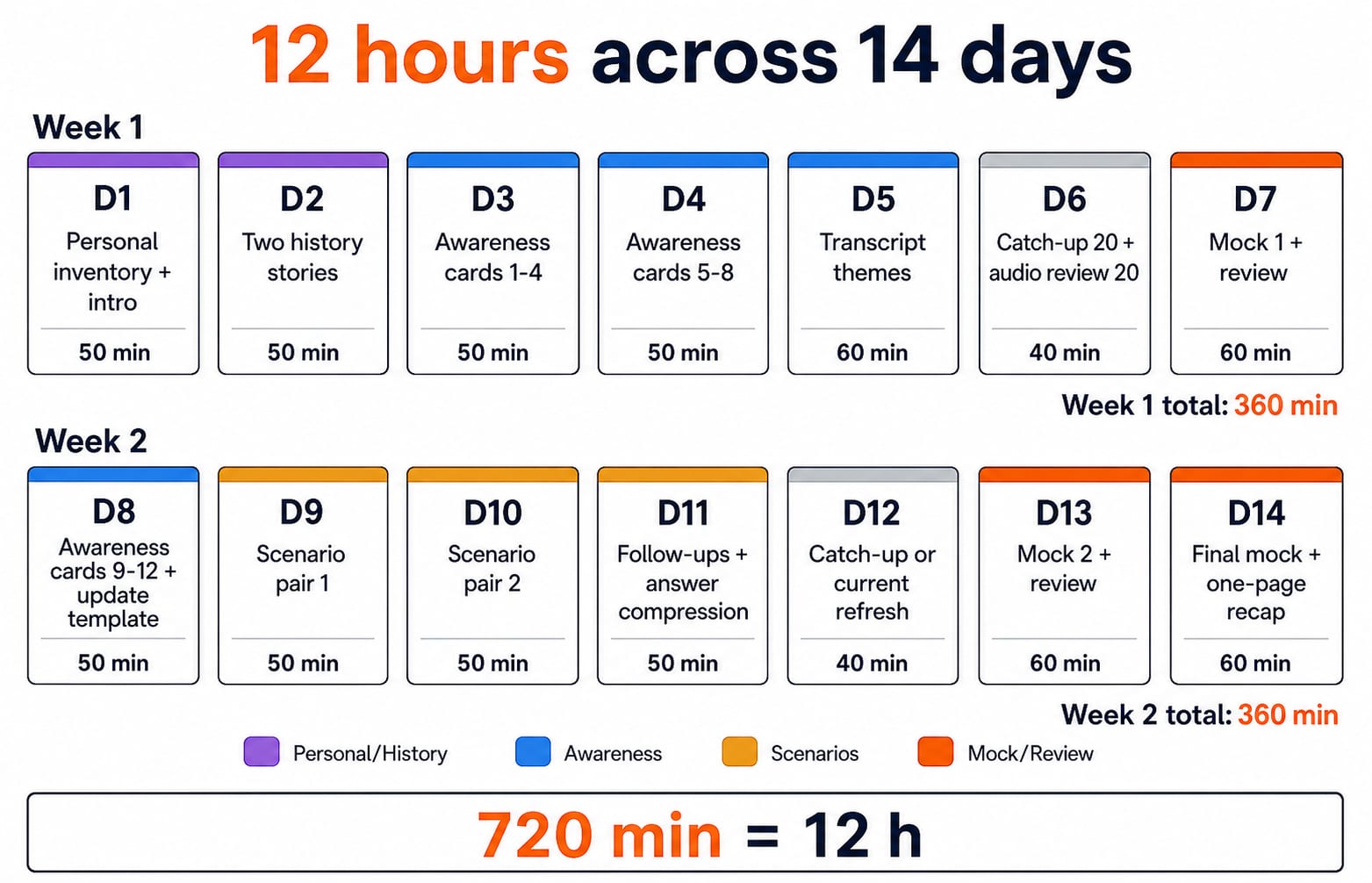
Week 1: days 1-4 use 50 minutes each for personal inventory/first introduction, two history stories/follow-ups, awareness cards 1-4, then cards 5-8. Day 5: 60 for transcripts; day 6: 20 catch-up plus 20 audio review; day 7: 60 for mock 1/review. 4 x 50 + 60 + 40 + 60 = 360 minutes.
Week 2: day 8 uses 50 for cards 9-12/update template; days 9-11 use 50 each for scenario pairs, cross-questioning, then answer compression; day 12: 40 for recovery/current refresh; days 13-14: 60 each for mock 2, then final mock, comparison and recap. 4 x 50 + 40 + 60 + 60 = 360. Total: 360 + 360 = 720 minutes = 12 hours.
Missed a day? Move its essential 20-minute unit to the next recovery block. Never double a later day to 100 minutes. Drop a duplicate recording before a weak theme. If the written stages are still ahead of you, the Bank PO prelims-versus-mains preparation split covers that ground first.
Run the final mock, keep the short version and take the next step
Run a 24-minute final mock: one introduction, one history/fit follow-up, two awareness questions and two scenarios, 6 prompts total. Apply the 10-point rubric, then spend 12 minutes on filler, unsupported claims and missed follow-ups. Score all three mocks on the same rubric; the trend across the sittings tells you more than any single number. Interview dates, the call-letter window and the weight the interview carries are set out in the official IBPS notification at ibps.in.
The short version: use truthful evidence, explain plainly, refresh sourced facts, practise judgement and index transcript themes. Record and score your 60-second introduction now. The IBPS PO Mains course carries the written-stage work if a later attempt is in view; the four answer banks stay yours to build either way.
Keep learning
IBPS SO IT Officer Last 60 Days Plan: Daily Revision and Mock Schedule
Turn the final 60 days into a repeatable cycle of diagnosis, focused revision, timed practice, mock analysis, repair, retesting, and a calm taper.
Updated 25 Oct 20265 min readIBPS Exams
IBPS Clerk Cutoff Trends: Set a Defensible Target Score
Turn comparable official cutoff values into a practical working target, then use mock accuracy and consistency to decide what to repair next.
Updated 24 Oct 20264 min readIBPS Exams
IBPS SO IT Officer Syllabus: What to Study for Each Section
Separate the official IBPS exam structure from the detailed study map. See what to cover for English, Reasoning, Quantitative Aptitude, Professional Knowledge and Descriptive English.
Updated 21 Oct 20264 min readIBPS Exams
IBPS SO IT Officer Preparation Strategy: A 16-Week Phase-by-Phase Plan
Turn 18 weekly hours into a realistic IBPS SO IT Officer plan, from the first diagnostic to mock repair, tapering and a conditional next-stage bridge.
Updated 17 Oct 20266 min readIBPS Exams