IBPS PO Reasoning Preparation: An 8-Week Puzzle-to-Mock Ladder
Build reasoning skill in a fixed sequence, from reliable singles and seating diagrams to multi-variable grids, set selection, and mock analysis.
KnowledgeGate Team
Exam prep & CS education
Updated 1 Aug 20266 min read
Some aspirants postpone puzzles until their basics feel perfect; others force the first difficult set. Eight weeks at eight hours a week takes you from reliable singles through seating and multi-variable grids to set selection and two sectionals. The IBPS PO and SO preparation tracks list the courses for both stages.
1. Start With a 30-Question Baseline and Measure More Than the Score
Build a diagnostic: 5 inequalities, 5 syllogisms, 5 direction or blood-relation questions, 5 order or ranking questions, and two 5-question puzzle sets. Attempt singles before sets, timing each family. Use the Bank PO reasoning topic guide to name your baskets, so your error log and practice sets share one vocabulary.
For 16 correct + 7 wrong + 7 unattempted = 30, attempts are 23. Attempt rate is 23/30 = 76.7%; accuracy is 16/23 = 69.6%; puzzle accuracy is 3/10. Classify the 14 non-correct items as 5 concept gaps + 3 diagram errors + 2 condition-reading errors + 4 time-based skips. Repair concept gaps first in W1; a skip is not automatically a concept weakness.
2. Use an 8-Hour Weekly Engine That Has a Bad-Week Floor
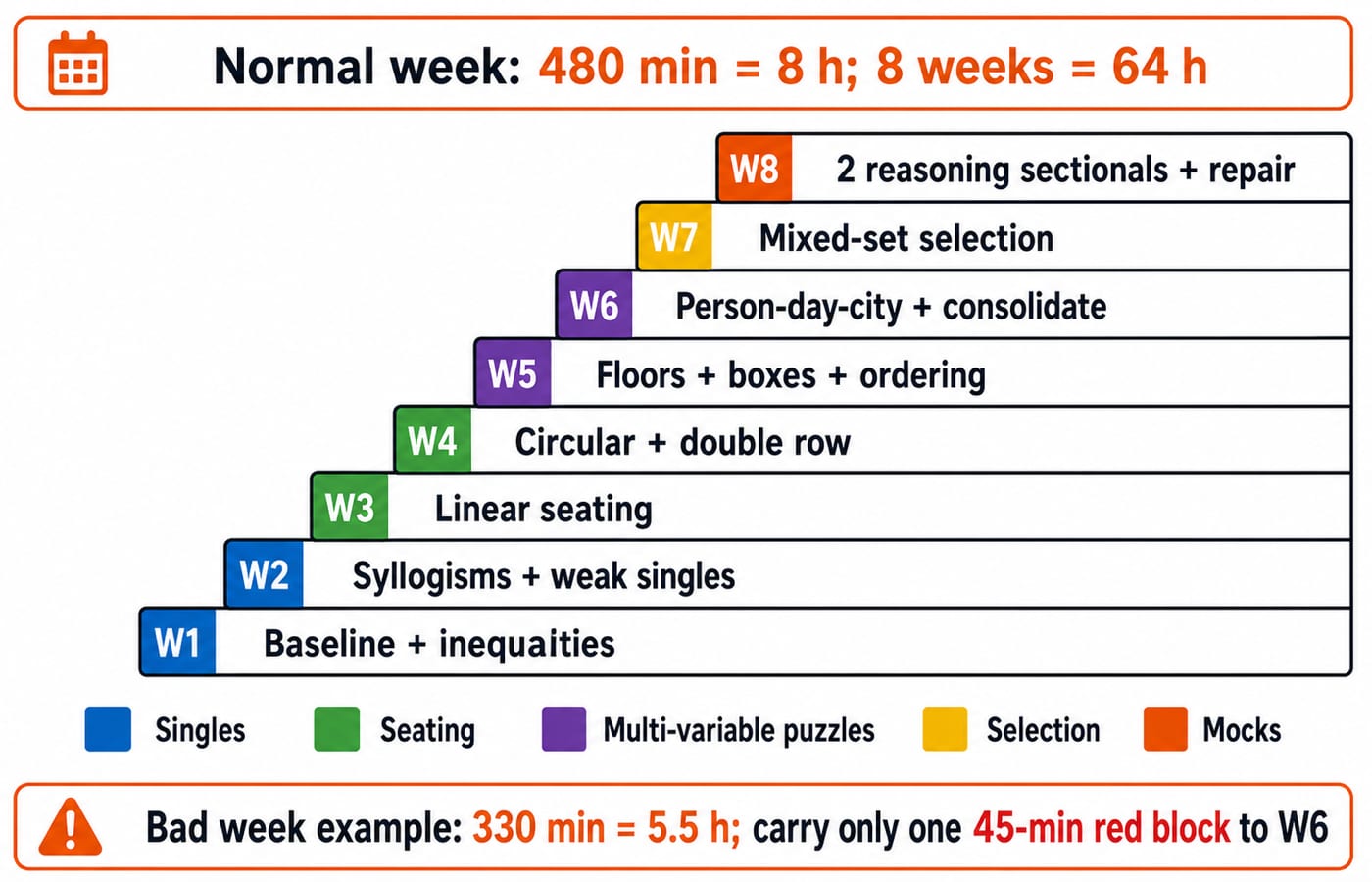
Schedule 45 minutes on Monday, Tuesday, Thursday, and Friday; 45 recovery minutes on Wednesday; 150 on Saturday; and 105 on Sunday. Thus 4 x 45 = 180, then 180 + 45 + 150 + 105 = 480 minutes = 8 hours.
Weekly focus: W1 inequalities and baseline repair; W2 syllogisms and weak singles; W3 linear seating; W4 circular and double-row seating; W5 floors, boxes, and ordering; W6 person-day-city grids and consolidation; W7 set selection; W8 two sectionals and repair.
Missing Tuesday and Thursday loses 90 minutes; losing 60 more Saturday gives 480 - (90 + 60) = 330 minutes = 5.5 hours. Recover priority work Wednesday, carry one 45-minute red block into W6 at most, and cancel the rest.
3. Weeks 1-2: Make Inequalities and Syllogisms Reliable Before Chasing Speed
For P >= Q > R = S < T <= U, test each relation. P > R follows from P >= Q > R; Q < T is indeterminate because Q > R = S < T points away from the shared middle; U > S follows from S < T <= U; P < U is indeterminate.
Given “All clerks are graduates. Some graduates are coders. No coder is a manager”, I, “Some graduates are not managers”, follows through the coders. II, “Some clerks are coders”, and III, “No clerk is a manager”, do not. Draw stated overlaps only; never reverse “all”.
Use 3 hours for concepts and diagrams, 2 for topic sets, 90 minutes for mixed singles, 1 hour for error replay, and 30 minutes as buffer. Total: 8 hours. Advance after 8/10 on two fresh sets, explaining every error aloud. One clean set is luck; two in a row is a signal.
4. Weeks 3-4: Build Seating Diagrams From the Most Constraining Clues First
Place fixed positions first, then immediate pairs and distance chains; save negative clues for elimination. Leave W3's first two linear sessions uncapped and record construction and review separately. Add circular and double-row sets in W4 once you can redraw a six-seat north-facing row without changing orientation.
Example: Charu is second right of Asha; Bharat immediately left of Charu; Deepak at one end; Farhan immediately right of Deepak; Esha not adjacent to Asha. Deepak and Farhan must be seats 1 and 2. Asha 4, Charu 6, Bharat 5 forces Esha into seat 3 beside Asha, so it fails. Valid: 1 Deepak | 2 Farhan | 3 Asha | 4 Bharat | 5 Charu | 6 Esha.
Two clues did the work. Deepak at one end with Farhan immediately right pinned seats 1 and 2 outright, and Esha not adjacent to Asha killed the only rival arrangement. Re-solve from blank space the next day.
5. Weeks 5-6: Add One Variable at a Time, Then Solve a Complete Grid
Move to floors or boxes in W5, then a person-day-city grid in W6. Separate people-day and people-city tables. Mark the decisive clue, main chain, and final negative condition.
Take Kabir, Meera, Nitin, and Riya; Monday to Thursday; Jaipur, Kochi, Pune, and Ranchi. Nitin is Monday; Meera is immediately before Riya; Riya is from Kochi; Jaipur is Tuesday; Meera is not from Jaipur; Pune is before Meera.
Meera Tuesday, Riya Wednesday fails because Tuesday is Jaipur. Therefore Meera is Wednesday, Riya Thursday, Kabir Tuesday, and Nitin Monday. Cities resolve to Nitin-Pune, Kabir-Jaipur, Meera-Ranchi, Riya-Kochi. Checks: Meera is Wednesday, Kabir is Jaipur, and Thursday is Riya-Kochi.
W6 uses 3 hours for fresh grids, 2 for W3-W5 error re-solves, 90 minutes for singles, 1 hour for a mixed set, and 30 minutes buffer. Total: 8 hours. Put the permitted carried 45-minute block here.
6. Week 7: Choose Sets With Evidence and Stop Forcing Weak Starts
Scan for 90 seconds. Green has two fixed placements and a usable chain; amber has one anchor and open branches; red is speculative. Attempt green first. If 2 minutes 30 seconds produces no stable placement, leave the set and return after the questions you can bank. Rehearse the stop weekly so obeying it costs nothing on exam day.
In a 20-question block, log singles 4/5 in 4 minutes; linear 5/5 in 7; circular 3/5 in 11; floor-profession left after 3 minutes without a stable placement. Total: 4 + 7 + 11 + 3 = 25 minutes and 4 + 5 + 3 = 12/20 correct. You banked green linear questions and stopped forcing red floors.
Review for 10 + 10 + 15 = 35 minutes: the single error, two circular errors, then an untimed floor rebuild. Change set order next time to test selection, not memory.
7. Week 8: Add Sectional Mocks, Analyse Decisions, Then Bridge to Full Mocks
The IBPS CRP PO/MT-XVI Detailed Notification dated 30 June 2026 specifies 35 Reasoning Ability questions, 40 maximum marks, and 20 separately timed preliminary minutes. A wrong objective answer loses one fourth of that question's marks. That is 20 x 60 / 35 = 34.3 seconds per question, so a 90-second scan and a hard stop rule protect more marks than raw speed.
Take matching sectionals early and late in W8. For 23 correct + 4 wrong + 8 unattempted = 35, attempts are 27. Attempt rate is 27/35 = 77.1%; attempted accuracy 23/27 = 85.2%; overall correct rate 23/35 = 65.7%. Each question carries 40/35 = 1.143 marks, so those 4 wrong answers cost 4 x 0.25 x 1.143 = 1.14, about one question. Compare only against mocks on the same 35-question, 40-mark section.
Classify 12 non-correct items as 3 concept or diagram errors + 1 rushed read + 5 skipped puzzle questions + 3 late singles. Allocate 2 hours to attempts, 3 to analysis, 90 minutes to repair, 1 hour to the skipped set, and 30 minutes buffer. Total: 8 hours. Use the prelims versus mains preparation guide to plan the Mains transition.
8. The Short Version: Climb the Ladder and Keep a Written Stop Rule
Take the rungs in order: baseline, singles, seating, grids, set selection, sectionals. Full mocks come after the eight weeks, not during them. Seek cleaner diagrams, fewer repeated errors, and better choices, not a promised score.
Protect the 8-hour ceiling, accept a 5.5-hour bad week, and carry one 45-minute red block at most. Keep the 90-second scan and 2-minute-30-second stop rule. Take the baseline today. Use the IBPS PO Prelims course for first-stage structure, then the IBPS PO Mains course for the 40-question, 45-minute Mains reasoning section.
Keep learning
IBPS Clerk Cutoff Trends: Set a Defensible Target Score
Turn comparable official cutoff values into a practical working target, then use mock accuracy and consistency to decide what to repair next.
Updated 24 Oct 20264 min readIBPS Exams
IBPS SO IT Officer Syllabus: What to Study for Each Section
Separate the official IBPS exam structure from the detailed study map. See what to cover for English, Reasoning, Quantitative Aptitude, Professional Knowledge and Descriptive English.
Updated 21 Oct 20264 min readIBPS Exams
IBPS SO IT Officer Preparation Strategy: A 16-Week Phase-by-Phase Plan
Turn 18 weekly hours into a realistic IBPS SO IT Officer plan, from the first diagnostic to mock repair, tapering and a conditional next-stage bridge.
Updated 17 Oct 20266 min readIBPS Exams
IBPS SO IT Officer Exam Pattern and Marking Scheme: Prelims, Mains and Interview
Understand the CRP SPL-XVI stage sequence, section timings and marks, then use worked score calculations and a 12-hour study plan to prepare for each stage.
Updated 13 Oct 20264 min read133 viewsIBPS Exams