Fuzzy Sets in Artificial Intelligence: Membership Functions, Operations, and Worked Examples
Learn fuzzy sets through one age-based example, from membership grades and alpha-cuts to max-min relation composition. Includes exact exam traps and revision rules.
KnowledgeGate Team
Exam prep & CS education
Updated 25 Jul 20266 min read
You already know ordinary set theory, but an AI syllabus can suddenly allow an element to belong to a set partially. The definitions look simple, yet one swapped max or min, or one wrong membership grade, can cost the mark. The whole topic turns on a single move: replace the yes/no characteristic function with a grade in [0, 1], and every set operation you learned there has to be rebuilt around max and min. One age-based example is enough to watch all of it happen.
From crisp sets to fuzzy sets: what changes
A crisp set uses a characteristic function that returns only 0 or 1. A person aged 29 is either in the set Young or outside it. A fuzzy set, introduced by Lotfi Zadeh in 1965, uses a membership function mu_A(x) that maps every element of universe X to a value in [0, 1]. The same person can therefore be Young to degree 0.55.
On a discrete universe, write A = {mu_A(x1)/x1, mu_A(x2)/x2, ...}. The slash attaches a grade to an element. It does not mean division. Fuzzy sets generalise the crisp machinery explained in Set Theory and Relations Explained.
Fix a universe of five ages and two fuzzy sets on it:
X = {10, 20, 30, 40, 50}
A = Young = {1.0/10, 0.8/20, 0.5/30, 0.2/40, 0.0/50}
B = Middle-aged = {0.0/10, 0.3/20, 0.9/30, 0.6/40, 0.2/50}
Membership functions: the shapes exams expect
A membership function decides how grades change across the universe. A triangular function has parameters (a, b, c), rises linearly from a to its peak at b, then falls to zero at c. A trapezoidal function (a, b, c, d) adds a flat region of full membership. A Gaussian function uses a centre and spread to produce a smooth bell shape. Triangles are easy to calculate, trapezoids model a range of equally typical values, and Gaussians suit smooth transitions.
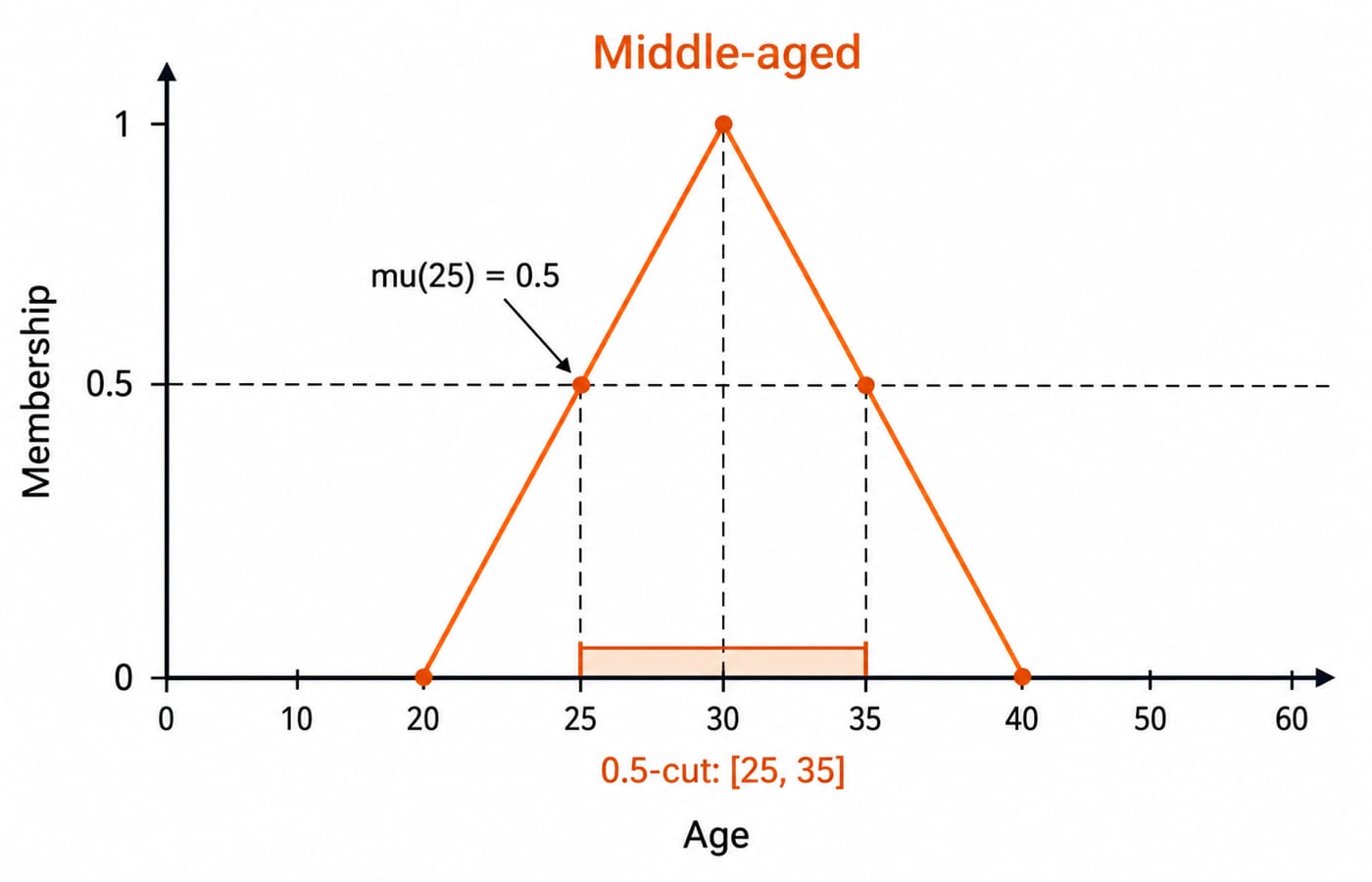
For Middle-aged on a continuous age axis, take a triangle with a = 20, b = 30, and c = 40. This smooth model shows the shape only. The discrete grades listed in B above, not this curve, are the numbers behind the arithmetic. On its rising edge:
mu(25) = (25 - 20) / (30 - 20) = 5 / 10 = 0.5
On its falling edge:
mu(38) = (40 - 38) / (40 - 30) = 2 / 10 = 0.2
Core fuzzy-set operations, worked end to end
For the standard operations, union takes the elementwise maximum, intersection takes the elementwise minimum, and complement subtracts each grade from 1.
Age |
|
| Union | Intersection | Complement |
|---|---|---|---|---|---|
10 | 1.0 | 0.0 | 1.0 | 0.0 | 0.0 |
20 | 0.8 | 0.3 | 0.8 | 0.3 | 0.2 |
30 | 0.5 | 0.9 | 0.9 | 0.5 | 0.5 |
40 | 0.2 | 0.6 | 0.6 | 0.2 | 0.8 |
50 | 0.0 | 0.2 | 0.2 | 0.0 | 1.0 |
At x = 30, the full comparisons are max(0.5, 0.9) = 0.9 and min(0.5, 0.9) = 0.5. Thus:
A union B = {1.0/10, 0.8/20, 0.9/30, 0.6/40, 0.2/50}
A intersection B = {0.0/10, 0.3/20, 0.5/30, 0.2/40, 0.0/50}
A' = {0.0/10, 0.2/20, 0.5/30, 0.8/40, 1.0/50}
The most-tested failure is the law of excluded middle. Here, A union A' = {1.0/10, 0.8/20, 0.5/30, 0.8/40, 1.0/50}, not the whole universe, because the grade at 30 is 0.5 rather than 1. Similarly, A intersection A' = {0.0/10, 0.2/20, 0.5/30, 0.2/40, 0.0/50}, so contradiction does not produce an empty fuzzy set. De Morgan's laws, commutativity, associativity, and distributivity still hold under these standard operations.
Do not confuse them with alternative operators. The algebraic sum is a + b - ab, while the algebraic product is ab. These often appear as MSQ distractors beside max and min.
Alpha-cuts, support, core, height, and cardinality
For A = Young, the support contains elements with positive grades: support(A) = {10, 20, 30, 40}. The core contains elements with grade exactly 1: core(A) = {10}. Its height is 1.0, so A is a normal fuzzy set.
Scalar cardinality is the sum of grades:
|A| = 1.0 + 0.8 + 0.5 + 0.2 + 0.0 = 2.5
An alpha-cut is the crisp set A_alpha = {x : mu_A(x) >= alpha}. Therefore, A_0.5 = {10, 20, 30}. A strong 0.5-cut uses strict inequality and gives {10, 20}. This weak-versus-strong distinction is a common one-mark trap. Alpha-cuts also decompose a fuzzy set into crisp sets, enabling fuzzy arithmetic and the extension principle.
Fuzzy relations and max-min composition
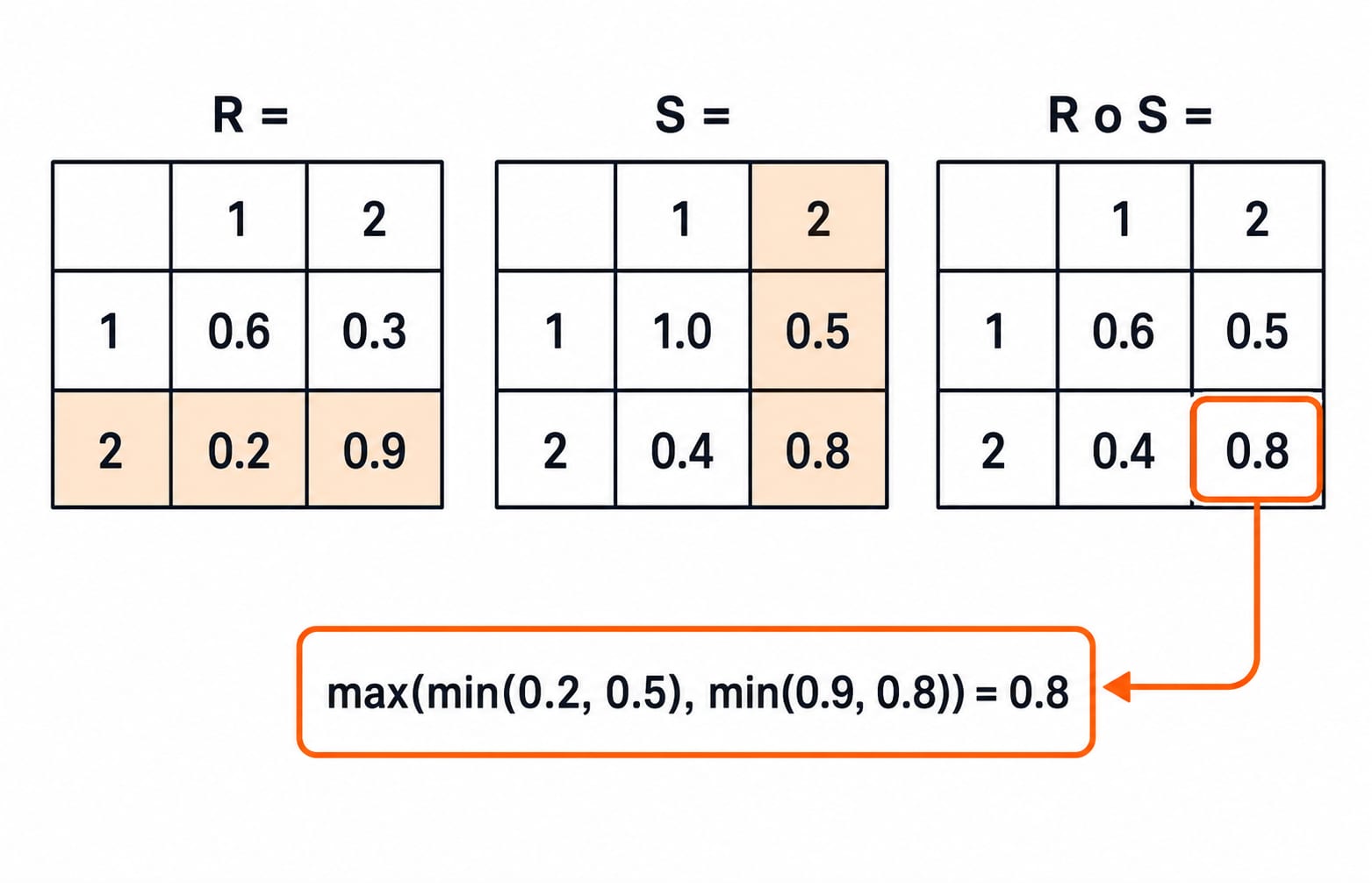
A fuzzy relation is a fuzzy set on a product universe and can be written as a matrix of grades. Let R be a relation on X x Y and S a relation on Y x Z, with two elements in each universe:
R = [[0.6, 0.3], [0.2, 0.9]] and S = [[1.0, 0.5], [0.4, 0.8]].
For max-min composition, take the minimum along each path and then the maximum across paths:
(1,1) = max(min(0.6, 1.0), min(0.3, 0.4)) = max(0.6, 0.3) = 0.6(1,2) = max(min(0.6, 0.5), min(0.3, 0.8)) = max(0.5, 0.3) = 0.5(2,1) = max(min(0.2, 1.0), min(0.9, 0.4)) = max(0.2, 0.4) = 0.4(2,2) = max(min(0.2, 0.5), min(0.9, 0.8)) = max(0.2, 0.8) = 0.8
Hence, R o S = [[0.6, 0.5], [0.4, 0.8]].
Composition is what makes fuzzy inference run. Hot, Warm and Cool are values of a linguistic variable, and a controller stores rules such as: if temperature is Hot then cooling is High. Each rule is a fuzzy relation, so composing the measured input with it gives a fuzzy output set, which defuzzification then collapses to a single number, most often by taking the centroid. A Mamdani system produces that output as a fuzzy set; a Sugeno system makes each rule emit a formula in the inputs instead, and averages those. Fuzzy logic relaxes two-valued truth exactly as fuzzy sets relax binary membership, and the two-valued version is in Propositional and Predicate Logic Explained.
Fuzzy-set traps that cost marks
Reading
mu(x)/xas division. Turning0.8/20into0.04destroys the representation. Read the slash as a label.Applying excluded middle automatically. Before accepting
A union A' = X, recompute the element whose grade is 0.5.Reversing max and min. Union uses max because it can only grow membership. Intersection uses min because it can only shrink membership.
Confusing weak and strong cuts.
>=includes grades equal to alpha, while>excludes them. Age 30 changes the answer at alpha 0.5.Treating membership as probability. A grade of 0.5 in Young is not a 50 percent chance that someone is young. It measures graded belonging, not uncertainty about an event.
How GATE, UGC NET, and interviews test fuzzy sets
Weighting differs by exam. Fuzzy sets stay peripheral to the GATE CS core paper rather than occupying a named unit, so keep them low on that priority list. The official NTA UGC NET portal carries the Computer Science and Applications syllabus, where fuzzy sets sit within AI and soft-computing coverage, so they are directly examinable there. Unit numbers and mark splits shift between cycles, so read them from the current year's syllabus rather than an older copy.
Expect definition checks on support, core, and normality; computations on grade lists and alpha-cuts; max-min composition; and MSQs asking which set identities survive fuzzification. Interviews often ask for the difference between fuzzy and probabilistic uncertainty. A practical answer is an AC or washing-machine controller that maps linguistic inputs such as Hot or Heavy load to an output such as Cooling level or Wash time.
After learning the method, practise it under timing through the GATE Test Series, especially when drilling mixed-topic computations.
The short version and the next step
Membership grades lie in
[0, 1].Union uses max, intersection uses min, and complement uses
1 - mu.Excluded middle fails, while De Morgan's laws hold.
An alpha-cut is crisp. A weak cut uses
>=.Cardinality is the grade sum, which is 2.5 for Young here.
Max-min composition takes min along a path and max across paths.
Fuzzy sets open the door to fuzzy inference, soft computing, and applied AI. Continue through AI and ML for Placements, or use the GATE CS Subject Weightage hub to place this topic beside the rest of your CS revision.
Keep learning
Problem Representation in AI: State Space, Worked Water-Jug Example and Exam Traps
Learn how states, operators, goals and costs turn a verbal task into a search problem. The worked water-jug trace separates valid states from reachable ones.
Updated 23 Oct 20265 min readML & Data Science
Foundations and Evolution of AI: Approaches, Timeline and a Worked Rational-Agent Example
Build a connected map of AI foundations, historical shifts and major paradigms, then calculate how a rational agent chooses under uncertainty.
Updated 19 Oct 20266 min readML & Data Science
Natural Language Processing Explained: Pipeline, TF-IDF Worked Example and Exam Patterns
Start from raw text, build BoW and TF-IDF vectors, compute cosine similarity, examine ambiguity, and finish with evaluation and exam-style checks.
Updated 15 Oct 20266 min readML & Data Science
Fundamentals of Planning in AI: STRIPS, State-Space Search and a Worked Blocks World Plan
Build a planning problem from facts, actions and goals, then follow every add and delete effect through a complete six-step Blocks World solution.
Updated 11 Oct 20266 min readML & Data Science