Expert Systems and Uncertainty Explained: Rules, Certainty Factors and Worked Problems
Build an expert system from its core components, trace its rules in both directions, and solve the same pump case using certainty factors, Bayes and fuzzy logic.
KnowledgeGate Team
Exam prep & CS education
Updated 21 Aug 20266 min read
An expert system seems simple until several rules fire, evidence is uncertain, and 0.77 looks like probability. One pump fault, three uncertainty models: the certainty factor comes out at 0.7712, the Bayesian posterior on the same two alarms at 0.7568, and the fuzzy membership of an 85 C reading at 0.50. Three numbers, three meanings, and only one of them obeys the probability axioms.
Expert systems: definition, architecture and rule-based knowledge
An expert system uses encoded domain knowledge and inference to reach conclusions in a restricted domain. Unlike a fixed-control program, it reasons over a knowledge base. Unlike a machine-learning model, it does not learn parameters from data. Not every AI system is an expert system.
Component | Function |
|---|---|
Knowledge base | Stores rules and domain relationships |
Working memory or fact base | Holds case-specific observations and intermediate conclusions |
Inference engine | Matches and fires rules |
Explanation facility | Records why and how a conclusion was reached |
Knowledge-acquisition facility | Helps capture and update expert knowledge |
User interface | Accepts facts and presents results |
An expert-system shell supplies reusable inference and interface machinery before these domain rules are added:
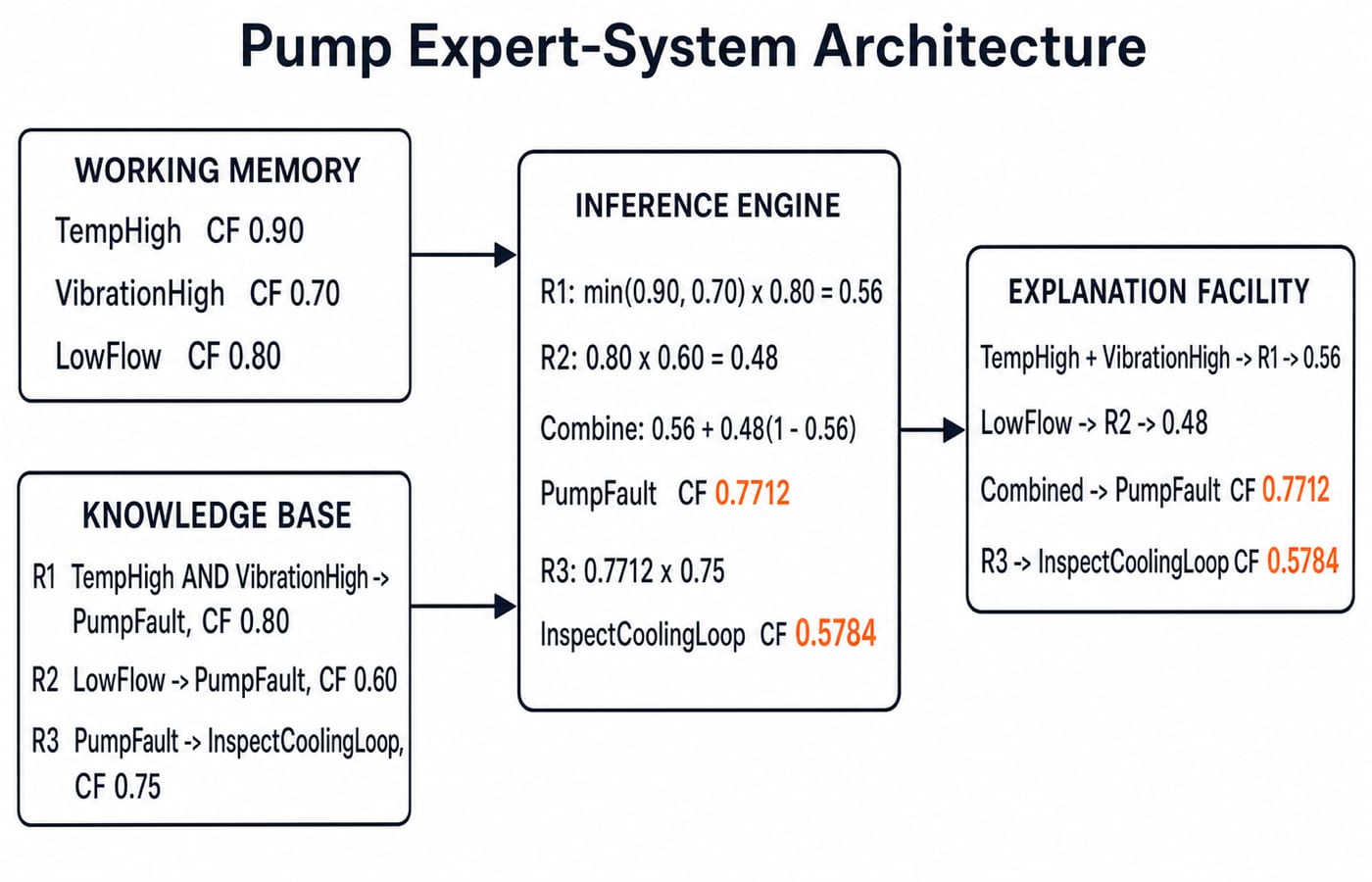
R1: IF TempHigh AND VibrationHigh THEN PumpFault, rule CF = 0.80R2: IF LowFlow THEN PumpFault, rule CF = 0.60R3: IF PumpFault THEN InspectCoolingLoop, rule CF = 0.75
Working memory starts with TempHigh CF = 0.90, VibrationHigh CF = 0.70, and LowFlow CF = 0.80. Propositional and Predicate Logic: Truth Tables to Proofs covers the propositions, connectives and implication these IF-THEN rules are built from.
Inference in expert systems: forward chaining, backward chaining and conflicts
Ignore CF values first. Forward chaining starts with TempHigh, VibrationHigh, and LowFlow. R1 and R2 derive PumpFault; R3 derives InspectCoolingLoop. It is data-driven because facts determine the conclusions.
Backward chaining starts at InspectCoolingLoop. R3 creates the subgoal PumpFault. R2 proves it from LowFlow; R1 needs both other facts. This goal-driven search may stop after a sufficient path, subject to control policy.
The inference engine repeats a match-select-execute cycle. Matching creates a conflict set. If R1 and R2 are eligible, selection needs salience, specificity, recency, fixed ordering, or another stated policy. None is universal. Our CF convention combines both supports. Graph Algorithms: BFS, DFS and Dijkstra Traced Step by Step traces the frontier expansion that backward chaining reuses, but no traversal order settles whether R1 or R2 fires first. Only the stated conflict-resolution policy does.
Uncertainty in expert systems: certainty factors, probability and fuzzy membership
Do not merge unreliable evidence, randomness about the true hypothesis, and vagueness in a word such as “hot”. A deterministic rule gives a conclusion; an uncertainty mechanism states its support.
Model | What the number means | Required operations | Running value |
|---|---|---|---|
Positive certainty-factor convention | Support score in | Supplied premise, rule, and combination formulas |
|
Bayesian probability | Posterior probability under stated assumptions | Priors, likelihoods, and normalisation |
|
Fuzzy membership | Degree of belonging to a defined set | The set's membership function |
|
Probability follows probability axioms and needs priors and likelihoods. A certainty factor is a rule-system score governed by its convention. Fuzzy membership is degree of belonging, not probability of truth. The decimals are not interchangeable, and other CF calculi exist.
Certainty factors: work the pump-fault rules step by step
Our convention takes the minimum CF for AND, multiplies by the positive rule CF, combines positive supports as c1 + c2(1 - c1), then multiplies through a later positive rule. A different convention gives different numbers, so use the one the question states.
R1 premise:
CF(TempHigh AND VibrationHigh) = min(0.90, 0.70) = 0.70.R1 support:
c1 = 0.70 x 0.80 = 0.56.R2 support:
c2 = 0.80 x 0.60 = 0.48.Combined result:
CF(PumpFault) = 0.56 + 0.48(1 - 0.56) = 0.56 + 0.2112 = 0.7712.R3 result:
CF(InspectCoolingLoop) = 0.7712 x 0.75 = 0.5784.
Direct addition gives 1.04, outside the [0,1] range and outside the supplied rule.
Bayesian reasoning and fuzzy logic: two different uncertainty questions
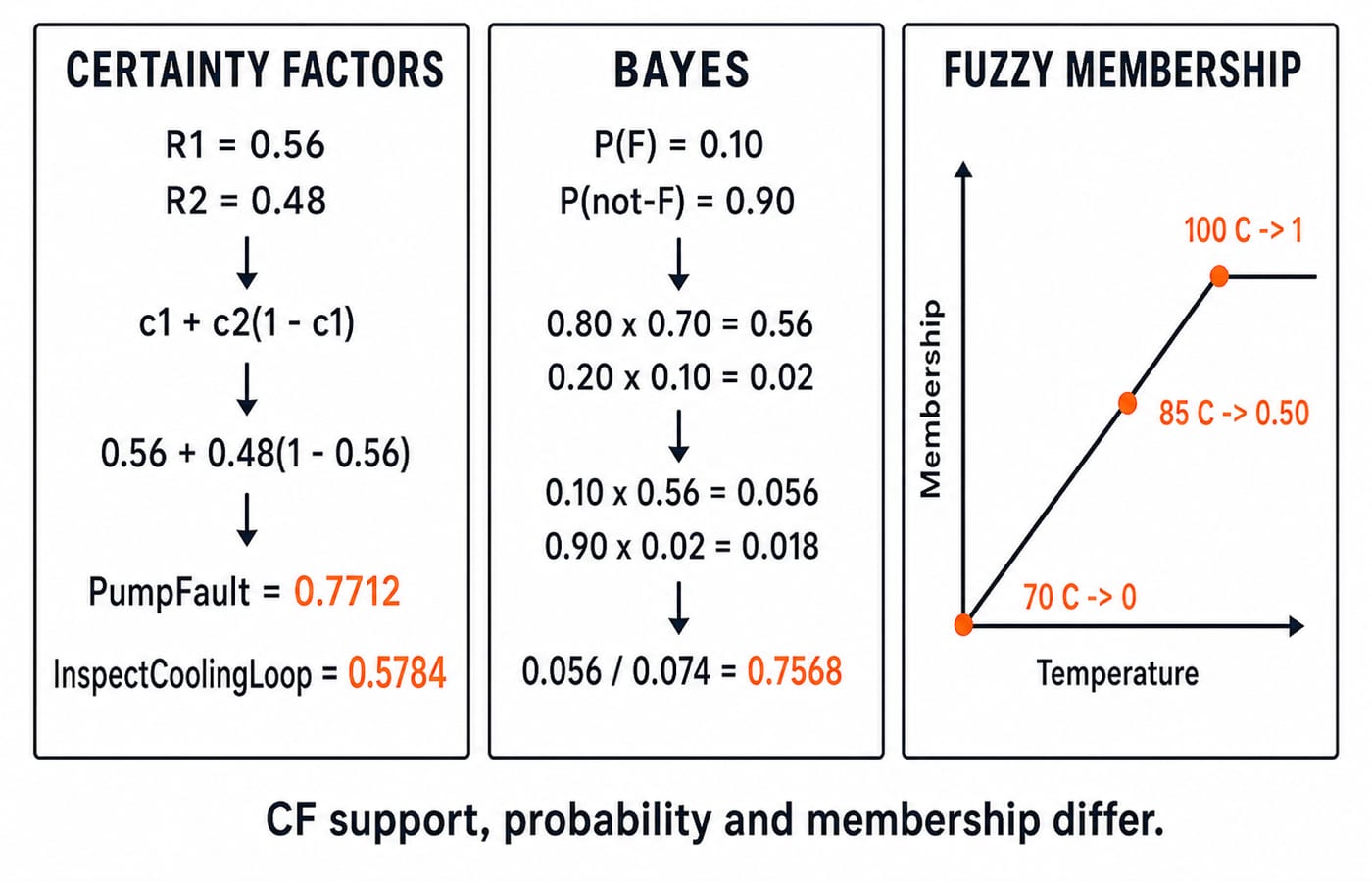
Bayes is separate from the CF result. Let F mean fault, T temperature alarm, and V vibration alarm. Use P(F) = 0.10, P(T|F) = 0.80, P(T|not F) = 0.20, P(V|F) = 0.70, and P(V|not F) = 0.10. Assume T and V are conditionally independent given F and also given not F.
With one alarm:
P(F|T) = (0.80 x 0.10) / [(0.80 x 0.10) + (0.20 x 0.90)] = 0.08 / 0.26 = 0.3077.
With both alarms, the fault branch is 0.10 x 0.80 x 0.70 = 0.056. The no-fault branch is 0.90 x 0.20 x 0.10 = 0.018. Therefore:
P(F|T,V) = 0.056 / (0.056 + 0.018) = 0.756756... = 0.7568 rounded.
The prior weights each branch; the denominator normalises them. Do not drop either.
Separately, define mu_hot(t) = 0 for t <= 70 C, mu_hot(t) = (t - 70)/30 for 70 C < t < 100 C, and mu_hot(t) = 1 for t >= 100 C. Then mu_hot(85 C) = (85 - 70)/30 = 0.50. This is halfway membership, not a 50% chance of a measurement or fault.
How exams test expert systems and uncertainty
Common tasks: matching components to functions, separating the two stores, tracing either chain, finding a conflict set, calculating a CF under the supplied rule, applying Bayes with a prior, and distinguishing probability from membership.
Four rapid checks:
“Why was
InspectCoolingLoopconcluded?” Answer: the explanation facility records that trail, not knowledge acquisition.Backward chaining from
InspectCoolingLoopfirst selects R3 and createsPumpFaultas a subgoal.With only R1 supported,
CF(PumpFault) = 0.56, not0.70or0.80.Here,
P(F|T,V) = 0.7568andmu_hot(85 C) = 0.50; neither can replace the other.
Artificial Intelligence is part of the Computer Science preparation in NTA-UGC-NET Paper - 2, so drill the component table, both chaining traces and the CF arithmetic until they come back without notes.
Expert-system traps, limitations and the correction for each
Knowledge base versus working memory: Both store information, but reusable rules belong in the base; present-case facts such as
LowFlow CF = 0.80belong in memory.Certainty factor versus probability: Similar decimals invite the error. Keep
0.7712in the named CF calculus, not probability complements.Fuzzy membership versus chance:
mu_hot(85 C) = 0.50means set membership, not chance.Direct addition and incomplete antecedents: Aggregate the full premise, apply rule strength, then combine correctly. TempHigh alone cannot fire R1.
Forward versus backward chaining: Start with facts for forward chaining and a goal for backward chaining.
Bayesian shortcuts: Write both prior-weighted branches and the denominator. Multiplying likelihoods also requires conditional independence.
Rules cost effort to acquire and maintain, and can become inconsistent or brittle. A trace shows what fired, not that the rules are correct. Uncertainty values need validation.
Expert systems and uncertainty: the short version and next step
Store rules in the knowledge base and case facts in working memory. Choose chaining direction from the task, retain an explanation trail, and use the named uncertainty model. Remember R1 -> 0.56, R2 -> 0.48, PumpFault -> 0.7712, and R3 -> 0.5784.
Self-check: if only LowFlow CF changes from 0.80 to 0.50, R2 contributes 0.50 x 0.60 = 0.30. The combined pump-fault CF is 0.56 + 0.30(1 - 0.56) = 0.56 + 0.132 = 0.6920. R3 then gives 0.6920 x 0.75 = 0.5190.
Continue with GATE Guidance by Sanchit Sir for a subject sequence, or use GATE CS Exam Preparation Courses & Test Series as the broader route. Next, retrace the rules and recompute the self-check without looking.
Keep learning
Intelligent and Rational Agents in AI: PEAS, Worked Decisions and Exam Traps
Learn what makes an AI agent rational, specify its task with PEAS, update a belief using Bayes' rule, and see why coordination matters in multi-agent systems.
Updated 7 Oct 20266 min readML & Data Science
A* Search Algorithm: Step-by-Step Worked Example, Heuristics and Exam Traps
Learn A* from first principles, follow every relaxation on a weighted graph, and test optimality, tie-breaking, parent updates and heuristic quality.
Updated 2 Oct 20266 min readML & Data Science
Philosophical and Theoretical Approaches to AI: Four Classical Views, Major Schools and a Worked Example
Separate the goals, engineering schools and philosophical claims behind AI. Then compare four classical approaches through one route-choice problem.
Updated 27 Sep 20265 min readML & Data Science
Artificial Intelligence for GATE: An 8-Week Topic-by-Topic Study Plan
Turn a 12-hour weekly budget into an eight-week AI study cycle with dependency-led concepts, hand-solved traces, timed sets, and error-driven revision.
25 Sep 20265 min readML & Data Science