ML & Data Science
44 articles in this topic
Foundations and Evolution of AI: Approaches, Timeline and a Worked Rational-Agent Example
Build a connected map of AI foundations, historical shifts and major paradigms, then calculate how a rational agent chooses under uncertainty.
Updated 19 Oct 20266 min readML & Data Science
Natural Language Processing Explained: Pipeline, TF-IDF Worked Example and Exam Patterns
Start from raw text, build BoW and TF-IDF vectors, compute cosine similarity, examine ambiguity, and finish with evaluation and exam-style checks.
Updated 15 Oct 20266 min readML & Data Science
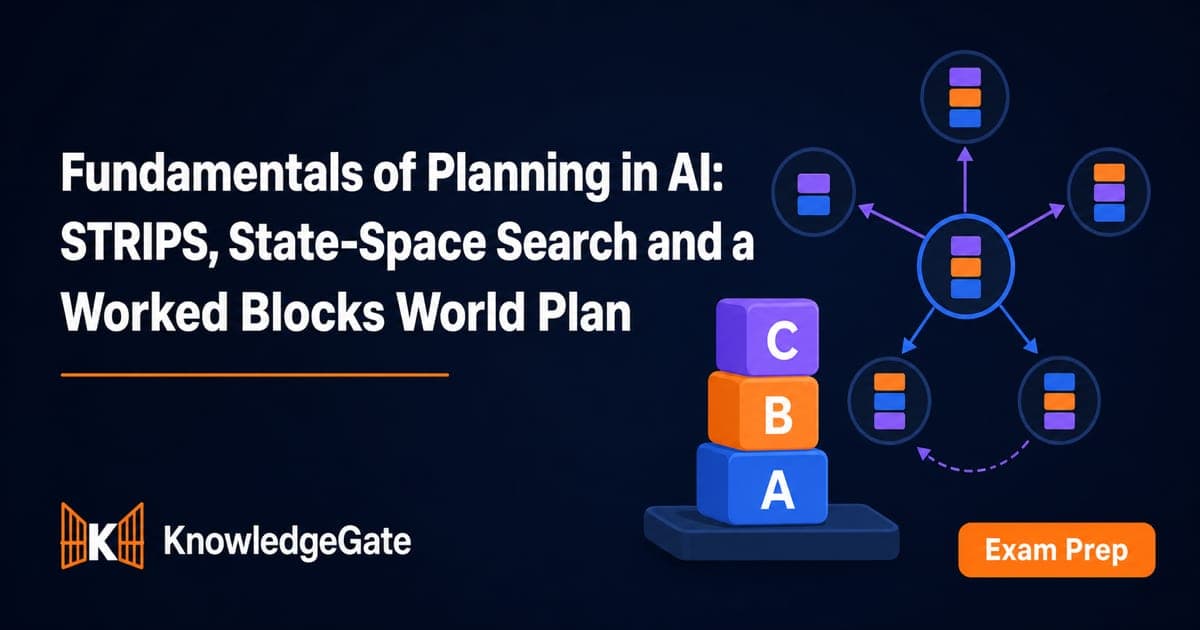
Fundamentals of Planning in AI: STRIPS, State-Space Search and a Worked Blocks World Plan
Build a planning problem from facts, actions and goals, then follow every add and delete effect through a complete six-step Blocks World solution.
Updated 11 Oct 20266 min readML & Data Science

Intelligent and Rational Agents in AI: PEAS, Worked Decisions and Exam Traps
Learn what makes an AI agent rational, specify its task with PEAS, update a belief using Bayes' rule, and see why coordination matters in multi-agent systems.
Updated 7 Oct 20266 min readML & Data Science
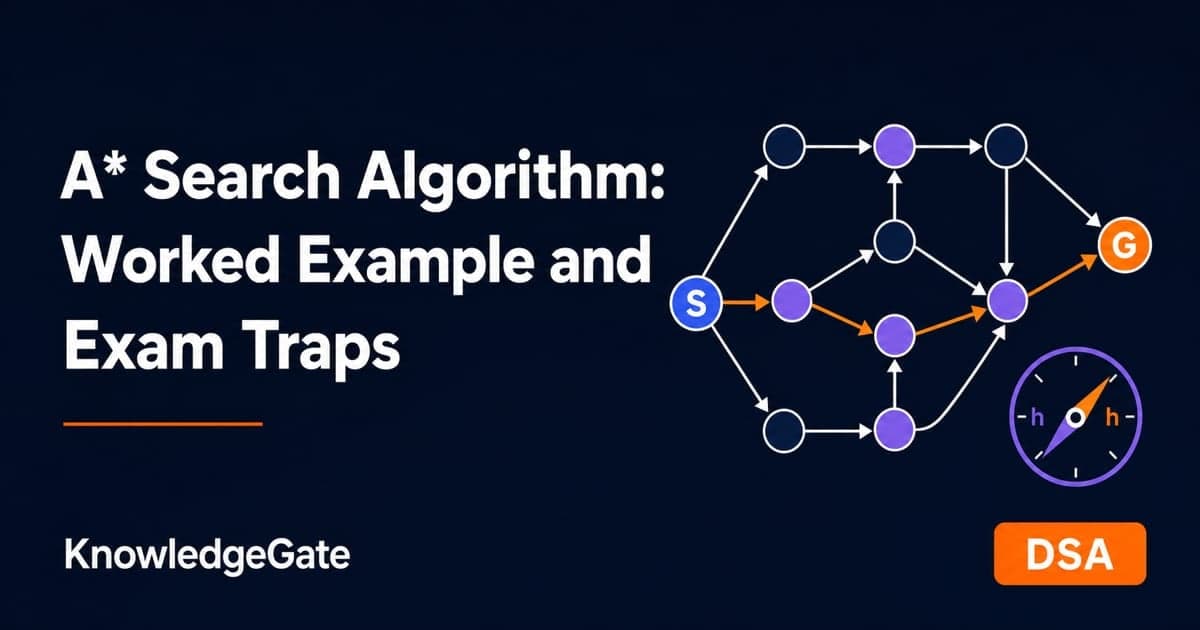
A* Search Algorithm: Step-by-Step Worked Example, Heuristics and Exam Traps
Learn A* from first principles, follow every relaxation on a weighted graph, and test optimality, tie-breaking, parent updates and heuristic quality.
Updated 2 Oct 20266 min readML & Data Science

Philosophical and Theoretical Approaches to AI: Four Classical Views, Major Schools and a Worked Example
Separate the goals, engineering schools and philosophical claims behind AI. Then compare four classical approaches through one route-choice problem.
Updated 27 Sep 20265 min readML & Data Science
Artificial Intelligence for GATE: An 8-Week Topic-by-Topic Study Plan
Turn a 12-hour weekly budget into an eight-week AI study cycle with dependency-led concepts, hand-solved traces, timed sets, and error-driven revision.
25 Sep 20265 min readML & Data Science
Artificial Intelligence for ICT Exams: Concepts, Tools and Worked Examples
Build a clear AI concept ladder, learn the main learning types, calculate classifier metrics step by step, and apply a practical tool-checking routine.
Updated 23 Sep 20266 min readML & Data Science
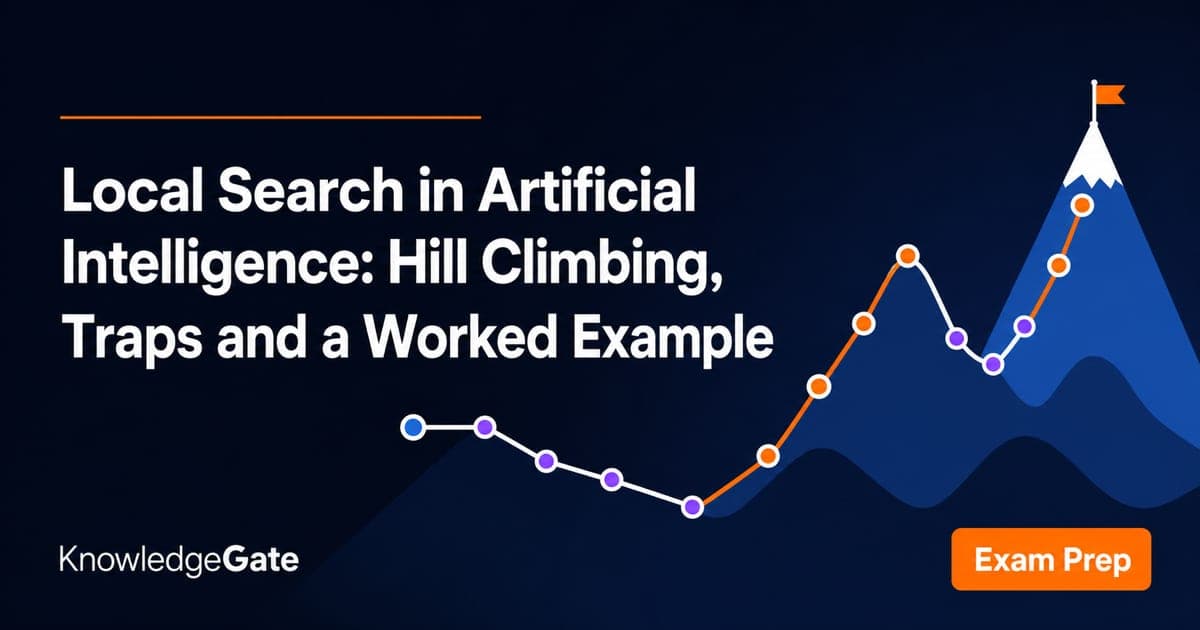
Local Search in Artificial Intelligence: Hill Climbing, Traps and a Worked Example
Local search keeps little memory, yet it can settle for a poor state. Learn the five-part model, trace hill climbing, diagnose its traps and compare standard escape methods.
Updated 22 Sep 20265 min readML & Data Science
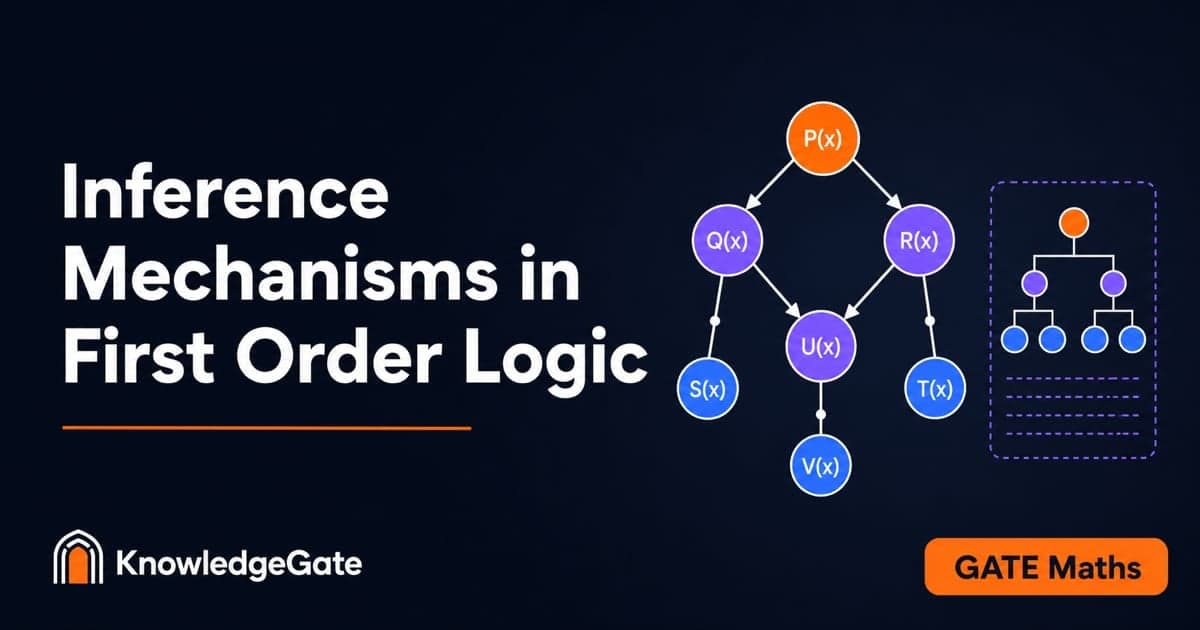
Inference Mechanisms in First Order Logic: Unification, Chaining, Resolution and Worked Proofs
See how substitutions turn First Order Logic rules into proofs. One Horn-clause example connects generalized modus ponens, forward and backward chaining, and resolution.
Updated 21 Sep 20265 min readML & Data Science
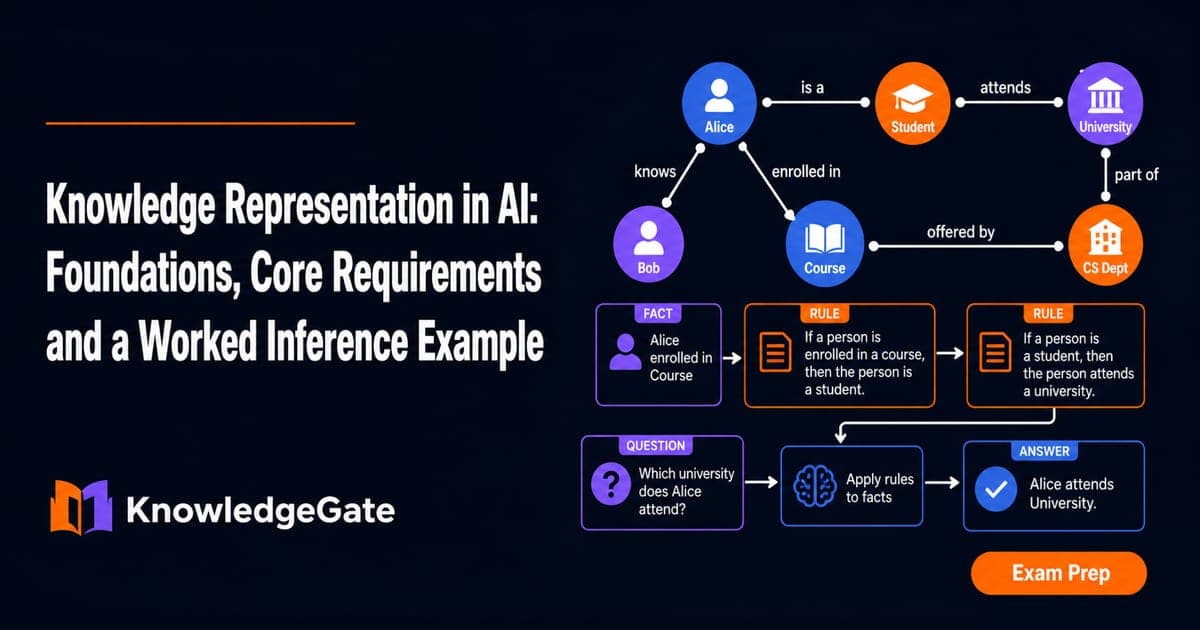
Knowledge Representation in AI: Foundations, Core Requirements and a Worked Inference Example
Learn how a small AI knowledge base turns observations about Asha and KR101 into a justified project-eligibility conclusion through two rule firings.
Updated 20 Sep 20266 min readML & Data Science
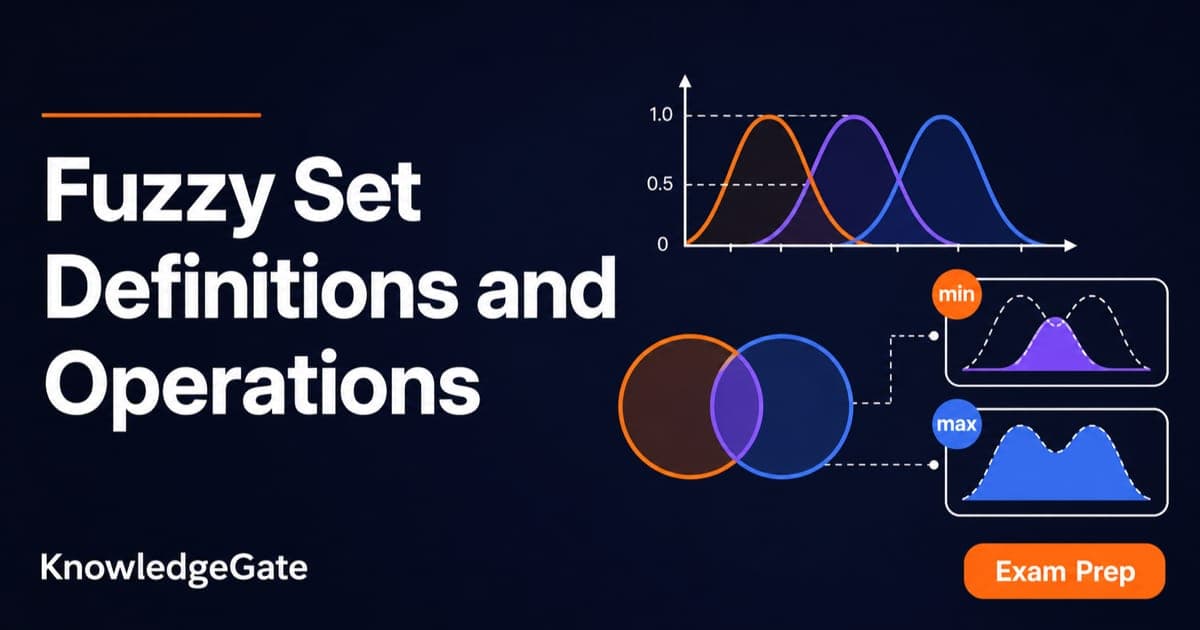
Fuzzy Set Definitions and Operations: Formulas, Worked Example and Exam Traps
Learn how membership grades change ordinary set operations, then solve one four-element example across max-min and algebraic operator families. Includes alpha-cuts, cardinality, exam patterns and error checks.
Updated 18 Sep 20265 min readML & Data Science