Means–Ends Analysis in AI: Subgoals, a 3-Disk Worked Example and Exam Traps
Learn the exact Means–Ends Analysis operator cycle, follow all seven moves of a 3-disk Tower of Hanoi solution, and avoid common reasoning traps.
KnowledgeGate Team
Exam prep & CS education
Updated 20 Aug 20266 min read
Means–Ends Analysis is often reduced to “compare the current state with the goal”, but that does not explain how an impossible operator becomes a useful subgoal, or why a disk may first move away from its final peg. The mechanism is a goal stack: when the operator that would close the difference fails its preconditions, those unmet preconditions are pushed as subgoals and solved before it. Three disks on peg A reach peg C in seven legal moves under that rule, and two of those moves carry disk 1 away from the peg where it must finish.
Means–Ends Analysis: states, goals, differences and operators
Means–Ends Analysis (MEA) is goal-directed. It compares current state S with goal G, selects a relevant difference Δ(S,G), chooses an operator whose effect reduces it, then checks preconditions. A difference may be a symbolic predicate mismatch, not a numerical distance.
Keep four objects separate:
A state describes what is true now.
A goal test states what must be true at completion.
An operator has preconditions and effects.
A subgoal is a temporary condition adopted to make an operator executable.
Let S: at(robot,A) and G: at(robot,C). Operator move(B,C) is relevant but requires at(robot,B), so that unmet predicate becomes the immediate subgoal. Predicates can be compared, satisfied and tested; “get closer” cannot. Propositional and Predicate Logic supports predicates and truth conditions, though MEA requires no single logic notation.
The Means–Ends Analysis cycle: from a difference to a subgoal
The cycle has six steps:
Compare
SwithG.Select an important difference.
Select a relevant operator that can reduce it.
Test the operator's preconditions.
Push every unmet precondition as a subgoal and solve it recursively.
Apply the operator, update the state, and repeat until the goal test succeeds.
At a failed subgoal or dead end, choose another operator or backtrack if supported.
For Tower of Hanoi, stacks run bottom to top and disk 1 is smallest:
S0 = (A:[3,2,1], B:[], C:[])
G = (A:[], B:[], C:[3,2,1])
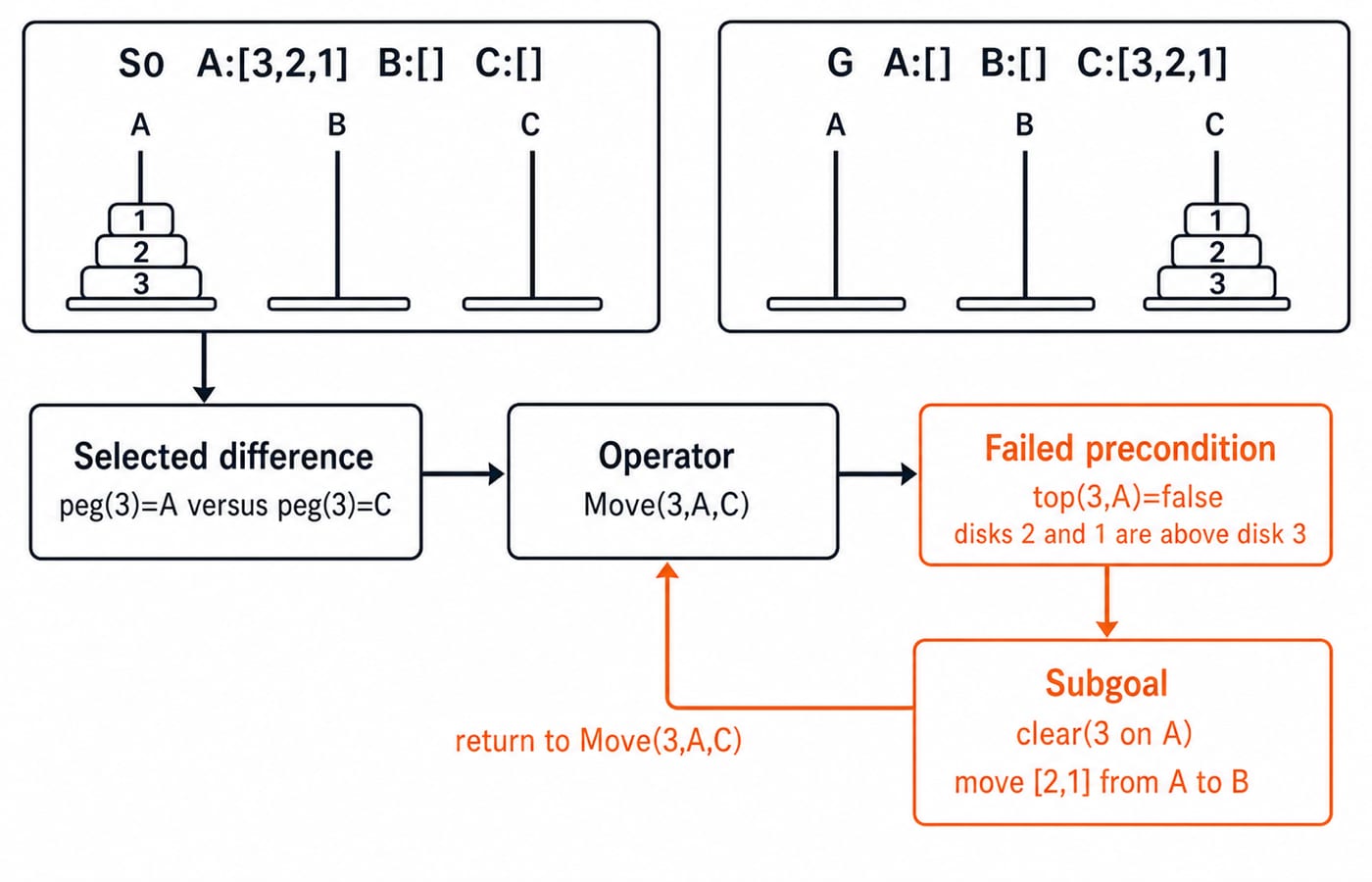
Select difference peg(3)=A versus peg(3)=C, then operator Move(3,A,C). It is blocked because top(3,A) is false. MEA creates clear(3 on A): move [2,1] from A to B, and have peg C empty at the moment the operator runs. The operator is postponed, not discarded.
Means–Ends Analysis worked example: solve the 3-disk Tower of Hanoi
Move(d,X,Y) is legal when d tops peg X and peg Y is empty or its top disk is larger than d. It removes d from X, places it on Y, and costs 1.
First solve the subgoal that clears disk 3:
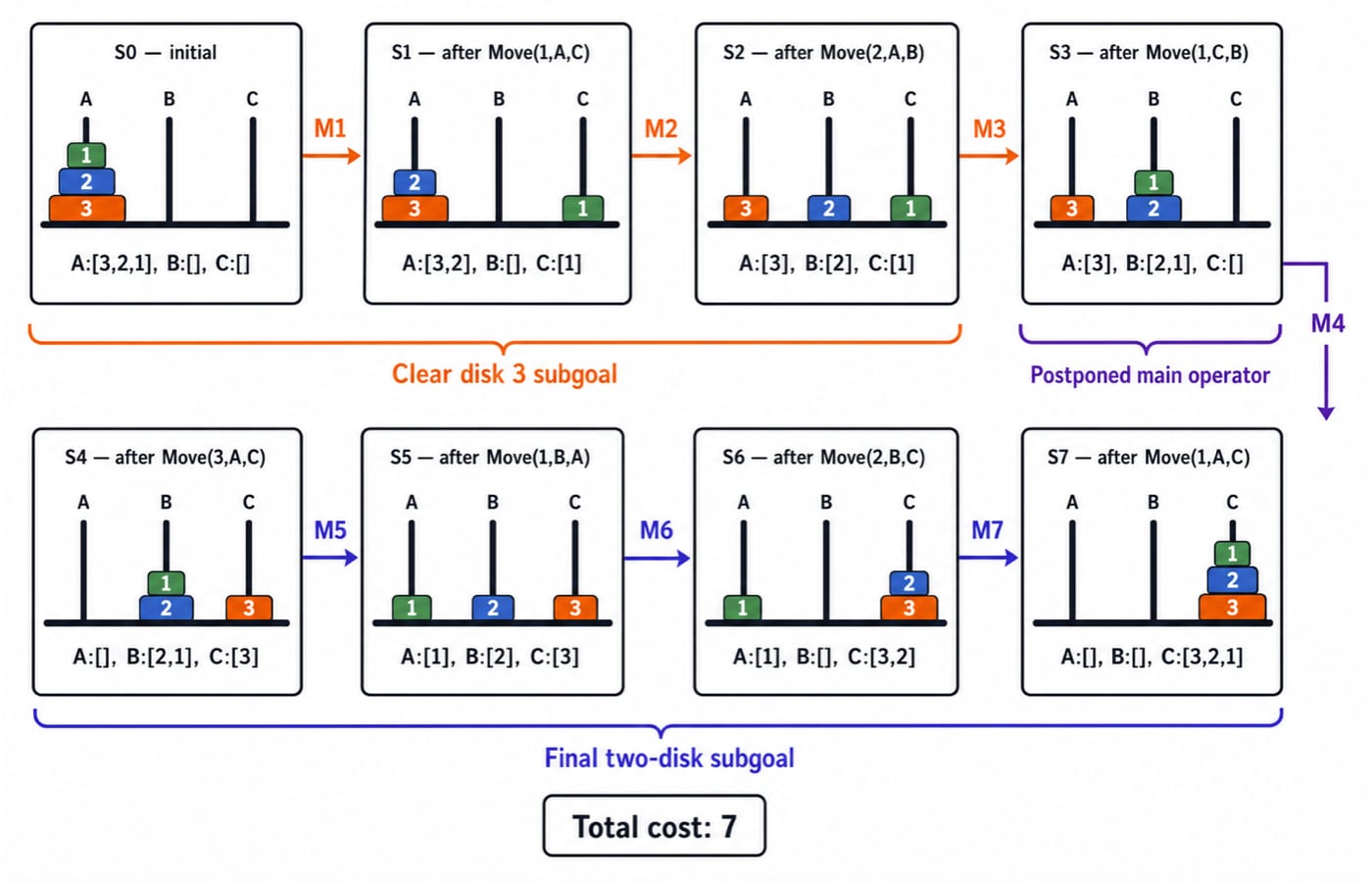
M1: Move(1,A,C)givesS1 = (A:[3,2], B:[], C:[1]).M2: Move(2,A,B)givesS2 = (A:[3], B:[2], C:[1]).M3: Move(1,C,B)givesS3 = (A:[3], B:[2,1], C:[]).
At S3, disk 3 is on top of A and C is empty. The postponed main operator is now legal:
M4: Move(3,A,C)givesS4 = (A:[], B:[2,1], C:[3]).M5: Move(1,B,A)givesS5 = (A:[1], B:[2], C:[3]).M6: Move(2,B,C)givesS6 = (A:[1], B:[], C:[3,2]).M7: Move(1,A,C)givesS7 = (A:[], B:[], C:[3,2,1]).
All source and destination preconditions hold. S7 equals G. Total cost is 7 × 1 = 7, and the minimum-count check gives 2^3 - 1 = 8 - 1 = 7.
Seven moves is the minimum for three disks, so this ordering is optimal here. That comes from Hanoi's recursive structure, not from a guarantee inside MEA: with a weaker difference rule the same method still reaches the goal, by a longer route.
Subgoals, temporary regress and backtracking in Means–Ends Analysis
MEA can look locally odd. M1 puts disk 1 on goal peg C, M3 moves it to B, and M5 moves it to A. They sacrifice its final position to satisfy higher-priority preconditions. This is planned subgoal work.
Do not confuse the physical disk stack with the active reasoning stack:
Active goal | Chosen operator | Unmet precondition | New subgoal |
|---|---|---|---|
Move disk 3 to C |
|
| Clear disk 3 by moving |
Move disk 2 to B |
|
| Clear disk 2 by moving disk |
Move disk 1 to C |
| None | Apply the operator and unwind |
Poor difference rules select unhelpful operators, and subgoals can undo one another, so MEA needs a way to abandon a choice instead of pushing deeper.
Backtracking is what that looks like when the parking peg is chosen wrongly. Suppose the subgoal had been read as move [2,1] to C rather than to B. Move(1,A,B) then Move(2,A,C) gives (A:[3], B:[1], C:[2]). Move(3,A,C) is still blocked, now because C holds a smaller disk, and the only legal way to clear C is Move(2,C,A), which returns (A:[3,2], B:[1], C:[]), the state from two moves earlier. A repeated-state check catches that loop, MEA pops the parking-peg choice off the goal stack, and B is tried instead. Without the check that pair of operators cycles indefinitely, which is why completeness rests on the control rules and not on the difference test alone.
Means–Ends Analysis versus hill climbing, BFS and A*
All can use a state-space graph, but their control strategies differ.
Feature | MEA | Hill climbing | BFS | A* |
|---|---|---|---|---|
Decision basis | Goal difference plus preconditions | Better heuristic neighbour | Shallowest depth | Lowest |
Memory or frontier | Goal stack, perhaps backtracking | Usually current state | Breadth-wise frontier | Ordered frontier |
Subgoals | Explicit recursive subgoals | Not inherent | Not inherent | Not inherent |
Can temporarily worsen the top-level difference | Yes | Normally rejects a worse move | Yes, if encountered by depth order | Yes, depending on costs and heuristic |
General guarantee | Depends on control rules | Can stop at maxima or plateaus | Complete on finite graphs with finite branching; minimum-edge path for equal costs | Depends on heuristic and search conditions |
MEA is not BFS with a goal because it need not keep a breadth-wise frontier. It is not hill climbing because Hanoi permits temporary regress for preconditions. It is not A* because it has no inherent g+h ordering or optimality proof. Use Graph MCQs on BFS, DFS and connectivity to revise traversal, not to equate it with MEA.
Means–Ends Analysis exam patterns and common traps
Questions can ask you to order the cycle, respond to an unmet precondition, trace an operator table, or distinguish MEA from hill climbing and uninformed search. After M4, the state is A:[], B:[2,1], C:[3].
Check three points:
If
Move(3,A,C)is relevant buttop(3,A)is false, createclear(3 on A). Do not execute an illegal move.After
M6, disk2is on C above disk3, while disk1is alone on A.Seven unit-cost operators cost
7, not6.
Traps include treating every difference as numeric, ignoring preconditions, confusing a subgoal with the final goal, demanding progress on every move, and reading general optimality into this one trace. The third is the expensive one under exam pressure: at M4 disk 3 reaches C, so the top-level difference peg(3)=A versus peg(3)=C is gone, yet the state is (A:[], B:[2,1], C:[3]) and the goal test still fails.
Means–Ends Analysis sits in the classical-search block alongside hill climbing, A* and goal-stack planning, so the trace-and-precondition reasoning here transfers directly to those topics. GATE CS Exam Preparation collects the surrounding subjects if you are revising that block as a whole.
Means–Ends Analysis in short and the next step
Recall: compare S with G; select a difference and operator; turn unmet preconditions into subgoals; solve and pop them; apply the postponed operator; test the goal and backtrack if needed. Checkpoint: Move(3,A,C) -> clear(3) -> move [2,1] to B -> apply Move(3,A,C).
Now try four disks on A with the same goal on C. Predict Move(4,A,C), identify the unmet subgoal “move [3,2,1] from A to B”, and check the minimum count: 2^4 - 1 = 16 - 1 = 15.
A GATE-focused learner can use GATE Guidance by Sanchit Sir for a structured route. Now redraw both diagrams and explain why M3 moves disk 1 away from C without contradicting goal-directed reasoning.
Keep learning
Intelligent and Rational Agents in AI: PEAS, Worked Decisions and Exam Traps
Learn what makes an AI agent rational, specify its task with PEAS, update a belief using Bayes' rule, and see why coordination matters in multi-agent systems.
Updated 7 Oct 20266 min readML & Data Science
A* Search Algorithm: Step-by-Step Worked Example, Heuristics and Exam Traps
Learn A* from first principles, follow every relaxation on a weighted graph, and test optimality, tie-breaking, parent updates and heuristic quality.
Updated 2 Oct 20266 min readML & Data Science
Philosophical and Theoretical Approaches to AI: Four Classical Views, Major Schools and a Worked Example
Separate the goals, engineering schools and philosophical claims behind AI. Then compare four classical approaches through one route-choice problem.
Updated 27 Sep 20265 min readML & Data Science
Artificial Intelligence for GATE: An 8-Week Topic-by-Topic Study Plan
Turn a 12-hour weekly budget into an eight-week AI study cycle with dependency-led concepts, hand-solved traces, timed sets, and error-driven revision.
25 Sep 20265 min readML & Data Science