GATE CS Subject Weightage: Where Your Study Hours Actually Pay Off
Not every GATE CS subject rewards your hours equally. Here is a practical way to prioritise, grounded in how questions actually distribute across the syllabus.
KnowledgeGate Team
Exam prep & CS education
Updated 26 Jul 20264 min read163 views
Every GATE aspirant eventually faces the same tension: the syllabus is large, time is finite, and every subject claims to be important. The honest answer is that subjects are not equally rewarding for your study hours, and pretending otherwise is how people run out of time in month five. Prioritising well means dropping the guesswork and looking at where the examinable questions actually sit across the CS syllabus.
Related reading: Compiler design basics and GATE aptitude and reasoning.
Two kinds of weight
When people say "weightage" they usually mean marks in the official paper. That number moves year to year, so chasing it precisely is a trap. A more stable signal is how densely a subject is tested across the full body of previous-year and practice questions. If a subject is consistently drilled with hundreds or thousands of distinct questions, that tells you it is deep, examinable, and worth your time.
On our platform, the question distribution across CS subjects looks roughly like this:
Computer Networks (over 2,000 questions)
Database Management System (over 2,000)
Operating System (about 2,000)
Computer Organisation & Architecture (over 1,700)
Digital Electronics (over 1,500)
Data Structures (about 1,500)
Discrete Mathematics (over 1,200)
Algorithms (over 1,100)
Theory of Computation (over 1,000)
Compiler Design (over 700)
Read that as a map of where examinable depth lives, not as a promise about next year's marks. The four systems subjects at the top (Networks, DBMS, Operating Systems and COA) are consistently the densest. When a subject supports thousands of distinct, non-repetitive questions, it is telling you the examiner has room to keep surprising you there, which is exactly why you cannot prepare it in a single hurried pass.
The high-yield core
If you did nothing else well, doing these well would carry you a long way:
Operating Systems, DBMS, Computer Networks and COA
These four are the workhorses of the paper. They are conceptual enough to test deeply and standard enough that the question patterns repeat. Time spent here is rarely wasted. If any of them feel shaky, our operating systems explainer and DBMS normalisation guide are good places to steady the foundations.
Engineering and Discrete Mathematics
Mathematics is doubly valuable: it is directly tested, and it underpins algorithms, theory of computation and more. Because the topics are stable, it is one of the most reliable places to earn marks, and maths and aptitude together carry more questions in our bank than any single CS subject. A focused engineering mathematics course is one of the safest uses of early study time.
Data Structures and Algorithms
These are the identity of a CS exam. They are tested heavily and they build the problem-solving reflex that helps you everywhere else on the paper.
The "do not skip, but do not obsess" tier
Theory of Computation, Compiler Design and Digital Electronics are important but bounded. Theory of Computation in particular is deceptively scoring. It is abstract to learn, but pattern-driven once you have seen enough previous-year questions. Compiler Design rewards a compact set of well-understood topics rather than broad coverage. Study them properly, but do not let them eat the hours that belong to the high-yield core.
General Aptitude: the most scoring 15 marks
It is easy to forget that General Aptitude is worth a full 15 marks, as the official GATE notification sets out, and it is the most predictable part of the paper. Skipping it to spend more time on a niche CS topic is one of the most common and costly mistakes aspirants make. Treat aptitude as a guaranteed-return investment and practise it steadily throughout your preparation, not in a last-minute rush.
Three costly weightage mistakes
Knowing the numbers is not enough; most aspirants know roughly which subjects are big and still misallocate their time. Three mistakes recur:
Perfecting one subject while neglecting three. Because no single core subject dominates the paper, the marginal mark is almost always cheaper in a subject you have barely started than in one you have already studied twice. Breadth beats obsessive depth.
Confusing effort with return. Digital Electronics and COA are dense and can swallow enormous time. They are worth studying, but watch that the hours match the return rather than the difficulty.
Leaving mathematics and aptitude for the end. These are the most stable, most predictable marks on the paper, and they compound into other subjects. Starting them late is leaving guaranteed marks on the table.
How to turn this into a plan
Weightage awareness only helps if it changes your calendar. Here is the practical translation:
Front-load mathematics and data structures. They are foundational and they compound.
Give the systems subjects your best months. Networks, DBMS, Operating Systems and COA deserve your sharpest, most rested study time.
Bound the abstract subjects. Theory of Computation and Compiler Design get focused, PYQ-heavy passes, not open-ended deep dives.
Protect aptitude. A little, every day, all the way through.
Let mocks re-rank you. Your personal weak subjects matter as much as the syllabus-wide weightage. A GATE test series tells you where your marks are leaking, which is the weightage that matters most.
The one-line version
Study the whole syllabus, but not with equal intensity. Give the dense, stable, high-yield subjects your best hours; bound the abstract ones; and never sacrifice the guaranteed marks in aptitude for a low-probability niche topic. If you want the full calendar, our six-month GATE CS plan sequences these priorities week by week, and the full GATE catalogue has the subject courses to go with it.
Keep learning
ISRO Scientist/Engineer CS Syllabus vs GATE CS: The Subject Overlap Map
See which core CS subjects transfer directly from GATE to ISRO, what drops out, how the question texture changes and where an ISRO-specific polish helps.
Updated 5 Oct 20264 min readGATE Strategy & Roadmap
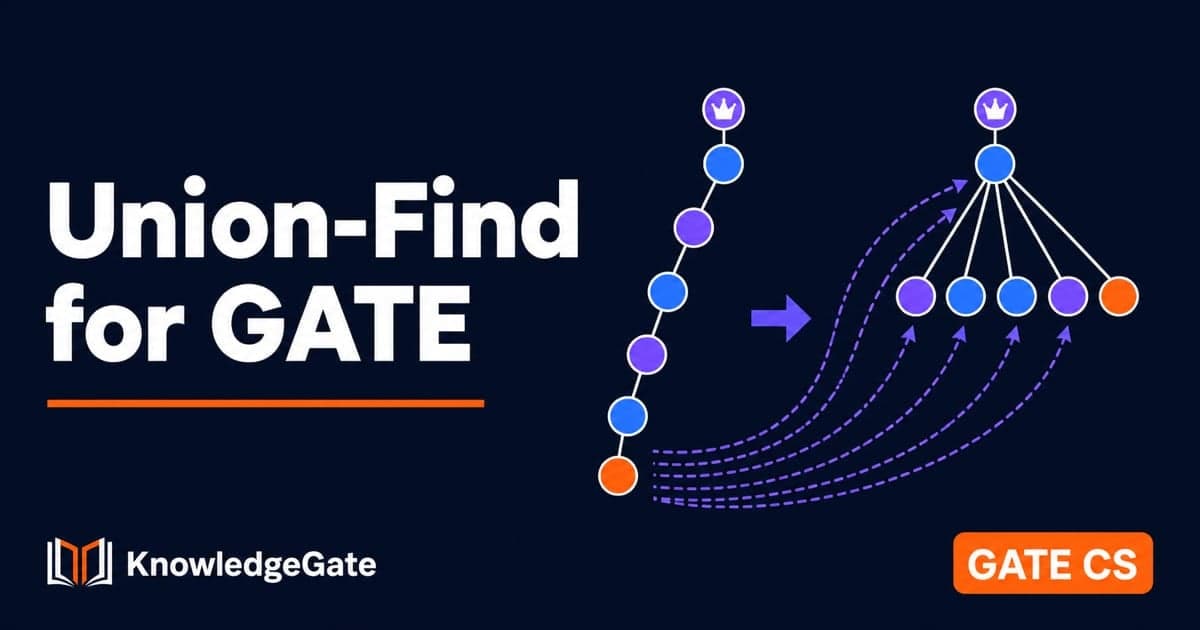
Union-Find for GATE: Union by Rank, Path Compression and the Near-Constant Bound
Trace seven unions, inspect the final ranks, then compress the deepest path by hand. The worked forest makes the inverse-Ackermann bound much less mysterious.
Updated 1 Oct 20265 min readGATE Strategy & Roadmap
RAID Levels for GATE: Striping, Mirroring, Parity and the Two Capacity Formulas
Stop memorising RAID names in isolation. Tie each level to usable capacity, failure tolerance and write cost, then test the formulas on one eight-disk array.
Updated 26 Sep 20265 min read58 viewsGATE Strategy & Roadmap
Memory Interfacing for GATE: Chip-Count and Address-Decoding Numericals, Fully Worked
Separate words from bits, split the address correctly, and verify the result with a gap-free hexadecimal map. This guide works through depth and width expansion step by step.
Updated 24 Sep 20265 min read55 viewsGATE Strategy & Roadmap