Multi-Layer Perceptron and Backpropagation MCQs: Solved with Full Working
Work through perceptron outputs, sigmoid derivatives, an MLP forward pass, gradient descent, and learning-rule updates with every step shown.
KnowledgeGate Team
Exam prep & CS education
Updated 16 Aug 20268 min read
Many learners can define a perceptron and say that backpropagation adjusts weights, but freeze when a question asks for an actual net input, activation, or training sequence. The twelve questions below come from previous-year papers, eleven from UGC NET Computer Science between 2015 and 2025 and one from Beltron Programmer 2025, so they double as targeted revision for the UGC NET CS Exam Preparation track. Attempt each one before reading the working.
One neuron from net input to activation
Every MLP starts with the same operation. A neuron computes z = sum(weight x input) + bias, then applies an activation function. Think weighted sum first, squash or threshold second.
Q1. Consider a single perceptron with a sign activation function. The perceptron is represented by the weight vector [0.4 -0.3 0.1] and a bias theta = 0. If the input vector to the perceptron is X = [0.2 0.6 0.5], the output of the perceptron is:
Asked in UGC NET Computer Science, Paper 2, November 2017
1
0
-0.05
-1
Answer: -1
The net input is:
0.4(0.2) + (-0.3)(0.6) + 0.1(0.5) + 0
= 0.08 - 0.18 + 0.05 = -0.05
The sign activation now gives sign(-0.05) = -1. The distractor -0.05 is the net input, not the output. A sign function returns +1 or -1.
Q2. A perceptron has input weights W1 = -3.9 and W2 = 1.1 with threshold value T = 0.3. What output does it give for the input x1 = 1.3 and x2 = 2.2?
Asked in UGC NET Computer Science, Paper 2, June 2016
-2.65
-2.3
0
1
Answer: 0
net = (-3.9)(1.3) + (1.1)(2.2) = -5.07 + 2.42 = -2.65
The rule gives output 1 when net >= 0.3, otherwise 0. Since -2.65 < 0.3, the output is 0. Again, the fractional option is the pre-activation value.
When a sign or threshold question offers fractional answers, ask whether the fraction is only the net input. Build this habit with structured problems in AI & ML for Placements | Generative AI Placement Course.
Activation functions and non-linearity
Q3. The sigmoid activation function f(t) is defined as:
Asked in UGC NET Computer Science, Paper 2, November 2017
1/(exp(t) + exp(-t))t exp(-t)1/(1 + exp(t))1/(1 + exp(-t))
Answer: 1/(1 + exp(-t))
The sigmoid is f(t) = 1/(1 + e^-t). It increases monotonically and stays strictly between 0 and 1. Its derivative, f'(t) = f(t)(1 - f(t)), is especially convenient during backpropagation. The near-miss 1/(1+exp(t)) reverses the sign in the exponent.
Q4. In the context of artificial neural networks, what role does the activation function play within a neuron?
Asked in Beltron Programmer, Computer Science, Shift 1, 2025
It updates the learning rate during gradient descent.
It measures the total error after backpropagation.
It initializes the weights of the network during training.
It introduces non-linearity to allow learning of complex patterns.
Answer: It introduces non-linearity to allow learning of complex patterns.
Without a non-linear activation, several stacked layers still collapse into one linear transformation. Depth would not create a non-linear decision boundary. The activation works on z; it does not set weights, learning rates, or total error. These conceptual patterns also appear in NTA-UGC-NET Paper - 2.
The sigmoid derivative used in backpropagation
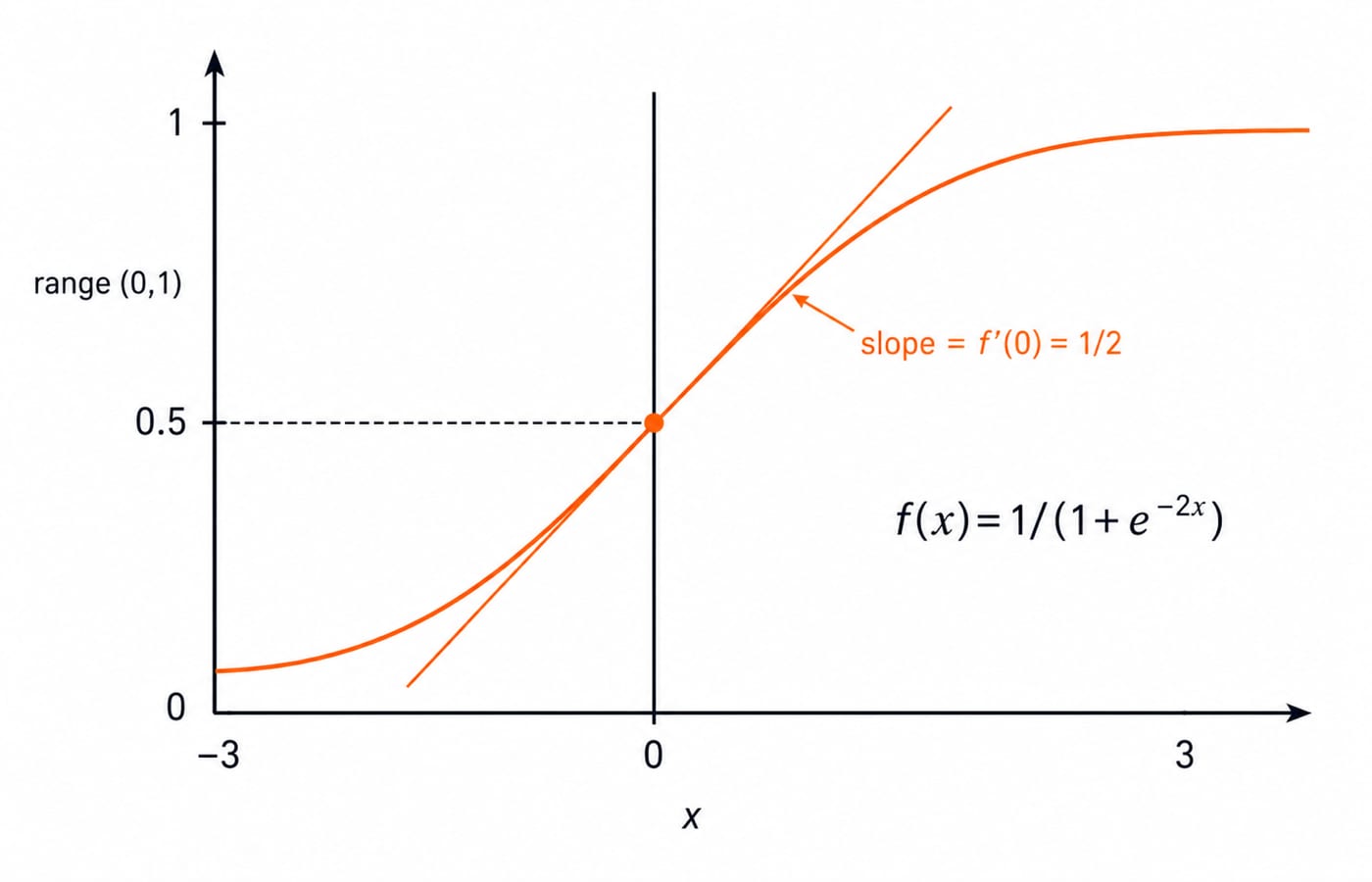
Q5. The value of the derivative of the sigmoid function f(x) = 1/(1 + e^(-2x)) at x = 0 is:
Asked in UGC NET Computer Science, Paper 2, June 2019
0
1/2
1/4
infinity
Answer: 1/2
Apply the chain rule:
f'(x) = 2e^(-2x)/(1 + e^(-2x))^2
At x = 0, e^0 = 1, so:
f'(0) = 2(1)/(1 + 1)^2 = 2/4 = 1/2
Check it a second way. Since f(0) = 1/2, the usual sigmoid derivative, scaled by the inner constant 2, gives 2(1/2)(1 - 1/2) = 2(1/4) = 1/2. Forgetting that factor of 2 produces the tempting wrong answer 1/4.
Forward pass through a multi-layer perceptron
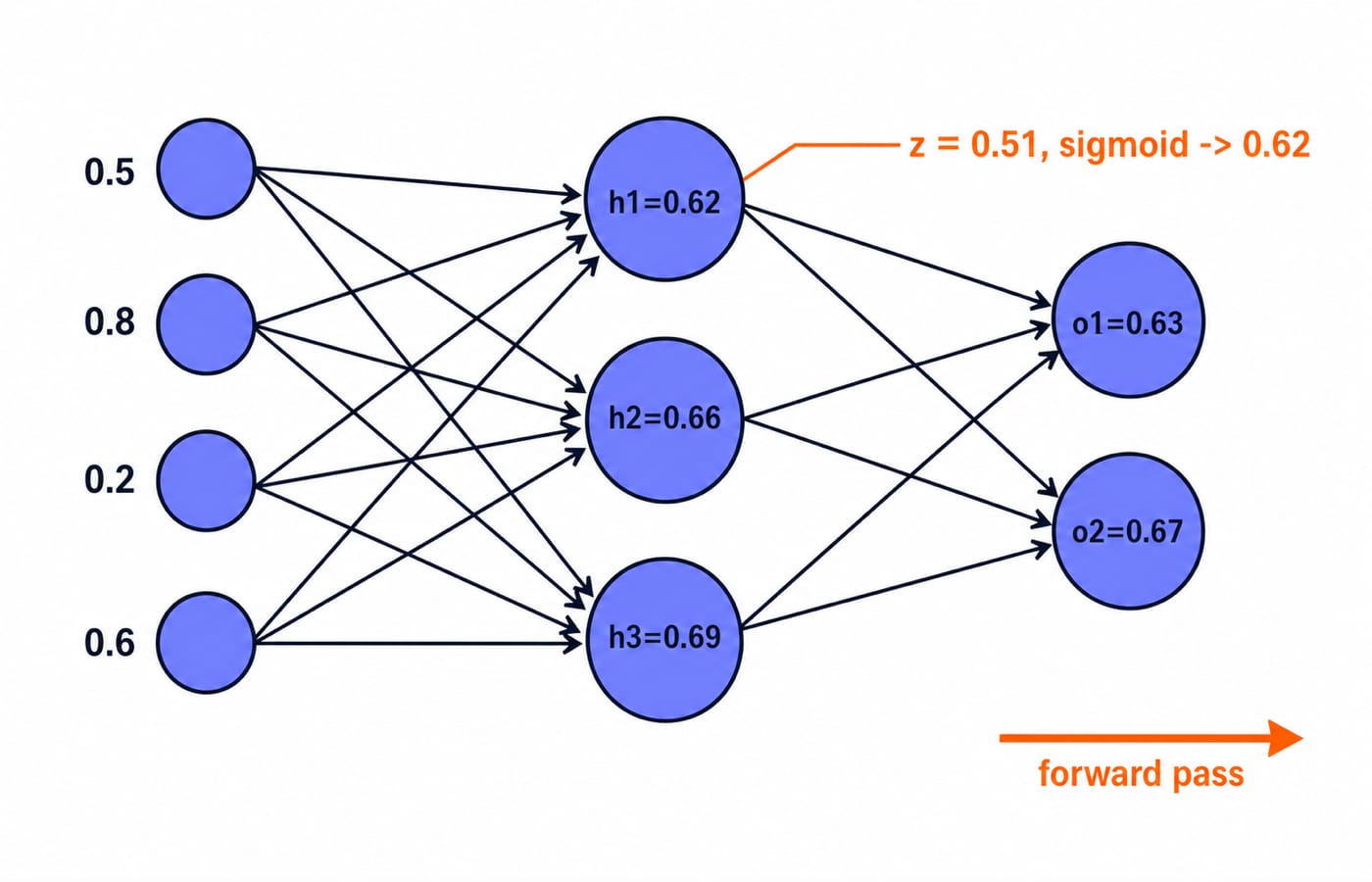
Q6. In a feed forward neural network the input layer has 4 neurons, the hidden layer has 3 neurons and the output layer has 2 neurons, all using sigmoid activation. The input is [0.5, 0.8, 0.2, 0.6]. Input-to-hidden weights are W1 = [0.1, 0.3, 0.5, 0.2], W2 = [0.2, 0.4, 0.6, 0.2] and W3 = [0.3, 0.5, 0.7, 0.2]. Hidden-to-output weights are W4 = [0.4, 0.1, 0.3] and W5 = [0.5, 0.2, 0.4]. What does the output layer produce, rounded to two decimal places?
Asked in UGC NET Computer Science, Paper 2, December 2023
[0.62, 0.68]
[0.72, 0.78]
[0.82, 0.88]
[0.92, 0.98]
Answer: [0.62, 0.68]
Compute one layer at a time:
Node | Pre-activation | Sigmoid activation |
|---|---|---|
h1 |
|
|
h2 |
|
|
h3 |
|
|
Using those more precise hidden activations:
z_o1 = 0.4(0.6248) + 0.1(0.6593) + 0.3(0.6921) = 0.5235
z_o2 = 0.5(0.6248) + 0.2(0.6593) + 0.4(0.6921) = 0.7211
Therefore o1 = sigmoid(0.5235) = 0.6280 and o2 = sigmoid(0.7211) = 0.6729, which round to [0.63, 0.67]. That pair is not on the option list. [0.62, 0.68] is the closest, within 0.01 on each coordinate, and it is the keyed answer. What the question actually tests is the order of work: finish one layer, then feed its activations into the next.
Training order and gradient descent
Q7. Arrange the following steps in a proper sequence for the process of training a neural network: (A) Weight initialization, (B) Feed forward, (C) Back propagation, (D) Loss calculation, (E) Weight update.
Asked in UGC NET Computer Science, Paper 2, August 2024
(A), (B), (D), (C), (E)
(D), (B), (A), (C), (E)
(A), (C), (D), (B), (E)
(E), (C), (B), (D), (A)
Answer: (A), (B), (D), (C), (E)
The sequence is weight initialization, feed forward, loss calculation, backpropagation, then weight update. Backpropagation needs a measured loss before it can calculate gradients.
Q8. Let Wij represent the weight between node i at layer k and node j at layer (k-1) of a multilayer perceptron. The weight update using the gradient descent method is given by:
Asked in UGC NET Computer Science, Paper 2, December 2019
Wij(t+1) = Wij(t) + alpha (dE/dWij)Wij(t+1) = Wij(t) - alpha (dE/dWij)Wij(t+1) = alpha (dE/dWij)Wij(t+1) = -alpha (dE/dWij)
Answer: Wij(t+1) = Wij(t) - alpha (dE/dWij)
The gradient points toward increasing error, so gradient descent subtracts alpha(dE/dWij). Keeping Wij(t) matters because this is an incremental update, not a replacement.
Perceptron learning rule across four samples
Q9. A perceptron starts with weights w1 = 0 and w2 = 0, learning rate 0.1, no bias, and a step activation that outputs 1 if the net input is greater than 0 and 0 otherwise. Four samples are applied in order: S1 with x = (0, 0) and target 0, S2 with x = (0, 1) and target 1, S3 with x = (1, 0) and target 1, S4 with x = (1, 1) and target 1. What are the weights after S4?
Asked in UGC NET Computer Science, Paper 2, June 2025
w1 = 0.1, w2 = 0.1
w1 = 0.0, w2 = 0.2
w1 = 0.0, w2 = 0.1
w1 = 0.2, w2 = 0.2
Answer: w1 = 0.1, w2 = 0.1
Use delta_w = 0.1(target - output)x.
Sample | Net and output | Update | New weights |
|---|---|---|---|
S1 |
| none |
|
S2 |
|
|
|
S3 |
|
|
|
S4 |
| none |
|
The final weights are w1=0.1, w2=0.1. Weights move only after a mistake. This small rule already contains backpropagation's central idea: measure error, then nudge weights toward the target.
Boundaries, supervision, and backpropagation requirements
Q10. Consider a two-class classification task. Class C1 contains [1, 1.5] and [1, -1.5]. Class C2 contains [-2, 2.5] and [-2, -2.5]. The decision boundary between the two classes using a single perceptron is given by:
Asked in UGC NET Computer Science, Paper 2, June 2015
x1 + x2 + 1.5 = 0
x1 + x2 - 1.5 = 0
x1 + 1.5 = 0
x1 - 1.5 = 0
Answer: x1 + 1.5 = 0
The positive and negative x2 values are symmetric inside each class, so x2 is not needed for separation. The boundary must be vertical. Of the options, x1 + 1.5 = 0, or x1 = -1.5, lies between the class columns at x1 = -2 and x1 = 1.
Q11. Which of the following neural networks uses supervised learning? (A) Multilayer perceptron, (B) Self organizing feature map, (C) Hopfield network.
Asked in UGC NET Computer Science, Paper 2, January 2017
(A) only
(B) only
(A) and (B) only
(A) and (C) only
Answer: (A) only
An MLP learns from labelled input-output pairs through backpropagation. A self-organizing map is unsupervised, while a Hopfield network is an associative-memory model rather than a supervised classifier.
Q12. Which one of the following is not related to feed forward networks under the backpropagation algorithm?
Asked in UGC NET Computer Science, Paper 2, January 2025
Boolean function
Continuous function
Arbitrary function
Greedy function
Answer: Greedy function
Backpropagation relies on differentiable, continuous components for gradients, and feedforward networks can represent Boolean functions and approximate broad classes of functions. "Greedy function" is not the relevant function class. This connects back to the activation and derivative questions: differentiability is the thread that makes gradient-based learning work.
The short version
A neuron performs a weighted sum, then applies an activation.
A fractional distractor is often the net input, not a sign or threshold output.
For a sigmoid,
f(1-f)supplies the local derivative used by backpropagation.Training follows initialization, forward pass, loss, backpropagation, then update.
Gradient descent subtracts
alphatimes the gradient, and weights move when error demands it.
Work these twelve until the arithmetic is automatic. Then widen the loop with Artificial Neural Networks MCQs for the definition and vocabulary questions that sit beside these numericals. The AI & ML for Placements | Generative AI Placement Course builds the same progression in order, and the official NTA UGC NET website carries the current pattern, marks split and negative-marking rule.
Keep learning

Intelligent and Rational Agents in AI: PEAS, Worked Decisions and Exam Traps
Learn what makes an AI agent rational, specify its task with PEAS, update a belief using Bayes' rule, and see why coordination matters in multi-agent systems.
Updated 7 Oct 20266 min readML & Data Science
A* Search Algorithm: Step-by-Step Worked Example, Heuristics and Exam Traps
Learn A* from first principles, follow every relaxation on a weighted graph, and test optimality, tie-breaking, parent updates and heuristic quality.
Updated 2 Oct 20266 min readML & Data Science

Philosophical and Theoretical Approaches to AI: Four Classical Views, Major Schools and a Worked Example
Separate the goals, engineering schools and philosophical claims behind AI. Then compare four classical approaches through one route-choice problem.
Updated 27 Sep 20265 min readML & Data Science

Artificial Intelligence for GATE: An 8-Week Topic-by-Topic Study Plan
Turn a 12-hour weekly budget into an eight-week AI study cycle with dependency-led concepts, hand-solved traces, timed sets, and error-driven revision.
25 Sep 20265 min readML & Data Science