Artificial Intelligence for GATE: Syllabus Areas, Weightage Pattern and Prep Order
AI is tested through the GATE DA paper, not as a section of GATE CS. See what to study, how recent papers have distributed marks, and which order avoids rework.
KnowledgeGate Team
Exam prep & CS education
Updated 22 Jul 20265 min read
Searching for "AI for GATE" produces contradictory plans because Artificial Intelligence is not a section in the GATE CS paper. It is examined in a separate paper, where most of the marks sit in Machine Learning rather than in AI itself, so the study order that works is not the obvious one.
Related reading: AI study plan for GATE and heuristic search.
Where AI actually sits in GATE: CS versus DA
GATE Computer Science and Information Technology has no separate Artificial Intelligence section. AI is examined instead through the Data Science and Artificial Intelligence (DA) paper, which GATE introduced from the 2024 cycle.
A candidate may sit up to two papers from an allowed combination list, and CS with DA is one of the permitted pairs. A CS aspirant who wants AI on the scorecard therefore takes DA as the second paper. Confirm the current combinations on the official GATE website of the organising IIT.
This suits students targeting MTech options in AI or data science, or wider admission choices. A student focused only on conventional CS programmes can skip DA without weakening CS preparation.
The AI syllabus areas, decoded
The AI-proper part of the DA syllabus has three clear blocks:
Search: BFS, DFS, uniform cost search, greedy best-first search, A* with admissible heuristics, minimax and alpha-beta pruning.
Logic: propositional and predicate logic, including syntax, semantics, entailment and inference.
Reasoning under uncertainty: conditional independence, Bayes rule based inference, variable elimination and basic sampling based approximate inference.
Machine Learning is an adjacent section containing much of what students informally call AI: regression, classification, SVMs, neural-network basics, clustering, PCA, bias-variance and cross-validation. Prepare ML and AI together.
Other DA subjects support them. Probability and statistics feed uncertainty and ML, while linear algebra, calculus and optimisation support models and training. Python, DSA, DBMS and warehousing complete the paper.
How marks have distributed in recent papers
The DA paper carries 100 marks across 65 questions, 15 of those marks in General Aptitude and 85 in the core subjects, asked as MCQs, MSQs and NATs. Negative marking applies only to MCQs: one-third of a mark for a wrong 1-mark answer and two-thirds for a wrong 2-mark answer. Those specifics are fixed per cycle in the GATE information brochure, so confirm them for your attempt on the organising IIT's official site.
Across the 2024 to 2026 papers, Machine Learning has appeared as the heaviest area, at roughly a quarter to a third of core marks. Probability and statistics has usually followed. AI-proper has generally occupied a high-single-digit band. These are observations, not official quotas.
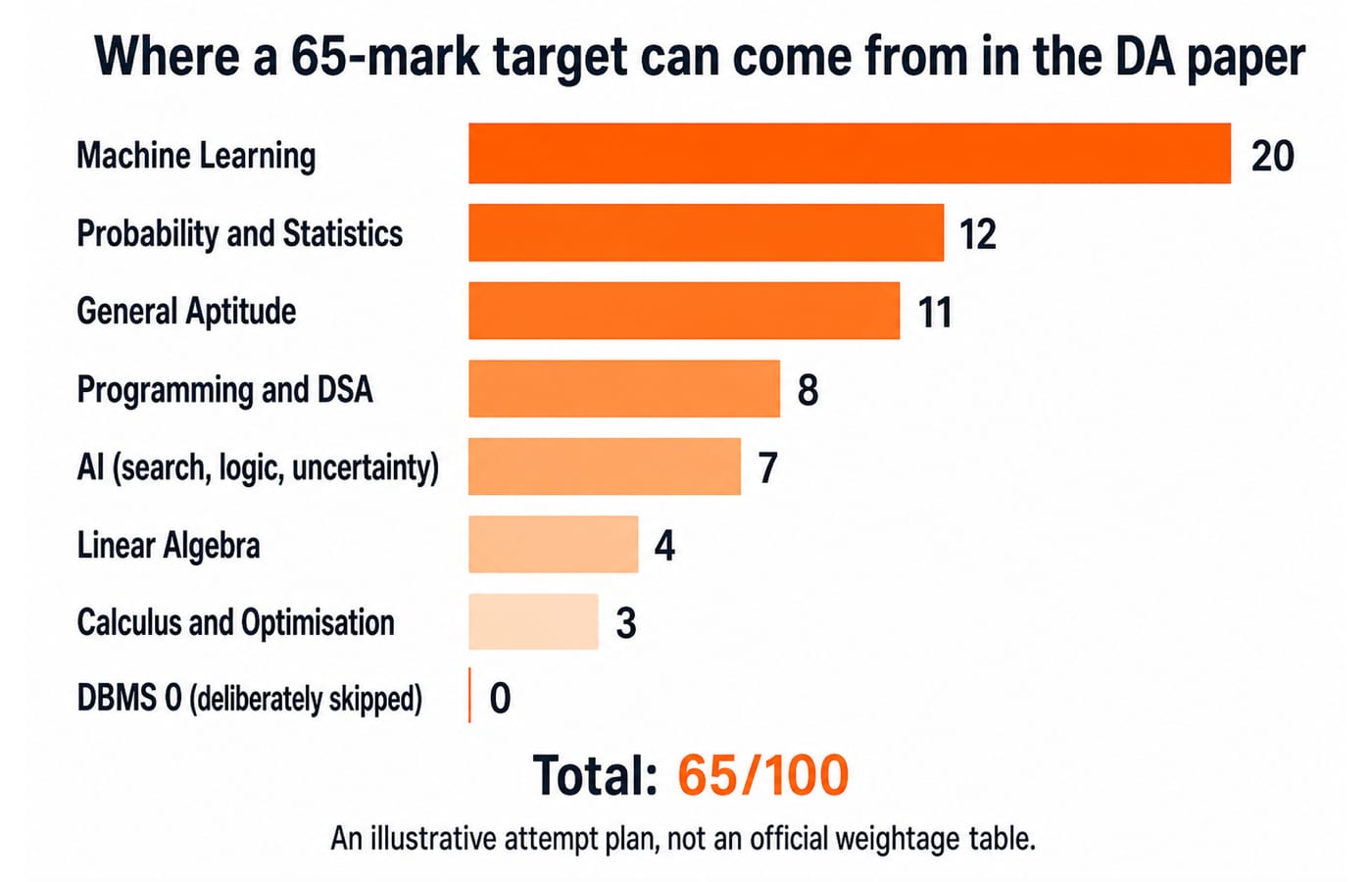
One illustrative 65-mark attempt target built on that reading:
General Aptitude: 11
Machine Learning: 20
Probability and Statistics: 12
AI-proper: 7
Programming and DSA: 8
Linear Algebra: 4
Calculus and Optimisation: 3
DBMS: 0, deliberately skipped in this attempt plan
The arithmetic is 11 + 20 + 12 + 7 + 8 + 4 + 3 + 0 = 65. Aptitude, ML and probability supply 43 marks, AI-proper adds 7, and selected remaining areas add 15.
What an AI question actually looks like
Consider an A* NAT question. Start node S connects to A at cost 1 and B at cost 4. A connects to goal G at cost 6, while B connects to G at cost 2. The admissible heuristics are h(S) = 5, h(A) = 5, h(B) = 2 and h(G) = 0.
Expand S: f(S) = g(S) + h(S) = 0 + 5 = 5.
Add A: f(A) = 1 + 5 = 6. Add B: f(B) = 4 + 2 = 6.
Break the tie by expanding A. It generates G with path cost 1 + 6 = 7, so f(G) = 7 + 0 = 7.
Expand B next. It generates G with path cost 4 + 2 = 6, so f(G) = 6 + 0 = 6.
A* returns S to B to G, with cost 6, not S to A to G with cost 7. The NAT answer is 6.
GATE tests AI through small computations. Alpha-beta pruned-node counts, entailment checks and Bayes-rule numericals demand the same hand discipline.
Prep order that avoids rework
Rework is what happens when you start with Machine Learning: every derivation stalls on a probability result or a matrix fact you have to go back and learn, so the ML weeks get spent twice. Order the subjects so nothing is learned twice. For 14 hours a week alongside college or a job, that means four phases:
Weeks 1 to 5: probability, statistics and linear algebra.
Weeks 6 to 11: Machine Learning end to end, deriving small results instead of memorising them.
Weeks 12 to 14: AI-proper, with one week each for search, logic and uncertain reasoning.
Week 15 onwards: DA previous-year questions and two full mocks per week, always with an error log.
Protect Phase 1 if you miss a week. Recover by reducing breadth, starting with DBMS and warehousing details, but never remove previous-year questions. CS-plus-DA aspirants should share programming, DSA and probability across both papers, then budget ML, AI and warehousing as extra load. Use the GATE CS subject weightage guide to coordinate the CS side.
Question formats and marks you should refuse to lose
Those marking rules decide attempt strategy. NAT carries no negative marking, MSQ carries no partial credit, and MCQ is the only format where a wrong answer costs you marks. So compute NATs cleanly, test logic-equivalence MSQs with truth tables, and avoid blind MCQ guesses in weak ML areas. The MCQ, MSQ and NAT guide explains the formats together.
Use two passes. In pass 1, target roughly 40 marks from directly computable NATs and secure 1-mark questions. In pass 2, spend the remaining time on 2-mark MCQs and MSQs. Ordered that way, the 65-mark target above stops being a list of topics you studied and becomes something you can execute in the hall.
The short version, and the next step
AI in GATE means the DA paper, not an AI section inside CS. AI-proper is search, logic and reasoning under uncertainty, while ML and probability usually carry more of the paper. Build probability and linear algebra first, learn ML second, compress AI third, and practise throughout.
For structured subject-wise preparation, use GATE Guidance by Sanchit Sir. Test the two-pass strategy under time pressure with the GATE Test Series, and browse more syllabus decodes in GATE Preparation.
Keep learning
Problem Representation in AI: State Space, Worked Water-Jug Example and Exam Traps
Learn how states, operators, goals and costs turn a verbal task into a search problem. The worked water-jug trace separates valid states from reachable ones.
Updated 23 Oct 20265 min readML & Data Science
Foundations and Evolution of AI: Approaches, Timeline and a Worked Rational-Agent Example
Build a connected map of AI foundations, historical shifts and major paradigms, then calculate how a rational agent chooses under uncertainty.
Updated 19 Oct 20266 min readML & Data Science
Natural Language Processing Explained: Pipeline, TF-IDF Worked Example and Exam Patterns
Start from raw text, build BoW and TF-IDF vectors, compute cosine similarity, examine ambiguity, and finish with evaluation and exam-style checks.
Updated 15 Oct 20266 min readML & Data Science
Fundamentals of Planning in AI: STRIPS, State-Space Search and a Worked Blocks World Plan
Build a planning problem from facts, actions and goals, then follow every add and delete effect through a complete six-step Blocks World solution.
Updated 11 Oct 20266 min readML & Data Science