Perceptron and Activation Functions MCQs: 11 Solved Questions
Work through 11 practice problems covering perceptron sums and outputs, sign and sigmoid activation, separating lines, linear separability, and ANN weights.
KnowledgeGate Team
Exam prep & CS education
Updated 18 Aug 20268 min read
Perceptron MCQs look short, but they mix three quantities examiners deliberately confuse: the weighted sum , the activated output , and the decision boundary that separates the classes. A stem that hands you weights and a threshold almost always plants the raw sum in the option list, so getting the arithmetic right is not the same as getting the answer right, and a boundary that looks reasonable on a sketch still has to be checked point by point. Write your own answer to each of the eleven questions before reading its explanation. Related neural-network and machine-learning material is collected under ML and Data Science, and the Skill Development Courses catalogue covers the wider coding track.
1. Perceptron arithmetic: weighted sum, threshold, and output
Use , then . If a stem states threshold instead of a bias, follow that convention and keep raw separate from the output.
Q1. Thresholded perceptron output
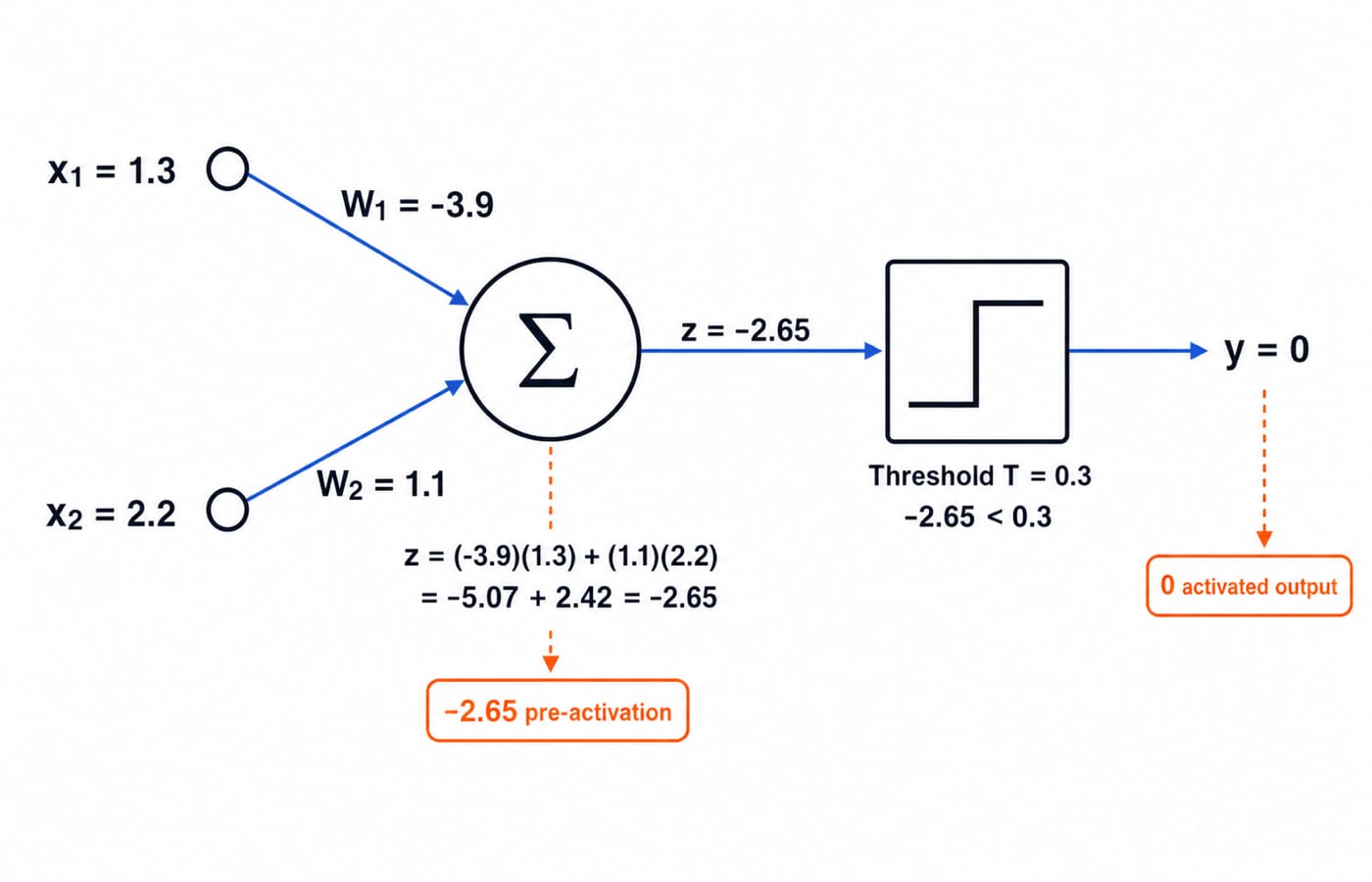
A perceptron has input weights W1 = −3.9 and W2 = 1.1 with threshold value T = 0.3. What output does it give for the input x1 = 1.3 and x2 = 2.2?
A.
−2.65B.
−2.3C.
0D.
1
Answer: C. Calculate . Since , the output is 0. Option A is the raw sum, not the activated output.
Appeared in UGC NET Computer Science, June 2016.
Q2. Linear transfer function with four inputs
A 4-input neuron has weights 1, 2, 3 and 4. The transfer function is linear, with the constant of proportionality equal to 3.
The inputs are 5, 7, 10 and 30 respectively. Then the output will be:
A.
120B.
213C.
410D.
507
Answer: D. The weighted sum is . Then . A result of 169 stops before the transfer function.
Appeared in UGC NET Computer Science, December 2022.
Q3. Total input to a neuron
A neuron has the weight vector and a bias . If the input vector is , the total input to the neuron is:
A.
0.20B.
1.0C.
0.02D.
−1.0
Answer: C. Compute . The stem asks for total input, so do not apply a sign or step function.
Appeared in UGC NET Computer Science, January 2017.
2. Sign and sigmoid activation functions
Under the usual exam convention, the sign function maps a negative input to and a positive input to . The sigmoid maps any real input into through ; useful checks are and .
Q4. Sign activation after a dot product
Consider a single perceptron with a sign activation function. The perceptron is represented by the weight vector and a bias . If the input vector to the perceptron is , then the output of the perceptron is:
A.
1B.
0C.
−0.05D.
−1
Answer: D. The dot product is . The sign activation converts the raw value , shown in option C, to .
Appeared in UGC NET Computer Science, November 2017.
Q5. Identify the sigmoid formula
The sigmoid activation function is defined as:
A.
B.
C.
D.
Answer: D. The sigmoid is . At , it gives . Option C reverses the exponent's sign and gives , not .
Appeared in UGC NET Computer Science, November 2017.
3. Decision boundaries from labelled points
A single perceptron's decision boundary is . Test a proposed boundary by substituting every labelled point and checking that the two classes produce opposite signs.
Q6. Separate one positive corner from three negative corners
Consider the two-class classification task that consists of the following points:
Class C1: [−1, −1], [−1, 1], [1, −1]
Class C2: [1, 1]
The decision boundary between the two classes C1 and C2 using a single perceptron is given by:
A.
B.
C.
D.
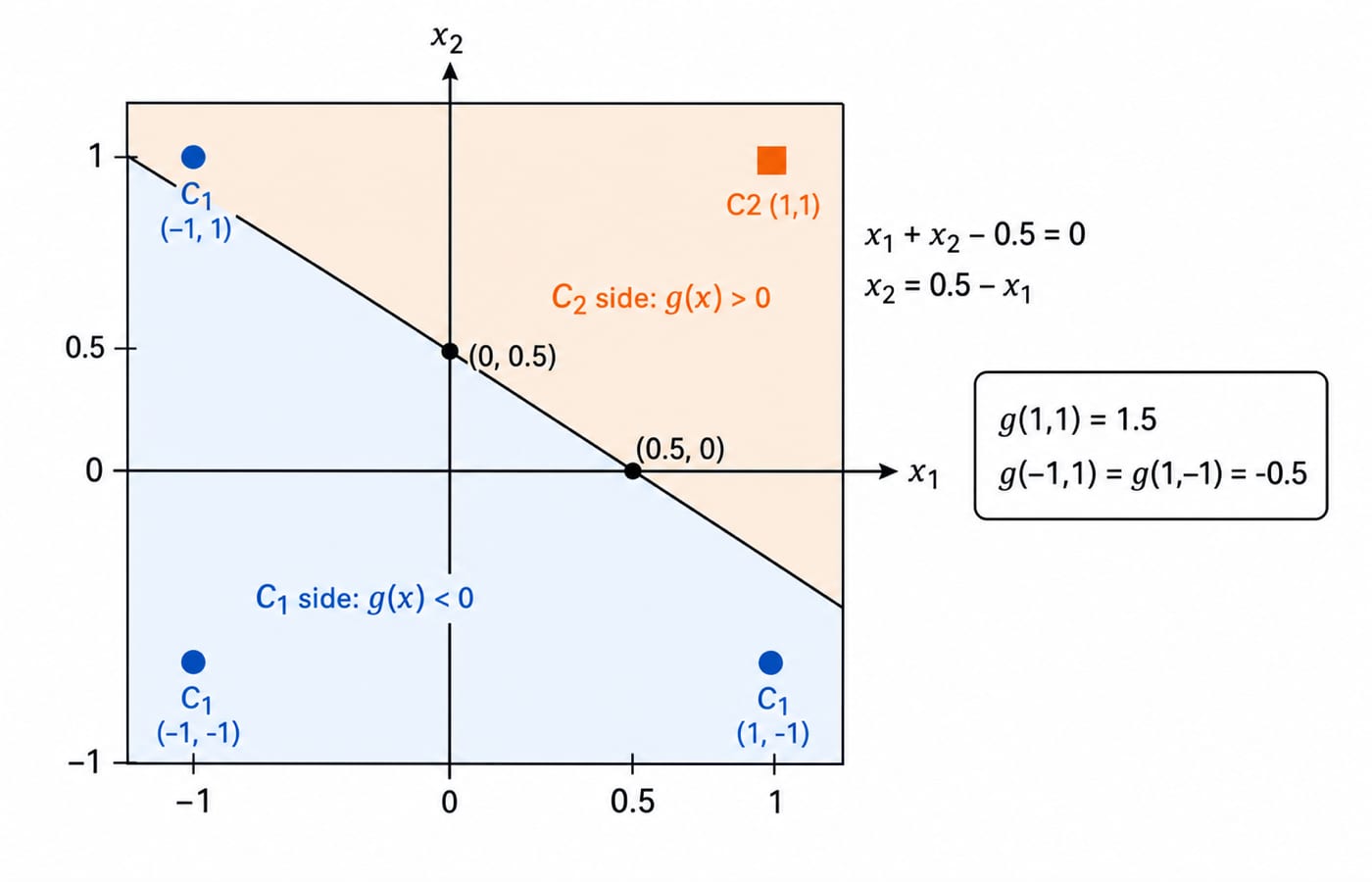
Answer: D. Put each point into . For C2, ; for C1, , , and . Every C1 value is negative, so the line separates the classes.
Appeared in UGC NET Computer Science, December 2015.
Q7. A vertical separating boundary
Consider the two-class classification task that consists of the following points:
Class C1: [1, 1.5], [1, −1.5]
Class C2: [−2, 2.5], [−2, −2.5]
The decision boundary between the two classes using a single perceptron is given by:
A.
B.
C.
D.
Answer: C. The boundary is . Both C1 points give , while both C2 points give . A valid separator need not be the maximum-margin midpoint unless the stem asks for one.
Appeared in UGC NET Computer Science, June 2015.
4. Linear separability and the perceptron learning model
A function is linearly separable when one straight boundary puts every positive case on one side of it and every negative case on the other. For two binary inputs, plot the four truth-table corners (0,0), (0,1), (1,0) and (1,1) and ask whether a single line can fence off the corners that output 1. The classical perceptron model pairs that test with fixed feature detectors sitting in front of one output unit, and trains only the weights feeding that unit.
Q8. Boolean functions a single layer can represent
Which Boolean operations on two variables can be represented by a single perceptron layer?
A. X1 AND X2
B. X1 OR X2
C. X1 NOR X2
D. X1 XOR X2
Choose the most appropriate answer from the options given below:
A.
A and B OnlyB.
B and C OnlyC.
A, B and C OnlyD.
A, B, C and D Only
Answer: C. AND, OR and NOR have linearly separable truth-table points. For binary inputs, separates AND and separates OR; NOR is the complement of OR, so the same line works with the two sides swapped. XOR places its two positive points at opposite corners of the square, with the negative points on the other diagonal, so no single straight line can separate them.
Appeared in UGC NET Computer Science, December 2022.
Q9. Fixed feature detectors and trainable output weights
Consider the following statements about a perceptron:
I. The feature detector can be any function of the input parameters.
II. The learning procedure only adjusts the connection weights to the output layer.
Identify the correct statement out of the following:
A.
I is false and II is false.B.
I is true and II is false.C.
I is false and II is true.D.
I is true and II is true.
Answer: D. In the classical fixed-feature perceptron model, the feature detectors are chosen functions of the inputs and are not themselves trained, so statement I holds. The perceptron learning rule then changes only the connection weights into the output unit, so statement II holds as well. Both are true, which rules out every option except D. Do not carry this over to a modern end-to-end network, where every layer is trained.
Appeared in UGC NET Computer Science, December 2014.
5. ANN weights and the linear transfer multiplier
Weights scale each incoming signal, and they are the quantity that training adjusts. When a stem names a linear transfer function with a constant of proportionality, that constant multiplies the weighted sum afterwards, so on its own is never the final answer.
Q10. Role of weights in an ANN
Read the passage below, then answer the question that follows.
Artificial Neural Networks (ANNs) are computational models inspired by the human brain's neural networks. They consist of inter-connected nodes, or neurons, organized into layers: an input layer, one or more hidden layers, and an output layer. Each connection between neurons has a weight that adjusts as learning progresses, allowing the network to adapt and improve its performance. ANNs are particularly effective in recognizing patterns, making them valuable for tasks such as image and speech recognition, natural language processing, and predictive analytics. Learning in ANNs typically involves training algorithms like backpropagation, which minimize the error by adjusting the weights. As a subset of machine learning, ANNs have revolutionized the field of Artificial Intelligence by providing solutions to complex problems that traditional algorithms struggle with.
What is the role of weights in an ANN?
A.
To store dataB.
To adjust and improve network performanceC.
To control the speedD.
To secure the network.
Answer: B. The passage says weights scale connections and are adjusted during learning to reduce error and improve the mapping. They do not store the dataset, control hardware speed, or secure the network.
Appeared in UGC NET Computer Science, August 2024.
Q11. Three-input linear neuron
A 3-input neuron has weights 1, 4 and 3. The transfer function is linear with constant of proportionality equal to 3. The inputs applied are 4, 8 and 5 respectively. What will be the output?
A.
139B.
153C.
162D.
160
Answer: B. First, . As in Q2, . The weighted sum 51 is not the output.
Appeared in UPPSC Polytechnic Lecturer Computer Science, 2022.
6. Score diagnosis and common perceptron MCQ traps
Count the answers you got right before reading their explanations, then take the revision step for your band.
Score | What to revise |
|---|---|
9-11 | Mechanics stable. Redo mixed questions without notes. |
6-8 | Revisit thresholds and boundary substitution. |
0-5 | Rebuild the weighted-sum pipeline before timed practice. |
Five traps explain most wrong answers:
Raw sum versus activated output: find , then apply .
Threshold versus bias convention: follow the stem's formula.
Forgotten transfer multiplier: Q2 and Q11 need it after the dot product.
XOR assumed separable: plot all four truth-table points.
Boundary judged by appearance: substitute every labelled point.
Perceptron questions sit inside a much larger syllabus, and UGC NET Computer Science high-yield topics, ranked shows where they fall against everything else on the paper. If you sit GATE as well, MCQ, MSQ or NAT? GATE question types explained covers how the marking changes across those three formats.
7. Short version and next step
Use one method: dot product first, activation second, and point substitution for every proposed boundary. Redo Q1, Q4, Q6, Q8, and Q11 without looking; together they cover the concept range.
For structured AI and machine-learning study, continue with AI and ML for Placements. Keep the raw sum and the activated output on separate lines.
Keep learning

Intelligent and Rational Agents in AI: PEAS, Worked Decisions and Exam Traps
Learn what makes an AI agent rational, specify its task with PEAS, update a belief using Bayes' rule, and see why coordination matters in multi-agent systems.
Updated 7 Oct 20266 min readML & Data Science
A* Search Algorithm: Step-by-Step Worked Example, Heuristics and Exam Traps
Learn A* from first principles, follow every relaxation on a weighted graph, and test optimality, tie-breaking, parent updates and heuristic quality.
Updated 2 Oct 20266 min readML & Data Science

Philosophical and Theoretical Approaches to AI: Four Classical Views, Major Schools and a Worked Example
Separate the goals, engineering schools and philosophical claims behind AI. Then compare four classical approaches through one route-choice problem.
Updated 27 Sep 20265 min readML & Data Science

Artificial Intelligence for GATE: An 8-Week Topic-by-Topic Study Plan
Turn a 12-hour weekly budget into an eight-week AI study cycle with dependency-led concepts, hand-solved traces, timed sets, and error-driven revision.
25 Sep 20265 min readML & Data Science