

Limits Questions with Solutions: 12 Worked MCQs and PYQs
Attempt 12 limits MCQs before reading their step-by-step solutions. The set moves from indeterminate forms to squeezing, series, recurrences and nested radicals.
KnowledgeGate Team
Exam prep & CS education
Updated 24 Nov 20268 min read
Limits often feel easy while direct substitution works. The hesitation starts when substitution produces 0/0, a power has the form 1^infinity or infinity^0, an oscillating term stays bounded, or a recurrence approaches an unknown value.
The 12 questions pair each answer with worked reasoning. Ten carry GATE or NIMCET past-paper attributions, while two are unattributed practice questions. For related practice, start with Introduction to Limits; the questions span several placements, so this common module page is more useful than guessed question links. The live Limits bank adds further practice under Mathematics and Aptitude > Calculus. Attempt each item before reading its solution.
1. Rational Limits and Bounded Terms (Questions 1-3)
Start with substitution. If it gives 0/0, confirm that indeterminate form before factoring or differentiating. If a bounded sine or cosine term appears beside an unbounded x, divide every term by x and compare their sizes.
Question 1 (GATE 2019)
Compute the limit as x approaches 3 of (x^4 - 81)/(2x^2 - 5x - 3).
(a)
1(b)
53/12(c)
108/7(d)
Limit does not exist
Solution. Substituting x = 3 makes both numerator and denominator zero, so the form is 0/0. Apply L'Hopital's rule once. The numerator derivative is 4x^3, which becomes 4(3^3) = 108. The denominator derivative is 4x - 5, which becomes 12 - 5 = 7. Therefore the limit is 108/7, so the correct answer is (c). Factoring both polynomials would also work, but is not needed here.
Question 2 (GATE 2017)
Find the limit as x approaches 1 of (x^7 - 2x^5 + 1)/(x^3 - 3x^2 + 2).
(a)
is 0(b)
is -1(c)
is 1(d)
does not exist
Solution. At x = 1, the numerator is 1 - 2 + 1 = 0 and the denominator is 1 - 3 + 2 = 0. Differentiate once. The numerator becomes 7x^6 - 10x^4, whose value at 1 is 7 - 10 = -3. The denominator becomes 3x^2 - 6x, also giving 3 - 6 = -3. Their ratio is (-3)/(-3) = 1, so (c), is 1, matches exactly.
Question 3 (GATE 2008)
Find the limit as x approaches infinity of (x - sin x)/(x + cos x).
(a)
1(b)
-1(c)
infinity(d)
-infinity
Solution. Divide the numerator and denominator by x. The expression becomes (1 - sin x/x)/(1 + cos x/x). Both sin x and cos x always lie between -1 and 1, so sin x/x approaches 0 and cos x/x approaches 0 as x approaches infinity. The entire ratio therefore approaches (1 - 0)/(1 + 0) = 1. The correct answer is (a). Oscillation does not prevent the limit because each oscillating term is divided by an unbounded quantity.
2. Logarithms for Power-Form Limits (Questions 4-6)
For a positive power form y = f(x)^{g(x)}, take logarithms: ln y = g(x) ln f(x). Find this logarithmic limit first, then exponentiate. This turns a vague-looking power into a product or quotient you can calculate.
Question 4 (GATE 2015)
Find the limit as x approaches infinity of (1 + x^2)^(e^-x).
(a)
0(b)
{1} {2}(c)
1(d)
infty
Solution. Put y = (1 + x^2)^{e^{-x}}. Taking logs gives ln y = ln(1 + x^2)/e^x. Exponential growth dominates the logarithm. One L'Hopital step changes the quotient to [2x/(1 + x^2)]/e^x, which tends to 0. Thus ln y approaches 0, and exponentiating gives y approaches e^0 = 1. The correct answer is (c). The logarithm is what resolves the power form cleanly rather than guessing it.
Question 5 (GATE 2015)
Find the limit as x approaches infinity of x^(1/x).
(a)
infinity(b)
0(c)
1(d)
Not defined
Solution. Let y = x^{1/x} for positive x. Then ln y = (ln x)/x. This quotient has the indeterminate form infinity/infinity, so L'Hopital's rule gives (1/x)/1 = 1/x, which tends to 0. Hence ln y approaches 0 and y approaches e^0 = 1. The correct answer is (c). The important trap is that infinity^0 is an indeterminate form. It is not automatically equal to 1 without this calculation.
Question 6 (GATE 2010)
Find the limit as n approaches infinity of (1 - 1/n)^(2n).
(a)
0(b)
e^{-2}(c)
e^{-1/2}(d)
1
Solution. Rewrite the expression as [(1 - 1/n)^n]^2. The standard exponential limit inside the square is e^{-1}. Squaring that limit gives (e^{-1})^2 = e^{-2}, so the correct answer is (b). You can reach the same result by taking logarithms, but the standard form is quicker. A common error is to recognise e^{-1} and stop, forgetting that the original exponent is 2n, so the outer power 2 must remain.
3. Standard Forms, Squeezing and Convergent Series (Questions 7-9)
These questions require three different recognitions. Convert an exponential difference to (e^h - 1)/h, bound an oscillating factor before squeezing, and split an interleaved positive series into familiar geometric series.
Question 7 (NIMCET 2025)
Find the limit as x approaches infinity of -(x + 1)(e^(1/(x + 1)) - 1).
(a)
0(b)
1(c)
-1(d)
Does not exist
Solution. Set h = 1/(x + 1). As x approaches infinity, we have h approaches 0+ and x + 1 = 1/h. The expression becomes -(e^h - 1)/h. The standard limit (e^h - 1)/h approaches 1 as h approaches 0, so the leading minus sign makes the required limit -1. Therefore (c) is correct. Keeping the sign outside the standard form prevents the most likely error in this calculation.
Question 8 (NIMCET 2020)
Find the limit as x approaches 0 of x^2 * e^(sin(1/x)).
(a)
1(b)
The limit does not exist(c)
infinity(d)
None
Solution. Since -1 <= sin(1/x) <= 1, exponentiation gives e^{-1} <= e^{sin(1/x)} <= e. Multiplying by the non-negative x^2 gives x^2/e <= x^2e^{sin(1/x)} <= ex^2. Both outer expressions approach 0 as x approaches 0, so the squeeze theorem makes the middle limit 0 too. Zero is not listed explicitly, which means the correct bank option is (d), None. The oscillating sine does not make this limit diverge.
Question 9 (GATE 2024)
The sum of this infinite series is 2 + 1/2 + 1/3 + 1/4 + 1/8 + 1/9 + 1/16 + 1/27 + ...
(a)
11/3(b)
7/2(c)
13/4(d)
9/2
Solution. After the initial 2, regroup the powers of 1/2 and 1/3. The first geometric series has sum (1/2)/(1 - 1/2) = 1. The second has sum (1/3)/(1 - 1/3) = 1/2. Therefore the complete sum is 2 + 1 + 1/2 = 7/2, making (b) correct. Regrouping is safe here because every term is positive, so changing the grouping does not alter the sum.
4. Limits of Recurrences and Infinite Radicals (Questions 10-12)
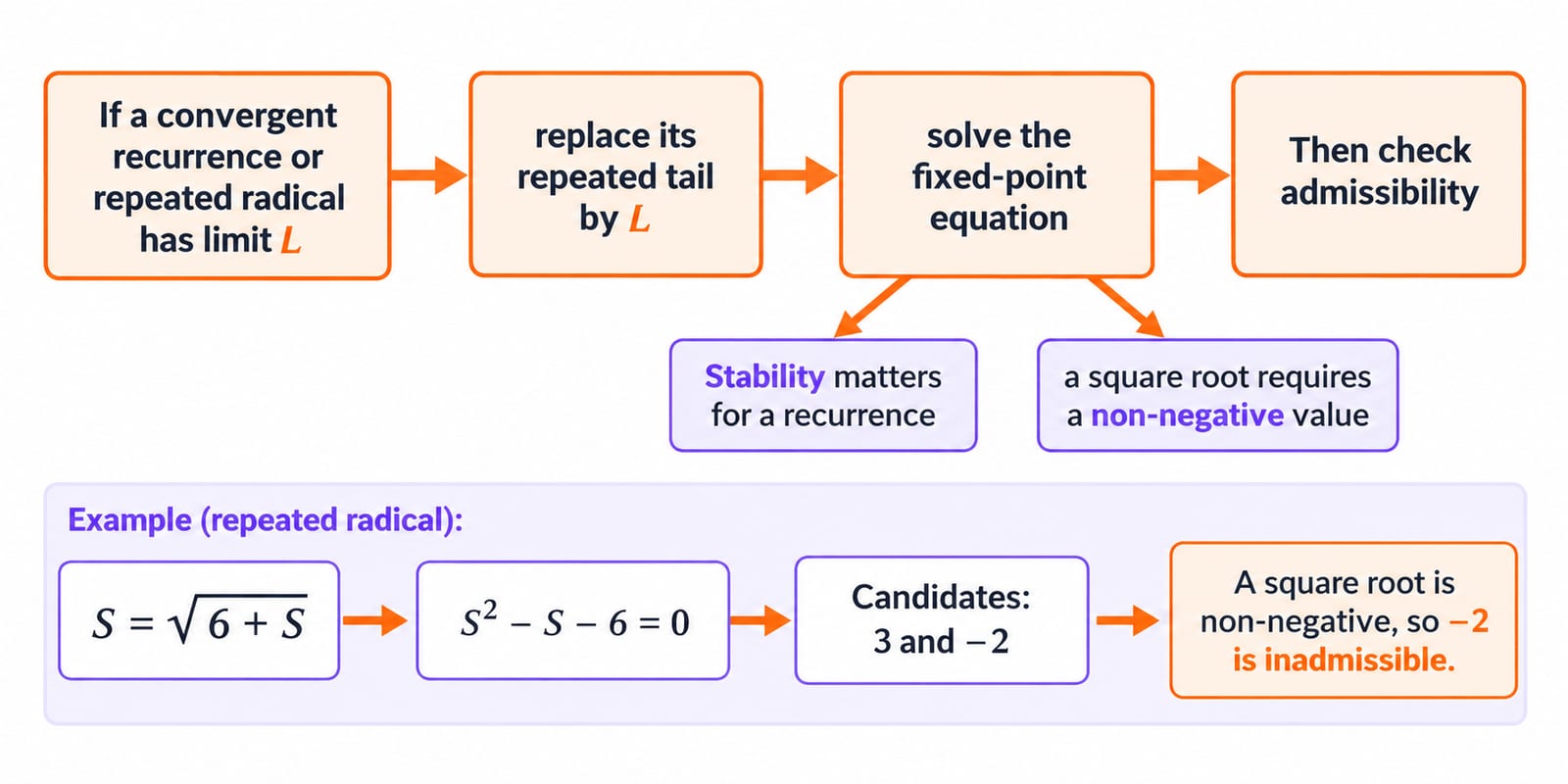
If a convergent recurrence or repeated radical has limit L, replace its repeated tail by L and solve the fixed-point equation. Then check admissibility. Stability matters for a recurrence, while a square root requires a non-negative value.
Question 10 (GATE 2007)
Consider the sequence x_n, n >= 0, defined by the recurrence relation x_(n+1) = c x_n^2 - 2, where c > 0. Suppose there exists a non-empty open interval (a, b) such that every x_0 in (a, b) produces a convergent sequence. The sequence converges to which value?
(a)
(1 + sqrt(1 + 8c))/(2c)(b)
(1 - sqrt(1 + 8c))/(2c)(c)
2(d)
2/(2c - 1)
Solution. If x_n approaches L, continuity gives L = cL^2 - 2, or cL^2 - L - 2 = 0. Thus L = (1 +/- sqrt(1 + 8c))/(2c). For the positive fixed point, f'(L) = 2cL = 1 + sqrt(1 + 8c) > 1, so it cannot attract every starting value in a non-empty open interval. Under the stated convergence premise, the limit must be the negative root, (1 - sqrt(1 + 8c))/(2c). Hence (b) is correct.
Question 11
sqrt(6 + sqrt(6 + sqrt(6 + ...))). Find the value of this infinite radical.
(a)
1(b)
2(c)
3(d)
4
Solution. Let the repeated radical be S. Its tail is the same expression, so S = sqrt(6 + S). Squaring gives S^2 = 6 + S, or S^2 - S - 6 = 0. Factoring gives (S - 3)(S + 2) = 0, with candidates 3 and -2. A square root is non-negative, so -2 is inadmissible. Therefore S = 3, and the correct answer is (c).
Question 12
Evaluate the infinite nested radical S = sqrt(6 - sqrt(6 - sqrt(6 - ...))). What is the value of S?
(a)
1(b)
2(c)
3(d)
4
Solution. Replacing the repeated tail by S gives S = sqrt(6 - S). Squaring produces S^2 = 6 - S, or S^2 + S - 6 = 0. Factoring gives (S + 3)(S - 2) = 0, so the candidates are -3 and 2. Non-negativity rejects -3, leaving S = 2. Thus (b) is correct. The minus sign inside this radical changes the equation, which is why Question 11 gives 3 but this one gives 2.
5. Limits Method Map and Common Traps
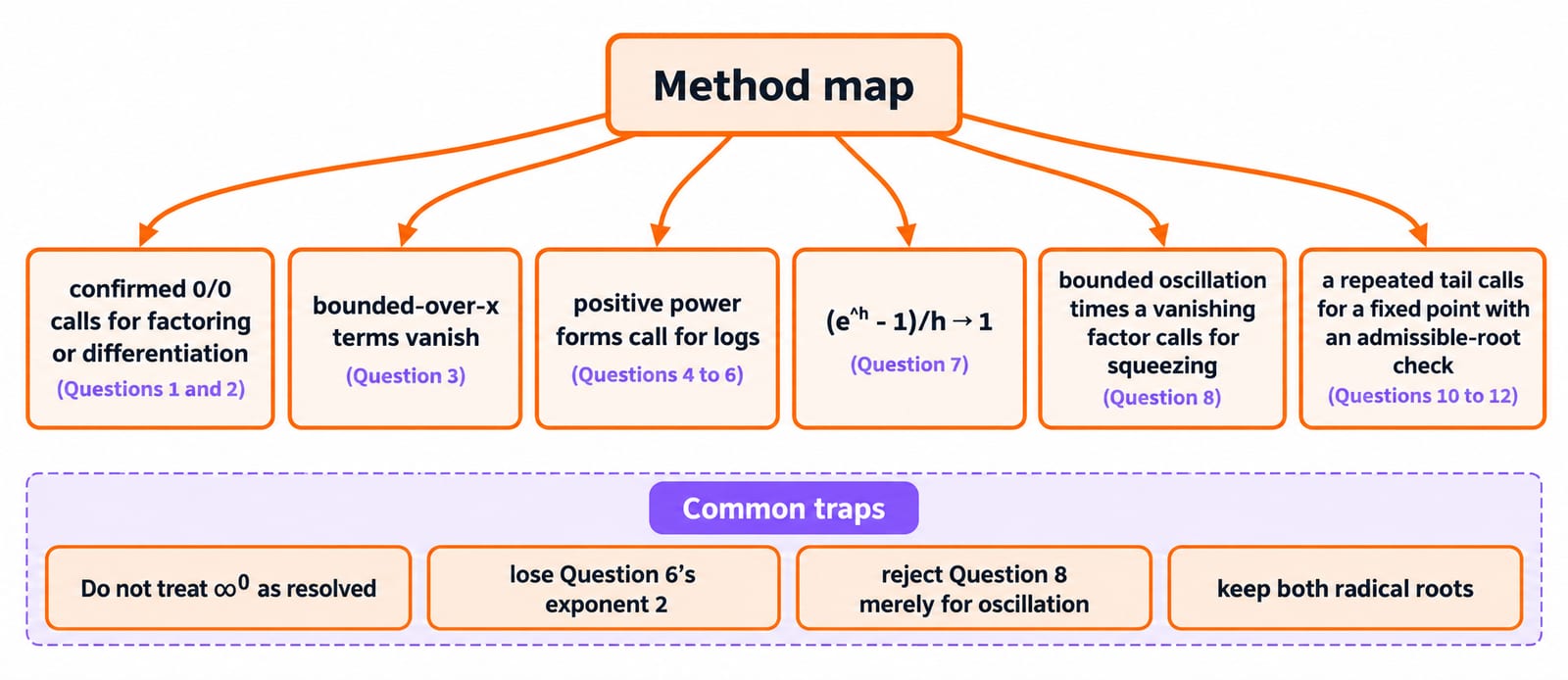
Method map: confirmed 0/0 calls for factoring or differentiation (Questions 1 and 2); bounded-over-x terms vanish (Question 3); positive power forms call for logs (Questions 4 to 6); (e^h - 1)/h approaches 1 (Question 7); bounded oscillation times a vanishing factor calls for squeezing (Question 8); and a repeated tail calls for a fixed point with an admissible-root check (Questions 10 to 12).
Do not treat infinity^0 as resolved, lose Question 6's exponent 2, reject Question 8 merely for oscillation, or keep both radical roots. For the full treatment of linear recurrence relations, read Recurrence Relations for GATE ; this set uses recurrence limits only to solve fixed points in Questions 10 to 12.
6. What This Set Tests and the Next Practice Step
The set tests rational simplification, logarithmic forms, squeeze and geometric convergence, and fixed points. Past-paper labels identify sources, not future frequency.
After 48 hours, reattempt all 12 without solutions. For each miss, write the triggering form before doing algebra. Continue calculus with Engineering Mathematics for GATE, browse the GATE CS exam category, or choose Aptitude for GATE for broader quantitative practice.
Go deeper with the full courseEngineering Mathematics for GATE Exam
Keep learning

Channel Capacity Limits MCQs: 12 Solved PYQs on Nyquist, Shannon and Throughput
Solve 12 published-bank channel capacity PYQs covering formula selection, substitutions and unit traps. Each answer includes a concise worked explanation.
Updated 29 Oct 20267 min read95 viewsComputer Networks MCQs

Program Control & I/O Handling MCQs: 12 Solved PYQs with Explanations
Practise 12 PYQs on program control and I/O handling. Trace PCs, memory overwrites, registers, flags, loops and interrupt handshakes step by step.
Updated 30 Oct 20267 min readComputer Organization MCQs
Closure Properties MCQs: 12 Solved Regular Language PYQs with Explanations
Solve 12 regular-language PYQs with proofs, counterexamples, and step-by-step transformations. The set targets the quantifier traps that make closure questions difficult.
Updated 29 Oct 20268 min read76 viewsTheory of Computation MCQs

Grammar Design via Regex MCQs: 12 Solved PYQs with Explanations
Solve 12 grammar and regex PYQs by tracing productions, removing dead branches, tracking symbol counts and proving membership with exact derivations.
Updated 29 Oct 20268 min readTheory of Computation MCQs