

Average Basic Concepts and Formulas: 12 Solved MCQs
Build a reliable average-solving method with 12 step-by-step MCQs covering direct means, missing values, overlapping groups, transformations, ratios and real-use models.
KnowledgeGate Team
Exam prep & CS education
Updated 21 Nov 20267 min read

Average questions look like one-formula arithmetic, but three small errors cost candidates repeatedly: averaging averages directly, forgetting an overlap, and changing a sum without changing its count. These 12 solved questions move from direct means to changed data, overlapping groups, ratios, percentages and equal-use averages. Before choosing an option, write sum = average × count, then compare your route with the worked solution. KnowledgeGate has over 50 questions on Average: Basic Concepts and Formulas, within its Aptitude Courses for Exams & Placements coverage.
Average formulas to write before solving
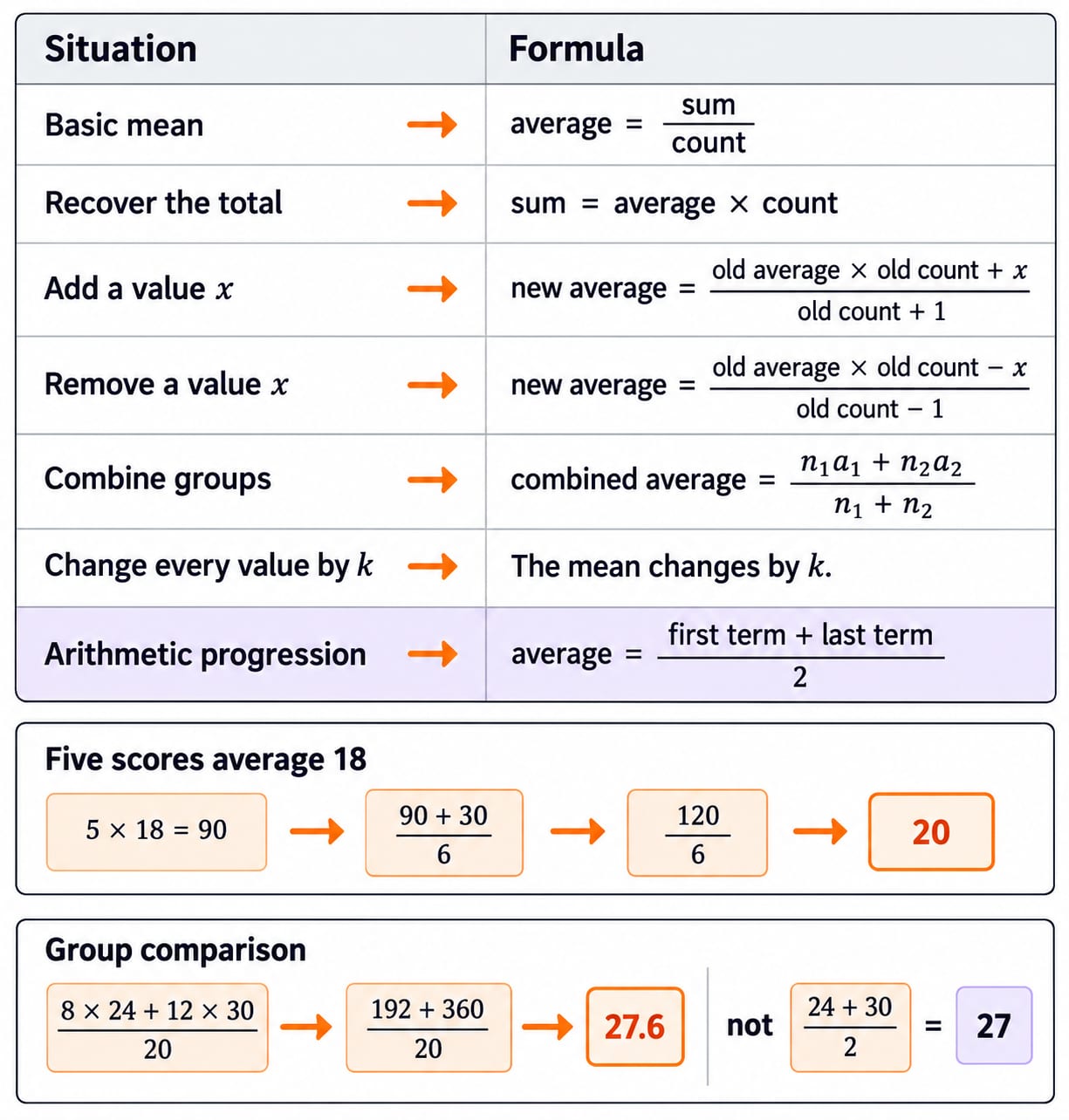
Situation | Formula |
|---|---|
Basic mean |
|
Recover the total |
|
Add a value |
|
Remove a value |
|
Combine groups |
|
Change every value by | The mean changes by |
Arithmetic progression |
|
Question 1 applies the last rule; Aptitude for GATE Exam develops it further.
Five scores average 18, so their sum is 5 × 18 = 90. Add 30 and the new average is (90 + 30)/6 = 120/6 = 20.
For groups of 8 averaging 24 and 12 averaging 30, the combined average is (8 × 24 + 12 × 30)/20 = (192 + 360)/20 = 27.6, not (24 + 30)/2 = 27. If first and last groups share an observation, adding their sums counts it twice.
Solved average MCQs 1-3: direct means and changed observations
Question 1
GATE Computer Science Set 2, 2014 (Average lesson hub; question page unavailable)
What is the average of all multiples of 10 from 2 to 198?
(a) 90
(b) 100
(c) 110
(d) 120
Correct answer: (b) 100.
The relevant multiples are 10, 20, ..., 190. Their average is (10 + 190)/2 = 100. There are 19 terms, and 19 × 100 = 1900, confirming the result.
Question 2
If the mean of the data 5,7,10,14,x,25,32,19 is x, then what is the value of x?
(a) 14
(b) 16
(c) 18
(d) 20
Correct answer: (b) 16.
The seven known values total 5 + 7 + 10 + 14 + 25 + 32 + 19 = 112. Since eight values have mean x, (112 + x)/8 = x. Thus 112 + x = 8x, so 112 = 7x and x = 16. Substitution checks it: (112 + 16)/8 = 128/8 = 16. For further practice, work through the related Basic Concepts and Formulas lesson.
Question 3
The mean of a set of data is 5. What will be the mean if ten is subtracted from each data ?
(a) 5
(b) 10
(c) -5
(d) -10
Correct answer: (c) -5.
Subtracting 10 from every observation subtracts 10 from the mean. The new mean is 5 - 10 = -5; neither the count nor the relative gaps matter.
Solved average MCQs 4-6: missing values and overlapping groups
Question 4
The average of 2, 7, 6 and x is 5 and the average of 18, 1, 6, x and y is 10. What is the value of y?
(a) 5
(b) 10
(c) 20
(d) 30
Correct answer: (c) 20.
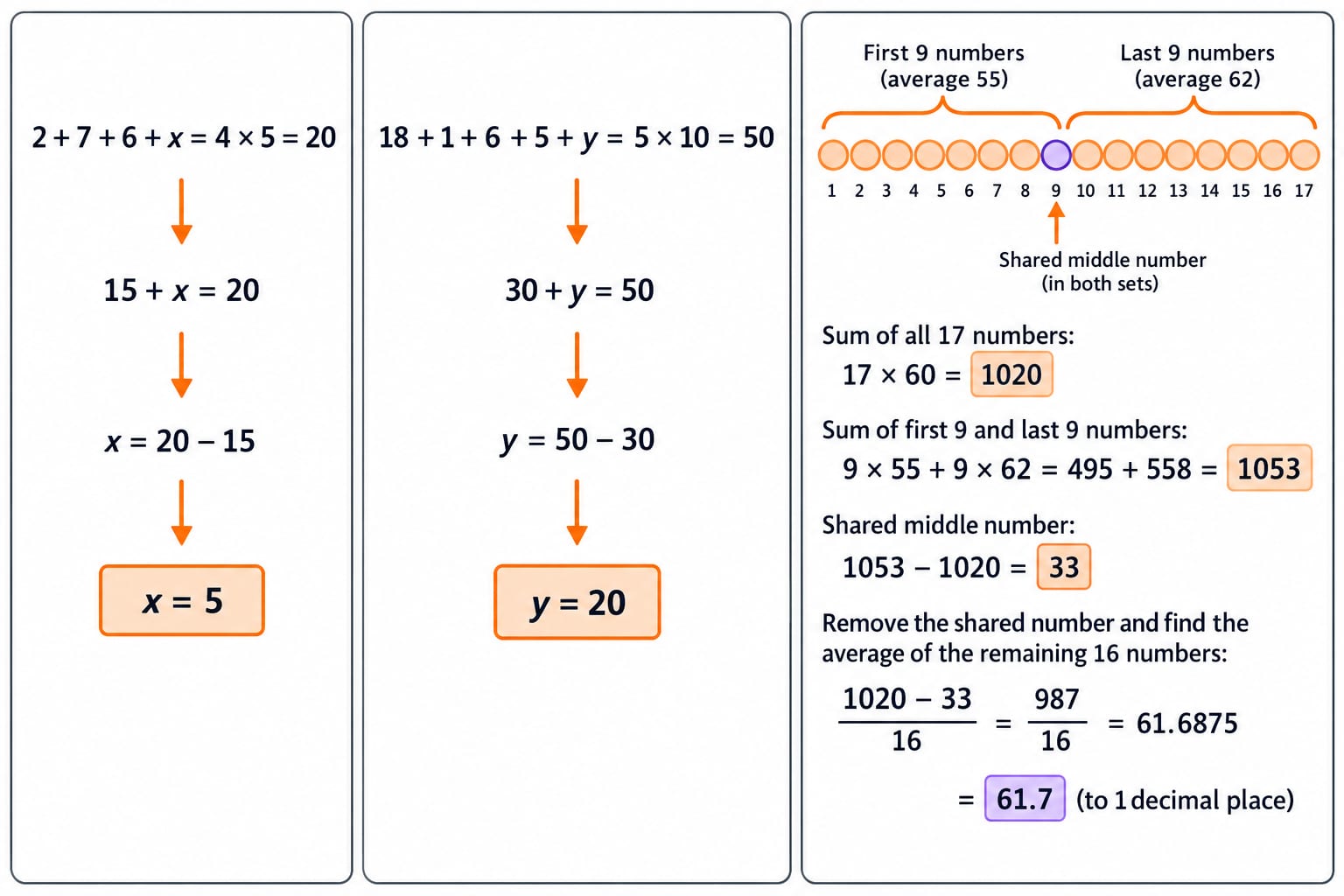
First, 2 + 7 + 6 + x = 4 × 5 = 20, so x = 5. Then 18 + 1 + 6 + 5 + y = 5 × 10 = 50. Thus 30 + y = 50 and y = 20.
Question 5
Navodaya Vidyalaya Samiti, 2019
The average of 17 numbers is 60. The average of the first 9 numbers is 55 and that of the last 9 numbers is 62.
If the middle number is removed, what will be the new average (correct to one decimal place)?
(a) 62.2
(b) 61.9
(c) 61.7
(d) 62.4
Correct answer: (c) 61.7.
The full sum is 17 × 60 = 1020. The two nine-number sums total 9 × 55 + 9 × 62 = 495 + 558 = 1053. Their shared middle number is 1053 - 1020 = 33. Remove it: (1020 - 33)/16 = 987/16 = 61.6875, or 61.7 to one decimal place.
Question 6
UGC NET Paper I December, 2023 (Average lesson hub; question page unavailable)
If the average of 10 numbers is 40 and the average of six of them is 28, what will be the average of the remaining four numbers?
(a) 52
(b) 54
(c) 56
(d) 58
Correct answer: (d) 58.
All ten numbers total 10 × 40 = 400; the selected six total 6 × 28 = 168. The other four total 400 - 168 = 232, and 232/4 = 58. Subtracting averages, 40 - 28, is meaningless here.
Solved average MCQs 7-9: zero mean, transformation and ratios
Question 7
The average of 20 numbers is zero. Of them, at the most, how many may be greater than zero?
(a) 0
(b) 1
(c) 10
(d) 19
Correct answer: (d) 19.
A zero average means the total is zero, not that every number is zero. Nineteen can be positive if the twentieth cancels their total. All 20 cannot be positive because their sum would be positive.
Question 8
UPTET Paper 2, 2017
There are 50 numbers. Each number is subtracted from 53 and the mean of the numbers so obtained is -3.5. The mean of the given numbers is
(a) 49.5
(b) 53.5
(c) 46.5
(d) 56.5
Correct answer: (d) 56.5.
Each transformed value is 53 - x, so 53 - original mean = -3.5. Therefore the original mean is 53 + 3.5 = 56.5. Using x - 53 would reverse the sign.
Question 9
The average age of three persons is 27 years. Their ages are in the proportion of 1:3:5.What is the age in years of the youngest one among them.
(a) 10
(b) 12
(c) 11
(d) 9
Correct answer: (d) 9.
The total age is 3 × 27 = 81. The ratio has 1 + 3 + 5 = 9 parts, so one part is 81/9 = 9. The youngest has one part and is 9.
Solved average MCQs 10-12: percentages, AM-GM and equal use
Question 10
Infosys 2024; Hexaware 2023; Cognizant 2024
In an exam, Amar scored 64 percent, Bhavan scored 36 percent and Chetan 44 percent. The maximum score awarded in the exam is 800. Find the average mark scored by all the three boys?
(a) 297
(b) 312
(c) 384
(d) 342
Correct answer: (c) 384.
All three percentages use the same maximum, so (64 + 36 + 44)/3 = 144/3 = 48%. Then 48% of 800 = 0.48 × 800 = 384. This shortcut fails if the maximums differ.
Question 11
The sum of two numbers is 15 and their geometric mean is 20% lower than the arithmetic mean. find the numbers?
(a) 11,4
(b) 12,3
(c) 9,6
(d) none
Correct answer: (b) 12,3.
The arithmetic mean is 15/2 = 7.5; the geometric mean is 80% of 7.5 = 6. Their product is 6² = 36. So t² - 15t + 36 = 0 = (t - 12)(t - 3), giving 12,3 with sum 15.
Question 12
For a car there are 5 tyres including one spare tyre(4+1). All tyres are equally used. If the total distance travelled by the car is 40000km then what is the average distance travelled by each tyre?
(a) 10000
(b) 40000
(c) 32000
(d) 8000
Correct answer: (c) 32000.
Four tyres work per kilometre, so the journey creates 4 × 40000 = 160000 tyre-kilometres. Equal rotation gives 160000/5 = 32000 km per tyre. Dividing 40000 by five ignores that four tyres work simultaneously.
Average-question traps to audit after every solution
Mistake | Why it fails | Correction |
|---|---|---|
Averaging group averages without weights | The groups may have different sizes | Use weighted totals: |
Subtracting averages | An average does not preserve group size | In Question 6, subtract totals: |
Double-counting an overlap | One shared value appears in both group sums | In Question 5, the middle value is |
Reversing | Changing the order changes the sign | In Question 8, use |
Use a 20-second check: write the total, verify the count, test plausibility, then substitute. In Question 4, x = 5 makes the first sum 20 and y = 20 makes the second sum 50.
For timed arithmetic practice, use the SSC CGL Quant Strategy: High-Yield Topics and Weekly Plan. Build fluency before advanced quant, as explained in CAT Quant Preparation: Arithmetic and Algebra First.
How these average formulas are tested, and the next practice step
The 12 questions reduce to four reusable shapes:
Direct total reconstruction in Questions 1 to 4.
Remove, combine or correct an overlap in Questions 5 and 6.
Conceptual transformations and constraints in Questions 7 to 9.
Contextual models in Questions 10 to 12.
The short version: convert averages to totals before combining groups. Transform the mean only when every observation receives the same operation. For equal use, count total work before dividing. Re-solve Questions 5, 8 and 12 without looking because they represent three distinct traps.
For structured work across broader quantitative aptitude, continue with Aptitude for Placement. If you only need a weekly practice order, use Aptitude for Placements: Section Topics and Weekly Plan instead.
Keep learning
Average Concepts and Shortcuts: Solved Examples for Competitive Exams
Turn every average into a total, then handle missing values, corrections, changed groups and weights with a small set of dependable shortcuts.
Updated 21 Sep 20266 min readAptitude & Reasoning
Basic Arithmetic Questions with Solutions: 12 Solved MCQs
Practise 12 arithmetic MCQs, inspect every worked step, and diagnose whether each miss came from order, scale, fraction base or translation.
Updated 20 Nov 20267 min readAptitude & Reasoning
Advance Arithmetic Questions with Solutions: 12 Solved MCQs
Attempt this 12-question mixed set before opening the solutions. Each answer models the story, shows the arithmetic, and finishes with a direct check.
Updated 19 Nov 20268 min readAptitude & Reasoning
Simplification Based Problems: 12 Solved Questions with Step-by-Step Solutions
Solve 12 simplification questions step by step, from nested signs and mixed fractions to continued fractions, approximation and structural shortcuts.
Updated 17 Nov 20266 min readAptitude & Reasoning