Discrete Mathematics for GATE: Syllabus, Weightage Context and Preparation Order
Learn where Discrete Mathematics sits in GATE CS, how its syllabus areas connect, and how to cover them through a practical 45-hour study plan.
KnowledgeGate Team
Exam prep & CS education
Updated 29 Jul 20265 min read184 views
Discrete Mathematics creates a peculiar GATE CS planning problem. It is one labelled part of Engineering Mathematics, yet its syllabus runs from propositional logic to graph colouring, and its question count shifts from paper to paper. So the two questions every aspirant asks about it have no clean answer: how many marks is it worth, and in what order should you learn five areas that keep borrowing each other's language? The marks answer is a range inside a fixed Engineering Mathematics allocation, never a quota of its own. The order answer is dependency-driven: logic first, then sets and relations, because almost everything after them is written in their notation.
Related reading: set theory foundations and universal and existential quantifiers.
1. Where Discrete Mathematics sits in GATE CS
In the official GATE 2026 CS syllabus, Discrete Mathematics appears inside Section 1, Engineering Mathematics. The GATE 2026 question-paper pattern allocates 13 marks to Engineering Mathematics in CS, alongside 15 marks for General Aptitude and 72 marks for subject questions.
That 13-mark allocation covers all Engineering Mathematics, including linear algebra, calculus, probability and statistics as well as Discrete Mathematics. It is not a separate Discrete Mathematics quota, and the pattern does not fix its question count. Use the GATE CS courses and test series page to place this subject within your wider preparation.
2. The official syllabus areas, translated into a study map
The official wording is: propositional and first-order logic; sets, relations, functions, partial orders and lattices; monoids and groups; graph connectivity, matching and colouring; counting, recurrence relations and generating functions.
For learning, regroup it into five clusters: (1) logic, (2) sets, relations and functions, (3) orders and algebraic structures, (4) graph theory, and (5) combinatorics and recurrences. Those five labels will not appear in the official PDF; they are a learning order, not exam sections. Begin logic with truth tables and quantifiers, then build sets and relations. The sequence matters because function questions use set language, while counting and graphs demand precise classification. Study each cluster as a family of question types, not as a list of definitions.
3. Weightage pattern: use a range mindset, not a fixed quota
The official allocation supports one precise claim: Engineering Mathematics has 13 marks in the cited GATE 2026 CS pattern. It does not support claims such as “Discrete Mathematics always carries 8 marks” or “Graph Theory always gives two questions”.
Build the range yourself, from three papers you have actually solved. Make rows for Logic, Sets/Relations/Functions, Graphs, and Combinatorics/Recurrences. Make one column per paper. Enter each question's marks, then record whether it was attempted, correct or wrong. If those three papers carry 6, 4 and 8 marks of Discrete Mathematics, what you hold is an observed 4 to 8 mark range in that sample, never a guarantee for the next paper. The row totals are the more useful number anyway: they tell you which cluster is quietly costing you marks.
4. How GATE-style questions combine syllabus areas
Let A = {1, 2, 3} and B = {a, b}. A function must send each element of A to exactly one element of B, so each of the three elements has two choices independently: 2 × 2 × 2 = 2^3 = 8 functions in total.
An onto function must use both a and b. Exactly two fail: the constant functions sending every input to a or every input to b. Hence, onto functions = 8 - 2 = 6.
Now change the object without changing the sets. A relation from A to B is any subset of A × B, and |A × B| = 3 × 2 = 6, so there are 2^6 = 64 relations. Same two sets, and the count jumps from 8 to 64, because a relation may pair an element of A with both elements of B, with one, or with neither, while a function has no such freedom. That gap is why classification comes before computation: name the domain size, the codomain size and the constraint, and the formula follows. Skip it, and a “how many” question gets answered with the neighbouring formula: 2^(mn) where n^m was wanted.
5. Worked graph example: connectivity, colouring and matching together
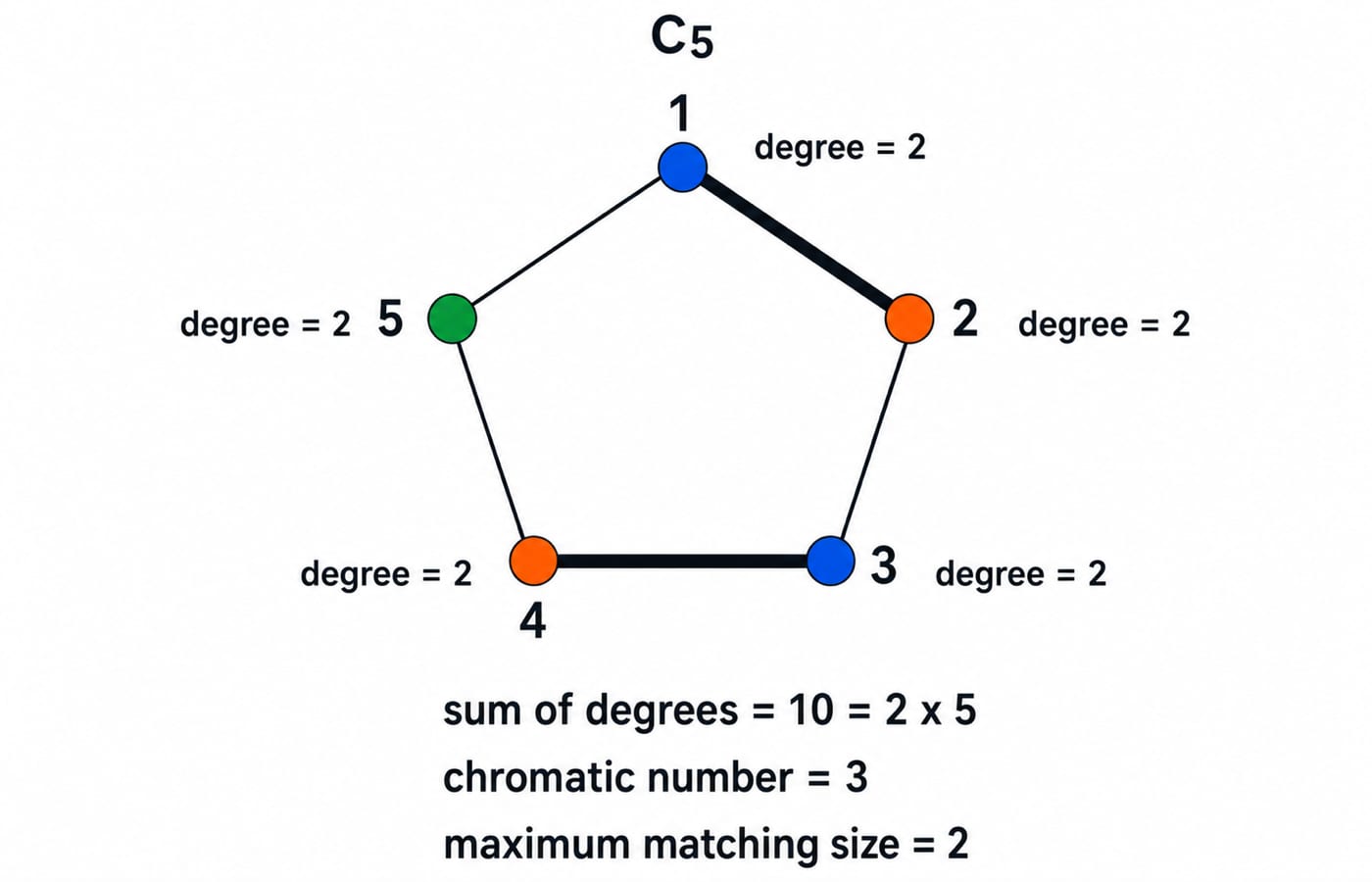
Consider C5 with V = {1, 2, 3, 4, 5} and E = {(1,2), (2,3), (3,4), (4,5), (5,1)}.
It is connected because a path exists between every pair of vertices.
Every vertex has degree 2, so the degree sum is 5 × 2 = 10. This agrees with 2|E| = 2 × 5 = 10.
C5 is an odd cycle, so it is not bipartite. Two colours cannot work, while three can, giving chromatic number 3.
A maximum matching has size 2, for example {(1,2), (3,4)}. No matching of size 3 is possible on five vertices, and vertex 5 remains unmatched, so there is no perfect matching.
The exam habit is to extract several consequences from one graph, not memorise each term in isolation. Continue with Euler, Hamiltonian and colouring problems to practise that connected reasoning.
6. Preparation order and a six-week, 45-hour plan
Study in five 90-minute sessions each week. That is 450 minutes, or 7.5 hours weekly, and 45 hours across six weeks.
Week 1: Logic.
Week 2: Sets, relations and functions.
Week 3: Counting and recurrence relations.
Week 4: Graph basics, connectivity, matching and colouring.
Week 5: Partial orders, lattices, monoids, groups and generating functions.
Week 6: Mixed timed sets, revision and error repair.
Give every session the same shape: 30 minutes of concept study, 45 minutes solving 6-10 questions, and 15 minutes updating a one-page error log. If you miss a day, move only the unfinished question set forward. Do not double the next session's theory load. Learners who want guided sequencing can use GATE Guidance by Sanchit Sir as a structured, adaptive route.
7. Traps, practice volume and the test loop
Trap | Why it fails | Replacement check |
|---|---|---|
Implication/converse |
| Write both |
Relation/function counts | Subsets versus assigned outputs | Name |
Maximal/maximum matching | Maximal may not be largest | Seek a larger matching |
Recurrence without initial values | Many sequences fit | Apply base cases |
KnowledgeGate carries more than 1,300 Discrete Mathematics practice questions, but volume alone does not mean readiness. Solve 20 mixed questions in one sitting, check every wrong or guessed answer against the table above, then retest those concepts after 48 hours. When the error log stops repeating itself, move to timed testing with the GATE Test Series.
8. The short version and next step
Learn the official clusters in dependency order. Treat weightage as variable inside the official Engineering Mathematics allocation. Use timed mixed practice to expose weak links.
Now download the official CS syllabus, mark the five teaching clusters on it, and begin Week 1 with logic. If you would rather not rebuild the sequence yourself every week, the GATE Guidance route sets it for you.
Keep learning

Classification of Finite and Infinite Groups: Orders, Cyclicity and Worked Examples
Learn how group axioms, group order, element order and generators classify finite and infinite groups through complete, checkable examples.
Updated 4 Oct 20266 min readEngineering Mathematics
Bipartite, Cycle, Regular and Complement Graphs: Tests, Formulas and a C6 Worked Example
Learn a dependable order for classifying simple graphs, then apply it to C6 and list, count and test every edge in its complement.
Updated 29 Sep 20266 min readEngineering Mathematics

Basic Terminologies in Linear Programming: Feasible Solutions, BFS and an Optimal Solution Worked Step by Step
Separate feasible, basic feasible and optimal solutions through geometry, slack variables, vertex enumeration and concise counterexamples.
Updated 25 Sep 20265 min readEngineering Mathematics
Assignment Problem and Hungarian Method: Formulation with a Complete Worked Example
Learn why greedy assignment fails, how matrix reductions preserve the optimum, and how the uncovered-value adjustment leads to a minimum cost of 140.
Updated 24 Sep 20266 min readEngineering Mathematics