

Transport Layer Cross-Concept MCQs: 10 Solved MCQ, MSQ and NAT Questions
Solve ten published cross-concept questions spanning transport, network, data-link and physical-layer decisions, with fresh explanations and checked arithmetic.
KnowledgeGate Team
Exam prep & CS education
Updated 20 Nov 20267 min read
A cross-concept networking question can begin with TCP, jump to ARP or Ethernet, and finish by testing an OSI-layer boundary. One misplaced layer or unit changes the answer. The ten questions use MCQ, MSQ and NAT formats across transport, network, data-link and physical-layer decisions. Question 10 switches to DBMS transaction scheduling, so reset the model before solving it. Attempt each question before reading the answer, and use CS Fundamentals for Exams & Placements for wider revision.
Build a cross-layer map before solving the questions
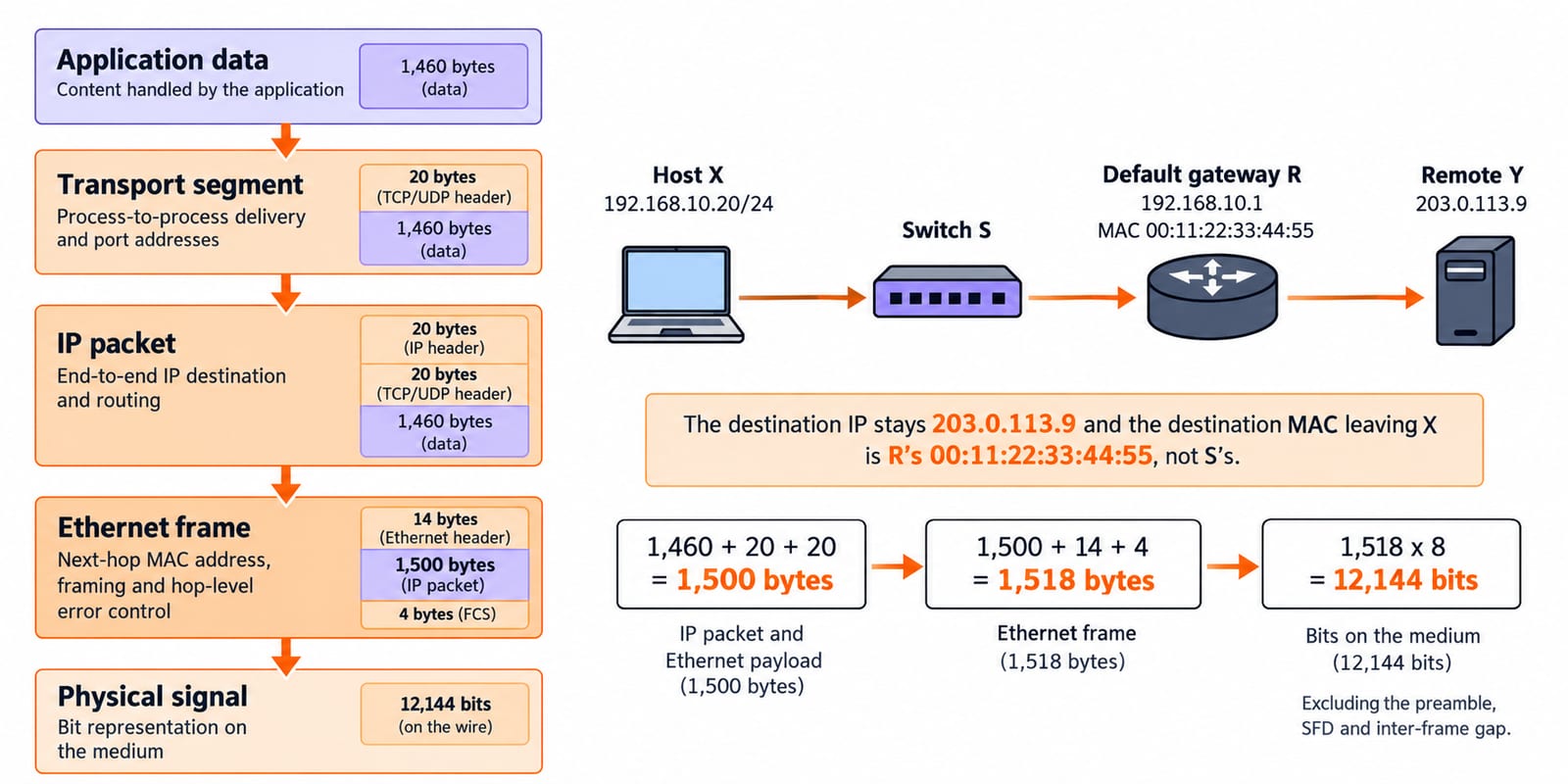
Flow stage | Main responsibility tested here |
|---|---|
Application data | Content handled by the application |
Transport segment | Process-to-process delivery and port addresses |
IP packet | End-to-end IP destination and routing |
Ethernet frame | Next-hop MAC address, framing and hop-level error control |
Physical signal | Bit representation on the medium |
ARP maps an IP address to a link-layer address on the local hop. A switch forwards the frame without becoming its destination.
Host X is 192.168.10.20/24. Its default gateway R is 192.168.10.1, with MAC 00:11:22:33:44:55. Remote Y is 203.0.113.9, and switch S lies between X and R. X sends 1,460 bytes of application data with a 20-byte TCP header and a 20-byte IPv4 header:
1,460 + 20 + 20 = 1,500 bytes for the IP packet and Ethernet payload.
Adding the 14-byte Ethernet header and 4-byte FCS gives 1,500 + 14 + 4 = 1,518 bytes, or 1,518 x 8 = 12,144 bits, excluding the preamble, SFD and inter-frame gap. The destination IP stays 203.0.113.9, but the destination MAC leaving X is R's 00:11:22:33:44:55, not S's. This primes Questions 1, 2, 3, 8 and 9. Use the earlier PPP, TCP/IP & VoIP MCQs: 10 Solved Questions to classify PPP, IP, VoIP, RTP and DHCP. Here, keep end-to-end and hop-level addresses separate, check units, and be ready for the DBMS context switch.
Questions 1-3: end-to-end addresses, piggybacking and layer roles
Question 1
GATE 2024, Computer Science, Set 2. MSQ.
Node X has a TCP connection open to node Y. The packets from X to Y go through an intermediate IP router R. Ethernet switch S is the first switch on the network path between X and R. Consider a packet sent from X to Y over this connection.
Which of the following statements is/are TRUE about the destination IP and MAC addresses on this packet at the time it leaves X?
A. The destination IP address is the IP address of R
B. The destination IP address is the IP address of Y
C. The destination MAC address is the MAC address of S
D. The destination MAC address is the MAC address of Y
Correct answer: B only.
The IP header keeps final destination Y, while the frame leaving X uses router R's interface as its destination MAC. Switch S only forwards it, so A, C and D are false.
Question 2
GATE 2025, Computer Science, Set 2. MCQ.
Consider the following statements:
(i) Address Resolution Protocol (ARP) provides a mapping from an IP address to the corresponding hardware (link-layer) address.
(ii) A single TCP segment from a sender S to a receiver R cannot carry both data from S to R and acknowledgement for a segment from R to S.
Which ONE of the following is CORRECT?
A. Both (i) and (ii) are TRUE
B. (i) is TRUE and (ii) is FALSE
C. (i) is FALSE and (ii) is TRUE
D. Both (i) and (ii) are FALSE
Correct answer: B. (i) is TRUE and (ii) is FALSE.
ARP makes (i) true by resolving an IPv4 address to a local link-layer address. Statement (ii) is false because a TCP data segment can acknowledge bytes received in the other direction. This is piggybacking, but it need not produce a new acknowledgement in every data segment.
Question 3
GATE 2004, Computer Science. MCQ.
Choose the best matching between Group 1 and Group 2.
   Group-1   	  	  Group-2
 P. Data link          1. Ensures reliable transport of data
                           over a physical point-to-point link
 Q. Network layer      2. Encoder/decodes data for physical
                          transmission
 R. Transport layer    3. Allows end-to-end communication
                          between two processes
                       4. Routes data from one network
                          node to the next
A. P-1, Q-4, R-3
B. P-2, Q-4, R-1
C. P-2, Q-3, R-1
D. P-1, Q-3, R-2
Correct answer: A. P-1, Q-4, R-3.
Match by scope. Data link handles the point-to-point link, network routes between nodes, and transport connects processes end to end. Item 2 is the physical-boundary distractor.
Questions 4-5: SCTP and connection-oriented service boundaries
Question 4
Choose the correct statement about SCTP.
A. SCTP stands for stream connection transmission protocol.
B. SCTP is message-oriented whereas TCP is stream-oriented.
C. SCTP can handle multiple simultaneous streams.
D. SCTP may provide more flexibility for certain applications, like Voice over IP (VoIP).
Correct answer: B, C and D.
A is false because SCTP expands to Stream Control Transmission Protocol. B contrasts preserved messages with TCP's byte stream, and C identifies multistreaming. D describes a possible application benefit, not universal preference for VoIP.
Question 5
UGC NET 2025, Computer Science, Paper 2 January. MCQ.
Choose the correct statements from the following
A. In connection oriented service, the destination address is to be specified only during the setup.
B. Packet sequencing is not guaranteed in connection oriented service
C. Flooding is method in which every incoming packet is sent out on every outgoing line except the one by which it arrived.
D. Presentation layer performs detection and recovery from errors in the transmitted data.
Choose the correct answer from the options given below:
A. A, B & C only
B. B, C & D only
C. A & C only
D. A, C & D only
Correct answer: C. A & C only.
In a virtual-circuit connection-oriented service, setup establishes the destination context, so A is the intended statement. B is false because packets using the established logical connection are delivered in sequence; C correctly defines flooding. D is false because the presentation layer handles representation, compression and encryption, while link or transport mechanisms handle error control.
Questions 6-7: sequence-number wraparound and error control
Question 6
Given the maximum lifetime of a segment is 30 sec and link capacity is 500Mbps, find the no. of bits required to avoid wraparound during this time?
A. 34
B. 36
C. 38
D. 40
Correct answer: A. 34.
Using the sequence-space model, a 500 Mbps link covers 500 x 10^6 x 30 = 15 x 10^9 bit positions during the 30-second lifetime. Since 2^33 = 8,589,934,592 is too small and 2^34 = 17,179,869,184 is large enough, the minimum sequence-number width is 34 bits.
Question 7
Which layer is responsible for Error Control?
A. Data Link Layer
B. Network Layer
C. Transport Layer
D. Application Layer
Correct answer: A and C.
Data Link Layer error control is hop-to-hop on one link. Transport Layer error control is end-to-end between endpoints. These scopes explain why this MSQ selects A and C.
Questions 8-9: network-layer ownership and Ethernet frame limits
Question 8
Find the correct match -
A. Port Address – Data link layer
B. IP – Application layer
C. Fragmentation – Network layer
D. ICMP – Transport layer
Correct answer: C. Fragmentation – Network layer.
Assign each item first. Port addresses belong to transport, while IP, IPv4 fragmentation and ICMP belong with the Internet or network layer. Only C survives.
Question 9
What is the minimum and maximum frame length of Ethernet?
A. Min – 64 bytes and Max - 12144 bits
B. Min – 512 bits and Max – 1516 bytes
C. Min – 46 bytes and Max – 1500 bytes
D. Min – 46 bytes and Max – 1518 bytes
Correct answer: A. Min – 64 bytes and Max - 12144 bits.
Convert first: 64 bytes x 8 = 512 bits, while 12,144 bits / 8 = 1,518 bytes. Option A gives frame limits in mixed units. The 46 bytes and 1,500 bytes values are payload limits. As above, 1,518 bytes = 14-byte header + 1,500-byte payload + 4-byte FCS.
For a narrower follow-up, solve TCP and UDP MCQs: 12 Solved Transport Layer Questions after this cross-layer set.
Question 10: solve the DBMS transaction-scheduling problem
Question 10
This is a DBMS transaction-scheduling problem, although it does not match the Transport Layer topic.
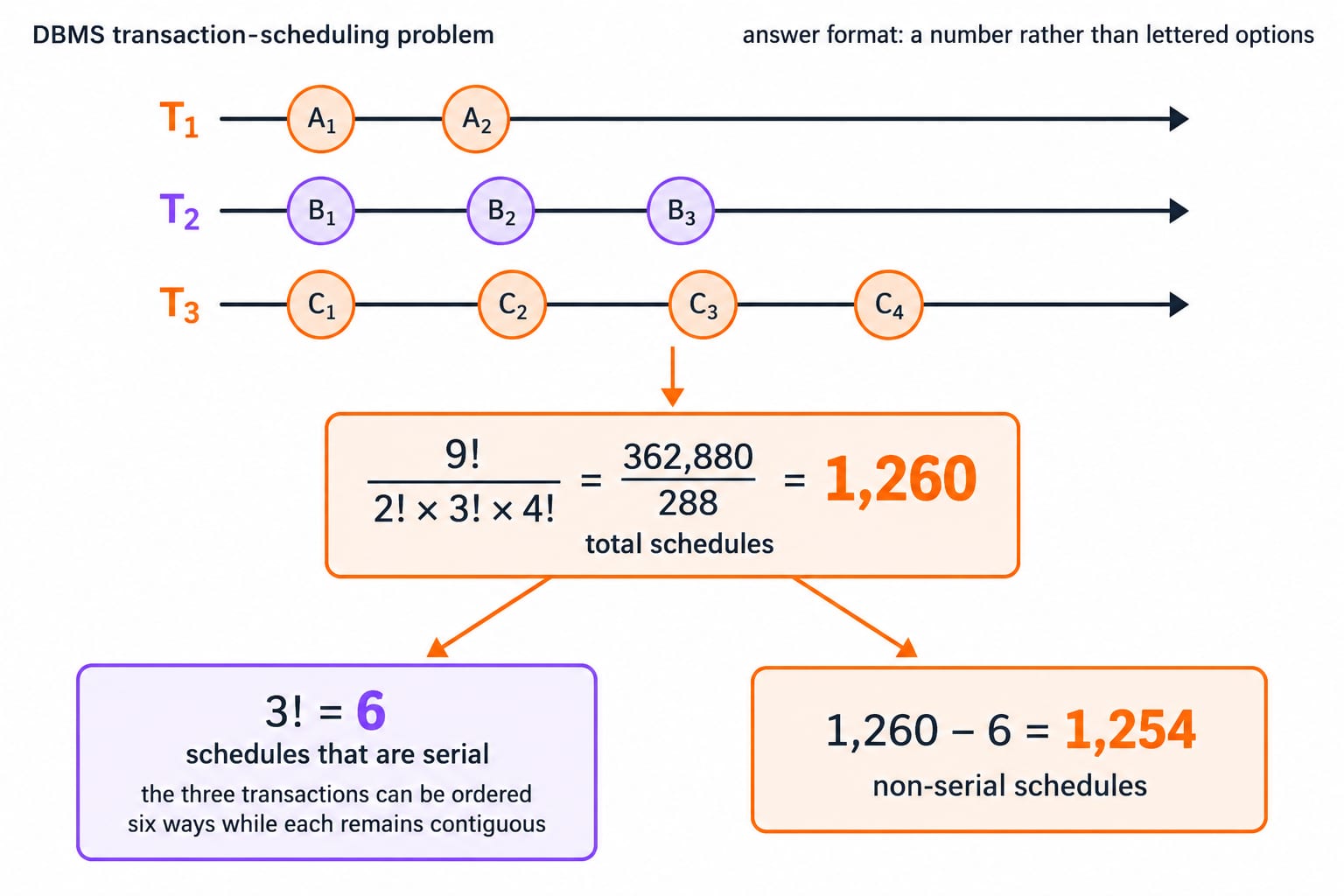
What is the number of non-serial schedules possible containing 3 transactions of 2,3 and 4 operations respectively?
Answer format:
This NAT item accepts a number rather than lettered options.
Correct answer: 1254.
There are 2 + 3 + 4 = 9 operations. Preserving the internal order of each transaction, the total number of interleavings is:
9! / (2! x 3! x 4!) = 362,880 / 288 = 1,260 total schedules.
Exactly 3! = 6 schedules are serial because the three transactions can be ordered six ways while each remains contiguous. Therefore the number of non-serial schedules is 1,260 - 6 = 1,254.
Cross-concept traps and the next practice step
Trap | Recheck |
|---|---|
End-to-end IP versus next-hop MAC | Q1 |
ARP versus TCP piggybacking | Q2 |
Layer scope | Q3, Q5, Q7 and Q8 |
Message versus byte-stream transport | Q4 |
Units and powers of two | Q6 and Q9 |
All schedules versus non-serial schedules | Q10 |
Under time pressure, mark MCQ, MSQ or NAT first. Underline the requested layer or unit, draw the relevant path, and convert bits and bytes before choosing. For statement sets, judge each statement independently before reading the combined options.
Retest Questions 1, 2, 6, 7, 9 and 10 without looking. The checkpoints are B only, B, 34, A and C, 64 bytes and 12,144 bits, and 1,254. For a structured GATE path, continue with GATE Guidance by Sanchit Sir. For placement revision, use CS Fundamentals for Placements by Sanchit Sir.
Keep learning
Ethernet Cross-Concept MCQs: 12 Solved Data Link Layer Questions
Solve 12 Ethernet questions spanning devices, MAC structure, CSMA/CD, STP, VLANs, collision domains, switch port accounting and frame payload conversion.
Updated 30 Aug 20267 min readComputer Networks MCQs

Data Link Layer Flow Control: Stop-and-Wait, Sliding Windows and Worked Numericals
Build a reliable method for DLL flow-control problems by tracing one link from frame timing to windows, receiver credit, sequence-space limits and ACK policy.
Updated 12 Nov 20266 min readComputer Networks
Transport Layer Services in Computer Networks: TCP, UDP and Reliability with Worked Examples
Understand process-to-process delivery, compare TCP with UDP, and follow one connection through setup, loss recovery, flow control and closure.
Updated 26 Aug 20265 min read54 viewsComputer Networks
MCQ, MSQ or NAT? Knowing the Question Type Is Half the Battle in GATE
GATE does not just test what you know. It tests whether you know the rules of each question type. MCQ, MSQ and NAT each reward a different strategy. Here is how to play each one.
Updated 29 Oct 20265 min read557 viewsGATE Strategy & Roadmap