Concept of Pedagogy: Meaning, Types, Maxims and How Teaching Exams Test It
Build an exam-ready understanding of pedagogy through clear definitions, comparison tables, theorist cues, teaching maxims and solved classroom scenarios.
KnowledgeGate Team
Exam prep & CS education
Updated 22 Jul 20266 min read
Pedagogy appears near the start of almost every teaching-exam syllabus, but “the way of teaching” is not a precise enough definition for an MCQ. CTET, state TET, UGC NET Paper 1 and teaching-recruitment papers test its origin, its related terms, its maxims and its theorists. The hardest of those are the scenario items: a plain classroom description with no technical word in it, where the answer is a single named maxim you have to recover from the order in which things happened.
What pedagogy means: origin, working definition, art and science
The Greek paidagogos combines pais (child) and agein (to lead). In ancient Greece, it named the attendant who led a child to school. Pedagogy now means the method and practice of teaching.
An exam-ready definition is: pedagogy is the systematic study of teaching methods, covering what is taught, how it is taught and how learning is assessed in relation to the learner’s stage of development.
Pedagogy is both an art and a science. It applies tested ideas about development, motivation and learning, but a teacher must adapt them to a particular class.
It is narrower than education, which includes aims, curriculum and policy, but wider than any single teaching method.
Pedagogy vs andragogy vs heutagogy
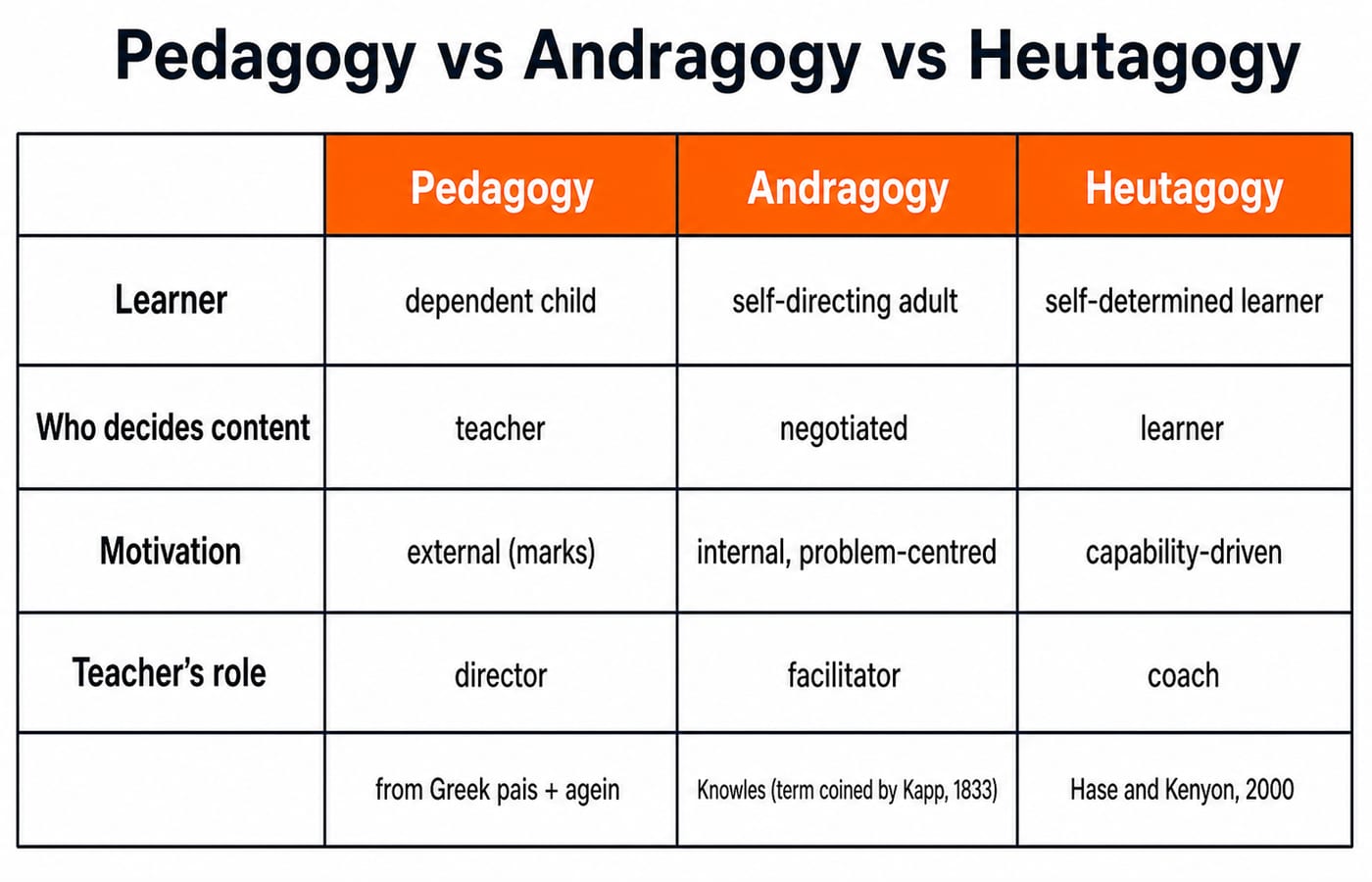
The three terms differ mainly in who directs learning.
Point of contrast | Pedagogy | Andragogy | Heutagogy |
|---|---|---|---|
Learner | Dependent child | Self-directing adult | Self-determined learner of any age |
Who decides content | Teacher | Negotiated using the learner’s experience | Learner, including how to learn |
Motivation | Largely external, such as marks and approval | Internal and problem-centred, linked to life roles | Capability-driven, including learning to learn |
Teacher’s role | Director | Facilitator | Coach or resource curator |
Andragogy is adult learning. Alexander Kapp coined the term in 1833, and Malcolm Knowles later popularised it. Heutagogy, proposed by Stewart Hase and Chris Kenyon in 2000, is self-determined learning.
Try a matching question: “The term andragogy is most closely associated with: (a) Paulo Freire (b) Malcolm Knowles (c) Lee Shulman (d) Jean Piaget.” The answer is (b) Malcolm Knowles. Freire means critical pedagogy, Shulman means PCK, and Piaget means cognitive development.
The maxims of teaching
A maxim is an ordered teaching principle. Read every pair as an arrow:
Maxim | Five-word classroom cue |
|---|---|
Known to unknown | Birthday cake before new fractions |
Simple to complex | Practise single-digit before multi-digit addition |
Concrete to abstract | Use objects before mathematical symbols |
Particular to general | Examples before rule, or induction |
Whole to part | Full sentence before naming nouns |
Learning by doing | Try activity before verbal explanation |
The common trap puts the right words in reverse. Write what happened first, draw the arrow, then inspect the choices.
Concrete to abstract reflects Piaget’s concrete-operational stage, roughly ages 7 to 11, when children reason more readily with objects than symbols. Primary pedagogy therefore uses material and activity.
Named pedagogical approaches and their theorists
Teacher-centred pedagogy: Knowledge is transmitted through explanation, drill and reinforcement. “Chalk and talk”, rote and stimulus-response are its cues.
Learner-centred constructivism: Learners build knowledge from experience. Piaget maps to cognitive constructivism. Vygotsky maps to social constructivism, the zone of proximal development and scaffolding. Look for activity, prior knowledge and peer collaboration. NCF 2005 favoured connecting knowledge to life and moving away from rote. NEP 2020 continues the emphasis on experiential, competency-based pedagogy.
Critical pedagogy: Paulo Freire’s Pedagogy of the Oppressed rejects the “banking concept” of depositing facts into passive learners. It replaces this with dialogue, problem-posing education and conscientisation.
Pedagogical Content Knowledge: Lee Shulman introduced PCK in 1986. It joins subject knowledge with ways to teach that subject, including useful examples and common misconceptions. It distinguishes a subject expert from a subject teacher.
Constructivism and this theorist map carry straight into the CDP section, so pair them with the CTET Child Development and Pedagogy high-yield concepts, and with CTET mathematics pedagogy for how the same maxims play out inside one subject.
Worked example: one lesson, two pedagogical stances
The task is a Class 5 lesson on 1/2 + 1/4.
Teacher-centred stance
The teacher states the rule: make denominators equal. Since 1/2 = 2/4, the sum is 2/4 + 1/4 = 3/4. She writes two examples; students copy them and drill ten similar sums. The procedure is fast but fragile. A learner who asks why 1/2 becomes 2/4 lacks a concrete explanation.
Constructivist, maxim-driven stance
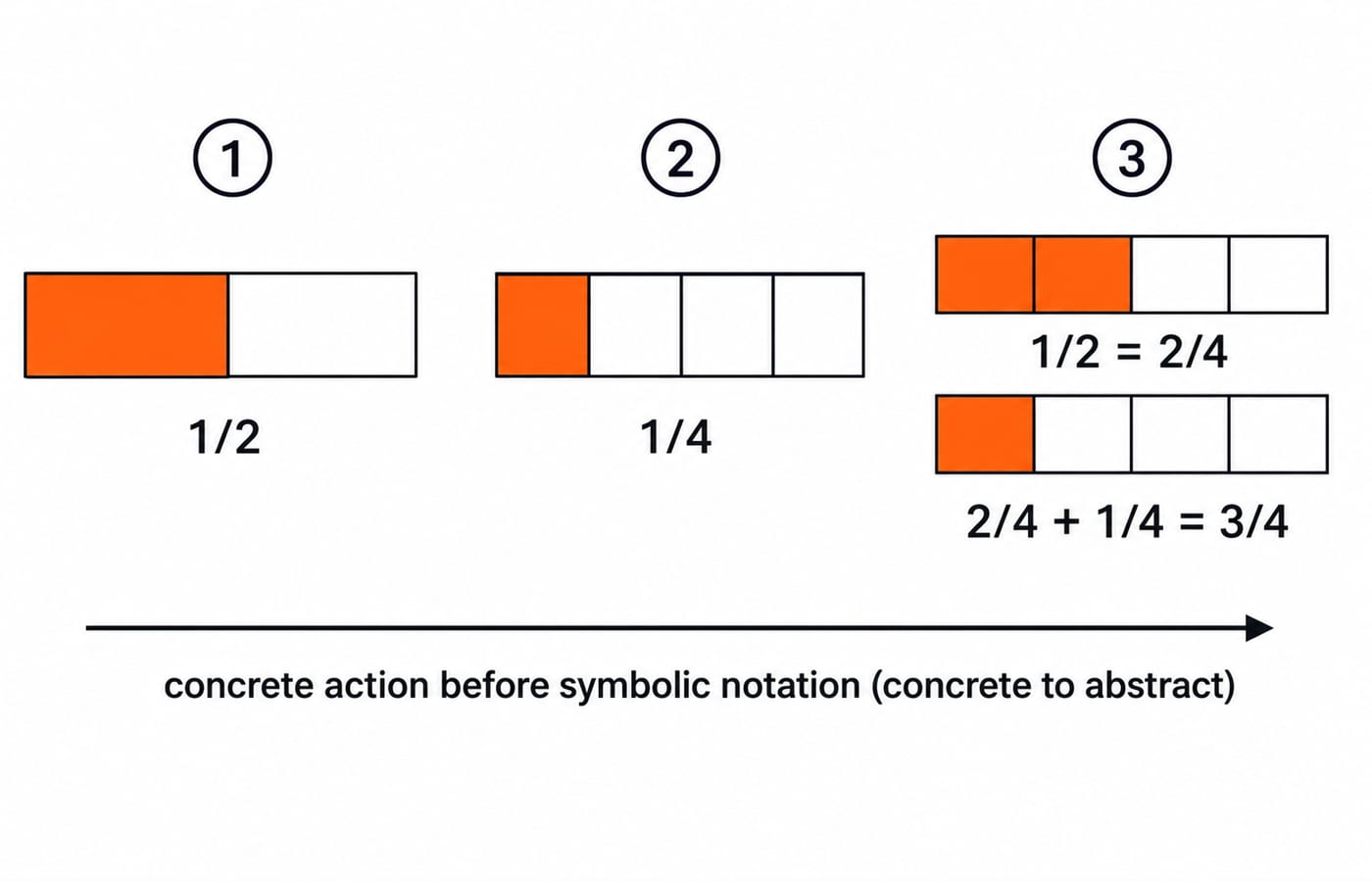
Each learner folds a strip into two equal parts and shades one for 1/2. An identical strip is folded into four parts, with one shaded for 1/4. Refolding the first strip shows two shaded quarters, so 1/2 = 2/4. Together they give 2/4 + 1/4 = 3/4. Only then does the teacher write the equation.
This is concrete to abstract, learning by doing and known to unknown. It uses Piaget’s concrete-operational reasoning. The prompt “fold once more and count” is scaffolding. The same content produces different learning through a different pedagogy.
How CTET, TET and NET test pedagogy
CTET carries a dedicated Child Development and Pedagogy section in both papers, and pedagogy returns inside the Paper 1 subjects and inside whichever subject you take in Paper 2. State TETs are built the same way; UPTET, for instance, also runs CDP through both of its papers. In UGC NET, higher-education pedagogy sits inside the teaching aptitude portion of Paper 1. Marks, question counts and timing move from one cycle to the next, so read those off the current bulletin at ctet.nic.in rather than off any set of notes.
Four shapes recur: definition or etymology, theorist matching, direction-of-maxim items, and classroom scenarios.
Scenario MCQ: “A Class 5 teacher begins a lesson on addition of fractions by having students fold and shade paper strips to show 1/2 and 1/4, and only afterwards writes 1/2 + 1/4 = 3/4 on the board. Which maxim of teaching is she primarily following? (a) abstract to concrete (b) concrete to abstract (c) complex to simple (d) general to particular.”
Eliminate systematically. Option (a) reverses the observed order. Option (c) reverses simple to complex and describes nothing here. Option (d) is deductive, but no general rule came before the strips. A physical object came before symbols, so (b) concrete to abstract is correct.
That stem is the constructivist lesson above with its vocabulary stripped out, which is the whole trick of scenario items: reconstruct the order of events, then name it. Rewrite two of your own lessons as stems, then use sectional and full-length practice in the CTET Paper 1 course or the CTET Paper 2 course.
Traps that cost marks
Reversed maxims: Familiar words hide the direction. Form the arrow before reading the options.
Andragogy attributed to Freire: Remember Freire for critical pedagogy and banking education, Knowles for adult learning.
Pedagogy reduced to one method: The full concept includes method, learner development and assessment.
Personal schooling used as the rule: Anchor scenarios to a named maxim or theorist, not memory.
Structure numbers recalled from memory: Section names hold steady across cycles, but question counts, marks and timing do not. If an item turns on a number, take it from the current bulletin rather than from a coaching handout you memorised two years ago.
The short version, then the next step
Pais and agein mean to lead the child.
It is both an art and a science.
Pedagogy, andragogy and heutagogy differ in who directs learning.
Maxims are arrows, especially concrete to abstract.
Piaget and Vygotsky map to constructivism, Freire to critical pedagogy, and Shulman to PCK.
Scenario questions are classroom lessons wearing new clothes.
Revise the theorist map until Kapp, Knowles, Hase and Kenyon, Freire and Shulman come back without hesitation, then practise CTET Paper 1 or Paper 2 sections for your target. The Teaching Eligibility Tests hub carries the next topic.
Keep learning
सामान्य अशुद्धियाँ (Samanya Ashuddhiyaan): Complete Hindi Grammar Notes for CTET and TET Exams
Learn to identify and correct Hindi word-form, agreement, pronoun and redundancy errors through exact examples, a worked MCQ and a scored diagnostic.
Updated 6 Oct 20266 min readCTET & UPTET
Universities and Learning Programmes for Teaching Exams: Types, Modes and Solved Examples
Separate university status, delivery mode and programme purpose with a repeatable method, then test it on five UGC NET-style classification cases.
Updated 2 Oct 20265 min readCTET & UPTET

National Education Policy (NEP) 2020 Notes for Teaching Exams: 5+3+3+4, Reforms and MCQ Traps
Build an exam-ready map of NEP 2020, from the age-stage structure to pedagogy, language, PARAKH, B.Ed. routes and reliable distractor elimination.
Updated 26 Sep 20265 min readCTET & UPTET
Miscellaneous Pedagogy Topics for Teaching Exams: Complete Notes and Worked Examples
Turn a loose syllabus label into a five-part concept map, then use classroom evidence to distinguish sound pedagogy from attractive but incomplete options.
Updated 25 Sep 20266 min readCTET & UPTET