CTET Mathematics pedagogy: what it tests and how to score it
A CTET Mathematics pedagogy guide: how children learn maths, common errors and misconceptions, teaching strategies, and how the pedagogy half is tested.
KnowledgeGate Team
Exam prep & CS education
Updated 14 Jul 20265 min read
In the CTET Mathematics section, the content and the pedagogy are two separate battles, and candidates who are strong at the maths itself often lose marks on the pedagogy half simply because they never studied it. That is a mistake, because pedagogy questions are frequently the more reliable marks. The pedagogy half sits in both papers, primary maths in Paper 1 and the upper-primary mathematics elective in Paper 2, and in both it asks you to judge how a child was taught rather than to work anything out yourself.
Maths pedagogy rests on a settled set of principles, few enough to learn cold: the child builds mathematical understanding rather than receiving it, and almost every teaching and assessment judgement the paper asks you to make follows from that one idea.
How children learn mathematics
The foundation of maths pedagogy is a view of the child as an active builder of mathematical understanding, not a passive receiver of procedures. Constructivism, the maxims of teaching and the named approaches with their theorists sit behind that view; our notes on the Concept of Pedagogy cover those in full.
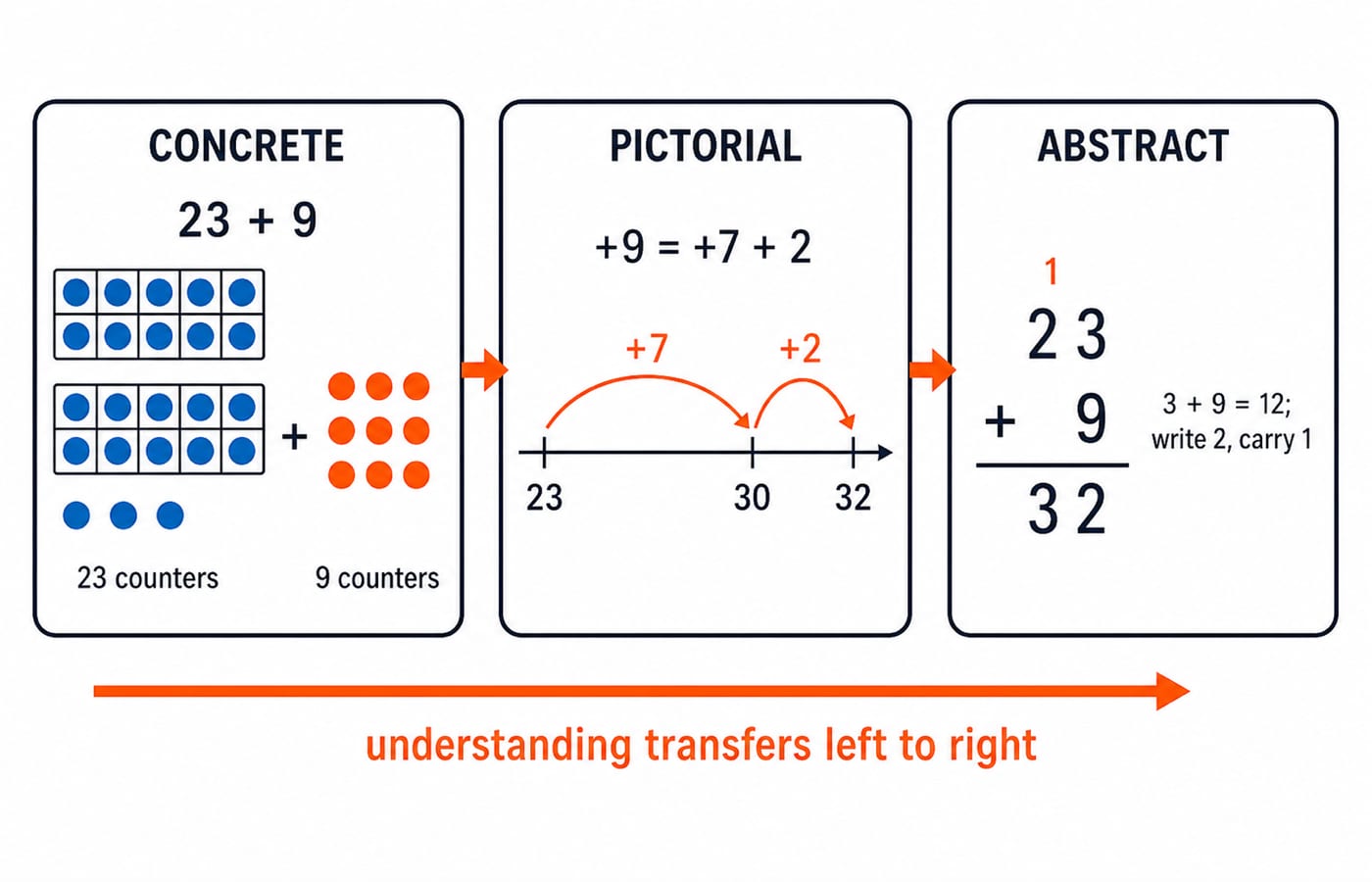
Concrete to abstract. Children grasp a concept through physical materials and lived experience first, then pictorial representation, and only then abstract symbols. The concrete-pictorial-abstract progression is a recurring idea.
Mathematics as reasoning, not computation. The section repeatedly favours understanding why a procedure works over speed at executing it. A child who can explain a method is valued over one who only memorised it.
The place of language and context. Word problems and everyday contexts are seen as tools that make abstract maths meaningful, not as decoration.
Errors and misconceptions: the theme to master first
If there is one theme to master in maths pedagogy, it is the treatment of errors. The modern view, and the one CTET rewards, is that a child's error is a window into their thinking, not merely a wrong answer.
Errors are systematic, not random. A child who writes that 23 plus 9 is 212 is applying a consistent, if flawed, rule about place value. The pedagogical task is to diagnose the rule.
Misconceptions must be surfaced and addressed, not just marked wrong. Good teaching brings the faulty idea into the open and lets the child confront it.
Errors are a resource for teaching. The expected teacher response is to understand the reasoning behind a mistake and use it to guide the next step.
Scenario items that hand you a child's specific error and ask what it reveals, or what the teacher should do next, are standard. The answer is almost always "diagnose the underlying misconception", never "penalise" or "re-explain the same way".
A worked example: diagnosing an error step by step
Consider the specific mistake above, a child who computes 23 + 9 = 212. It is tempting to mark it wrong and move on, but the pedagogy section wants the diagnosis. Reason through it: the child has written the 2 and the 12 side by side, which means they added 3 + 9 = 12 and 2 + 0 (an assumed tens digit for 9) and then simply placed the results next to each other instead of carrying. The error is not carelessness; it is a consistent, incorrect rule about place value and carrying.
Now choose the teaching response. Re-stating the standard algorithm will not help, because the child is applying a rule confidently, just the wrong one. The sound response is to take the child back to a concrete representation, bundling ten ones into a ten with physical materials, so they see why the extra ten must move to the next column. This is the concrete-to-abstract progression applied to repair a specific misconception, and it is precisely the kind of answer CTET Mathematics pedagogy rewards. The general skill on display is the one the section always tests: read the error as thinking, then teach to the thinking.
Teaching strategies and the nature of maths
CTET wants a teacher who makes mathematics active and connected, so in a strategy question the sound option is nearly always the one that gives the child something to build, notice or estimate before it gives them a rule.
Activity-based and problem-solving approaches are preferred over rote drilling. Games, manipulatives, and estimation activities all signal good practice.
Connecting to daily life makes concepts meaningful and is consistently the favoured stance.
The nature of mathematics. The subject is presented as involving abstraction, patterns, logical reasoning, and generalisation, and questions may probe whether you recognise these as its essential character.
Evaluation in mathematics
Assessment follows the same child-centred logic as the Child Development and Pedagogy paper: its job is to find out what a child understands and where that understanding stops, not to rank the class.
Continuous and comprehensive evaluation is favoured over a single high-stakes test.
Assessment should reveal understanding, so open-ended tasks that show a child's reasoning are valued over questions with only a right-or-wrong answer.
Diagnostic assessment, used to find where a learner's understanding breaks down, ties directly back to the errors-and-misconceptions theme.
How the pedagogy half is tested
Pedagogy questions are application-driven. A typical item describes a teacher's method, a child's response, or a classroom activity, and asks which approach is sound or what a particular error indicates. There is rarely a computation to perform; the skill being tested is your judgement about how maths should be taught and assessed.
This is exactly why the pedagogy half is scoreable even if your own maths is rusty. The right answers cluster around a small, consistent set of values: understanding over memorisation, diagnosis over penalty, concrete before abstract. Once you internalise that value system, most questions resolve quickly. Scenario practice at the level you are attempting builds that instinct fastest: the CTET Paper 1 course drills primary maths items and the CTET Paper 2 course the upper-primary elective.
Your next step
Prepare CTET Mathematics as two linked halves: the content you likely already have, and the pedagogy that turns it into marks. Give the pedagogy real study time, anchor it around the errors-and-misconceptions theme, and practise scenario questions until the value system feels automatic.
Our sequenced coverage of both papers sits in the CTET 2026 (Paper 1 and 2) bundle, and the full teaching-eligibility line-up is on the CTET category page. Confirm the Mathematics weightage on the official notification at ctet.nic.in before you plan your hours.
Keep learning

Guidance, Counselling and Mental Health for Teaching Exams: Concepts, Cases and Exam Traps
Learn to separate guidance, counselling and mental-health support, then apply the distinctions to learner cases without crossing a teacher's professional boundaries.
Updated 23 Oct 20266 min readCTET & UPTET

Classroom Management and Communication for Teaching Exams: Complete Notes and Worked Scenarios
Connect classroom management, communication, feedback, discipline, and teacher immediacy, then practise an exam-style vignette with a step-by-step solution.
Updated 19 Oct 20266 min readCTET & UPTET

Teaching-Learning Aids and ICT Integration for Teaching Exams: Notes with Worked Classroom Examples
Learn how to select and sequence teaching-learning aids, recognise genuine ICT integration, and solve classroom scenarios with worked calculations.
Updated 15 Oct 20265 min readCTET & UPTET
Nature, Objectives and Characteristics of Teaching: Concept Notes for Teaching Exams
Learn to separate what teaching is, what change it seeks and how an effective teaching process operates. A worked fraction lesson connects every concept.
Updated 10 Oct 20265 min readCTET & UPTET