Personality Development for CTET and Teaching Exams: Complete Notes with Solved Examples
Build exam-ready personality notes from type and trait theories to Freud, Erikson, humanistic views and assessment. Then apply them to classroom cases and MCQs.
KnowledgeGate Team
Exam prep & CS education
Updated 24 Jul 20265 min read
Personality development in a teaching exam is not a soft-skills chapter about grooming or confidence. It is psychology, where vague reading loses marks on theorist names, stage ages and test classifications. One question may ask for Erikson's stage from a child's age; the next may ask whether Rorschach is self-report. Both turn on exact recall: the theorist's name, the age band, and the family a test belongs to.
What personality means when the paper asks
Personality is the relatively stable and unique organisation of a person's traits, thinking and behaviour. The word comes from the Latin persona, the mask worn by Roman actors. Stable does not mean fixed: maturation and social experience develop personality, so it belongs in Child Development and Pedagogy (CDP).
The exam tests theories, stages, determinants and assessment, not presentation. The main families are type, trait, psychoanalytic and psychosocial, and humanistic approaches.
Heredity provides a temperament base; family, school, peers and culture shape its expression. Personality results from heredity and environment in interaction, never either alone.
Type approaches: Hippocrates, Kretschmer, Sheldon and Jung
Hippocrates linked four humours with temperaments: blood with sanguine (cheerful, active), phlegm with phlegmatic (calm, slow), yellow bile with choleric (irritable, hot-tempered), and black bile with melancholic (sad, pessimistic).
Approach | Types the exam may swap |
|---|---|
Kretschmer | Pyknic: short, stout, sociable; asthenic or leptosomatic: tall, thin, reserved; athletic: muscular, energetic; dysplastic: mixed |
Sheldon | Endomorph: relaxed, comfort-loving; mesomorph: assertive, energetic; ectomorph: restrained, introverted |
Jung classified psychic energy as inward and reflective (introvert), outward and sociable (extrovert), or the middle band commonly called ambivert. Introversion is not shyness.
Trait approaches: Allport, Cattell, Eysenck and the Big Five
Allport proposed three levels: a rare cardinal trait becomes a ruling passion, 5 to 10 central traits summarise a person, and secondary traits are situational preferences.
Cattell used factor analysis to separate observable surface traits from deeper source traits. His 16 source traits underpin the 16PF questionnaire. Eysenck treated introversion-extraversion and neuroticism-stability as continua, later adding psychoticism. These are dimensions, not boxes.
The Big Five mnemonic is OCEAN:
Openness: a learner enjoys new ideas and unusual project methods.
Conscientiousness: homework is complete and on time.
Extraversion: the learner readily joins group discussion.
Agreeableness: the learner cooperates and resolves conflict.
Neuroticism: the learner experiences worry and emotional instability more easily.
Freud and Erikson worked through classroom cases
Class 8 student Nikhil, age 13, finds a leaked question paper the evening before his exam, and his id, following the pleasure principle, says: use it, marks now. His superego, following morality, says: using it is cheating, guilt. His ego, following reality, balances both, so he closes it and revises his own notes instead. A healthy personality has the ego managing the id-superego conflict.
Freud's psychosexual stages are oral (0-1), anal (1-3), phallic (3-6), latency (6-12) and genital (12 onwards). Fixation means an unresolved stage conflict influences later personality.
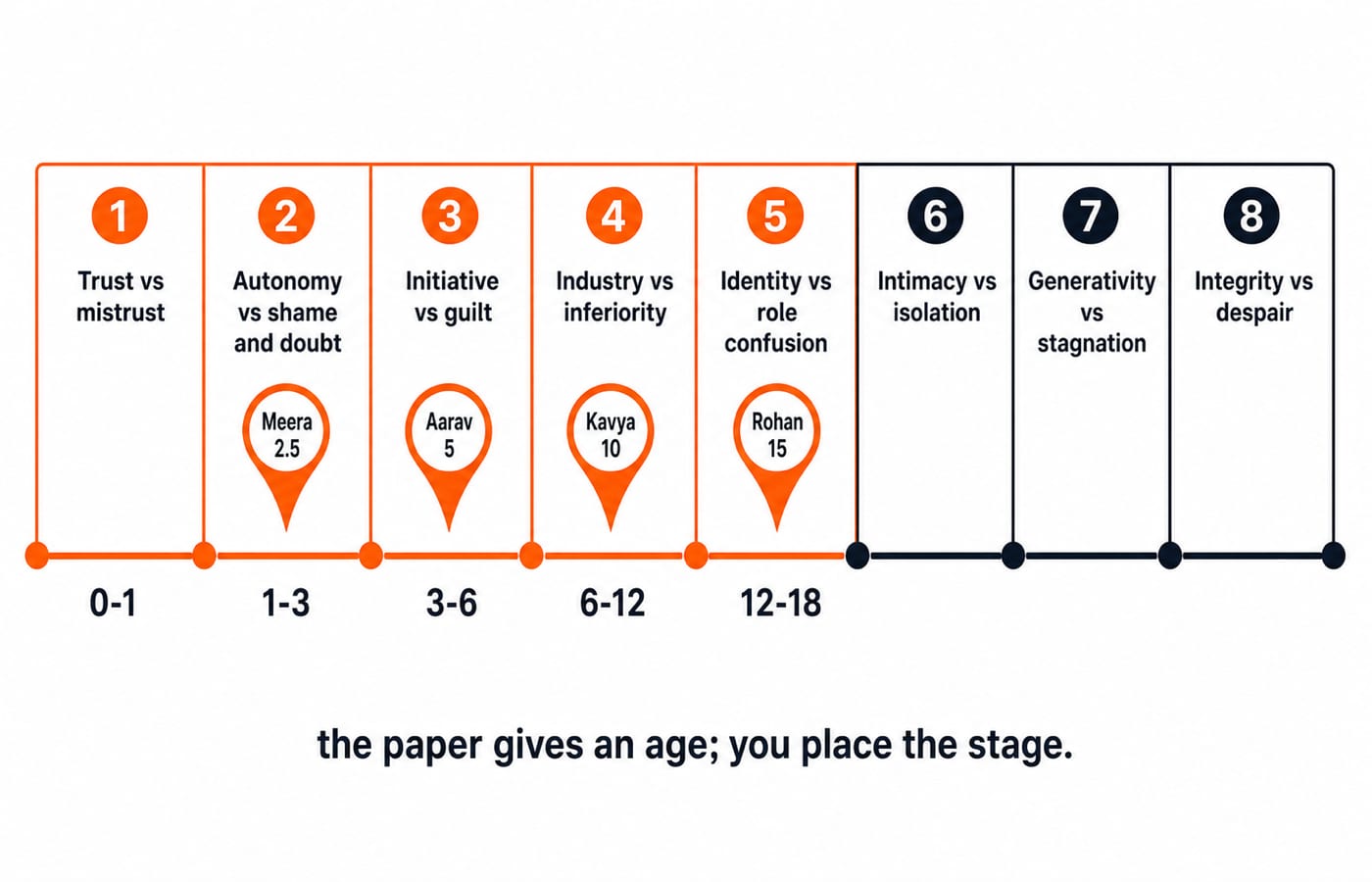
Now map each learner by age, crisis and appropriate teacher response:
Learner | Erikson stage | Correct teacher response |
|---|---|---|
Meera, 2.5, playgroup | Autonomy vs shame and doubt, 1-3 | Let her try buttoning her bag. Taking over teaches shame. |
Aarav, 5, UKG | Initiative vs guilt, 3-6 | Accept his invented game rules. Punishing ideas teaches guilt. |
Kavya, 10, Class 5 | Industry vs inferiority, 6-12 | Assess her project against criteria, not the class topper. Constant comparison teaches inferiority. |
Rohan, 15, Class 10 | Identity vs role confusion, 12-18 | Give real subject-choice counselling. Deciding for him prolongs confusion. |
The sequence is trust vs mistrust (0-1), autonomy vs shame and doubt (1-3), initiative vs guilt (3-6), industry vs inferiority (6-12), identity vs role confusion (12-18), intimacy vs isolation (young adulthood), generativity vs stagnation (middle age), and integrity vs despair (old age). Exams usually sample the first five.
The humanistic view and personality in school
Maslow saw growth as movement through a need hierarchy towards self-actualisation. A hungry or unsafe child cannot be expected to show esteem-level behaviour, the teaching implication CDP tests.
Rogers focused on self-concept, the real and ideal selves, and unconditional positive regard. Congruence between the two supports healthy adjustment and a "fully functioning person".
Family is the first socialisation agency. School is planned, with the teacher as model; peers dominate in adolescence; culture supplies norms and gender roles. Teachers should offer acceptance, autonomy and initiative, then evaluate against criteria rather than peers.
Personality assessment: classify before answering
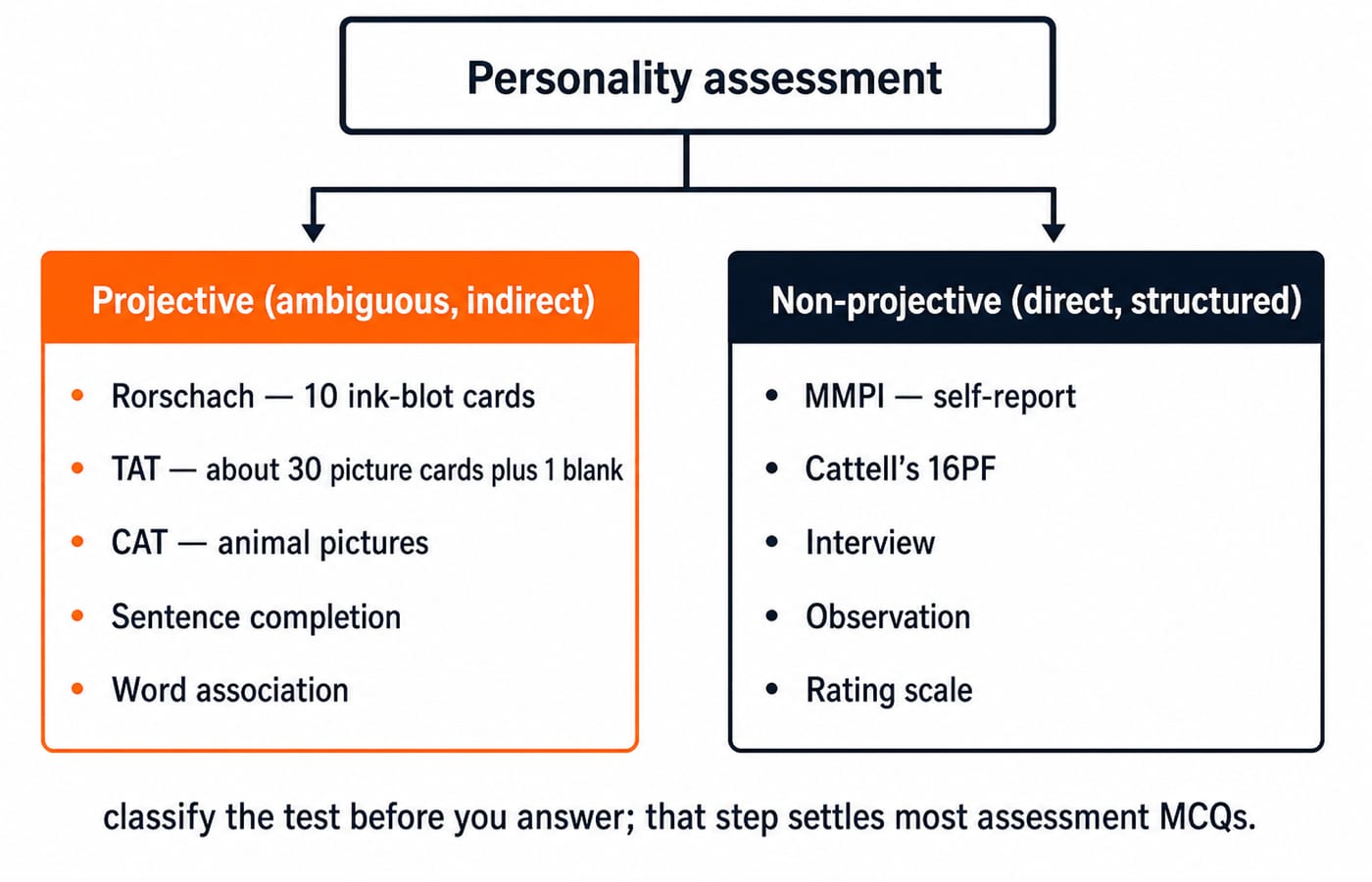
Projective techniques use ambiguous stimuli indirectly to reveal unconscious content. Non-projective techniques are direct, structured and scorable, including self-report and observational tools.
Branch | Tests and identifying facts |
|---|---|
Projective | Rorschach ink blot test by Hermann Rorschach: 10 standard ink-blot cards; Thematic Apperception Test by Murray and Morgan: about 30 picture cards plus 1 blank; Children's Apperception Test: animal pictures; sentence completion; word association |
Non-projective | MMPI: several hundred true or false statements; Cattell's 16PF questionnaire; interview; observation; rating scales |
A classroom teacher mainly uses observation and rating, not projective testing.
Traps that cost marks
Type versus trait: Jung and Sheldon use types or boxes. Cattell, Eysenck and the Big Five use trait dimensions or continua. Read an assertion about Eysenck carefully.
Freud versus Erikson: a 4-year-old is in Freud's phallic stage but Erikson's initiative vs guilt stage. Follow the theorist named in the stem.
Projective versus self-report: Rorschach and TAT are projective. MMPI and 16PF are self-report inventories.
Ages at the boundary: industry vs inferiority covers 6-12 and identity vs role confusion covers 12-18. For a 12-year-old, use the behaviour cue: peer comparison suggests industry, while "Who am I?" suggests identity.
Introversion as a defect: Jung described energy direction, not social anxiety. An introvert child is not a problem child.
One-sided determinants: options saying personality develops "only" through heredity or environment are distractors. It develops through their interaction.
Content traps are only half the loss. The attempt-level errors that cost marks even when the theory is known are collected in 7 common CTET mistakes aspirants make, and what to do instead.
How teaching exams test personality, and the next step
Personality development sits within CDP in both CTET papers. The section split and weightage are fixed by the current cycle's information bulletin, so confirm them on the official CTET portal, not a coaching chart. State TET details follow the conducting body's notification. UGC NET Paper 1 uses related ideas in teaching aptitude, while KVS, DSSSB and state PSC teacher papers reuse theorist-match and stage-match questions with harder distractors.
Expect four shapes:
Theorist-match: Who classified personality using source traits identified through factor analysis? Cattell.
Stage-match: A 10-year-old feels inferior when her project is compared with classmates. Which Erikson stage applies? Industry vs inferiority, as in Kavya's case.
Test-classification: Which is projective: (a) MMPI, (b) 16PF, (c) TAT, or (d) rating scale? (c) TAT.
Classroom-application: What should a teacher do with a 5-year-old's invented game rules? Accept and extend the initiative.
The CTET Exam Preparation category keeps broader material together. If you are unsure which paper fits, use CTET Paper 1 vs Paper 2.
For primary-stage preparation, learn CDP in sequence through the CTET Paper 1 Course 2026. For both papers, use CTET 2026 (Paper 1 & 2). Learn theory names, map ages, classify tools, then solve classroom applications. This turns a memory list into a dependable scoring area.
Keep learning
सामान्य अशुद्धियाँ (Samanya Ashuddhiyaan): Complete Hindi Grammar Notes for CTET and TET Exams
Learn to identify and correct Hindi word-form, agreement, pronoun and redundancy errors through exact examples, a worked MCQ and a scored diagnostic.
Updated 6 Oct 20266 min readCTET & UPTET
Universities and Learning Programmes for Teaching Exams: Types, Modes and Solved Examples
Separate university status, delivery mode and programme purpose with a repeatable method, then test it on five UGC NET-style classification cases.
Updated 2 Oct 20265 min readCTET & UPTET
National Education Policy (NEP) 2020 Notes for Teaching Exams: 5+3+3+4, Reforms and MCQ Traps
Build an exam-ready map of NEP 2020, from the age-stage structure to pedagogy, language, PARAKH, B.Ed. routes and reliable distractor elimination.
Updated 26 Sep 20265 min readCTET & UPTET
Miscellaneous Pedagogy Topics for Teaching Exams: Complete Notes and Worked Examples
Turn a loose syllabus label into a five-part concept map, then use classroom evidence to distinguish sound pedagogy from attractive but incomplete options.
Updated 25 Sep 20266 min readCTET & UPTET