विलोम शब्द (Vilom Shabd): Teaching Exam Notes, Rules and Solved Examples
Learn how to identify विलोम शब्द by meaning, context and grammatical form. Practise exact exam-style questions, avoid common traps and build a focused recall routine.
KnowledgeGate Team
Exam prep & CS education
Updated 15 Aug 20265 min read
Familiar pairs such as दिन ↔ रात look easy, yet options may contain a synonym, a prefixed lookalike or a word whose opposite changes with the sentence. उन्नति pairs with अवनति, not with प्रगति, and हल्का becomes भारी, गहरा or कठोर depending on what it is describing. Four steps settle almost every item: fix the meaning the sentence needs, keep the grammatical form parallel, eliminate synonyms and unrelated words, then read your answer back into the sentence.
1. विलोम शब्द क्या हैं, और सही जोड़ी की पहचान कैसे होती है?
विलोम शब्द express opposite meanings in the same grammatical and contextual frame. In लाभ ↔ हानि, both words are nouns that can fill the same sentence position. This also holds for जीवन ↔ मृत्यु, आरंभ ↔ अंत and उपस्थित ↔ अनुपस्थित.
An opposite is not merely a word from the same topic. उन्नति ↔ अवनति reverses the direction of meaning, while उन्नति ↔ प्रगति is a synonym pair. लाल and नीला differ, but neither reverses the other.
When you do not know where to start, ask one cold-start question:
क्या दूसरा शब्द पहले अर्थ को उलटता है, और क्या वह उसी वाक्य में व्याकरण की दृष्टि से बैठता है?
The meaning must reverse, and the new word must fit the original sentence grammatically.
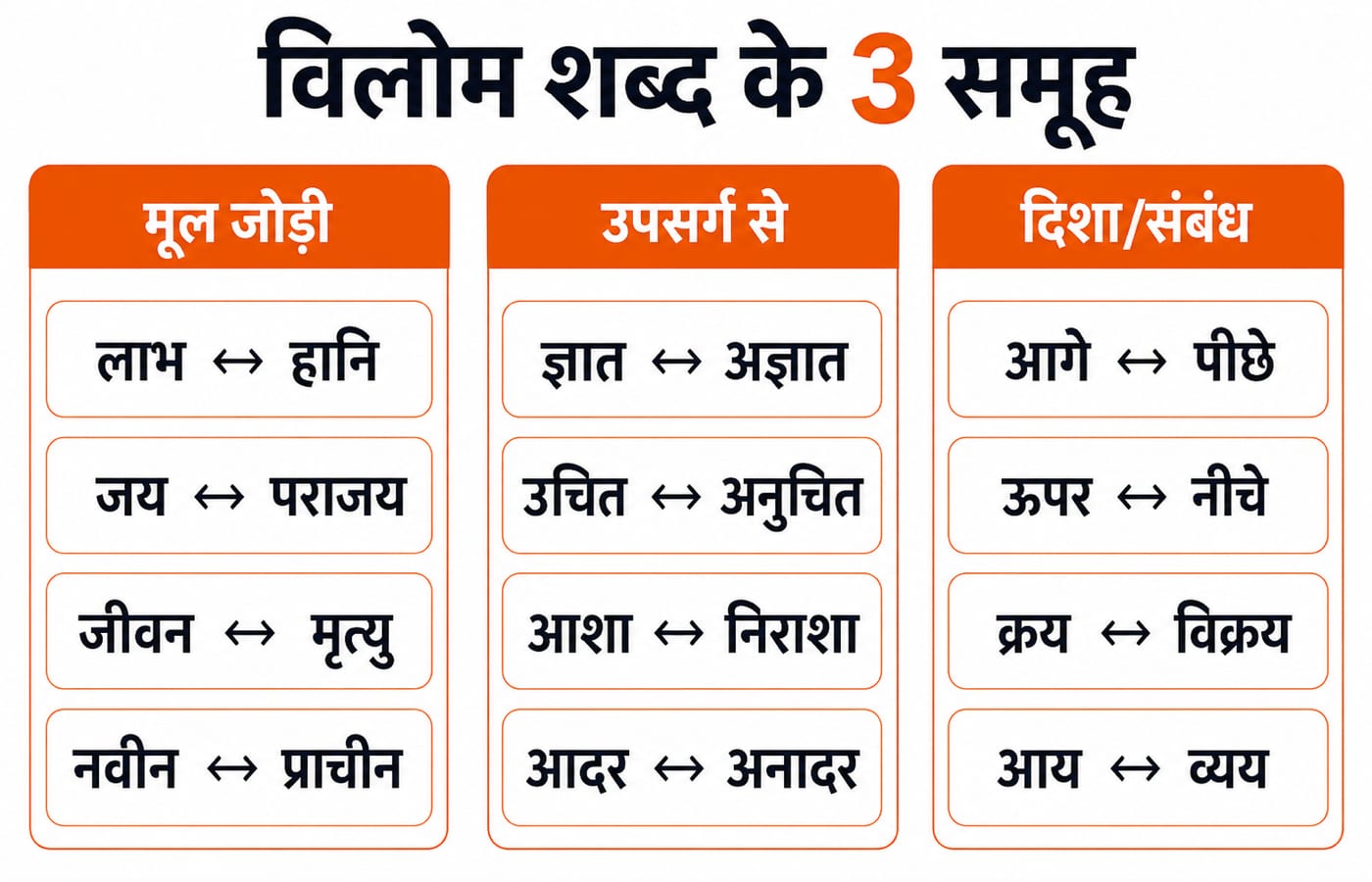
2. विलोम के तीन उपयोगी समूह: मूल जोड़ी, उपसर्ग और संबंध
Grouping pairs makes recall faster.
मूल जोड़ी | उपसर्ग से | दिशा या संबंध |
|---|---|---|
लाभ ↔ हानि | ज्ञात ↔ अज्ञात | आगे ↔ पीछे |
जय ↔ पराजय | उचित ↔ अनुचित | ऊपर ↔ नीचे |
जीवन ↔ मृत्यु | आशा ↔ निराशा | क्रय ↔ विक्रय |
नवीन ↔ प्राचीन | आदर ↔ अनादर | आय ↔ व्यय |
Prefix attachment is not a mechanical rule. Hindi uses established pairs such as सुंदर ↔ कुरूप and मित्र ↔ शत्रु. Do not invent a form because अ, अन or निर works elsewhere. Compare the options and choose the accepted word.
3. चार चरणों में उत्तर निकालें: एक पूरा worked example
Consider this MCQ: “‘उन्नति’ का विलोम चुनिए: (A) प्रगति (B) वृद्धि (C) अवनति (D) उन्नयन.”
Fix the meaning first.
उन्नतिis an abstract noun meaning upward progress or improvement.Check the grammatical form. All four options are abstract nouns, so form rules nothing out in this item and the decision has to be made on meaning.
Eliminate the synonyms.
प्रगति,वृद्धिandउन्नयनall continue the idea of progress, increase or improvement, so none of them reverses it.अवनतिturns the direction to decline.Read it back.
कंपनी की उन्नतिagainstकंपनी की अवनतिreverses cleanly, so the answer is (C) अवनति.
Step 2 is idle here, but it decides other items. Had the paper offered the adjective अवनत beside the noun अवनति, the noun would win, because the stem उन्नति is itself a noun.
Now solve a contextual item: “कृत्रिम साधनों के स्थान पर ____ उपाय अपनाइए। (A) बनावटी (B) प्राकृतिक (C) असत्य (D) सरल.”
Substitute each option. बनावटी उपाय remains close to कृत्रिम. प्राकृतिक उपाय reverses the artificial versus natural contrast. असत्य उपाय shifts to truthfulness, while सरल उपाय shifts to difficulty. The answer is (B) प्राकृतिक.
Instruction words matter. In (A) आदि-अंत, (B) लाभ-हानि, (C) उन्नति-प्रगति, (D) उपस्थित-अनुपस्थित, the incorrect antonym pair is (C) because its words are synonyms. Always inspect what the question asks.
4. प्रसंग बदलते ही विलोम भी बदल सकता है
The opposite of a word belongs to its meaning in the sentence, not to its spelling alone. For example:
हल्का बैगbecomesभारी बैगbecause the contrast is about weight.हल्का नीला रंगbecomesगहरा नीला रंगbecause the contrast is about shade.हल्का दंडbecomesकठोर दंडbecause the contrast is about severity.
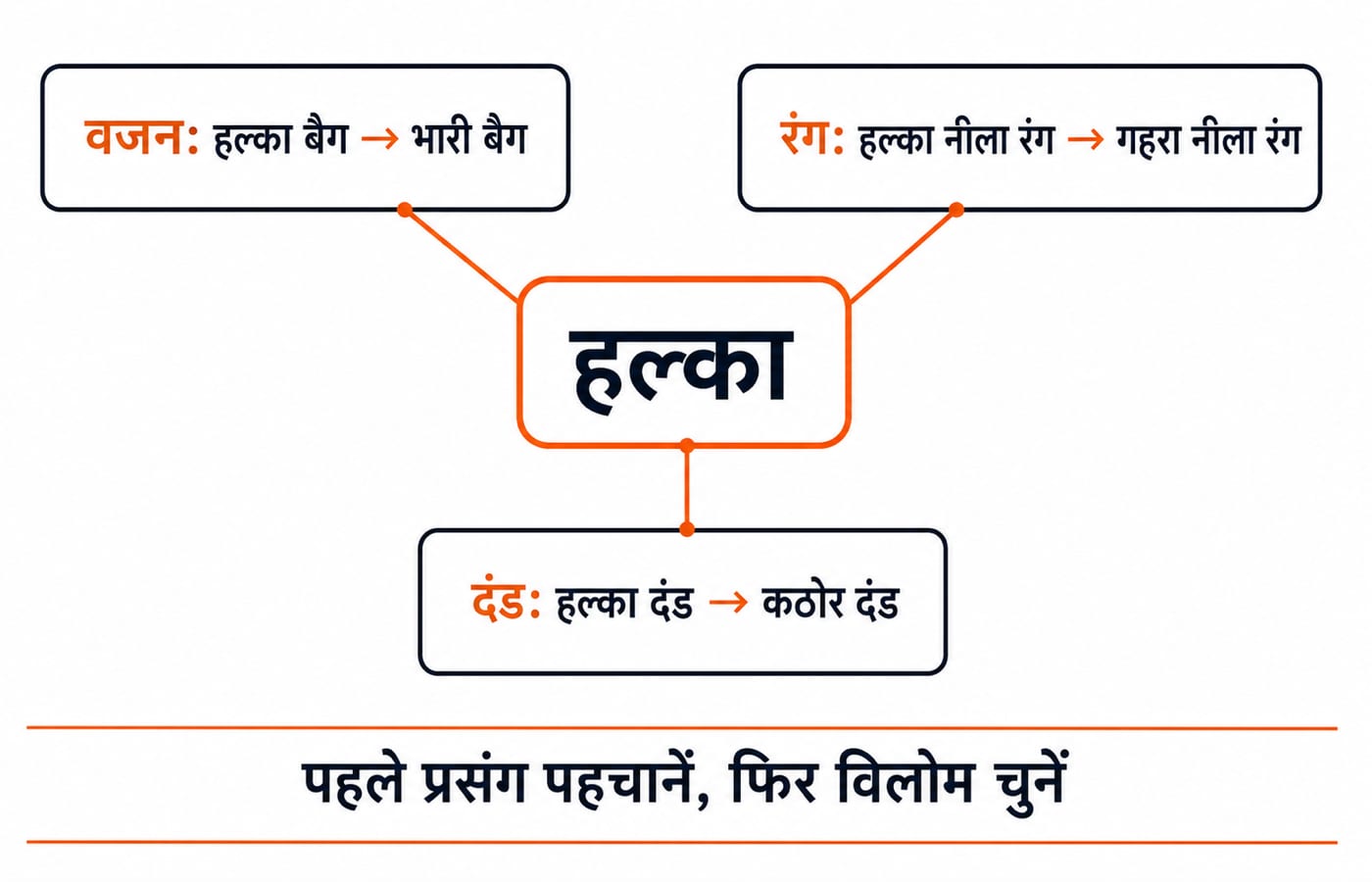
The same principle explains तेज गति ↔ धीमी गति, तेज प्रकाश ↔ मंद प्रकाश and तेज धार ↔ कुंद धार. Speed, brightness and sharpness are different senses of तेज, so one memorised answer cannot fit all three.
5. Teaching exams में विलोम शब्द किस तरह पूछे जा सकते हैं?
A teaching exam may use a direct antonym MCQ, a sentence-based blank, a match-the-pairs item or an incorrect-pair question. Which of the four turn up depends on the board, so drill the method rather than one format.
For a matching example, place आय, आदर, स्थिर, आशा in Column A and निराशा, व्यय, गतिशील, अनादर in Column B. Resolve by meaning and form:
Column A | Correct match |
|---|---|
आय | व्यय |
आदर | अनादर |
स्थिर | गतिशील |
आशा | निराशा |
CBSE's current CTET information bulletin on the official CTET website defines the Language I and Language II structure, including permitted language choices, syllabus wording, question distribution and marking. A state TET or a recruitment board issues its own bulletin, so read the one for your paper instead of carrying CTET figures across. Vocabulary sits in the same section as comprehension and language pedagogy, and the CTET Language I and Language II strategy sets out how to split time between the three.
6. पाँच traps जो सही जोड़ी जानते हुए भी अंक कटवाते हैं
Synonym trap:
प्रगतिlooks relevant besideउन्नति, but relevance is not reversal. Test the direction of meaning.Mechanical prefix trap: A learner invents a prefixed answer instead of choosing an established pair such as
सुंदर-कुरूप. Compare accepted words in the options.Context trap:
भारीis selected for every use ofहल्का. Read the noun and the whole phrase before deciding.Instruction trap: A correct pair is chosen after the question asks which option is “विलोम नहीं है”. Circle or mentally restate the instruction before checking options.
Form trap: The noun
स्वतंत्रताis paired with the adjectiveपरतंत्र. Keep the form parallel and choose the nounपरतंत्रता.
Run the four steps in the same order every time: meaning, form, elimination, then a read-back into the original sentence. The same discipline is what keeps the wider errors in 7 common CTET mistakes aspirants make out of your answer sheet.
7. Short version, recall drill and the next step
Keep the method to four lines:
Identify the contextual meaning.
Keep the grammatical form parallel.
Eliminate synonyms and unrelated options.
Verify the chosen word in the sentence.
Build a 24-pair deck: 8 independent pairs, 8 prefix-led pairs and 8 contextual pairs. Spend 8 minutes on recall, solve 10 mixed items, and retest only your errors after 48 hours. Eight in each group keeps the practice even, so no one type of pair gets neglected.
KnowledgeGate's question bank carries over 70 विलोम शब्द practice items, enough to rebuild that deck three times over. Record every miss in a four-field error log: word | correct opposite | my choice | reason for error. Then use the CTET mock test strategy to turn those logged errors into targeted revision.
Your next action is simple. Confirm your paper and the current rules on the official exam site, compare the Govt Teaching Eligibility Tests options, and then take the plan that matches: CTET 2026 (Paper 1 & 2) is built as one plan across both papers, so you do not have to settle the Paper 1 versus Paper 2 question before you start revising. Practise the four-step method until you can explain why every wrong option fails.
Keep learning
सामान्य अशुद्धियाँ (Samanya Ashuddhiyaan): Complete Hindi Grammar Notes for CTET and TET Exams
Learn to identify and correct Hindi word-form, agreement, pronoun and redundancy errors through exact examples, a worked MCQ and a scored diagnostic.
Updated 6 Oct 20266 min readCTET & UPTET

Universities and Learning Programmes for Teaching Exams: Types, Modes and Solved Examples
Separate university status, delivery mode and programme purpose with a repeatable method, then test it on five UGC NET-style classification cases.
Updated 2 Oct 20265 min readCTET & UPTET

National Education Policy (NEP) 2020 Notes for Teaching Exams: 5+3+3+4, Reforms and MCQ Traps
Build an exam-ready map of NEP 2020, from the age-stage structure to pedagogy, language, PARAKH, B.Ed. routes and reliable distractor elimination.
Updated 26 Sep 20265 min readCTET & UPTET

Miscellaneous Pedagogy Topics for Teaching Exams: Complete Notes and Worked Examples
Turn a loose syllabus label into a five-part concept map, then use classroom evidence to distinguish sound pedagogy from attractive but incomplete options.
Updated 25 Sep 20266 min readCTET & UPTET