संधि (Sandhi) for Teaching Exams: Rules, Types and Solved Examples
Split and rebuild Sandhi words by checking the exact sound boundary: स्वर, व्यंजन and विसर्ग rules, worked examples like महोत्सव and सज्जन, and a five-word drill.
KnowledgeGate Team
Exam prep & CS education
Updated 19 Aug 20266 min read
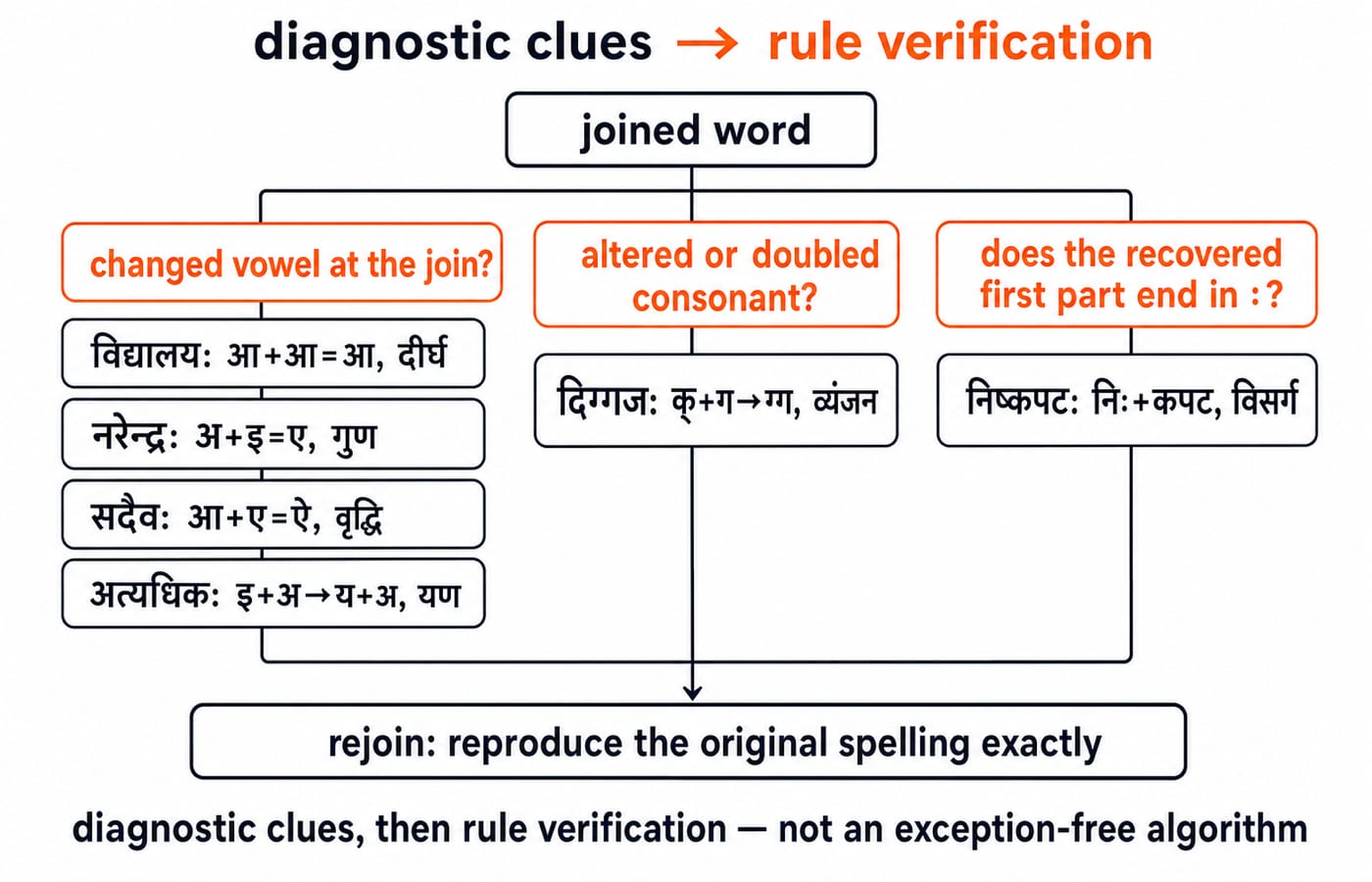
A joined word can look familiar while its exact boundary remains unclear. In महोत्सव, सज्जन, and मनोहर, the visible change occurs in a vowel, a consonant, and a विसर्ग respectively. The reliable approach is to recover the source words, inspect their boundary sounds, apply the exact rule, and rebuild the word. Each family changes a different thing at that boundary: two vowels merge into one, a consonant hardens or doubles, or a विसर्ग turns into a vowel or a fresh consonant.
संधि and संधि-विच्छेद: what each one actually asks
संधि is the sound or letter change at the boundary when two वर्ण or पद come together. संधि-विच्छेद recovers the intended source parts and boundary rule. It is not a plus sign inserted wherever a spelling looks divisible.
The three working families are स्वर संधि, as in महा + उत्सव = महोत्सव; व्यंजन संधि, as in सत् + जन = सज्जन; and विसर्ग संधि, as in मनः + हर = मनोहर.
Do not treat संधि and समास as synonyms. संधि asks what changed at the sound boundary. समास asks how meanings were compressed, as in राजपुत्र = राजा का पुत्र. Identify the question before assigning a label.
स्वर संधि: the five vowel patterns and their boundary values
In स्वर संधि, name both input vowels before naming the type. The inputs fix the pattern: दीर्घ combines two vowels of the same class, गुण and वृद्धि merge unlike vowels into a single new one, and यण and अयादि turn the first vowel into a semivowel that carries the second.
प्रकार | boundary rule | joined example | विच्छेद |
|---|---|---|---|
दीर्घ | आ + आ = आ | विद्यालय | विद्या + आलय |
गुण | आ + उ = ओ | महोत्सव | महा + उत्सव |
वृद्धि | आ + ए = ऐ | सदैव | सदा + एव |
यण | इ + अ = य + अ | अत्यधिक | अति + अधिक |
अयादि | औ + इ = आव + इ | नाविक | नौ + इक |
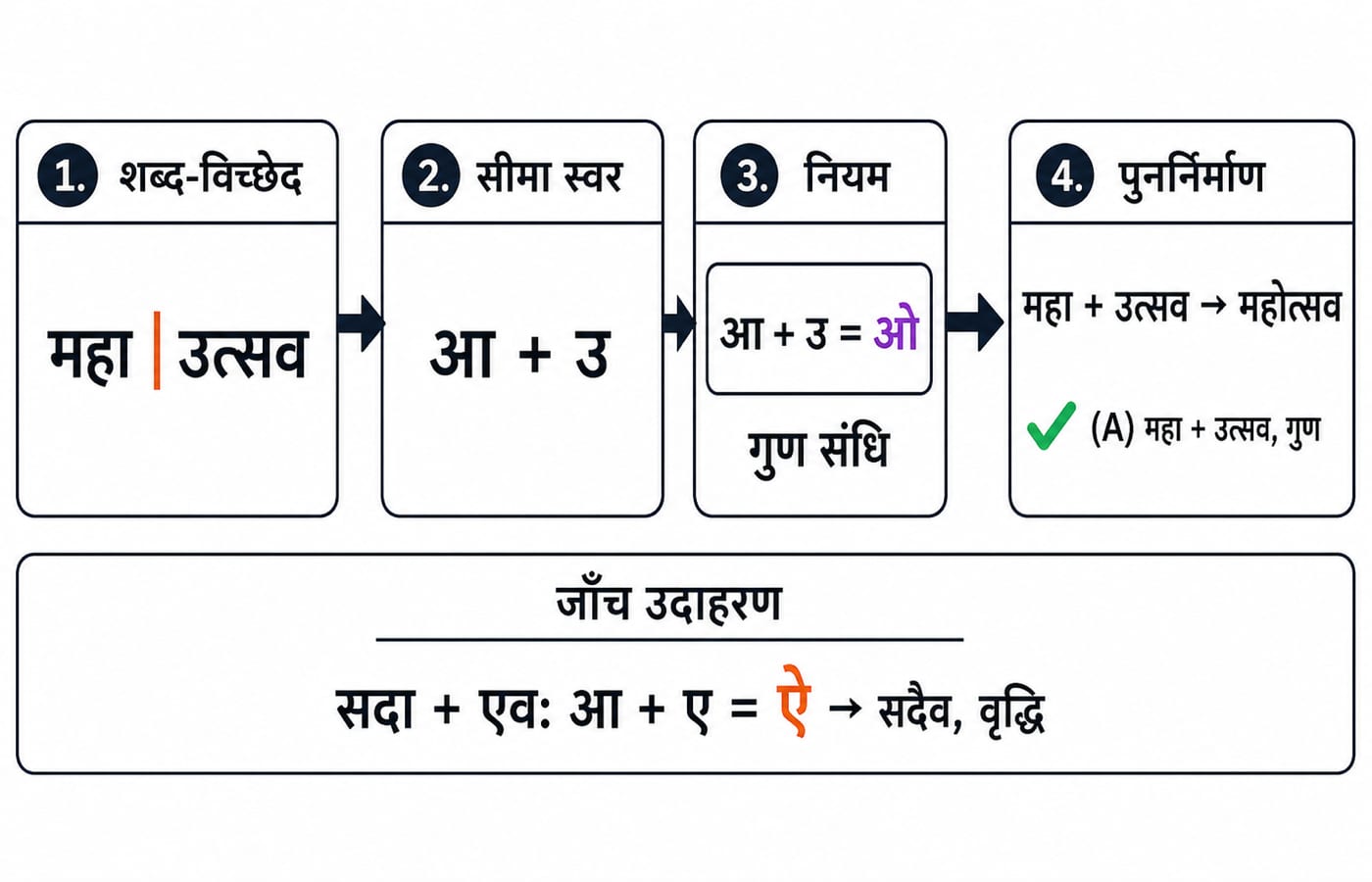
Consider the question: “महोत्सव” का सही संधि-विच्छेद और प्रकार चुनिए.
(A) महा + उत्सव, गुण
(B) मह + ओत्सव, दीर्घ
(C) महो + उत्सव, यण
(D) महत् + उत्सव, व्यंजन
The correct answer is (A). Mark महा | उत्सव and isolate आ + उ. Apply आ + उ = ओ, then reconstruct महा + उत्सव → महोत्सव. Options B and C do not recover the intended source words. Option D proposes a consonant boundary that cannot produce the spelling.
As a check, सदा + एव → सदैव uses आ + ए = ऐ, so it is वृद्धि, not गुण. The inputs decide the rule.
व्यंजन संधि: reversing an altered or doubled consonant
व्यंजन संधि often appears as an altered or doubled consonant at the join. The visible pair is a clue, but you must recover the exact left and right consonants:
सत् + जन → सज्जन, where त् + ज → ज्ज
उत् + चारण → उच्चारण, where त् + च → च्च
दिक् + गज → दिग्गज, where क् + ग → ग्ग
जगत् + नाथ → जगन्नाथ, where त् + न → न्न
For सज्जन, begin with the intended source words सत् and जन. Place त् beside ज, then apply त् + ज → ज् + ज = ज्ज. Joining the remaining letters gives सज्जन. The circular split सज् + जन is wrong because it copies the changed sound instead of recovering the source form. Reject any split that cannot reproduce every letter through a stated rule.
विसर्ग संधि: finding the hidden ः
In विसर्ग संधि, the joined word may no longer show ः. Test whether the first source form conventionally ends in विसर्ग: मनः + हर → मनोहर, निः + कपट → निष्कपट, निः + चल → निश्चल, and दुः + साहस → दुस्साहस.
For मनोहर, recover मनः + हर. Its boundary is अः + ह, and the joined form becomes मनोहर, with ओ before ह. The visual split मन + ओहर fails because ओहर is not the intended second source word.
Do not stretch this into one universal substitution. The visible result depends on the sound that follows. In निः, the विसर्ग hardens to ष् before क and प, giving निष्कपट; it becomes श् before च, giving निश्चल; and it becomes स् before स, giving दुस्साहस. Read the next consonant before you write the split.
संधि-विच्छेद: a boundary-first method in five steps
Use this five-step routine:
Copy the joined spelling exactly.
Circle the likely boundary signal.
Propose two meaningful source words.
Write the boundary values and named rule.
Rejoin the parts, allowing no extra or missing letter.
joined word | source words | boundary rule | प्रकार |
|---|---|---|---|
विद्यालय | विद्या + आलय | आ + आ = आ | दीर्घ |
नरेन्द्र | नर + इन्द्र | अ + इ = ए | गुण |
सदैव | सदा + एव | आ + ए = ऐ | वृद्धि |
अत्यधिक | अति + अधिक | इ + अ = य + अ | यण |
दिग्गज | दिक् + गज | क् + ग = ग्ग | व्यंजन |
निष्कपट | निः + कपट | ः + क = ष् + क | विसर्ग |
Preserve every source spelling and boundary value. A likely-looking output never justifies an invented split.
संधि: six common traps and their fixes
Type chosen from the output only: seeing ओ in महोत्सव invites a guess. Recover आ + उ first, then identify गुण.
Changed form copied into the split: सज् + जन repeats the output. Recover सत् + जन and prove त् + ज → ज्ज.
Meaningful source word ignored: मन + ओहर looks visually possible, but ओहर is not the intended form. Use मनः + हर.
संधि and समास merged: meaning does not prove a sound rule. State the boundary transformation for संधि and meaning relation for समास.
मात्रा treated as the whole rule: saying only that “ो appears” hides the inputs. Write आ + उ = ओ.
One विसर्ग result applied everywhere: the change in मनोहर does not explain every विसर्ग word. Check the following consonant and the conventional spelling.
Sandhi in CTET and UPTET: how the questions are set
In CTET and UPTET, Hindi is taken as Language I or Language II, so संधि reaches you inside a language paper rather than a separate grammar paper. The stems repeat in five shapes: choose the correct विच्छेद, name the प्रकार, join two given parts, match a word to its rule, or reject an invalid split. Confirm the topic list and paper rules for your cycle in the official notification, which for CTET is published at ctet.nic.in.
Try this retrieval drill without looking back: विद्यालय, सदैव, अत्यधिक, दिग्गज, निष्कपट.
Answers with boundary rules: विद्या + आलय, आ + आ = आ, दीर्घ; सदा + एव, आ + ए = ऐ, वृद्धि; अति + अधिक, इ + अ = य + अ, यण; दिक् + गज, क् + ग = ग्ग, व्यंजन; निः + कपट, ः + क = ष् + क, विसर्ग.
Write the boundary rule beside every answer. Place this drill inside the CTET Language I and Language II strategy, then use the Govt Teaching Eligibility Tests category for a broader learning path. The KnowledgeGate question bank carries more than 30 Sandhi questions, including split-the-word stems on वाग्जाल and दिग्गज, so the drilling does not stop with these five.
Sandhi: the short version and your next step
Solve in this order: source words → boundary sounds → rule → type → rejoin. Vowels change in स्वर संधि, consonants alter or double in व्यंजन संधि, and a source विसर्ग may disappear or change.
Redo the drill after one day. Log the गलत विच्छेद you wrote, the correct source words, and the boundary rule you missed. If choosing an exam, read the UPTET vs CTET comparison. For structured preparation, use the CTET Paper 1 course or UPTET Paper 1 course matching your target.
Keep learning
सामान्य अशुद्धियाँ (Samanya Ashuddhiyaan): Complete Hindi Grammar Notes for CTET and TET Exams
Learn to identify and correct Hindi word-form, agreement, pronoun and redundancy errors through exact examples, a worked MCQ and a scored diagnostic.
Updated 6 Oct 20266 min readCTET & UPTET
Universities and Learning Programmes for Teaching Exams: Types, Modes and Solved Examples
Separate university status, delivery mode and programme purpose with a repeatable method, then test it on five UGC NET-style classification cases.
Updated 2 Oct 20265 min readCTET & UPTET
National Education Policy (NEP) 2020 Notes for Teaching Exams: 5+3+3+4, Reforms and MCQ Traps
Build an exam-ready map of NEP 2020, from the age-stage structure to pedagogy, language, PARAKH, B.Ed. routes and reliable distractor elimination.
Updated 26 Sep 20265 min readCTET & UPTET
Miscellaneous Pedagogy Topics for Teaching Exams: Complete Notes and Worked Examples
Turn a loose syllabus label into a five-part concept map, then use classroom evidence to distinguish sound pedagogy from attractive but incomplete options.
Updated 25 Sep 20266 min readCTET & UPTET