वाक्यांशों के लिए एक शब्द: Teaching Exams के लिए नियम, उदाहरण और हल करने की विधि
Learn to preserve every clue in a Hindi phrase, distinguish confusing one-word substitutions, and build reliable recall through worked MCQs and a seven-day drill.
KnowledgeGate Team
Exam prep & CS education
Updated 21 Aug 20266 min read
Knowing the broad meaning of a Hindi phrase may still leave you choosing between अजेय, अज्ञेय, अमर, and अजन्मा. Decode every clue, recall the accepted word, and reject options that change the meaning. KnowledgeGate's question bank carries more than 30 practice questions on one-word substitution.
वाक्यांशों के लिए एक शब्द क्या है?
One accepted word replaces a phrase about a person, quality, condition, time, place, or action without changing its central meaning. जो ईश्वर में विश्वास रखता हो = आस्तिक, but जो ईश्वर में विश्वास न रखता हो = नास्तिक. The clue न reverses the answer.
This is not synonym recall. Preserve न, योग्य, पहले, बाद, सब, and कभी. जो सब कुछ जानता हो = सर्वज्ञ, whereas जिसे जाना न जा सके = अज्ञेय.
Papers ask this in both directions. A phrase-to-word item gives जो कम बोलता हो and asks for the word; a reverse item gives मितभाषी and asks which phrase it replaces. Both turn on the same clue, so learn the pair together rather than the answer alone.
वाक्यांश को decode करने की तीन-कदम विधि
Use the same sequence:
Circle the governing clue.
Identify the semantic family, such as person, impossible action, quality, time, or place.
Test each option against the complete phrase.
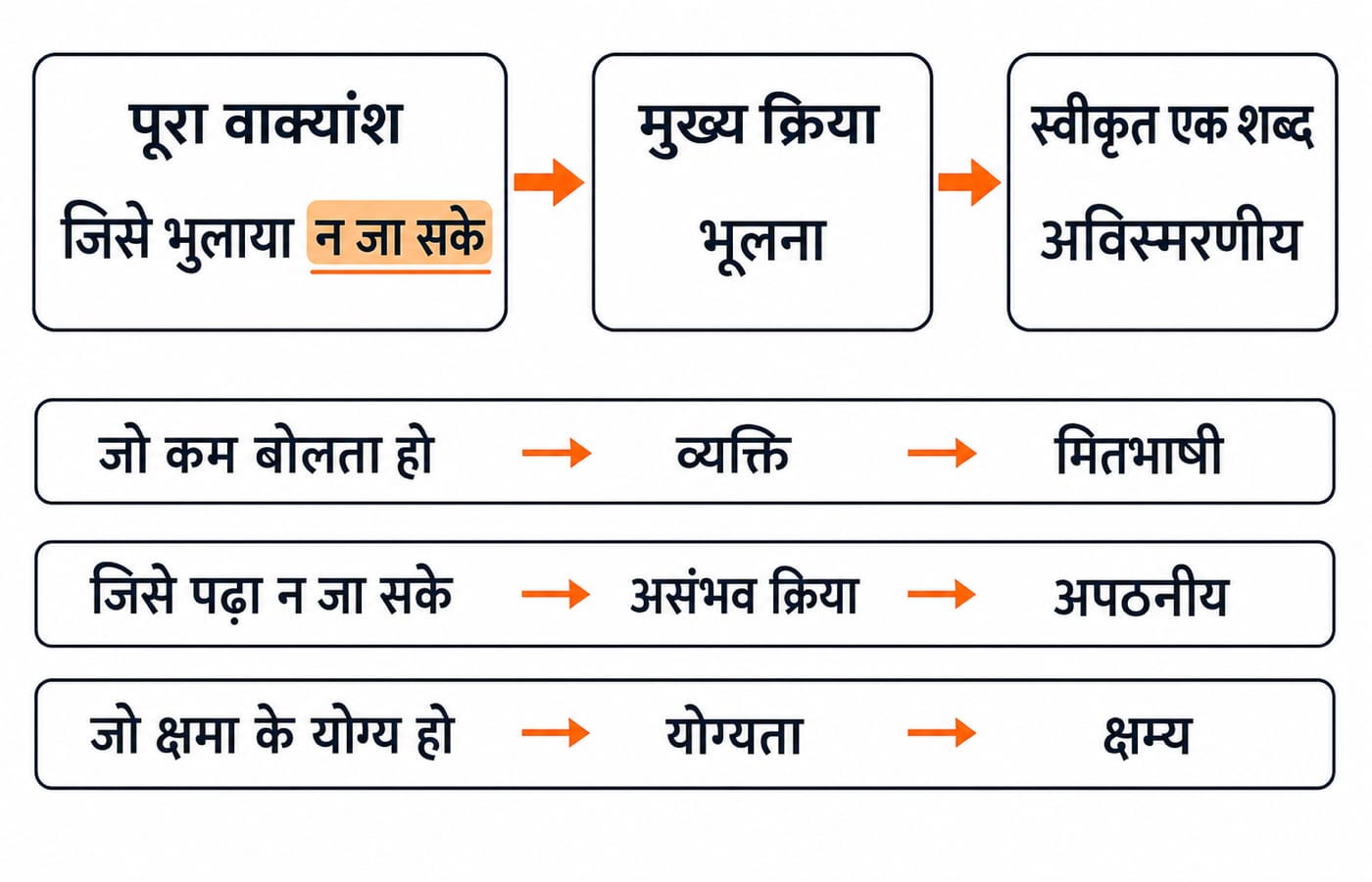
For जिसे भुलाया न जा सके, the governing clue is न जा सके, the action is भूलना, and the answer is अविस्मरणीय. A negative-looking word must still preserve the action.
Three clue families recur. जो...करता/बोलता है often identifies a person: जो कम बोलता हो = मितभाषी. जिसे...न जा सके expresses impossibility: जिसे पढ़ा न जा सके = अपठनीय. के योग्य forms adjectives such as क्षम्य and दर्शनीय.
Word parts support recall: सर्व + ज्ञ = सर्वज्ञ, अनु + करणीय = अनुकरणीय, and अ + जेय = अजेय. They do not replace meaning, so never invent a form from a prefix and root.
45 exact phrase-word pairs, grouped in three families
Learn these in three families so the decisive clue stays visible.
Person and conduct | One word |
|---|---|
जो उपकार मानता हो | कृतज्ञ |
जो उपकार न माने | कृतघ्न |
जो कम बोलता हो | मितभाषी |
जो मीठा बोलता हो | मृदुभाषी |
जो सत्य बोलता हो | सत्यवादी |
जो देश से प्रेम करता हो | देशभक्त |
जो दूसरों का भला करे | परोपकारी |
जो केवल अपना हित चाहे | स्वार्थी |
जो सब कुछ जानता हो | सर्वज्ञ |
जो दूर की सोचता हो | दूरदर्शी |
जिसका कोई शत्रु पैदा न हुआ हो | अजातशत्रु |
जो किसी पक्ष में न हो | तटस्थ |
जिसके माता-पिता न हों | अनाथ |
जो अपने बल पर निर्भर हो | स्वावलंबी |
जो दूसरे पर निर्भर हो | पराश्रित |
First identify the conduct or relation, then preserve कम, सब, न, and अपने.
Possibility, quality, and relation | One word |
|---|---|
जिसे जीता न जा सके | अजेय |
जिसे जाना न जा सके | अज्ञेय |
जिसे भुलाया न जा सके | अविस्मरणीय |
जिसे टाला न जा सके | अपरिहार्य |
जिसे पढ़ा न जा सके | अपठनीय |
जिसे कहा न जा सके | अकथनीय |
जिसकी कल्पना न की जा सके | अकल्पनीय |
जो देखने योग्य हो | दर्शनीय |
जो अनुकरण के योग्य हो | अनुकरणीय |
जो क्षमा के योग्य हो | क्षम्य |
जिसकी उपमा न हो | अनुपम |
जो पहले कभी न हुआ हो | अभूतपूर्व |
जो नष्ट न हो | अविनाशी |
जिसका अंत न हो | अनंत |
जिसका आदि न हो | अनादि |
Here, track the action after न जा सके, योग्य, or the boundary आदि or अंत.
Time, place, and condition | One word |
|---|---|
जो प्रतिदिन हो | दैनिक |
जो सप्ताह में एक बार हो | साप्ताहिक |
जो महीने में एक बार हो | मासिक |
जो वर्ष में एक बार हो | वार्षिक |
जो रात में घूमता हो | निशाचर |
जो जल में विचरता हो | जलचर |
जो आकाश में विचरता हो | नभचर |
जो जल और थल दोनों पर रहता हो | उभयचर |
जो सब जगह व्याप्त हो | सर्वव्यापी |
जो आँखों के सामने हो | प्रत्यक्ष |
जो आँखों से दिखाई न दे | अदृश्य |
जो पहले जन्मा हो | अग्रज |
जो बाद में जन्मा हो | अनुज |
जो जन्मा न हो | अजन्मा |
जो कभी न मरे | अमर |
Identify frequency, habitat, visibility, birth order, or condition first.
Fully worked MCQ: अर्थ से option elimination तक
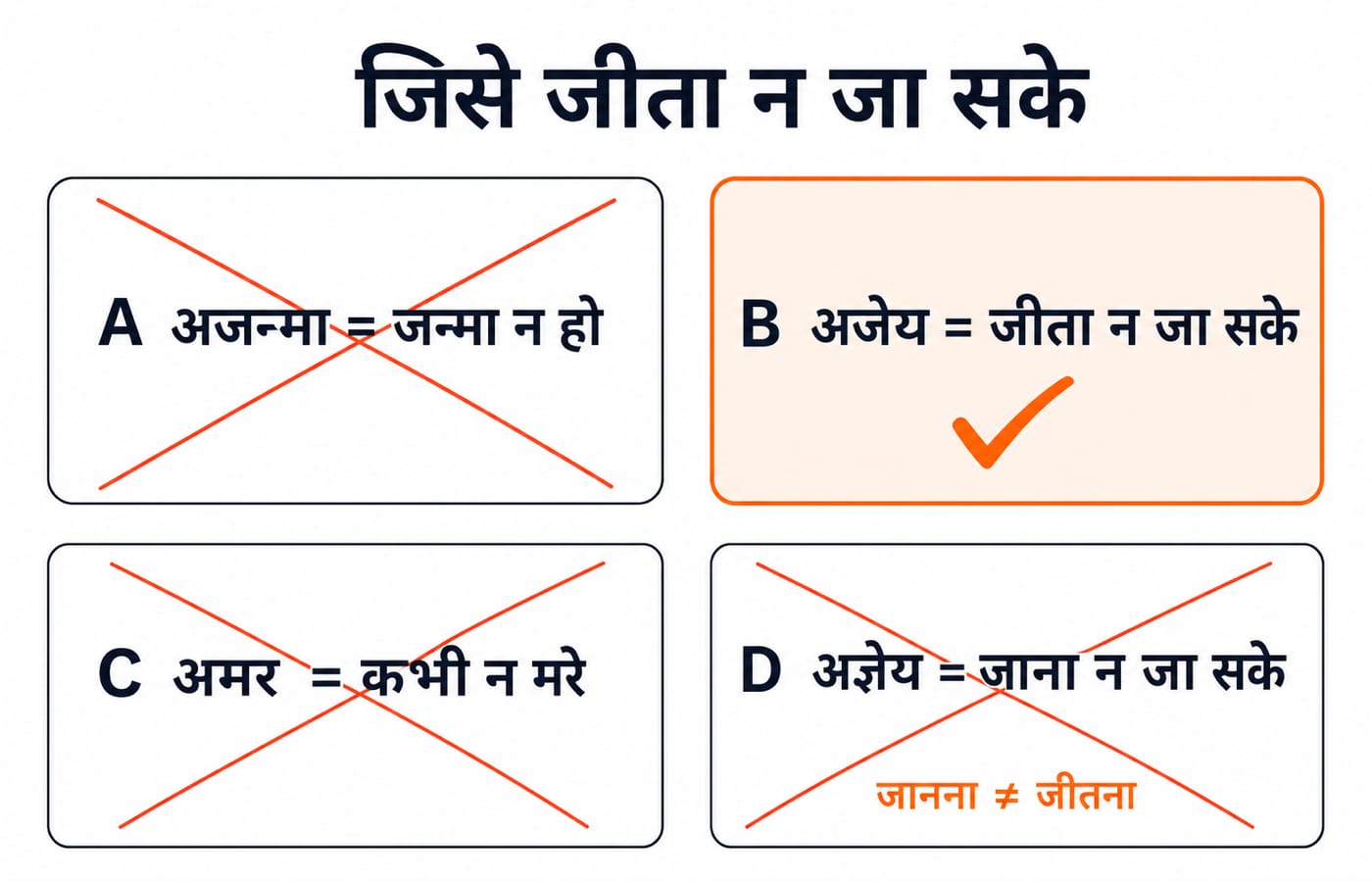
Question: “जिसे जीता न जा सके” के लिए सही एक शब्द चुनिए।
Options: A. अजन्मा, B. अजेय, C. अमर, D. अज्ञेय
The root action is जीतना. अजेय preserves it, so B is correct. अज्ञेय means जिसे जाना न जा सके, अमर means जो कभी न मरे, and अजन्मा means जो जन्मा न हो. Only B matches the action.
For “जो उपकार को नहीं मानता”, choose from A. कृतज्ञ, B. कृतघ्न, C. परोपकारी, D. स्वार्थी. B. कृतघ्न preserves नहीं. The others do not express rejected gratitude.
वे जोड़े जिनमें सबसे अधिक भ्रम होता है
Confusing pair | Decisive distinction |
|---|---|
सर्वज्ञ / अज्ञेय | सब जानने वाला / जिसे जाना न जा सके |
कृतज्ञ / कृतघ्न | उपकार मानने वाला / उपकार न मानने वाला |
अमर / अजर / अजन्मा | न मरने वाला / बूढ़ा न होने वाला / जन्मा न हो |
अनादि / अनंत | जिसका आरम्भ न हो / जिसका अंत न हो |
अग्रज / अनुज | पहले जन्मा / बाद में जन्मा |
Check spelling with meaning: अविस्मरणीय is not forgettable, अपरिहार्य is unavoidable, अभूतपूर्व has not happened before, and स्वावलंबी relies on one's own strength. After speaking a difficult word in chunks, reconnect it to the phrase.
A related option is wrong if it drops a limiting clue. For जो किसी पक्ष में न हो, तटस्थ directly means standing with neither side. The close variant निष्पक्ष means free from bias while judging, so it fits a judge or a report rather than a phrase about taking no side at all.
Teaching-exam practice में यह topic कैसे पूछा जाता है
Use the same vocabulary in four directions:
Direct phrase-to-word: जिसे टाला न जा सके → अपरिहार्य.
Reverse matching: दर्शनीय → जो देखने योग्य हो.
Incorrect pair: अज्ञेय → जो सब कुछ जानता हो is wrong.
Sentence completion: यह उपलब्धि पहले कभी नहीं हुई थी, इसलिए यह अभूतपूर्व थी.
The CTET Language I & II: A Scoring Strategy places vocabulary beside comprehension and pedagogy. During mixed timed review, use the CTET mock test strategy to analyse slow answers, not only the score.
How many vocabulary questions your paper carries is set by the board, not by this topic. The exact language-section split is in the official notification (for CTET, ctet.nic.in).
सात दिन का recall drill
Use fifteen honest minutes a day:
Day 1: learn 15 person and conduct pairs.
Day 2: retrieve those 15 without looking.
Day 3: learn 15 possibility and quality pairs.
Day 4: mix and retrieve the first 30.
Day 5: learn 15 time, place, and condition pairs.
Day 6: attempt the KnowledgeGate question-bank set.
Day 7: do one mixed, timed recall and rewrite only the missed pairs.
If you miss a day, resume the unfinished block instead of doubling the next session.
For the final oral check, say the decisive clue first: जो बहुत बोलता हो; जो कठिनाई से मिले; जिसका कोई आकार न हो; जिसकी सीमा न हो; जो सबको प्रिय हो; जो आसानी से समझ में आए; जिसे भेदा न जा सके; जो वर्णन से परे हो.
Answer key
वाचाल; दुर्लभ; निराकार; असीम; सर्वप्रिय; सुबोध; दुर्भेद्य; वर्णनातीत
Language and pedagogy learners can continue with DSSSB 2026 Section A. For a broader English-and-Hindi component, use BPSC TRE 4.0.
Short version and next step
Preserve every clue, group the answer by meaning, and eliminate options through the root action. जिसे जीता न जा सके = अजेय, while जिसे जाना न जा सके = अज्ञेय.
Choose 15 pairs from the tables, cover the answer column, and retrieve them twice today. For a wider preparation route, browse the Govt Teaching Jobs category.
Then attempt a mixed practice set, note only the wrong or slow answers, and bring those pairs back into the next day's retrieval.
Keep learning
सामान्य अशुद्धियाँ (Samanya Ashuddhiyaan): Complete Hindi Grammar Notes for CTET and TET Exams
Learn to identify and correct Hindi word-form, agreement, pronoun and redundancy errors through exact examples, a worked MCQ and a scored diagnostic.
Updated 6 Oct 20266 min readCTET & UPTET
Universities and Learning Programmes for Teaching Exams: Types, Modes and Solved Examples
Separate university status, delivery mode and programme purpose with a repeatable method, then test it on five UGC NET-style classification cases.
Updated 2 Oct 20265 min readCTET & UPTET
National Education Policy (NEP) 2020 Notes for Teaching Exams: 5+3+3+4, Reforms and MCQ Traps
Build an exam-ready map of NEP 2020, from the age-stage structure to pedagogy, language, PARAKH, B.Ed. routes and reliable distractor elimination.
Updated 26 Sep 20265 min readCTET & UPTET
Miscellaneous Pedagogy Topics for Teaching Exams: Complete Notes and Worked Examples
Turn a loose syllabus label into a five-part concept map, then use classroom evidence to distinguish sound pedagogy from attractive but incomplete options.
Updated 25 Sep 20266 min readCTET & UPTET