Coal India Management Trainee (Systems) Syllabus Decoded: the Technical and Aptitude Split
The MT Systems paper is two preparation jobs: a CS core revised for recall speed, and an aptitude half built beside it. The notification settles the numbers.
KnowledgeGate Team
Exam prep & CS education
Updated 27 Jul 20265 min read
Coal India MT Systems candidates often prepare the half they already like. CS graduates keep solving technical questions, while some general-exam aspirants spend too much time on aptitude and never build the computer-science core.
The paper is better understood as two tests joined together. Each side needs its own syllabus map, practice style and revision standard.
1. Why the split is the whole story
The technical side rewards breadth across core computer science. The general side draws on quantitative aptitude, reasoning, English and awareness. Strength in one does not remove the work required in the other.
That changes how you plan. Do not divide time only by comfort. Diagnose both halves separately, set a minimum weekly practice level for each, and use full mocks to learn the transition between them.
Keep separate accuracy records too. A single overall mock score can hide a weak half behind a strong one. After every sectional or mock, record attempted, correct, incorrect and slow questions for the technical and general sides separately. The comparison tells you whether the next week needs concept repair, speed work or better question selection.
A simple first audit is enough. Mark every technical subject as strong, needs revision or new. Do the same for quant, reasoning, English and awareness. You now have a real workload instead of the vague instruction to "prepare everything".
2. The two-part paper shape
The technical part covers the CS core. The general part covers aptitude, reasoning, English and general awareness, including the areas specified for the recruitment cycle. Both parts belong to one paper, so speed lost in one can affect decisions in the other.
Do not memorise question counts, marks, duration or negative-marking rules from an old blog or notification. Coal India has specified these details for individual recruitment cycles, and the structure can change. Read the current notification on the official Coal India website before choosing a mock pattern or section-time split.
The syllabus map itself is stable from one cycle to the next; the numbers attached to it are not. Prepare against the map, and let the notification settle the arithmetic.
3. The technical half: CS core subjects
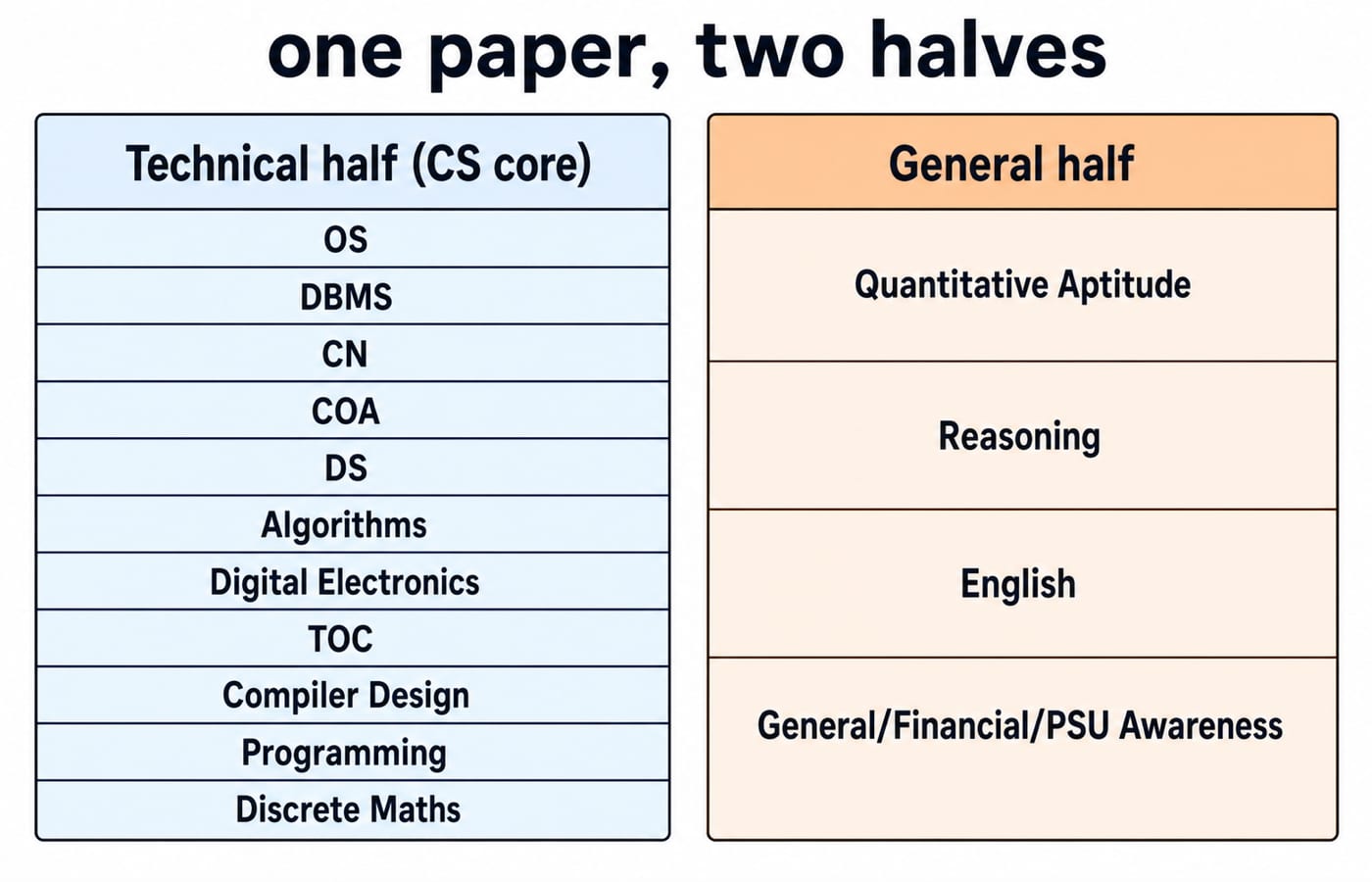
Build the technical side around these subject families:
operating systems
database management systems
computer networks
computer organisation and architecture
data structures and algorithms
digital electronics
theory of computation and compiler design
programming
discrete mathematics
KnowledgeGate's question bank carries well over 18,000 computer-science practice questions across these areas. Use the GATE CS subject-weightage guide to decide which of these nine families get your first revision slots, rather than giving all of them equal time.
Revise each technical topic at two levels. First, be able to state the governing rule or definition. Second, solve short questions that expose common confusions. For example, knowing what a deadlock is is level one; identifying which prevention method breaks circular wait is level two.
4. The general-aptitude half
The general side is not a rest period between technical questions. It needs a conventional bank and SSC-style preparation base:
quantitative aptitude, especially arithmetic and data interpretation
reasoning, including arrangements, series and logical classification
English language, grammar and comprehension
general, financial, PSU or mining awareness as named in the notification
KnowledgeGate's question bank includes over 8,000 quantitative-aptitude questions and over 6,000 reasoning questions. Begin with topic sets, then move to mixed timed sections. Topic practice teaches the method; mixed practice teaches recognition and selection.
Awareness needs boundaries. Use the notification to decide which areas matter, maintain concise rolling notes, and revise those notes repeatedly. An unlimited GK plan will consume time without giving you a reliable revision unit. The sector slice is where a generic SSC-style GK routine usually falls short, so keep a short running note on the coal and energy sector beside your national current-affairs notes, and let the notification's wording decide how far that note has to go.
5. How the CS half maps onto GATE CS
Your GATE CS base carries most of the technical half. The subject-by-subject transfer map, and the weekly hour split it implies, are worked out in the Coal India MT Systems preparation strategy.
The change is the question style. Keep GATE's conceptual depth, but add rapid recall and option-level discrimination. After completing a deep GATE set, answer a short mixed MCQ set without notes. For every wrong answer, write the rule that would have eliminated the distractor.
Use three passes for each technical subject. In the first pass, compress the notes into definitions, formulas and common distinctions. In the second, solve a focused topic set without a timer and repair the concepts. In the third, take a mixed timed set containing old and new topics. That final pass checks whether you can recognise the governing idea before the options pull you towards a familiar but wrong statement.
This approach avoids two extremes. You do not reduce the CS core to shallow memorisation, and you do not spend every session on long numericals when the recruitment paper also rewards broad coverage.
6. Reading the notification correctly
Read the current notification before creating the final study timetable. Extract the following into one page:
the sections and their stated scope
question and mark distribution
total and sectional timing, if any
negative-marking rule, if any
qualifying conditions and selection stages
instructions about the awareness component
Treat every extracted number as cycle-specific. If a coaching page and the notification disagree, the notification wins. The PSU category can help you place this exam among related opportunities, but it does not replace Coal India's recruitment notice.
Then make the syllabus operational. Give each topic a resource, a question set, a revision date and a status. A list of subject names becomes useful only when it drives the next study session.
7. The short version and your next step
MT Systems preparation has two genuine halves. Carry your GATE CS base into the technical side, add faster conceptual MCQ work, and give quant, reasoning, English and specified awareness their own recurring schedule. Verify all counts, timings and rules from the current Coal India notification.
Use the Coal India Management Trainee course to structure both halves, then use the Coal India MT CS recruitment test series to practise them as one paper. Start by making the two-column syllabus sheet shown above and marking your weakest area on each side.
Keep learning
Programmed I/O: Polling, CPU Utilisation, Worked Examples and GATE Question Patterns
Follow one programmed-input transfer from control write to data read, then calculate how many polls one word costs and what a longer poll period buys.
Updated 7 Oct 20266 min readComputer Organization & Architecture
Multiprocessor Fundamentals: Architecture, Speedup and Worked Examples
Build a clear model of multiprocessor systems, then use it to calculate speedup and efficiency, trace a coherent write, and diagnose a lost update.
Updated 2 Oct 20265 min readComputer Organization & Architecture
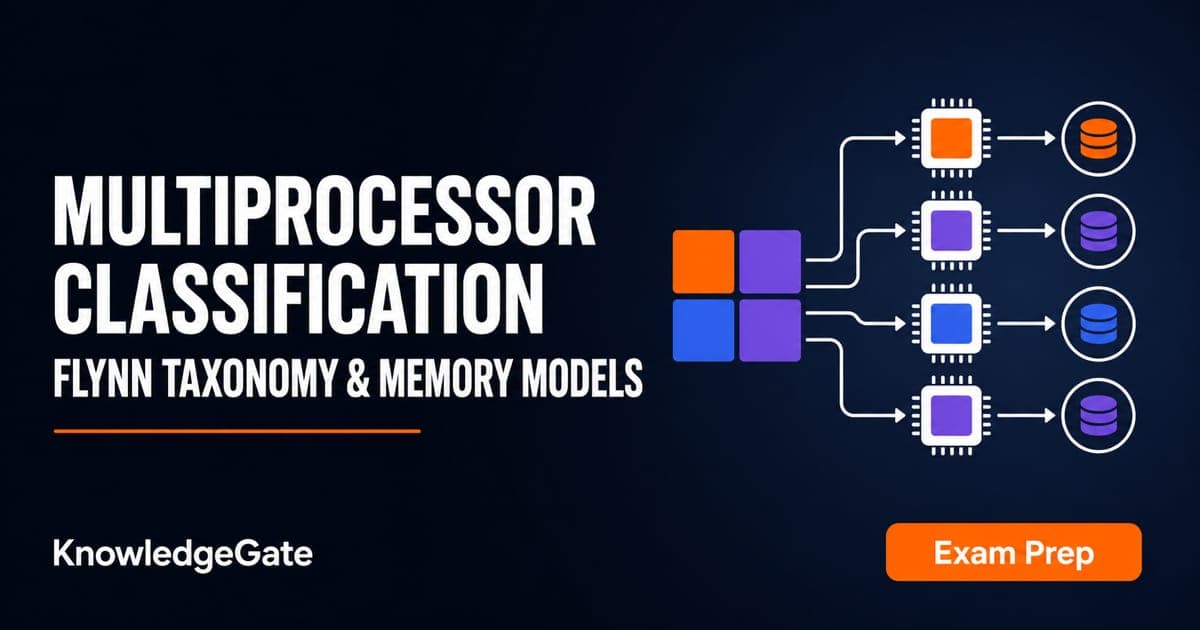
Multiprocessor Classification: Flynn Taxonomy, Memory Models and Exam-Style Worked Examples
Learn how to choose the right multiprocessor classification axis, then solve a four-lane SIMD trace and a NUMA average-access-time problem step by step.
Updated 27 Sep 20266 min readComputer Organization & Architecture
Interrupt-Driven I/O Explained: CPU Handshake, Worked Timing Example and GATE Traps
Trace an interrupt from device request to return-from-interrupt, then compare polling, per-event interrupts, and DMA through worked timing examples.
Updated 25 Sep 20267 min readComputer Organization & Architecture