Coal India MT Mock Analysis: Manage Both Papers as One Exam
A combined mock score can hide which paper cost you marks. Use this worked two-paper scorecard to test section order, diagnose errors and plan the next retest.
KnowledgeGate Team
Exam prep & CS education
Updated 12 Aug 20265 min read54 views

One mock total cannot show whether Paper I consumed Paper II's time, knowledge gaps caused the loss, or the final minutes were wasted. Treat both papers as one exam, but score each separately. The total only tells you that something went wrong; the split tells you which paper to repair.
Start with one 180-minute system, not two unrelated papers
Recent Coal India Limited recruitment material has specified Paper I on General Knowledge and Awareness, Reasoning, Numerical Ability and General English, plus Paper II on Professional Knowledge. It specified 100 questions and 100 marks per paper, three hours combined, and no negative marking. Use the Coal India MT course overview for preparation scope, but confirm these numbers in the latest notification on the verified CIL careers page.
For planning, write the exam as one equation:
180 minutes = Paper I working block + Paper II working block + shared reserve
A 126/200 total is weak evidence. Split each paper into marks, time, accuracy and unattempted questions. Maximise combined correct answers, not the feeling of finishing the easier paper. A strong first paper is a poor trade if Paper II remains unfinished.
Choose section order and reserve time before the mock begins
Test both orders with the same candidate trial budget:
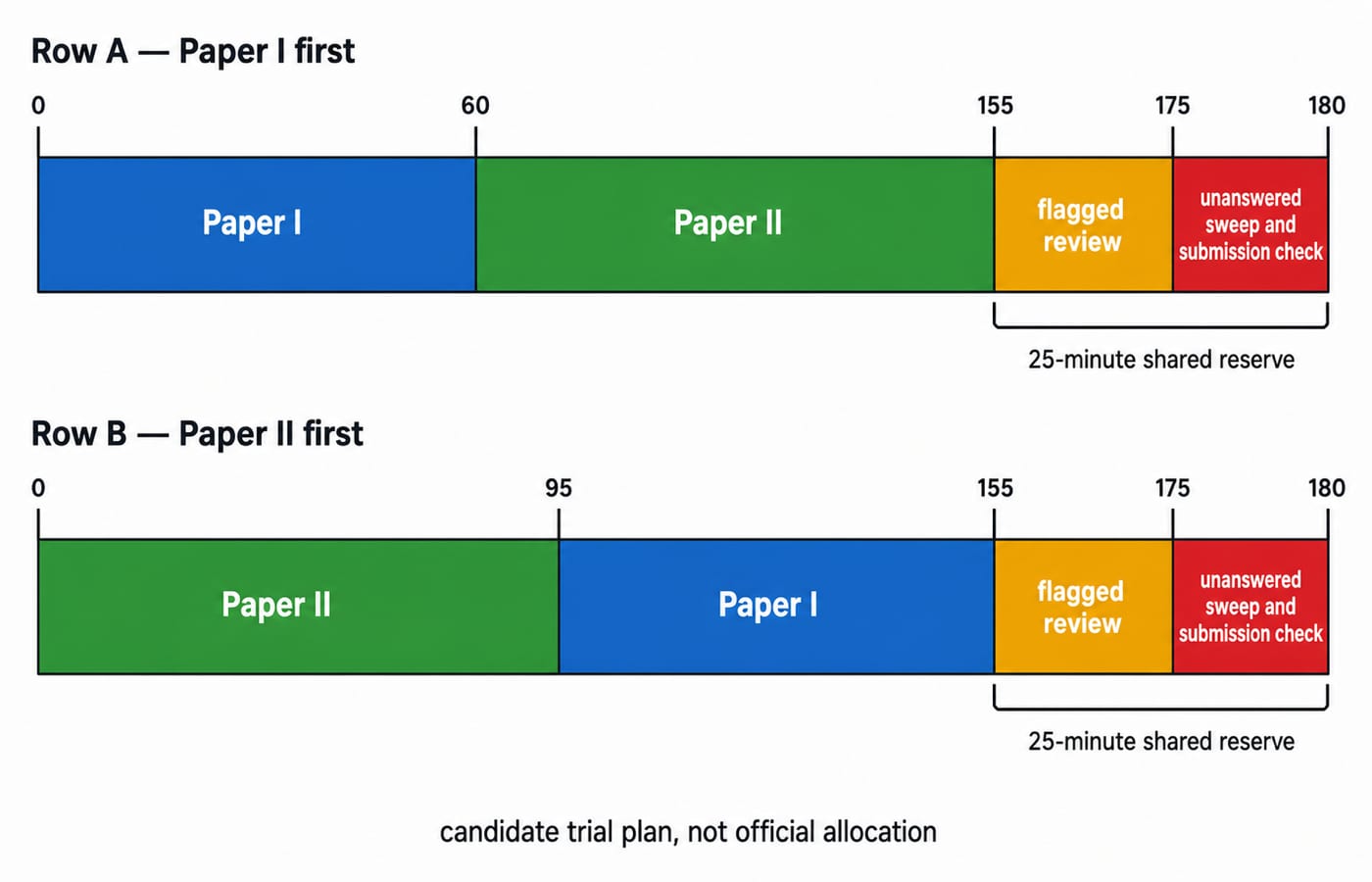
Plan A, Paper I first: 0 to 60 Paper I, 60 to 155 Paper II, 155 to 175 flagged review across both, then 175 to 180 unanswered sweep and submission checks.
Plan B, Paper II first: 0 to 95 Paper II, 95 to 155 Paper I, then the same 20-minute review and 5-minute sweep.
The closing 5 minutes are not spare time. Where there is no negative marking, a blank scores zero and a blind mark can only score zero or one, so plan to finish the mock with nothing left unfilled.
Treat the 60, 95, 20 and 5-minute blocks as starting values to be tested, not settled ones. Run A/B/A across three comparable full mocks, changing only order. Keep preparation and budgets steady. Choose only if correct answers rise and timeouts fall in at least two trials. Comfort is not evidence.
The UGC NET two-paper mock strategy is a useful two-demand comparison. Coal India MT timings and rules must come from its current notification.
Capture a two-paper scorecard immediately after every mock
Use these columns every time. Accuracy is correct / attempted x 100, not correct / 100. Fill the row within minutes of submitting, before you open the solutions, while you still remember which questions you rushed and which you never reached.
Paper | Planned minutes | Actual first-pass minutes | Reserve minutes used | Attempted | Correct | Wrong | Unattempted | Attempt accuracy | Marks | Questions lost to time |
|---|---|---|---|---|---|---|---|---|---|---|
Paper I | 60 | 63 | 3 | 90 | 72 | 18 | 10 | 80.0% | 72/100 | 3 |
Paper II | 95 | 102 | 7 | 75 | 54 | 21 | 25 | 72.0% | 54/100 | 11 |
Combined | 155 | 165 | 10 | 165 | 126 | 39 | 35 | 76.4% | 126/200 | 14 |
The checks are 72 + 54 = 126 correct, 18 + 21 = 39 wrong and 10 + 25 = 35 unattempted. Attempts are 126 + 39 = 165, so accuracy is 126 / 165 x 100 = 76.4%. Overruns use 3 + 7 = 10 minutes, leaving 25 - 10 = 15 reserve minutes. Keep the 18-point paper gap and 35 unattempted questions visible.
Score your considered answers only. Where there is no negative marking you should still mark an option on every question you never reached, but those blind marks measure luck, not preparation, and folding them in would flatter both accuracy and marks. Keep them out, and read the 35 unattempted as questions you never got to rather than as bubbles you left empty.
Turn 126/200 into a 14-mark repair target
Tag every wrong and unattempted question.
Error source | Paper I | Paper II |
|---|---|---|
Knowledge gaps among wrong answers | 5 | 12 |
Misreads | 4 | 3 |
Calculation or logic slips | 6 | 4 |
Rushed guesses | 3 | 2 |
Known but timed out | 3 | 11 |
Not known and unattempted | 7 | 14 |
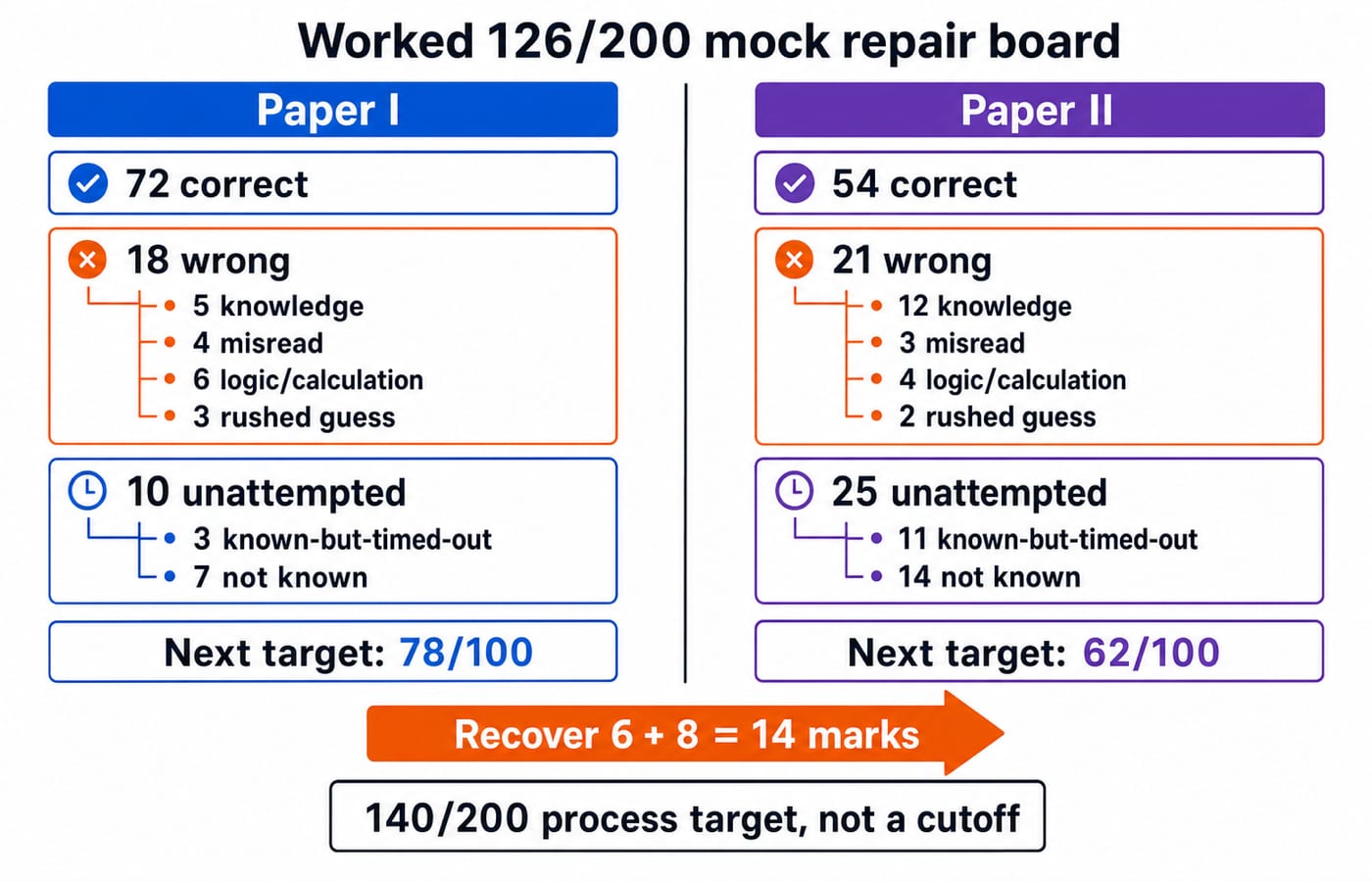
Check the tags: 5 + 4 + 6 + 3 = 18 wrong in Paper I and 12 + 3 + 4 + 2 = 21 in Paper II. Unattempted totals are 3 + 7 = 10 and 11 + 14 = 25.
Separate execution losses from syllabus gaps. Paper I's pool is 4 misreads + 6 slips + 3 known-but-timed-out = 13. Paper II's is 3 + 4 + 11 = 18. Do not assume all 31 execution losses will become marks in one week.
Choose a smaller next-mock recovery: 6 marks in Paper I and 8 in Paper II. That gives 126 + 6 + 8 = 140/200.
Next target | Attempted | Correct | Wrong | Unattempted | Attempt accuracy | Marks |
|---|---|---|---|---|---|---|
Paper I | 92 | 78 | 14 | 8 | 84.8% | 78/100 |
Paper II | 80 | 62 | 18 | 20 | 77.5% | 62/100 |
The accuracy checks are 78 / 92 x 100 = 84.8% and 62 / 80 x 100 = 77.5%. The 6 and 8 are close to 45% of each execution pool, 6 of 13 in Paper I and 8 of 18 in Paper II, which is what one honest week of repair can realistically convert.
Use a nine-hour weekly mock-and-repair loop
Build the week around one measurement:
One 180-minute full mock.
A 60-minute same-day analysis.
Four 60-minute repairs: Paper I speed and accuracy, Paper II's largest knowledge gap, mixed timeouts, and a closed-book reattempt of wrong answers.
One 60-minute retest.
The load is 180 + 60 + 240 + 60 = 540 minutes, or 9 hours. Match the resource to the error. Use the complete Coal India MT course for concept gaps and the Coal India MT test series for the next timed measurement.
If you miss a day, preserve the next full mock and analysis. Merge the two lowest-priority repairs into one 60-minute session and carry the high-impact repair forward. Do not double the next day to make the timetable look complete. The teaching-exam mock review loop explains the wider review discipline.
Compare three mocks without letting the total hide the cause
Log one row per mock, and always record the order used alongside both paper marks.
Mock | Order | Paper I | Paper II | Total | Reserve left | Known but timed out |
|---|---|---|---|---|---|---|
1 | Paper I first | 72 | 54 | 126 | 15 min | 14 |
2 | Paper II first | 70 | 61 | 131 | 20 min | 8 |
3 | Paper I first | 76 | 58 | 134 | 16 min | 10 |
Mock 2 makes Paper II first look promising, but one result cannot settle the order. Difficulty and normal score variation can still differ.
Judge paper-level marks, attempt accuracy and known-but-timed-out counts. Keep at least 20 reserve minutes next time before pushing attempts higher. Change only one variable between mocks: order, allocation or guessing policy. Otherwise you cannot identify what helped.
Short version: plan, split, tag, repair, retest
Write the 180-minute plan before starting.
Record Paper I and Paper II separately.
Tag every wrong and unattempted question.
Choose a small mark-recovery target.
Retest under the same conditions.
The latest Coal India Limited notification governs the pattern. If syllabus gaps dominate, begin with the complete course. If you need repeated timed diagnosis, use the test series. Two paper scorecards produce one better exam decision.
Keep learning

Coal India MT PYQ Analysis: Balance Paper I and Professional Knowledge
A combined Coal India MT score hides which paper is weak. Score Paper I and professional knowledge separately, classify every miss by cause, and rebalance the week from that.
Updated 10 Aug 20265 min read245 viewsCoal India MT

Coal India MT Cutoffs: Qualifying Marks vs Merit List
Learn why clearing Coal India MT's paper-wise minimum does not guarantee selection. Read the 2026 System rules in order with a worked merit example.
Updated 8 Aug 20265 min read321 viewsCoal India MT

Coal India MT Numerical Ability: Ratios, Percentages and a Worked DI Set
Learn how ratio parts, percentage bases, and table reading work together. Includes checked examples, conversion shortcuts, common traps, and a 30-minute drill.
Updated 5 Aug 20266 min readCoal India MT

Coal India MT Computer Awareness: Office Tools, Internet and Security Guide
Turn a broad syllabus phrase into four practical revision buckets, then test your understanding with worked spreadsheet calculations and six concept checks.
Updated 3 Aug 20265 min readCoal India MT