Coal India MT CBT Preparation Plan: 10 Weeks for General and Technical Revision
Build ten weeks of Coal India MT preparation around a measured baseline, protected general practice, technical repair, reviewed mocks and a calm final taper.
KnowledgeGate Team
Exam prep & CS education
Updated 23 Jul 20266 min read100 views
You finish technical chapters, then realise numerical ability, reasoning, awareness or English has gone untouched for days. An oversized weekend leaves every lane half-revised. Ten weeks and a 138-hour budget fix that only if each lane gets named hours and the mock load rises after review time is protected, not before. Build your Coal India MT preparation on the section names and systems discipline syllabus published on CIL's CBT-26 page, then find out where you actually stand.
Related reading: Coal India recruitment routes and Coal India mock analysis.
1. Take an 80-question baseline before assigning ten weeks
Start with an 80-question home diagnostic: 40 technical, then 10 each from numerical ability, reasoning, general awareness and English. That 40-against-40 weighting is a planning choice for a home test; the paper's own question counts come from the CBT-26 advertisement. Draw every item from topics named in the CIL Paper I and systems discipline syllabi.
Suppose the record is technical 23C, 12W, 5S; numerical 6C, 2W, 2S; reasoning 7C, 2W, 1S; awareness 4C, 4W, 2S; and English 8C, 1W, 1S. The totals are 48 correct, 21 wrong, 11 skipped, so attempts are 48 + 21 = 69. Attempted accuracy is 48 / 69 x 100 = 69.6%, while coverage is 69 / 80 x 100 = 86.3%. Awareness has the lowest accuracy; technical has the largest error load. Those two facts pick your first repairs, and the sheet gives Week 10 something like-for-like to beat.
2. Lock a 138-hour plan with a deliberate taper
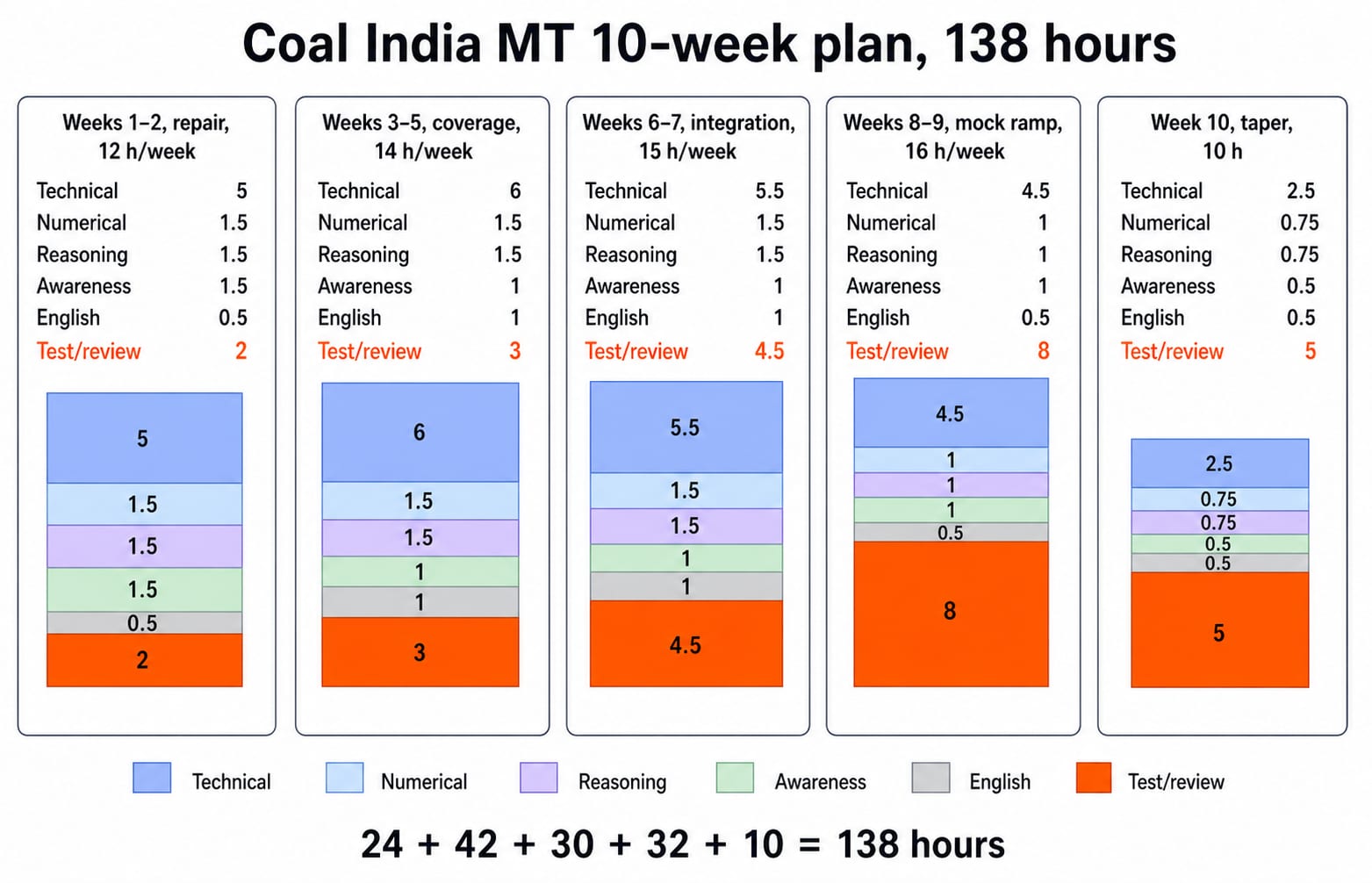
The load rises, then falls in Week 10. The total is (2 x 12) + (3 x 14) + (2 x 15) + (2 x 16) + 10 = 24 + 42 + 30 + 32 + 10 = 138 hours.
Phase | Technical | Numerical | Reasoning | Awareness | English | Tests and review | Total each week |
|---|---|---|---|---|---|---|---|
Weeks 1-2, repair | 5 h | 1.5 h | 1.5 h | 1.5 h | 0.5 h | 2 h | 12 h |
Weeks 3-5, coverage | 6 h | 1.5 h | 1.5 h | 1 h | 1 h | 3 h | 14 h |
Weeks 6-7, integration | 5.5 h | 1.5 h | 1.5 h | 1 h | 1 h | 4.5 h | 15 h |
Weeks 8-9, mock ramp | 4.5 h | 1 h | 1 h | 1 h | 0.5 h | 8 h | 16 h |
Week 10, taper | 2.5 h | 0.75 h | 0.75 h | 0.5 h | 0.5 h | 5 h | 10 h |
Each row balances: coverage leads early, review rises later, and Week 10 tapers without dropping a lane.
3. Weeks 1-2: repair the two weakest lanes without dropping the rest
Give awareness three 30-minute sessions weekly. Put three of five technical hours on the two clusters with most wrong or skipped answers. Give numerical and reasoning three 30-minute blocks each, English one, and tests plus review two hours.
For a technical loop, take a 32-bit byte-addressable system with 4 KB = 2^12 bytes pages. The page offset needs 12 bits; the virtual page number needs 32 - 12 = 20 bits. Spend 20 minutes recalling without notes, 20 minutes solving five fresh address-translation items, and 20 minutes correcting them. Mark it repaired after a fresh retest reaches at least 4/5. If the numerical and reasoning blocks feel shapeless, borrow the daily shape from the Aptitude for Placements 30-day routine, which runs the same recall, solve, correct loop on shorter blocks.
4. Weeks 3-5: complete one controlled coverage pass
Sequence your technical study against the CIL systems discipline syllabus and finish it once, without doubling back. Week 3 covers programming and data structures plus DBMS. Week 4 takes algorithms, operating systems, and networks/security. Week 5 covers digital logic and computer organisation, theory of computation, compiler design, and engineering mathematics.
Each week has three 120-minute technical blocks: 45 minutes recall, 45 minutes fresh questions, and 30 minutes correction. Protect Paper I with 90 minutes numerical, 90 minutes reasoning, 60 minutes awareness, and 60 minutes English. Put those four blocks in the calendar by name. The general lanes are the ones that quietly lose their slot to a long technical chapter.
Build each practice set from one syllabus topic at a time, ten to fifteen questions deep, so a poor result points at a single cluster rather than a whole subject. Mixed sets come later, in Weeks 6 and 7, once the clusters hold on their own.
5. Weeks 6-7: make technical and general practice meet under one timer
Run one 45-question mixed set: 25 technical + 20 general, with five each for numerical, reasoning, awareness, and English. Tag every miss as concept, recall, calculation, reading or time decision.
In Week 6, suppose technical gives 14 correct, 7 wrong, 4 skipped. That is 21 attempts and 14 / 21 = 66.7% attempted accuracy. General gives 15 correct, 3 wrong, 2 skipped, or 15 / 18 = 83.3%. Overall, there are 29 correct from 39 attempts, so accuracy is 29 / 39 = 74.4%, with 6 skipped. Repair the most frequent technical error tag next. Repeat the 25 + 20 shape with fresh questions in Week 7, comparing accuracy, coverage, and error mix.
6. Weeks 8-9: ramp mocks only when review time is protected
Spend Week 8's eight test-and-review hours like this: a 180-minute full practice block plus 120 minutes of review, a 60-minute technical mixed set plus 45 minutes of review, and a 45-minute general set plus 30 minutes of review. 180 minutes is the home-study length; if your mock series runs to a different duration, match it and hold the same review-to-test ratio.
In Week 9, place two non-consecutive 180-minute practice blocks, each followed by 60 minutes of first-pass review, for eight hours total. For an 80-question mock with 62 attempted, 46 correct, 16 wrong, 18 skipped, accuracy is 46 / 62 = 74.2% and coverage is 62 / 80 = 77.5%. If nine wrong answers are technical recall errors, repair that recall the next day. Coal India Management Trainee (CS) Recruitment Test Series supplies ready mocks for both of those blocks. Teaching Exam mock strategy for CS papers sets out a review workflow worth borrowing here: score, tag, repair, retest, in that order.
7. Recover from missed days, then taper in Week 10
Recovery has three rules. First, turn one missed 60 to 90-minute block into a 30-minute floor: 15 minutes reattempting errors, then 15 on the weakest lane. Do not double sessions. Second, after two missed days, drop one new-content block but retain review. Third, set a four-hour disrupted-week floor: technical 120 minutes, numerical 30, reasoning 30, awareness 20, English 20, and error review 20. The sum is 120 + 30 + 30 + 20 + 20 + 20 = 240 minutes.
Week 10 tapers to 10 hours: 2.5 technical hours, 45 numerical minutes, 45 reasoning minutes, 30 awareness minutes, 30 English minutes, and five hours for one final diagnostic plus review. Add no new source after that diagnostic.
8. Repeat the baseline and choose the next action from evidence
Repeat the 40 + 10 + 10 + 10 + 10 shape with fresh questions. Suppose results are technical 31C, 7W, 2S; numerical 8C, 1W, 1S; reasoning 8C, 1W, 1S; awareness 7C, 2W, 1S; and English 9C, 1W, 0S. Totals are 63 correct, 12 wrong, 5 skipped. Thus, 63 / 75 = 84.0% attempted accuracy and 75 / 80 = 93.8% coverage. Against Week 0, that is +14.4 percentage points and +7.5 points.
Read the retest as three decisions. If attempted accuracy has crossed 80% and coverage 90%, as here, stop adding topics and give the remaining days to timed sets and error review only. If accuracy holds but coverage stays under 80%, the problem is pace rather than knowledge: practise section order and skip decisions, not new chapters. If one lane is still ten or more points below the rest, hand it the whole Week 10 technical slot and leave the other four on maintenance.
The short version: diagnose, protect five lanes, shift to review, ramp mocks, then taper. If you would rather not sequence the discipline syllabus yourself, the Coal India Management Trainee (CS) Recruitment 2026 complete course arrives already ordered that way.
Keep learning

Coal India MT Mock Analysis: Manage Both Papers as One Exam
A combined mock score can hide which paper cost you marks. Use this worked two-paper scorecard to test section order, diagnose errors and plan the next retest.
Updated 12 Aug 20265 min read54 viewsCoal India MT

Coal India MT PYQ Analysis: Balance Paper I and Professional Knowledge
A combined Coal India MT score hides which paper is weak. Score Paper I and professional knowledge separately, classify every miss by cause, and rebalance the week from that.
Updated 10 Aug 20265 min read245 viewsCoal India MT

Coal India MT Cutoffs: Qualifying Marks vs Merit List
Learn why clearing Coal India MT's paper-wise minimum does not guarantee selection. Read the 2026 System rules in order with a worked merit example.
Updated 8 Aug 20265 min read321 viewsCoal India MT

Coal India MT Numerical Ability: Ratios, Percentages and a Worked DI Set
Learn how ratio parts, percentage bases, and table reading work together. Includes checked examples, conversion shortcuts, common traps, and a 30-minute drill.
Updated 5 Aug 20266 min readCoal India MT