Programming the Basic Computer (COA): Instruction Set, Assembly Language and Worked Examples
Learn the Morris Mano Basic Computer by decoding an indirect instruction and assembling a subtraction program from source to final memory values.
KnowledgeGate Team
Exam prep & CS education
Updated 30 Jul 20266 min read
Many COA students know that the Morris Mano Basic Computer has 25 instructions, yet freeze when given a 16-bit hexadecimal word or a loop without SUB or MUL. The gap is rarely theory. It is the habit of writing down I, the opcode and the address before touching memory, and of building subtraction out of CMA, INC and ADD when the instruction set refuses to supply it.
1. The Basic Computer programming model
The machine has 4096 words of 16-bit memory and 12-bit addresses. It provides AC, the 16-bit accumulator; E, a 1-bit carry or extension flip-flop; PC, AR, IR, DR and TR; and 8-bit INPR and OUTR registers. Every calculation passes through AC, shaping every program. The register-transfer notation these registers obey is developed in the Computer Architecture module.
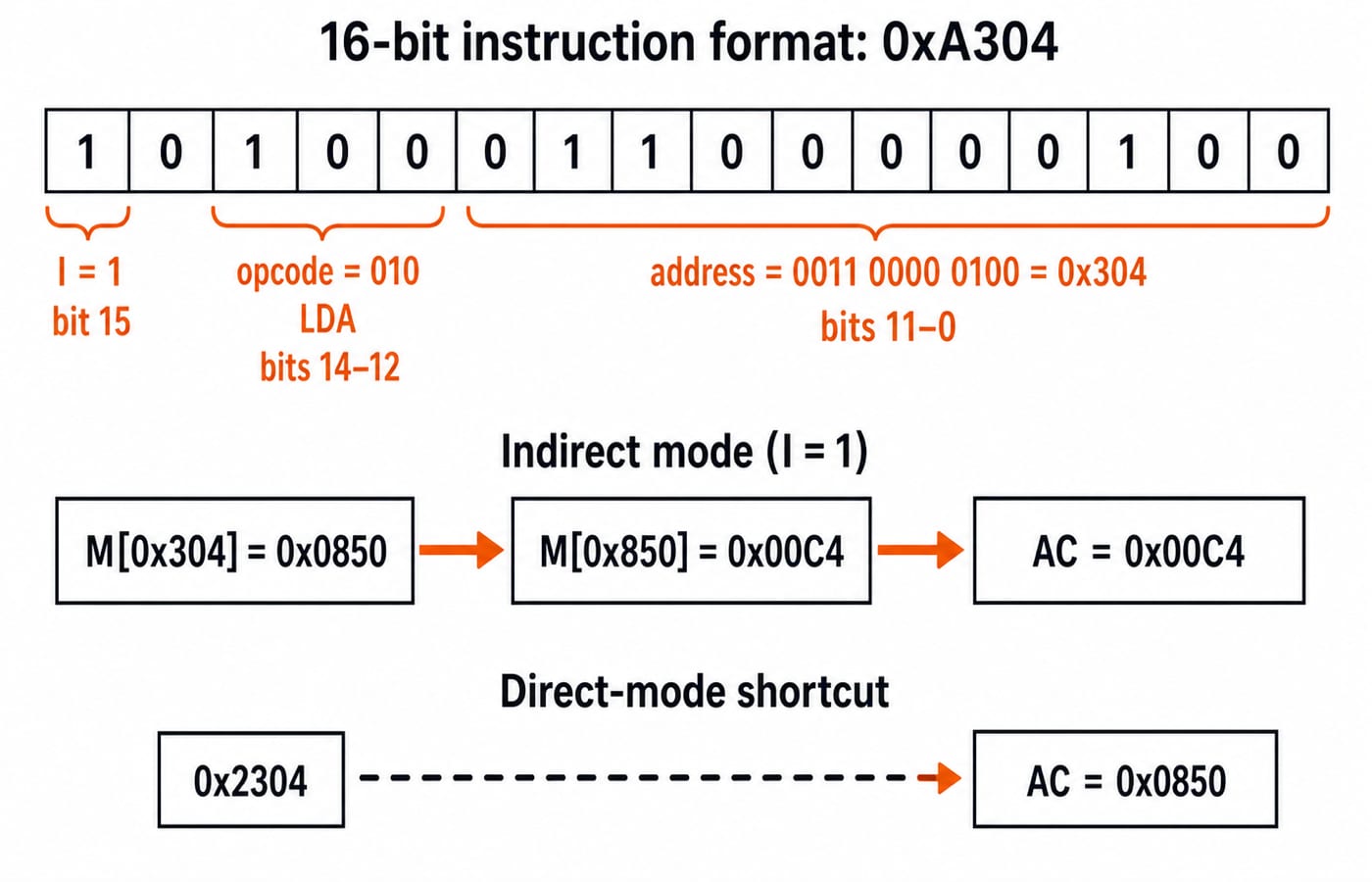
A memory-reference instruction has three fields: bit 15 is I, bits 14 to 12 are the opcode, and bits 11 to 0 are the address. In 0xA304, these are 1, 010 and 0x304.
Use the first hexadecimal digit as a recall rule. Digits 0 to 6 mean direct memory reference, 8 to E indirect memory reference, 7 register reference, and F I/O. Thus 0x7200 has no operand address, while 0x2xxx is always direct LDA.
2. All 25 Basic Computer instructions, grouped by function
The seven memory-reference instructions fall into three groups:
Data movement:
LDAloads a memory word into AC.STAcopies AC to memory.Arithmetic and logic:
ADDadds a memory word to AC and sends the carry to E.ANDperforms a bitwise AND with AC.Control:
BUNloads the effective address into PC.BSAstores the return PC at the effective address and branches to the next word.ISZincrements a memory word and skips the next instruction if the result is zero.
The 12 register-reference instructions need no memory operand. CLA, CLE, CMA and CME clear or complement AC or E. CIR and CIL rotate E with AC, and INC increments AC. SPA, SNA, SZA and SZE skip for positive AC, negative AC, zero AC and zero E. HLT stops the computer. Three of these codes are worth memorising: CMA = 0x7200, INC = 0x7020 and HLT = 0x7001.
The six I/O instructions are INP and OUT for byte transfer, SKI and SKO for readiness tests, and ION and IOF for interrupt control.
Programs synthesise the missing operations: subtraction uses CMA + INC + ADD, multiplication uses shift-and-add, and subroutines use BSA. That synthesis is what exams test.
3. Worked example A: decode one instruction by hand
Suppose IR contains 0xA304. Since A = 1010, I = 1, opcode 010 means LDA, and the address is 0x304. It is an indirect load.
Given M[0x304] = 0x0850 and M[0x850] = 0x00C4, the trace is:
Read
M[0x304], giving effective address0x850.Read
M[0x850], giving operand0x00C4.Load it:
AC = 0x00C4.
If IR had instead contained 0x2304, the leading 2 would make it direct. AC would then receive M[0x304] = 0x0850.
4. Worked example B: assemble and run a complete program
Compute MIN - SUB = 83 - (-23) without a subtraction instruction:
ORG 100
LDA SUB
CMA
INC
ADD MIN
STA DIF
HLT
MIN, DEC 83
SUB, DEC -23
DIF, HEX 0
END
ORG 100 starts at hexadecimal 0x100. DEC and HEX define data, END stops translation, and a comma-terminated label names an address.
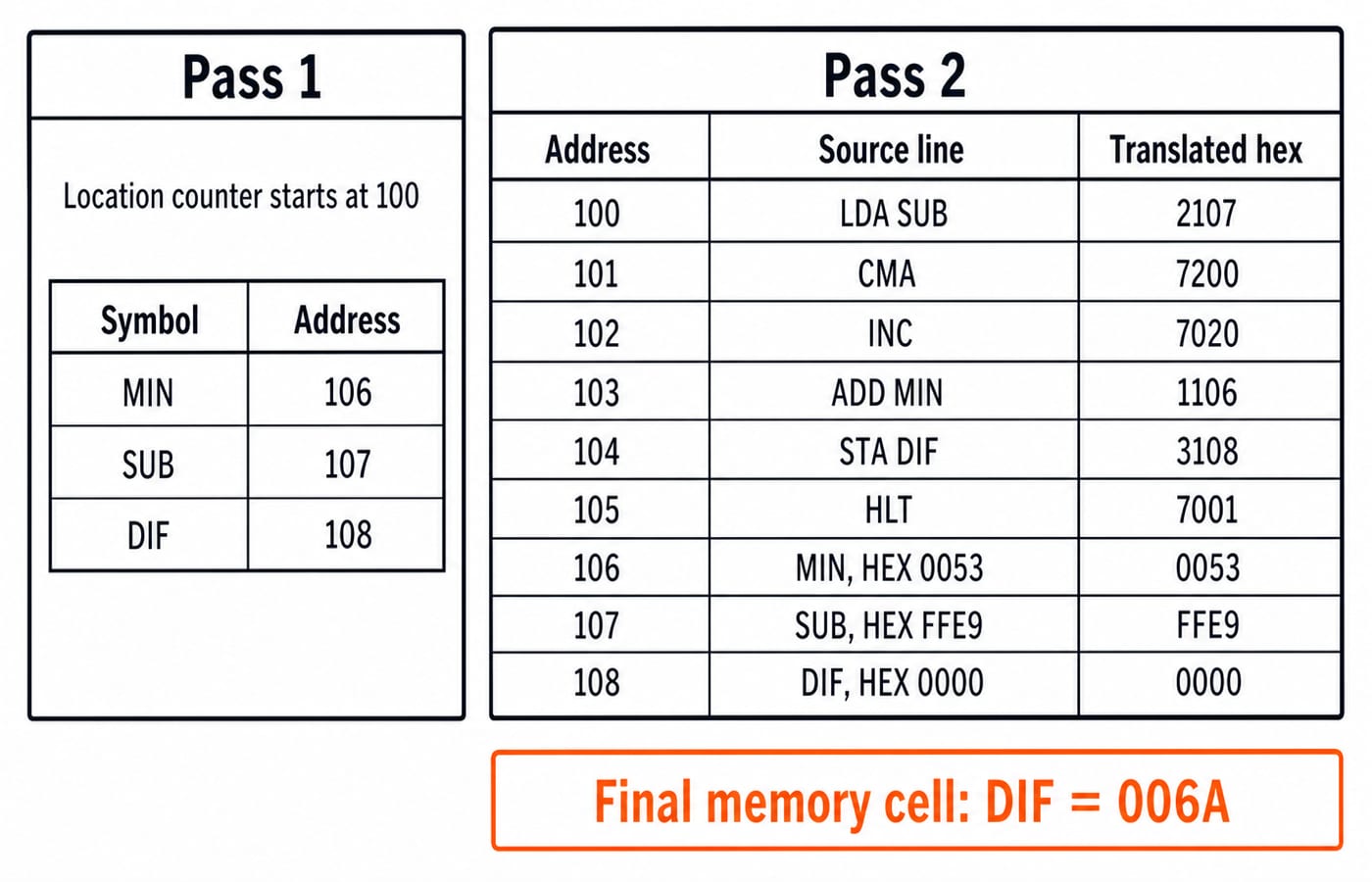
Address | Source | Translated word |
|---|---|---|
|
|
|
|
|
|
|
|
|
|
|
|
|
|
|
|
|
|
|
|
|
|
|
|
|
|
|
Execution loads 0xFFE9, the 16-bit two's-complement form of -23. CMA gives 0x0016; INC gives 0x0017, or +23. Adding 0x0053 gives 0x006A, which STA DIF writes at 0x108. Therefore DIF = 0x006A = 106 = 83 - (-23). The program built subtraction from simpler instructions.
5. Why the assembler needs two passes
Pass 1 advances the location counter and records MIN = 0x106, SUB = 0x107 and DIF = 0x108. Pass 2 substitutes these addresses and emits code.
At LDA SUB, the assembler has not reached the definition of SUB. Two passes resolve this forward reference; one pass would require a placeholder and later backpatch.
6. Exam patterns: loops, multiplication, subroutines and I/O
Counting loop: initialise
CTR, DEC -5. PlaceISZ CTRafter the body, followed byBUN LOP. Each iteration increments the counter. Only the fifth increment reaches zero and skips the followingBUN, so the body runs exactly five times.ISZskips one instruction, it does not branch.Multiplication: test the multiplier's low bit, conditionally add the multiplicand, then shift.
CIRcarries information through E for the next test.Subroutine:
BSA SUBplaced at 0x120, with SUB = 0x150, writes the return address 0x121 into M[0x150] and continues at 0x151.BUN SUB Iat the end of the routine reads M[0x150] and jumps back to 0x121. A fixed return word makes the routine non-re-entrant and non-recursive.Polled I/O:
SKIand a backwardBUNwait for FGI, thenINPtransfers INPR to AC.SKOandOUTmirror this for output.IONenables interrupts. The interrupt cycle saves PC at0x000and branches to0x001, so0x000is the return word.
Assembled under the same rules, that loop is six words:
ORG 100
        CLA          / 0x100: 7800
LOP,    INC          / 0x101: 7020
        ISZ CTR      / 0x102: 6105
        BUN LOP      / 0x103: 4101
        HLT          / 0x104: 7001
CTR,    DEC -5       / 0x105: FFFB
        END
CTR starts at 0xFFFB. The fifth ISZ CTR makes it 0x0000 and skips the BUN, so INC runs exactly five times and AC ends at 0x0005.
For neighbouring COA concepts, continue with pipelining in computer architecture and cache memory mapping and hit ratio.
7. Traps that cost marks
Misreading the first digit: treating
0xA304as direct gives0x0850, not0x00C4. Write I, opcode and address before reading memory.Treating ISZ as a branch: it only skips the next instruction. Write the
ISZandBUNpair together.Writing minus as a sign: memory stores
-23as0xFFE9, not as0x8017with a sign bit and not as the bare magnitude0x0017. Convert negativeDECvalues before checking pass 2.Expecting BSA to push a stack: another call overwrites the fixed return word, destroying the earlier return address.
Miscounting after ORG: every emitted instruction or data word advances the counter. Use
MIN = 0x106as the check for this listing.
8. How GATE and interviews test Basic Computer programming
GATE questions give a hexadecimal instruction and memory contents, then ask for the effective address or final AC. They also test ISZ, BSA or a sequence that implements subtraction. Recent official GATE syllabuses place machine instructions, addressing modes and I/O under COA. Check the current organising institute's official GATE website for exact wording.
Interviews ask you to implement subtraction or multiplication on an accumulator machine, or explain why this subroutine cannot recurse. The worked program and BSA pattern answer both.
Use the GATE Test Series, Mocks & Topic-wise Tests to practise decode-and-trace questions under time.
The short version is:
A 16-bit instruction contains I, an opcode and a 12-bit address.
The first hexadecimal digit identifies direct, indirect, register-reference or I/O form.
Computation passes through AC, with E carrying an extra bit.
Subtraction is
CMA + INC + ADD; here83 - (-23) = 106.ISZskips, whileBSAsaves a return address in the subroutine's first word.I/O can use polling loops or interrupts.
For structured COA coverage within full GATE CS preparation, follow GATE Guidance by Sanchit Sir, then return to this program and assemble it once without looking at the table.
Keep learning
Multiprocessor Fundamentals: Architecture, Speedup and Worked Examples
Build a clear model of multiprocessor systems, then use it to calculate speedup and efficiency, trace a coherent write, and diagnose a lost update.
Updated 2 Oct 20265 min readComputer Organization & Architecture
Multiprocessor Classification: Flynn Taxonomy, Memory Models and Exam-Style Worked Examples
Learn how to choose the right multiprocessor classification axis, then solve a four-lane SIMD trace and a NUMA average-access-time problem step by step.
Updated 27 Sep 20266 min readComputer Organization & Architecture
Interrupt-Driven I/O Explained: CPU Handshake, Worked Timing Example and GATE Traps
Trace an interrupt from device request to return-from-interrupt, then compare polling, per-event interrupts, and DMA through worked timing examples.
Updated 25 Sep 20267 min readComputer Organization & Architecture
Interface Addressing Explained: Memory-Mapped vs Isolated I/O with Worked Examples
Understand what an interface address selects, how memory-mapped and isolated I/O differ, and why partial decoding creates multiple addresses for the same register.
Updated 23 Sep 20266 min readComputer Organization & Architecture