Coal India MT Systems Preparation Strategy: How Much of Your GATE CS Prep Transfers
Reuse your GATE CS foundation instead of rebuilding it. Most of the technical core transfers to MT Systems. The aptitude half is what you add, over ten weeks.
KnowledgeGate Team
Exam prep & CS education
Updated 25 Jul 20265 min read

If you already study for GATE CS, starting a separate Coal India MT Systems plan from zero wastes your strongest preparation. The technical core largely overlaps, but the general section demands aptitude, English, reasoning and awareness work that GATE does not supply.
The sensible plan is to preserve the deep CS study you have done, change part of your question practice to faster MCQs, and build the missing half as a separate daily track. In hour terms that is roughly two-thirds of the week on the CS core you already own and one-third on the aptitude, reasoning, English and awareness work you do not.
1. The overlap is bigger than you think
Candidates tend to make one of two errors. Some reopen every CS subject as if MT Systems were a new syllabus. Others assume a strong GATE score automatically covers the whole recruitment test and postpone aptitude until the end.
Use a cleaner model: MT Systems preparation = GATE CS core + PSU aptitude add-on + timed MCQ practice. That model makes the workload finite. It also tells you where each hour should go.
Your existing notes, concept sheets and solved GATE questions remain valuable. The adjustment is in depth and speed. GATE can ask a multi-step numerical that rewards patient reasoning. A PSU recruitment paper can move rapidly across more concepts, so recall speed and option elimination matter more.
2. The transfer map: what carries over directly
Coal India recruits Management Trainees discipline-wise, so a Systems candidate is examined on a computer-science syllabus rather than a general engineering one. That is what makes the transfer possible. The technical core that carries over includes:
operating systems
database management systems
computer networks
computer organisation and architecture
data structures and algorithms
theory of computation and compiler design
digital electronics
programming
discrete mathematics
KnowledgeGate's question bank has well over 18,000 computer-science questions across this core. That is enough range to revise a concept, solve a short set and identify whether the problem is memory, understanding or speed. Use the GATE CS subject-weightage guide to order the core rather than giving every subject equal time.
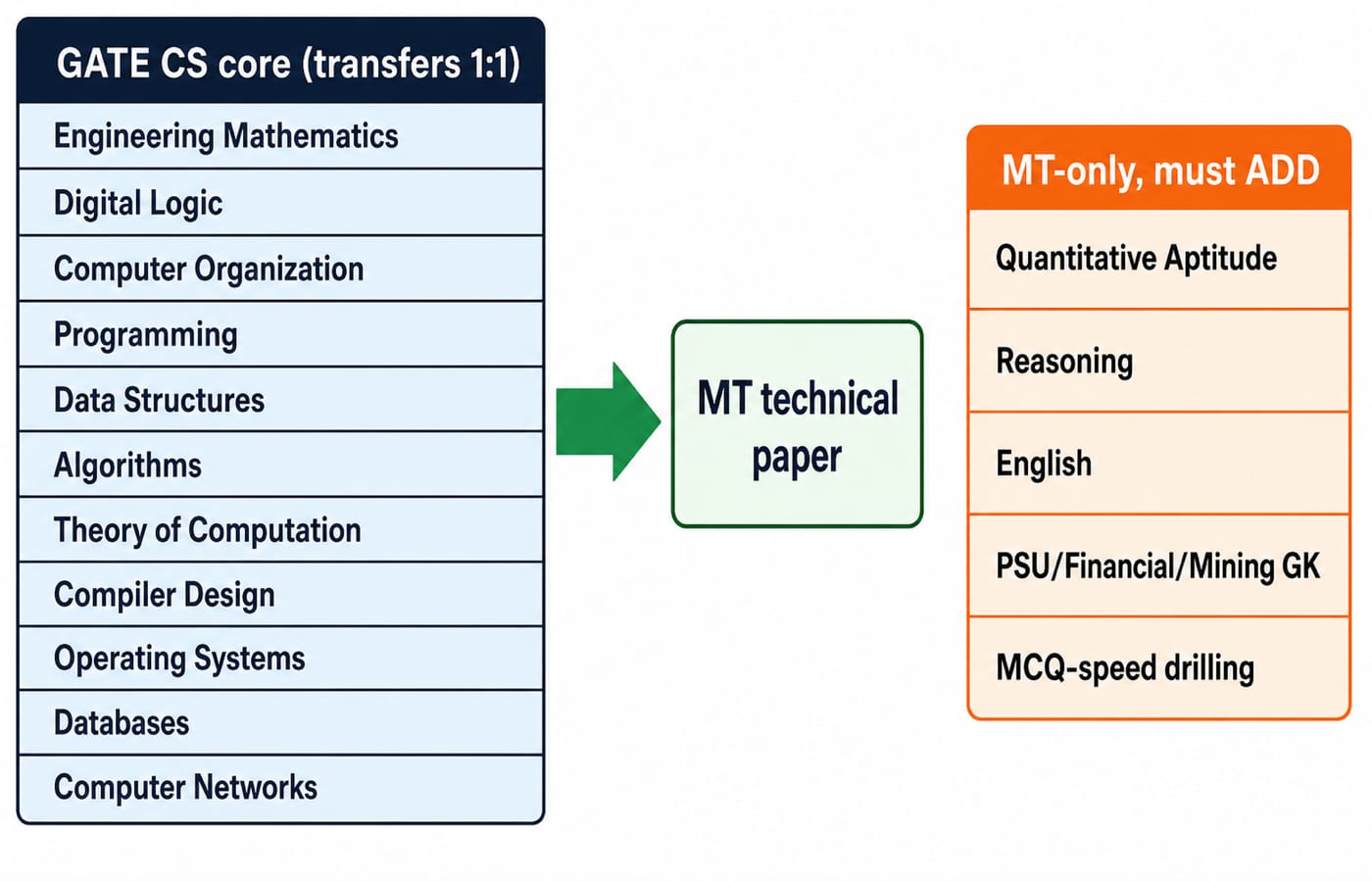
The diagram is also a useful notebook layout. Keep one error log for the CS core and another for the MT-only work. Mixing them makes it harder to see whether you are losing marks through a forgotten technical concept or an undeveloped aptitude skill.
3. Where MT differs and how to adjust
The technical side calls for broad conceptual recall and MCQ speed. Do not throw away difficult GATE numericals, because they build understanding. Instead, convert some revision sessions into short, mixed sets where you must choose an answer quickly and explain why the other options fail.
The second change is non-technical. Quantitative aptitude, reasoning, English, and general awareness need recurring practice. KnowledgeGate's question bank also holds more than 8,000 quantitative-aptitude questions, so the aptitude track can be built through graded sets instead of random worksheets.
Use the PSU preparation category to keep the recruitment context separate from your GATE plan. For the paper's current structure, section details and selection rules, check the relevant notification on the official Coal India website. Do not carry an old cycle's pattern into a new one.
4. A 10-week dual-track plan at about 15 hours a week
Treat 15 hours as a weekly budget, not as a perfect attendance target.
Weeks | CS core | MT-only work | Main output |
|---|---|---|---|
1-3 | 10 hours on one or two core subjects | 5 hours on mixed recall and aptitude basics | Short notes plus an error list |
4-6 | 10 hours on rapid CS concept drills | 5 hours on quant, reasoning, English and awareness | Timed sectional sets |
7 | 10 hours on mixed technical revision | 5 hours on the weakest aptitude areas | Two balanced sectionals |
8 | 5 hours closing aptitude gaps | 10 hours on MT-pattern mocks and review | Section-switch strategy |
9-10 | Technical revision inside mocks | Aptitude revision inside mocks | Full mocks and same-day analysis |
For weeks 1 to 6, aim to refresh one or two technical subjects each week. Breadth comes first. In weeks 4 to 8, maintain about five hours for the non-technical section even when CS feels more comfortable. In the last three weeks, practice the paper as one timed unit.
If a weekday disappears, keep the short CS drill and the aptitude repetitions. Move awareness reading to the weekend. A missed news session can be recovered; arithmetic speed is harder to rebuild in one sitting.
This split assumes the CS core is already deep. If your technical and general sections sit at a similar level, the Coal India MT CBT preparation plan sets the hours the other way round and is the better schedule to start from.
5. Preparing for GATE and MT together
Sequence the two goals instead of duplicating them. Use your longest, freshest study block for GATE-depth concepts and numericals. Use a shorter evening block for rapid technical MCQs, quantitative aptitude or reasoning.
Your existing six-month GATE schedule can remain the backbone. Add the MT work around it:
Keep the current GATE subject as the week's technical focus.
End each concept session with a short MCQ sprint.
Rotate quant, reasoning and English across the week.
Reserve one weekly slot for awareness notes.
Take an MT-pattern sectional or mock on the weekend.
You now have one technical syllabus studied at two depths, not two separate technical syllabi.
6. The aptitude catch-up plan for a pure-CS candidate
Start with a minimum routine you can repeat. Solve one small quant set, one reasoning set and one English set each study day. Review every error before adding more questions. Keep a rolling page for current affairs and PSU, financial or mining awareness, guided by the notification rather than an unlimited GK list.
Quant improves when you classify errors. A wrong percentage answer may come from concept, calculation or time pressure. Reasoning improves when you redraw the arrangement instead of staring at the solution. English improves through daily contact with grammar and comprehension, not a large weekend burst.
7. The final two weeks
Stop opening major new topics. Take full MT-pattern mocks, rehearse the switch between the technical and general parts, and review each mock on the same day.
Divide the error log into three columns: concept not known, method too slow, careless execution. Revise the first, practise the second, and write a prevention rule for the third. Refresh current affairs and PSU or mining awareness from your own rolling notes.
A mock is useful only when its review changes the next attempt. Raw mock count is not the goal.
8. The short version and your next step
Most GATE CS work transfers to the MT technical side. Keep that foundation, add a protected aptitude track, shift some practice to fast conceptual MCQs, and rehearse both parts together. Confirm the exact current pattern on Coal India's official site before fixing your final mock strategy.
Use the Coal India MT CS recruitment test series for pattern practice and the Coal India Management Trainee course to organise the complete preparation sequence. Your next action is simple: mark every syllabus topic as transfer, add or speed-drill, then schedule the first week.
Keep learning

Programmed I/O: Polling, CPU Utilisation, Worked Examples and GATE Question Patterns
Follow one programmed-input transfer from control write to data read, then calculate how many polls one word costs and what a longer poll period buys.
Updated 7 Oct 20266 min readComputer Organization & Architecture
Multiprocessor Fundamentals: Architecture, Speedup and Worked Examples
Build a clear model of multiprocessor systems, then use it to calculate speedup and efficiency, trace a coherent write, and diagnose a lost update.
Updated 2 Oct 20265 min readComputer Organization & Architecture

Multiprocessor Classification: Flynn Taxonomy, Memory Models and Exam-Style Worked Examples
Learn how to choose the right multiprocessor classification axis, then solve a four-lane SIMD trace and a NUMA average-access-time problem step by step.
Updated 27 Sep 20266 min readComputer Organization & Architecture

Interrupt-Driven I/O Explained: CPU Handshake, Worked Timing Example and GATE Traps
Trace an interrupt from device request to return-from-interrupt, then compare polling, per-event interrupts, and DMA through worked timing examples.
Updated 25 Sep 20267 min readComputer Organization & Architecture