Coal India MT PYQ Analysis: Balance Paper I and Professional Knowledge
A combined Coal India MT score hides which paper is weak. Score Paper I and professional knowledge separately, classify every miss by cause, and rebalance the week from that.
KnowledgeGate Team
Exam prep & CS education
Updated 10 Aug 20265 min read245 views

Coal India Management Trainee aspirants read one combined score off a previous-year attempt, and that single number hides what matters. A decent Paper I result masks weak professional knowledge, and slow arithmetic undoes real technical strength. Score each paper on its own sheet, and the same attempt shows where the next fortnight of Coal India MT preparation should go.
Read Paper I and Paper II as different performance profiles
Paper I runs on general awareness, reasoning ability, numerical ability and general English. Paper II is professional Computer Science and IT knowledge. Marks, question counts, duration and negative marking move between recruitment cycles, so read the current CIL recruitment notice at coalindia.in.
Do not diagnose the two with one percentage. Paper I mixes recall, reading and short calculations, so its misses are staleness and speed. Paper II tests concepts, so its misses are depth. Track six numbers per paper and never merge them: coverage, attempted, correct, wrong, skipped and time.
Build a two-column PYQ audit
Take your most recent previous-year attempt, 40 questions per paper, and score the halves separately. The sheet below is a worked sample, not published Coal India data, so fill in your own counts.
Metric | Paper I | Paper II |
|---|---|---|
Attempted | 36 | 34 |
Correct | 28 | 22 |
Wrong | 8 | 12 |
Skipped | 4 | 6 |
Coverage | 36 / 40 = 90% | 34 / 40 = 85% |
Attempt accuracy | 28 / 36 = 77.8% | 22 / 34 = 64.7% |
Unresolved | 8 + 4 = 12 | 12 + 6 = 18 |
Paper II needs the larger repair. The raw correct-answer gap is only 28 - 22 = 6, which is how a combined score hides the problem; the gap that matters is 77.8% against 64.7%.
Classify all 30 unresolved questions by cause. Paper I has 3 concept gaps, 4 method gaps, 2 reading errors and 3 time skips, totalling 12. Paper II has 9 concept gaps, 4 method gaps, 2 reading errors and 3 time skips, totalling 18. Method, reading and timing are identical at 9 each, so the entire difference is concept: 9 against 3. More mock tests will not touch that.
Coal India MT weekly split: 5 hours Paper I, 7 Paper II, 2 combined
The split follows the audit, not the paper count. Paper II takes 7 of the 14 hours because it carries 18 unresolved questions against 12, and 64.7% accuracy against 77.8%. Paper I takes 5, and 2 stay combined.
Paper I, 300 minutes: numerical ability 75, reasoning 75, English 60, general awareness 60, error-log review 30.
Paper II, 420 minutes: DBMS 90, operating systems 90, computer networks 75, data structures and algorithms 75, software engineering 45, mixed technical review 45.
Combined, 120 minutes: one 90-minute mixed drill and 30 minutes of review.
Those six areas are practice lanes, not the whole discipline paper. If you are still building coverage rather than repairing it, start from the Coal India MT CBT syllabus map.
Train Paper I with one 30-question drill across four lanes
Build a 30-question, 60-minute drill: 8 reasoning, 8 numerical ability, 7 English and 7 general awareness. Spend 35 minutes solving and 25 reviewing. Move the lane weights as your own weak lanes move.
Suppose the sheet reads reasoning 6/8, numerical ability 5/8, English 6/7 and general awareness 3/7. Then 6 + 5 + 6 + 3 = 20, and 20/30 = 66.7%. General awareness is weakest at 3/7 = 42.9%, a recall problem. Numerical ability at 5/8 is a method problem, because those 3 misses came on questions you attempted.
The repair hour that follows is 20 minutes on the seven awareness items, 25 re-solving the three numerical misses untimed, and 15 writing down why each miss happened: 20 + 25 + 15 = 60. As a heuristic, a lane below 60% gets recall or concept repair, one from 60% to 80% gets untimed method practice, and one above 80% gets timed maintenance only.
Triage Paper II professional knowledge subject by subject
Run the same audit one level deeper. Suppose a 50-question technical set breaks down like this:
Subject | Correct | Unresolved |
|---|---|---|
DBMS | 5/8 | 3 |
Operating systems | 4/8 | 4 |
Computer networks | 6/8 | 2 |
Data structures | 5/8 | 3 |
Algorithms | 2/6 | 4 |
Software engineering | 5/6 | 1 |
Mixed core CS | 3/6 | 3 |
Total | 30/50 = 60% | 20 |
Rank repair by unresolved count first, then by prerequisite value. Operating systems and algorithms are worst at 4 unresolved each, and algorithms also blocks data structures, so both take 50 minutes. DBMS and data structures take 35 each, networks 20, software engineering 10 and the mixed-core log 10: 50 + 50 + 35 + 35 + 20 + 10 + 10 = 210 minutes, half the week's 420 technical minutes. The other half stays on fresh questions.
End each block with a closed-book re-solve. If you cannot say why every wrong distractor is wrong, the item stays in the ledger. For the same exercise run on a different exam, see the IBPS SO IT professional-knowledge topic map.
Recombine Paper I and Paper II in one timed mock
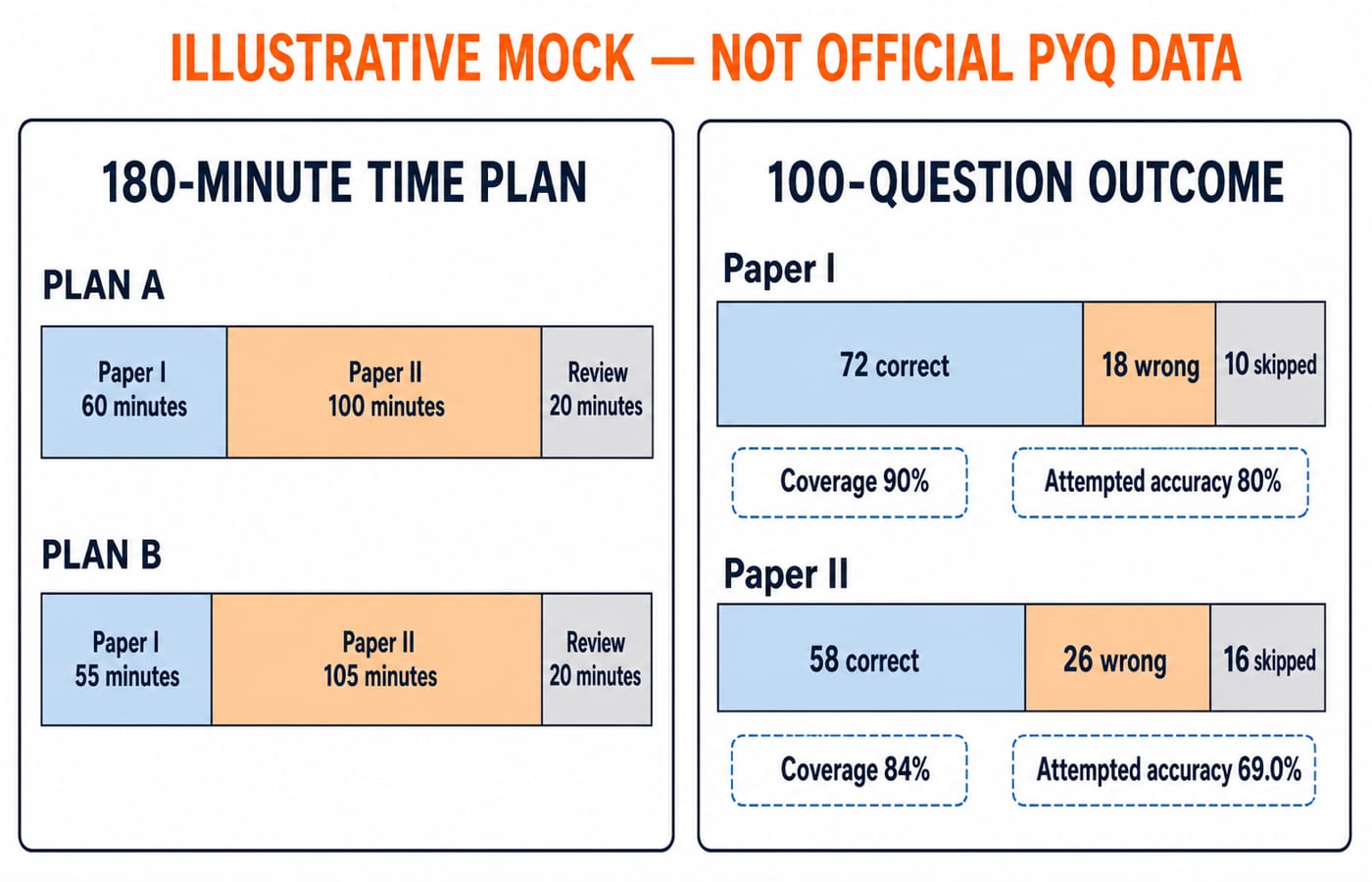
Now sit a full-length mock: 100 Paper I questions and 100 Paper II questions in 180 minutes. A first pacing plan spends 60 minutes on Paper I, 100 on Paper II and holds 20 back for review: 60 + 100 + 20 = 180.
Say Paper I records 72 correct, 18 wrong and 10 skipped, and Paper II 58 correct, 26 wrong and 16 skipped. The combined 72 + 58 = 130 tells you least. Paper I coverage is (72 + 18)/100 = 90% and accuracy 72/90 = 80%. Paper II coverage is (58 + 26)/100 = 84% and accuracy 58/84 = 69.0%. Both improved on the diagnostic, but the gap between them only closed from 13.1 points to 11.
So keep the 20 review minutes and test a 55/105 split next time: 55 + 105 + 20 = 180. Paper II carries 26 wrong and 16 skipped against Paper I's 18 and 10, so the five minutes come from the stronger paper.
Run a seven-day Coal India MT feedback loop
Repeat this cycle: Day 1, audit a Paper I set for 60 minutes. Day 2, spend 90 minutes on its two largest error groups. Day 3, audit a Paper II set for 90 minutes. Days 4 and 5, spend 120 minutes each on the two weakest technical subjects. Day 6, take a mixed timed test. Day 7, spend 45 minutes updating coverage, accuracy and unresolved counts.
Set sizes change; the formulas do not. Each cycle, beat your own last numbers: Paper I unresolved below 12, Paper II below 18, Paper II accuracy above 64.7%. If unresolved falls but accuracy does not, you have bought coverage rather than depth.
The short version and next step
Score the papers separately, classify every miss by cause, spend the week where the concept gaps are, then recombine under a timer. Use the complete Coal India MT course when the audit says concepts, and the Coal India MT test series when it says pacing.
Keep learning
Coal India MT Mock Analysis: Manage Both Papers as One Exam
A combined mock score can hide which paper cost you marks. Use this worked two-paper scorecard to test section order, diagnose errors and plan the next retest.
Updated 12 Aug 20265 min read54 viewsCoal India MT

Coal India MT Cutoffs: Qualifying Marks vs Merit List
Learn why clearing Coal India MT's paper-wise minimum does not guarantee selection. Read the 2026 System rules in order with a worked merit example.
Updated 8 Aug 20265 min read321 viewsCoal India MT
Coal India MT Numerical Ability: Ratios, Percentages and a Worked DI Set
Learn how ratio parts, percentage bases, and table reading work together. Includes checked examples, conversion shortcuts, common traps, and a 30-minute drill.
Updated 5 Aug 20266 min readCoal India MT
Coal India MT Computer Awareness: Office Tools, Internet and Security Guide
Turn a broad syllabus phrase into four practical revision buckets, then test your understanding with worked spreadsheet calculations and six concept checks.
Updated 3 Aug 20265 min readCoal India MT