Behavioural Interview Conflict and Teamwork Questions: Show Collaboration Without Blame
Learn how to build truthful conflict and teamwork stories that show ownership, a fair decision process, a defensible result and a working relationship that continued.
KnowledgeGate Team
Exam prep & CS education
Updated 26 Jul 20266 min read
Denying conflict sounds evasive; blaming a teammate sounds unsafe. A strong answer shows the disagreement, decision process, your action, result and later relationship. Building one takes a truthful story, a decision rule you can say out loud, and a rehearsal that proves the story survives five probes without changing its numbers. These prompts sit inside the wider resume and interview preparation round, next to resume defence and technical follow-ups.
1. Behavioural Interview Conflict Questions: Know What Your Story Must Prove
Disagreement, difficult-teammate, missed-plan and opposed-decision prompts test communication under tension. Show ownership, listening, a transparent decision method and continued collaboration.
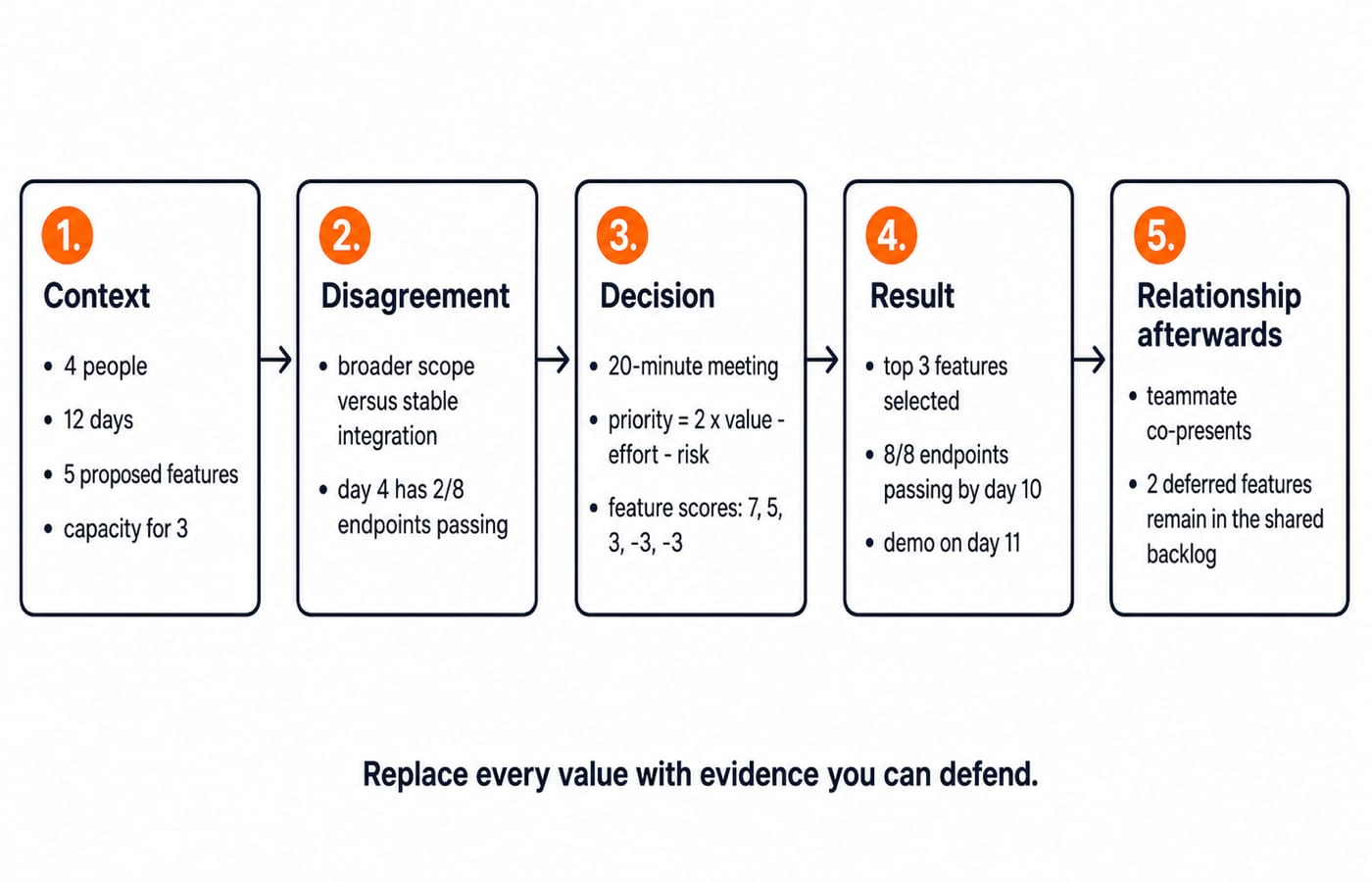
Use context -> disagreement -> decision process -> result -> relationship afterwards. STAR helps, but include the team's choice and later relationship.
Describe behaviour and constraints, not character. Use I for your action and we for the agreed result.
2. Build a Three-Story Evidence Bank Before You Script an Answer
Build three stories: a disagreement over a decision, a teammate who could not deliver what they had committed to, and a call of your own that turned out wrong. Spend 45 minutes mining projects, internships, clubs, volunteering and coursework, keeping only incidents that are evidence already supported by the resume. Fill one table row per story. The general mining method, six fields per moment, is worked through in STAR stories from college projects.
People and deadline | Point of disagreement | My exact action | Decision rule | Measurable result | What I would change | Relationship after the result |
|---|---|---|---|---|---|---|
4 people, 12 days | 5 features, capacity for 3; 2/8 endpoints passed on day 4 | Called a 20-minute scope meeting |
| 3 features; 8/8 endpoints by day 10; demo day 11 | Raise integration risk sooner | Teammate co-presented |
5 people, 10-day sprint | 9 issues; teammate away for 3 days | Took a 2-hour guide and paired for 45 minutes | Agree bounded redistribution and defer 1 issue | 8/9 issues closed by day 10; 12 tests reviewed | Surface capacity earlier | Teammate later reviewed my pull request |
Your truthful story |
Then stress-test each row against the five probes an interviewer will actually use, and mark every cell Answered, Contradicts a stated number, or Missing.
Probe | Scope story | Sprint story | Your story |
|---|---|---|---|
What did you say? | Answered | Answered | |
Why was the other view reasonable? | Answered | Answered | |
Who decided? | Answered | Answered | |
What trade-off remained? | Answered | Answered | |
Did you work together again? | Answered | Answered |
A story is rehearsal-ready only when all five rows read Answered; a Contradicts cell means fix the facts before any wording work.
3. Conflict Answer Worked Example: Scope Versus Stability in a Four-Person Project
This is a composite, not a real student's project. Its numbers are consistent so you can watch an answer hold together under probing; copy the shape, never claim the experience.
In a four-person capstone, we had 12 days, five proposed features and capacity for three. On day 4, only two of eight API endpoints passed integration. A teammate wanted all five for user value; I argued for stability. I requested a 20-minute meeting, restated their concern, then suggested
priority = 2 x user value - effort - integration risk, rating each input 1 to 5. Search/filter scored2 x 5 - 2 - 1 = 7; application tracking,2 x 5 - 3 - 2 = 5; notifications,2 x 4 - 3 - 2 = 3; analytics dashboard,2 x 3 - 5 - 4 = -3; and PDF export,2 x 2 - 4 - 3 = -3. The formula made assumptions visible for all four members to challenge. We chose the three positive scores, backlogged analytics and PDF export, and added a 10-minute daily integration check. By day 10, all eight endpoints passed. On day 11, that teammate co-presented the demo.
4. Teamwork Answer Worked Example: Protect the Sprint Without Becoming the Hero
The second composite turns on capacity rather than scope: a teammate who cannot deliver what they committed to. Again the shape is the lesson, not the events.
In a five-person student team, we planned nine issues for a 10-day sprint. On day 4, a teammate said university examinations would take them away for three days. They owned a three-hour API-test ticket and a two-hour setup-guide ticket. I recorded the risk. With team agreement, I took the guide and spent 45 minutes pairing on the test outline. I proposed deferring one low-priority dashboard-filter issue rather than hiding the capacity loss. They returned on day 8 and completed the tests; I reviewed all 12 cases. By day 10, we had closed eight of nine issues and moved the filter to the next sprint. The teammate later reviewed my pull request. We exposed the constraint, redistributed bounded work with consent, protected ownership and recorded the trade-off.
Coordinating a recovery like this without any formal authority is its own prompt, covered in leadership without a formal title.
5. Conflict and Teamwork Follow-Ups: Answer the Hard Variant Without Blame
Risky prompt | Repair | What I would do differently now |
|---|---|---|
Difficult teammate | “A teammate and I disagreed about scope.” | I would surface both constraints sooner. |
A senior rejected your idea | Explain the evidence requested and final decision. | I would ask for the decision criterion earlier. |
Someone did not contribute | State the missed commitment, not a motive. | I would check capacity before assigning work. |
Your decision was wrong | Name the cost, correction and changed process. | I would add an earlier review point. |
Prepare five probes: What did you say? Why was the other view reasonable? Who decided? What trade-off remained? Did you work together again? The scope story answers all five without moving: same 20-minute meeting, same user-value concern, same scores 7/5/3/-3/-3, same two deferred features, same day-11 co-presentation. Fix your own facts once, because a probe that draws two different numbers stops being about your teamwork.
Avoid fake harmony. “We never had conflict” removes evidence. “I convinced everyone” erases process. “My teammate was careless” assigns character. Prepare with HR Interview Questions for Freshers & Answers. When the probe is about a call of your own that was wrong, that is a failure question; the full ownership and repair arc is in behavioural interview failure, feedback and learning.
6. Rehearse With Three Mocks, Not a Timetable
Mock 1 is a solo recording. Say both stories start to finish, uninterrupted, into your phone, then play the recording back with the evidence bank open and confirm every spoken number matches the written row. You are checking that the told story and the recorded facts are the same story, not polishing delivery.
Mock 2 needs a partner. Give them the five probes and ask them to interrupt in random order while you answer, the way an interviewer does. Answer each probe directly and return to the thread; mark any probe that stalls you or pulls out a new number, because that mark means the facts need repair before the wording does.
Mock 3 comes at least one day later and is a fact-consistency pass. The partner asks for the same numbers cold: how many features, what the formula scored, who decided, which issue was deferred. Any drift from the evidence-bank row fails the mock, because a story that drifts between rehearsals will drift under an interviewer's probes.
7. Score the Recording, Then Remove the Red Flags
Play the recording back through the probe-survival grid from section 2. “A teammate was difficult, but I convinced them and we finished” fails because three probes come back Missing: what you actually said, who decided, and whether you worked together again. The scope story passes because all five probes come back Answered, which means it is ready to rehearse, not that it wins the offer.
Fix four defects: over 30 seconds of setup, we without personal action, a result without method, and no later relationship. Delete numbers unsupported by notes, code, a board, messages or memory. Explain your ownership behind eight endpoints or 12 test cases. Also prepare the technical and project follow-ups behind the story.
8. Behavioural Interview Answers: The Short Version and Next Step
Check five things:
Real disagreement.
Owned action.
Visible decision process.
Defensible result.
Continued relationship.
Complete all three mocks without changing facts. Do not erase or dramatise conflict. Show competing needs, a chosen path, an accepted trade-off and later collaboration. Never borrow the composites' values, outputs or scores.
Draft and record one truthful conflict answer today. For structured resume, technical and HR preparation, one-to-one resume review and mock-interview practice, use the Interview & Resume Preparation Course.
Keep learning
Placement Mock Analysis: One Error Ledger Across Every Test Round
Use one error ledger without flattening unlike round results. This worked example shows how to find the first wrong step, prioritise repairs and close errors only after fresh retests.
Updated 4 Oct 20265 min readInterview Corner
Internship to PPO: Build a Weekly Evidence Trail Before the Final Review
Use a weekly outcome ledger to make your internship work visible before the final review. This practice model shows how to record delivery, feedback, effect and handoff honestly.
Updated 28 Sep 20265 min readInterview Corner
DSA Mock Interview Rubric: A 100-Point Scorecard for Reasoning, Code and Communication
A practical six-part scorecard for running comparable DSA mocks, grading visible evidence and turning weak areas into the next week's practice.
Updated 25 Sep 20265 min readInterview Corner
Campus Recruitment Timeline: Stage by Stage from Pre-Placement Talk to Written Offer
Follow a campus drive without guessing. Build an evidence sheet, verify eligibility, plan each preparation window and check the written offer before responding.
Updated 24 Sep 20265 min readInterview Corner