HR Interview Answers: Explain Career Gaps, Backlogs and Low Grades
A difficult academic or career record does not need an evasive answer. Build precise responses that acknowledge the fact, show ownership and redirect to proof you can defend.
KnowledgeGate Team
Exam prep & CS education
Updated 24 Jul 20265 min read

One line on your resume or marksheet can feel as if it will dominate the HR round before your current skills are discussed. A strong answer does not hide the record or become a long apology. It states the fact briefly, owns what was controllable and redirects to recent evidence of readiness. This cannot override an employer's stated eligibility rule, but it can stop an explainable history from sounding evasive.
What HR checks about gaps, backlogs and marks
A gap asks what you did with the months and whether you can show it. A backlog asks whether the failure repeated or the method changed. Low grades ask whether you can still learn what the role needs. None of the three is settled by tone, so answer each with a dated fact and a piece of work the interviewer can check.
Separate record from interpretation. "My CGPA was 6.4/10" is a record. "I am weak at every technical task" is an interpretation you can replace with checkable work. The rest of the round works the same way, from "tell me about yourself" to salary expectations: HR Interview Questions for Freshers & Answers, and the wider Resume & Interview Preparation set.
Never alter facts, blame others or overshare private details. Check the employer's official academic threshold because an answer cannot waive it.
Build a one-page evidence ledger
Work one example end to end, then swap your own record into it. B.Tech CSE completed May 2025, CGPA 6.4/10, three backlogs in semesters 3 and 4 cleared by semester 6, no job from June 2025 through February 2026, then a four-month internship from March through June 2026.
Issue | Exact fact | Controllable lesson | Recent proof |
|---|---|---|---|
Gap | June 2025 to February 2026, nine months | First 12 weeks had no milestones | March to June 2026 internship |
Backlogs | Data Structures, DBMS and Discrete Mathematics, cleared by semester 6 | Last-week revision failed | Later 10-week cycle with weekly tests |
Low grades | CGPA 6.4/10 | Inconsistent practice | Java/Spring Boot inventory API, 12 endpoints, 18/18 tests; 120 DSA problems in 12 weeks |
Match every date, stack and result to your resume. One mismatch and the interviewer starts auditing the rest of your answers instead of listening to them. The resume has to hold up on its own first: Resume for Freshers: Clear the First Screen. Replace these values with evidence you can defend.
Use a 60-second evidence bridge
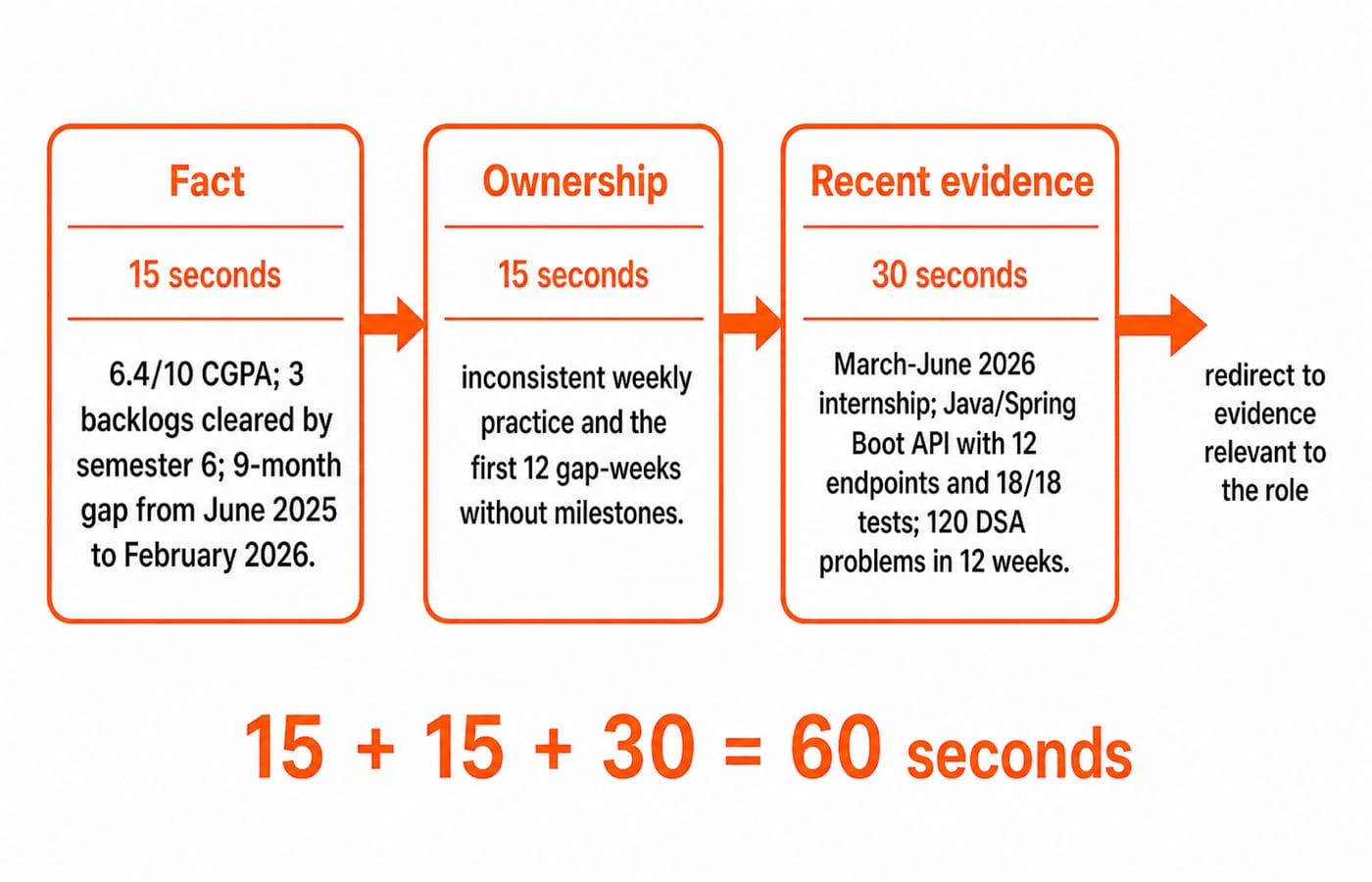
Use three blocks: fact for 15 seconds, ownership for 15, then evidence and a role redirect for 30. Thus, 15 + 15 + 30 = 60 seconds, with half for evidence.
Template: "The record is [exact fact]. My part was [controllable behaviour], and I changed [method]. Since then, [two recent proofs]. I can relate that work to this role." Rehearse five anchors: fact, ownership, method, proof 1 and proof 2.
Career gap answer: account for time and show momentum
I completed my B.Tech in May 2025 and was not employed from June 2025 through February 2026, so the gap was nine months. I began with broad and open-ended preparation, but the first 12 weeks lacked milestones, and I take responsibility for that. I then moved to weekly deliverables, completed a Java/Spring Boot inventory API with 12 endpoints and 18 tests passing 18/18, and started a four-month internship in March 2026. That internship finished in June, so my most recent evidence is structured, hands-on work.
Months account for the timeline, the mistake shows ownership, and outputs redirect. For "Why nine months?", explain that broad preparation became weekly deliverables, then the project and internship. Never invent activity. State health, caregiving or exam preparation truthfully and briefly.
Backlog answer: show recovery without minimising it
I had three backlogs, in Data Structures, DBMS and Discrete Mathematics, across semesters 3 and 4. I had been relying on last-week revision instead of weekly problem practice. I changed that with a 10-week cycle: two 60-minute concept sessions, one 90-minute problem session and one 30-minute test each week. I cleared all three by semester 6. More recently, I have kept the same consistency through 120 DSA problems over 12 weeks.
The weekly total is 60 + 60 + 90 + 30 = 240 minutes, or four hours. That system is clearer than "I became serious." If a backlog remains, say so, mention only a confirmed attempt and never claim completion early.
Low-grades answer: separate score from capability
My final CGPA is 6.4 out of 10, and I do not present it as a strong academic score. My inconsistent weekly practice contributed to it. To improve how I learn and apply concepts, I now work in small deliverables and test the output. In my recent Java/Spring Boot inventory project, I implemented 12 endpoints and wrote 18 automated tests that pass 18 out of 18. I also completed 120 DSA problems in 12 weeks. I would like to demonstrate that current work against the skills this role needs.
A project does not erase the transcript. It offers current evidence. Explain one endpoint, justify one test and discuss one DSA problem. Remove any value you cannot defend.
Handle sharp follow-ups without worsening the record
For "Why believe the pattern changed?", use the four-month internship and 18/18 tests. For "Which backlog was hardest?", name a real subject and the weekly method, not a made-up mark. For "Why is your CGPA relevant?", acknowledge it, then offer current work. Answer in 30 to 45 seconds without new facts.
Replace blame with "My CGPA is 6.4/10, and inconsistent practice was my part." Replace "upskilling" with dated evidence and "a few backlogs" with "three, cleared by semester 6." That reflex costs offers elsewhere in the season too: 7 Placement Preparation Mistakes to Avoid.
Name the fact by second 20 and evidence by second 30. Otherwise, shorten the context.
Practise in 7.5 honest hours over 14 days
Week 1 takes 210 minutes: 30 to verify facts, then 45 each for the ledger, three drafts, six recordings and resume comparison. Check: 30 + 45 + 45 + 45 + 45 = 210.
Week 2 takes 240 minutes: three 30-minute mocks give 90, then 60 for review, 45 for six follow-ups and 45 for retakes plus a five-anchor card. Check: 90 + 60 + 45 + 45 = 240. So 210 + 240 = 450 minutes, and 450 / 60 = 7.5 hours.
If one session is missed, use 20 minutes to check facts and record once, then move the rest. After three missed days, keep the ledger, one recording per issue and one mock, but cut duplicate retakes. Never compress 450 minutes into one night.
Pass only when facts match the resume, the record appears by second 20, evidence by second 30, and you finish within 75 seconds without reading.
The short version
State the fact, own your part, show the changed method and prove readiness. Complete the ledger and record one 60-second answer today. For guided resume, technical and HR interview preparation with mock practice, use the Interview & Resume Preparation Course.
Keep learning
Placement Mock Analysis: One Error Ledger Across Every Test Round
Use one error ledger without flattening unlike round results. This worked example shows how to find the first wrong step, prioritise repairs and close errors only after fresh retests.
Updated 4 Oct 20265 min readInterview Corner
Internship to PPO: Build a Weekly Evidence Trail Before the Final Review
Use a weekly outcome ledger to make your internship work visible before the final review. This practice model shows how to record delivery, feedback, effect and handoff honestly.
Updated 28 Sep 20265 min readInterview Corner
DSA Mock Interview Rubric: A 100-Point Scorecard for Reasoning, Code and Communication
A practical six-part scorecard for running comparable DSA mocks, grading visible evidence and turning weak areas into the next week's practice.
Updated 25 Sep 20265 min readInterview Corner
Campus Recruitment Timeline: Stage by Stage from Pre-Placement Talk to Written Offer
Follow a campus drive without guessing. Build an evidence sheet, verify eligibility, plan each preparation window and check the written offer before responding.
Updated 24 Sep 20265 min readInterview Corner