Internship to PPO: Build a Weekly Evidence Trail Before the Final Review
Use a weekly outcome ledger to make your internship work visible before the final review. This practice model shows how to record delivery, feedback, effect and handoff honestly.
KnowledgeGate Team
Exam prep & CS education
Updated 28 Sep 20265 min read
Good work can disappear from memory-led reviews. Waiting until the final week leaves no time to close gaps. Record delivery, feedback, effect and handoff as you work. Kavya is a hypothetical intern; your employer and manager decide the PPO outcome and which evidence is approved.
Internship to PPO evidence starts with one outcome ledger
Each ledger row records the commitment, the action and decision, the proof source, the observed effect, and the next owner or step. Commits show activity, while tests, measures and handoffs demonstrate outcomes. Preserve links and dates without copying confidential material.
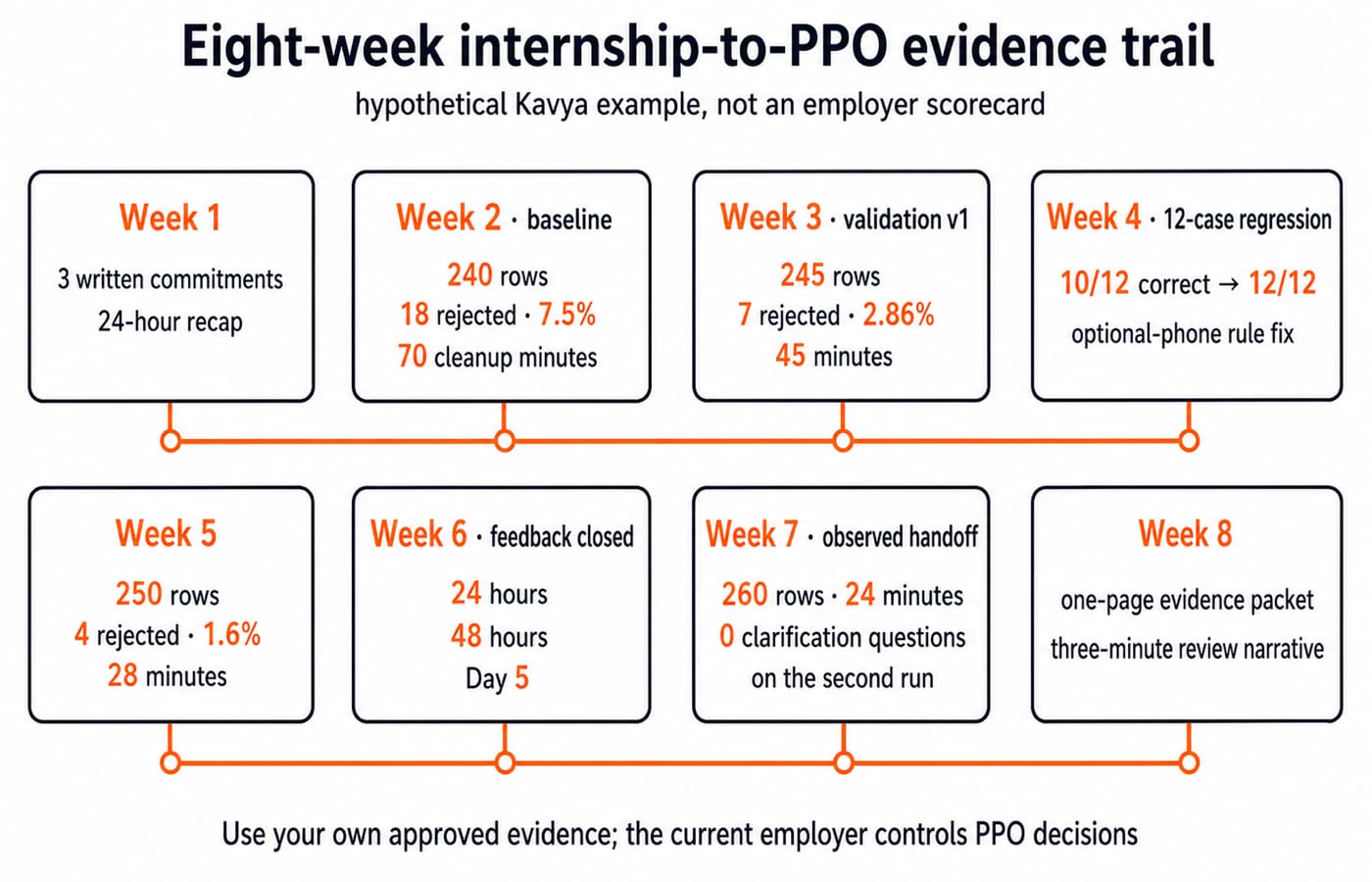
Hypothetical intern Kavya handles a data import. Week 2 has 18 rejected of 240 approved rows, 18 / 240 = 7.5%, and 70 cleanup minutes. Week 5 has 4 of 250, 4 / 250 = 1.6%, and 28 minutes. That is 5.9 percentage points lower, a (7.5 - 1.6) / 7.5 = 78.7% relative reduction. Cleanup falls 42 minutes, 42 / 70 = 60%. Preserve denominators; do not claim causation.
This evidence strengthens your resume and interview answers. Resume & Interview Preparation helps you turn recorded work into clear examples for both.
Week 1: turn vague expectations into three observable commitments
After a 30-minute alignment, Kavya sends a recap within 24 hours. She asks which three outcomes matter, what proves quality, who uses the work, which risks need escalation and when feedback can change it. Treat any answer you have not had confirmed as an open question.
In Kavya's example, the three commitments are validation version 1 on the approved sample by Week 3, rejected-row and cleanup-time measures through Week 6, and a runbook with an observed handoff by Week 7. For this team, under 2.5% is the planning signal.
Keep this weekly trail focused on manager-facing PPO evidence. Resume Experience Section: Internship Bullets That Prove Impact owns the later task of converting approved internship proof into bounded resume bullets.
Weeks 2 and 3: ship a useful slice and capture proof
Outside delivery, use four 10-minute notes, 25 Friday minutes for proof, 15 for risk and 10 for feedback: 4 x 10 + 25 + 15 + 10 = 90 minutes. Keep this evidence routine focused and proportionate.
Week 2 records 240 rows, 18 rejected, 70 minutes, sources and timer method. Week 3 records version 1 on 245 rows, 7 rejected and 45 minutes: 7 / 245 = 2.86%. Add reviewer comment, optional-field risk and next test.
Reconstruct the record only from approved tasks, files, commits or meetings. Mark missing notes “not recorded” and absent metrics “not measured”.
Weeks 4 and 5: show ownership through decisions and effect
Own the chain: clarify, expose risk, propose, obtain a decision, make the smallest safe change, test, measure and unblock the next owner.
Kavya tests 4 missing required emails, 3 malformed emails, 3 duplicate IDs and 2 blank optional-phone cases. Version 1 handles the first 10 but rejects the last 2: 10 / 12 = 83.3%. The field owner confirms phone is optional, so Kavya fixes the rule and gets 12 / 12 = 100%. Week 5 records 250 rows, 4 rejected and 28 minutes. The tiny set isolates the optional-phone decision.
Credit Kavya for finding, framing and fixing the pattern; credit the reviewer and operations user for approval and measurement.
Week 6: ask for feedback early and close one gap
Ask: “Which part of my work currently gives you the strongest confidence?”, “Where am I still creating review or coordination cost?” and “What one behaviour should look different before the final review?” Use the answers to identify one specific gap and act on it.
Use a 24-hour, 48-hour, Day 5 loop: acknowledge the feedback, agree on the change, collect three observations, then check back. Kavya finds an unresolved definition Tuesday at 11:00 and raises the blocked cases at 11:30. The loop turns feedback into observable changed behaviour.
Each feedback row records the feedback, its source and date, the agreed behaviour, three observations, and the check-back result. Praise without a specific example does not count as evidence. Corrective feedback closes after the changed behaviour is observed.
Week 7: make collaboration and handoff part of the evidence
The packet needs purpose, input contract, five-step procedure, output, limitation, escalation path, 12 regression cases and next owner. A teammate uses it unaided.
On the same approved 260-row file, run one takes 36 minutes and needs three clarifications: input location, optional phone and failure log. After repairs, run two takes 24 minutes with zero questions. The reduction is 12 / 36 = 33.3%. Record it as evidence of clearer documentation and credit the teammate.
Explain the context, technical decision, test, trade-off and result. Technical Interview Prep: OS, DBMS, CN and OOP Answers helps you prepare this technical account for later interview discussions.
Week 8: present a one-page PPO review case without overselling
Use six blocks: commitments; weekly evidence; measures with denominators; changed behaviour; collaboration and handoff; one risk plus the next 30-day contribution. Name sources and contributors. Exclude confidential or unapproved material.
Week | Approved observation | Result | Time |
|---|---|---|---|
2 | 240 rows, 18 rejected | 7.5% rejected | 70 minutes |
3 | 245 rows, 7 rejected | 2.86% rejected | 45 minutes |
5 | 250 rows, 4 rejected | 1.6% rejected | 28 minutes |
7 | 260-row second documentation run | 0 clarification questions | 24 minutes |
The Week 7 row records a handoff observation. It does not measure a rejection rate.
Rehearse 30 seconds for the problem, 60 for decisions, 45 for effect, 25 for changed behaviour and 20 for next steps: 30 + 60 + 45 + 25 + 20 = 180 seconds. Use the Interview & Resume Preparation Course to practise this delivery. Express interest and ask what remains.
Internship to PPO: the short version and missed-week recovery
Align three outcomes, keep a ledger, measure honestly, seek feedback, observe the handoff and build one clear review page.
The evidence routine totals 60 + (6 x 90) + 120 = 720 minutes = 12 hours, separate from delivery. Recover one missed week in 60 minutes: 20 for sources, 20 for measures, 10 for feedback and 10 for the next step. After two blanks, start a new baseline.
Write your first commitment and proof source today.
Keep learning
Placement Mock Analysis: One Error Ledger Across Every Test Round
Use one error ledger without flattening unlike round results. This worked example shows how to find the first wrong step, prioritise repairs and close errors only after fresh retests.
Updated 4 Oct 20265 min readInterview Corner
DSA Mock Interview Rubric: A 100-Point Scorecard for Reasoning, Code and Communication
A practical six-part scorecard for running comparable DSA mocks, grading visible evidence and turning weak areas into the next week's practice.
Updated 25 Sep 20265 min readInterview Corner

Campus Recruitment Timeline: Stage by Stage from Pre-Placement Talk to Written Offer
Follow a campus drive without guessing. Build an evidence sheet, verify eligibility, plan each preparation window and check the written offer before responding.
Updated 24 Sep 20265 min readInterview Corner

Campus GD Debrief Rubric: Score Ideas, Clarity and Teamwork
Turn a recorded campus group discussion into useful evidence. This five-part rubric helps you justify each score and choose one behaviour to test in your next mock.
Updated 23 Sep 20265 min readInterview Corner